Ainadamar

8 12 2008

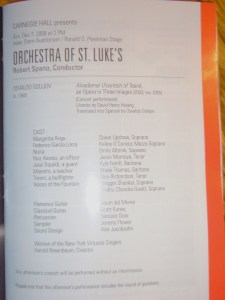
The musicians were tuning their instruments as we entered the auditorium. Some of them sauntered in, a violin or french horn in hand, others stood, and others sat and concentrated on the score in front of them.

It was my first performance at Carnegie Hall, and I leaned forward from my second tier seat to take in the sight. The space itself is relatively spare, for acoustical reasons, I’d guess, but it felt luxurious to be seated in a box with five other people. I’d brought Ricola to stem any inconvenient cough (tho’ later spied the overflowing bins of Ricola near the tops of stairs), and dug out my kleenex. I was prepared.
010

The concert performance, after all, of Osvaldo Golijov’s Ainadamar, about the death of Frederico Garcia Lorca (sung by Kelley O’Connor), about his life, and the life and sorrows of his friend and would-be protector Margarita Xirgu (Dawn Upshaw), would almost certainly make me cry. I hate to cry, and I cry every time I listen to the cd, but I can’t not listen to such beauty. And I did cry—when Margarita fails to convince Lorca to flee to Havana with her, when the Falangist Ruiz Alonso (Jesus Montoya) calls for the head (Ay! Entregeuenio, ay Dios mio, al cabezon!) of Lorca, and started crying when the guard (Kyle Ferrill) sings to Lorca to confess and didn’t stop until after the volley of gunshots ended. Oh, and (I thought I cried only three times), as Margarita sings out her death.

I came to Dawn Upshaw the way many of us non-opera (or new-to-opera) do, via Gorecki’s Symphony no. 3, ‘Sorrowful Songs’. I heard it in the movie Fearless, and paid close attention to the closing credits for the song. I was am (still) only very slowly making my way into opera, but I was caught by this music. Now, whether that was due to Gorecki or Upshaw, I don’t know, although I have pursued both the composer and the soprano.

The draw of this program was not only Upshaw, however, but also Golijov. I first read about his St Mark’s Passion many years ago (still haven’t heard it), and his name stayed with me. A few years ago I heard an interview with him, and the interview featured extensive excerpts from Ayre and Ainadamar. Oh! I think it was a dual interview, with both Golijov and Upshaw. Rekindle interest in Upshaw. Rekindle interest in Golijov. Buy the cds.

So I thought I knew what I was getting into today. (I brought kleenex, fer cryin’ out loud!) But I was tossed back in my seat by the power of the live performance itself. To sit in an auditorium with a few hundred other people and watch and listen to these men and women give themselves wholly over to the music, to us—oh, I had forgotten what it was to witness such fearlessness, to be enveloped by such naked sound.

There was no irony, no detachment in this performance. Yes, there is the physical distance between the stage and the seating, but Upshaw and O’Connor and Montoya (and Emily Albrink, as Nuria, Margarita’s student) did not stand back from their characters or this music. Conductor Robert Spano swivelled his hips along the sinuous line of Golijov’s music, which seemed distracting at first, but I came to see less as indulgence than his entire body responding to the opera. And at the end! I’d forgotten the great and furious charge of the orchestra at the end, and watched as the double-bassists bent over their instruments, following the movement down and across the strings.

So much more to say. The tenderness between Margarita and Nuria, as first Margarita leads her student, then the student holds up the teacher. The sexiness of ‘A la Habana’ as Margarita and Lorca imagine ‘alegria, coral y tambor, ay!’ And, noticing, as Margarita sings ‘Adios’, Lorca and Nuria, sitting off to the side, holding hands.

And the long silence at the end, as we all waited, waited, waited, before the clapping began.

To give oneself wholly over to the moment—that is a gift worthy of ovation.


Get offa my cloud

6 12 2008

Getting bogged in the blog.

I have in mind a couple of pieces (about abortion, morality and politics) in which I lay out a comprehensive argument, with arrows running hither and yon, connecting outliers to the center, blah blah, so as to capture as fully as possible the phenomenon under investigation.

Hah.

Bit by bit, I know. Still, I used to be able to pull my thoughts together for more than a paragraph or two, so my current impatience-slash-laziness (hm, what is the connection between impatience and laziness? I’ll have to blog on that. . . .), both feeds that distraction and increases my sense that I should do. . . something.

Anyway, a coupla’ good pieces on abortion and conscience clauses from Slate:

Dahlia Lithwick notes that so-called conscience clauses only run one way, that is, those who oppose abortion (and anything contra-conceptual) may opt out of their fiduciary responsibilities to their patients any procedures or conversations related to these matters, but those who do provide abortions have to read from scripts with which they disagree and know to be medically misleadling.

And William Saletan has more on the obsfucations surrounding the morning-after pill, involving, unsurprisingly, the substitution of religious for medical definitions. My take? Hey, if you want to make a religious argument about the status of the embryo or fetus, go right ahead. But don’t misrepresent that position as the scientific or medical definition.

Shite. Now I’ll have to blog on the relationships between science, medicine, and morality. And, oh, hell, let’s throw in politics.

Okay, one last thing: the William Ayers op-ed in the New York Times, and Obama’s interactions with Ayers. There’s a lot that’s provocative in this piece, but I want to pull back and consider the larger question of conversations/arguments in the public square.

I gotta go to work, but I want to argue that it is precisely in public that one is able to meet or even consort with those with whom one disagrees, or even finds distasteful. (Remember, I’m an argue-and-eat-pie kinda gal.) I wouldn’t invite a fascist into my home, but I’d certainly talk with her outside of my house.

Shit, this could all get quite complicated quite quickly, and I really do have to go. Would it make sense to say that the public is a more a space of freedom and the home more a place of judgement or discernment?

Nah, I didn’t think so. More on this. Eventually.

Hah.


Sing a song

4 12 2008

So I’ve used the same Poi Dog Pondering song for THREE posts. Yeesh. And I discovered this while checking to see if I used another title previously—which I had (neither post was published).

It’s not as if I don’t have enough song titles and lyrics to choose from. Yeah, ‘Sandra at the beach’ is explicitly about same sex love (‘no kinds of love are better than others’), but it’s not as if I require my posts and the titles or lyric bits to line up exactly. If I like a line, I use it—in this case, three times.

Gotta keep on top of things.

Shees.


Java jive

1 12 2008

Bit by bit. I keep forgetting that, but it’s bit by bit that one’s life settles into the ground.

I was in GradCity for over a decade (w/a year’s interlude in SouthwesternTown), and didn’t really notice how much I adapted to that city until long after I left it. The bus routes. The running and bike routes. This restaurant and that diner and the coffee shop on the corner and bourgie co-op and the militant co-op and the hidden beach with the nudists and the punks and the families and the men in suits (really!). My loop of used bookstores (starting at the cheapest one first, of course) and cd shops. The old Nat and the new (hated because new and then Oh My God It’s Fantastic!) pool and gym. The cheap movie houses and the really good-not-horribly-expensive theatre and the dive bars and wine bars and bars for groups and bars for couples. Mexican and Thai and Caribbean and Vietnamese and American soul and American diner food.

And friends. Pla and Pl and Pt and J and C and D and K and I and L and T and S and C and Js and R and Jn and god, I must be forgetting some.

Nostalgia? Not really. I didn’t like GradCity at all. Okay, my last two years there weren’t bad, especially since I had finished my dissertation and was lecturing or post-docking, but I used to complain (LOUDLY) of how much I despised the place.

But I had a life there. Bit by bit, I put together a life there. And now I live in a city which drives me around a freakin’ bend but where I really really (mostly) really want to make my home, and I haven’t yet figured out (switch to rock climbing metaphor) where are the cracks and footholds. Why not? Because I’ve been so busy trying to live in the entire freakin’ city that I’ve forgotten that I live in it in pieces.

I have tried forcing things, eagerly looking for ‘my’ cafe or park or neighborhood, but these things can’t be forced; they have to come on their own. They come when I go back to a cafe or shop or neighborhood because I’m drawn there—when the place catches on me, rather than me trying to grab on to it.

When I was a teenager my family travelled to New York on vacation, and in the midst of one of those scarifying bus tours (‘Look to the left, people, look to the left. If you don’t look to the left you won’t see it.’), we stopped at this amazing Episcopal church. I remember poking around and glimpsing, through a door, this stoneyard out back. A stoneyard! All of a sudden, the guide’s comments about this church being a work-in-progress slid into a literal, concrete, reality. This old craft in this becoming-building in New York City.

I remembered that when I moved to New York, and on a both very good and very bad day I took the train up to the Cathedral Church of St. John the Divine and rested in this large, still, space.

There’s more to be said about that, but I mention it because that’s one piece. (I have also tried forcing a relationship with this place as well—that’s a part of the more-to-be-said—but St. John’s stays with me, regardless.)

And there is another piece, as well, a coffee shop I found courtesy of Rod Dreher at CrunchyCon, where I can buy my dark roast free trade coffee—Porto Rico, on Bleeker just off W 3rd. It sounds dumb—why not just buy Paul Newman’s coffee at Target?—but I love the act of making these people, in this place, a part of my life.Yeah, it’s a wee out of my way, work-wise, but why let the work commute dictate all? Plans, and all that. . . .

Bit by prosaic bit. The poetry rises out of this.