Not touching ground at all

6 11 2010

Sarah Palin in 2012?

Oh no, no. No no no.

Some commentators think that a Sarah Palin candidacy would guarantee an Obama win, which, given her current low approval ratings, is not an unreasonable conclusion.

But ohp, there’s that word: unreasonable.

Sarah Palin is not much concerned with reason. Evidence, experience, coherence—no thank you. So how do you fight against someone concerned only with her own creation of the truth?

Did you ever watch the show, NewsRadio? In one episode, Joe and Lisa co-host a news program, and Joe responds to Lisa’s wonky queries with a stream of bullshit. I finally managed to track down the episode (it’s ‘The Fiftieth Episode’, the one in which Bill is sent to a psych ward, thus necessitating the fill-in hosts of Joe and Lisa), and to view the clip, skip ahead to around 9:20 or so:

This exchange has stayed with me ever since I first watched it. How do you counter such cheerful lies?

Hence the half-guv dilemma: How do you counter such chipper mendacity?

As is evident from my previous posts, I’m unsurprised by manipulation and trickery in politics, and in fact am critical of the Dems for their flusterment in the face of such flim-flammery. Fight! Fight! Fight! I say.

But. But the legislative manueverings of the GOP, while accompanied by all variety of obfuscation, was nonetheless grounded in the practical reality of Congressional procedure. Senators could filibuster and hold and delay and deny because the rules allowed them to do so; reps could attach earmarks or poison pills or call for vote after vote because, again, the rules allowed them to do so. They may have used and abused the rules, but they did not question the reality of those rules.

But the reality star who is able to conjure death panels out of thin air? How do you counter someone who ignores the laws of gravity?

You can deal with a reality-manipulator, because the manipulator has to have some sense of that reality before she warps it to her own ends. And even that Bush staffer who sniffed to the NYTimes reporter about those stuck in the ‘reality-based community’ and the ability of the Bush admin to create its own reality nonetheless still gestured to reality. They did, in their own baleful way, seek to create new facts on the ground.

But La Palin? What are facts and who cares about the ground?

The Bushers did not succeed in their quest to reshape reality: there were no roses in Iraq and a heckuva job was done to and not on behalf of New Orleans and the Gulf Coast. The Photoshop of the first six years failed, and Rove et. al. lost control of the negatives.

So how does someone avoid the physics of politics, the inevitable grinding down and peeling back and failure associated with all political action? You don’t accept that there are any rules, any downs on the other side of up, any nulls to one’s hypotheses; there is only the rabbit pulled out of the hat and the declaration that this is, indeed, magic. And that magic is real.

Does Sarah Palin really believe all she says? Does it matter? She is constructing her own universe and has little use for those of us (left, right, and otherwise) who, however disgruntled with this one, nonetheless understand that this is where we live. We don’t matter in the Palinverse, have no mass or weight or anything which would identify us as real; we are figments in her imagination.

Given her low approval ratings, I’d like to think that this means most voters share my distrust of Palin. I’d like to think that most of us, when asked, ‘Who you gonna believe (gosh darn it!), me or your lyin’ eyes?’, will respond, Uh, my eyes are just fine, thankyouverymuch.

That may be, in fact, the only way to deal with a serial fantasist—to disengage, to walk away.

But if she is the candidate, Obama can’t simply walk away, he will have to engage her. Maybe it would be enough to play to the refs—us—and point out that 2 + 2 does not equal oranges.

But if there are enough of us who think 2 + 2 should equal oranges?

I’d rather not find out.


Wipeout, pt. III

4 11 2010

Do the Republicans care about ideas?

EmilyLHauser agrees that ideas are important but in a cri de coeur argues that Republicans don’t care about ideas, don’t care much about people, period:

If we, the Democrats, were fighting an ideology that was somehow bigger than “defeat the Democrats and support the rich,” I wouldn’t feel so ill. If today’s GOP were offering, you know, ideas, I wouldn’t feel so ill. If we were engaging on the merits of a case, the merits of a piece of legislation, the merits of this appointee or that bit of policy — I wouldn’t feel so ill.

But what the GOP is doing — what it has done since the Newt Gingrich House — is dragging us down to our lowest level of discourse, our basest fears, our most easily pushed buttons. They are playing us, and they are doing it magnificently. And the depth of the hypocrisy, not to mention the utter lack of concern for honest-to-God real human lives that are damaged or destroyed in the process is just mindboggling to me.

It is enough, she notes, to make me hang my head and weep.

I don’t disagree that the Repubs were nasty and mean, that they appealed to the lowest common denominator—even helped to lower that denominator—or that they impeded the progress of even noncontroversial legislation and executive appointments simply because they could, and because they thought it would hurt the President and the Democrats.

But I don’t know if that’s all they were. Yes, the notion bring-down-the-deficit-by-reducing-taxes is unsupported by the evidence and the show-solidarity-with-the-little-guy-by-helping-the-Big-Guy sensibility is incoherent at best, but that these themes are deployed to manipulate doesn’t mean they’re only manipulative.

There are people who honestly believe in supply-side economics, who think wealth actually does trickle down, so why wouldn’t they try to convince voters of the same? Why wouldn’t they try to bollix up any and all legislation or presidential maneuvers which counters their views?

In the past two years the Republicans have treated the entire executive, judicial, and legislative arenas as fields of action for Total War. Gentlemen’s agreements, practical accommodations for the sake of governance, across-the-aisle alliances for shared agendas—gone gone, gone daddy gone. Day-to-day tactics are now driven by partisan strategy and whether it is good or bad (I tend to think the latter), it is now the standard operating procedure.

The Democrats and President Obama (bless their hearts. . .) have been operating as if good-will still mattered, as if individual legislators would cross party lines in the name of a worthy cause, as if party didn’t override everything. And while they’ve been able to accomplish a great deal, much of what they have accomplished they won precisely because they, too, sought to beat back every bit of opposition to their preferences.

The key difference is that the Republicans have evolved to fight in every way, while the Dems have contented themselves to fighting bit-by-bit.

And here is the hard nut of my disagreement with Mizz Emily: The issue isn’t that the Republicans are devoid of ideology, but that they see all that they do in service to that which preserves that ideology. No, they’re not fighting idea-by-idea; they’ve gone global.

And if the Dems are going to advance their causes, they’re going either going to have to pull the GOPers back to the Dems preferred methods (unlikely, not least because it’s not clear that the Dems have a clear and effective notion of their preferred methods) or they’re  going to have to go global, too.

That doesn’t mean they have to deploy the same hatefulness as did some of the GOP campaigns, but it does mean that they will have to bring it to every.single.thing. they do. It may be ugly and awful, but it’s also necessary.

Ideas matter, but so does the strategy used to bring those ideas forth. Let’s hope the Dems figure that out before 2012.


Wipeout, pt. II

3 11 2010

I am an ideologue.

No, not particularly happy to write that, and as quickly as I might state that that’s not all that I am, I also have to admit that it is also that I am.

I bring this up to consider the interpretations of elections. After the Republicans suffered reverses in 2006 and 2008, a fair number of activists blamed those reversals on the lack of conservative steadfastness. Had the GOPers only stuck to their guns, these folks said, we’d a-won.

Yeah, right, I thought.

But that same thought skittered around my mind in the lead-up to this election. If only the Dems hadn’t been so pusillanimous, election night would have been a bleed rather than a hemorrhage.

In my defense, I was thinking more about tactics, whereas the conservatives were thinking more about policy. I’m not a moderate, but I think welcoming moderates (and even conservatives) into the Democratic party isn’t a bad thing: I am most decidedly not a purist on political matters.

But that interpretation rather too conveniently lets me off the hook. I want the Dems to push hard, to ignore squeals about the supposed unfairness of maneuvering to enact their agenda, and I want that agenda to reflect my leftist views.

When you win, goddammit, you act as if you’ve won.

And when you lose, you obstruct and resist and dissent and do what you can to limit the damage likely to flow from the other side’s win.

That’s how it is, for Dems and GOPers, liberals and conservatives. Shut up about the process—really, SHUT UP. It’s terrific when you win and terrible when you lose and all your whining about fairness or rudeness or partisanship is just so much rote rot. If you truly think it’s unfair, then change the process; otherwise, shut up.

So that’s how I know I’m an ideologue: However annoyed I may be when political adversaries obstruct what I want done, I don’t think they’re wrong to obstruct. In fact, if they think they can best achieve their aims through obstruction, then they’re fools if they don’t obstruct.

That’s not cynicism; that’s smart politics.

And finally, I know I’m an ideologue because however fatigued or Machiavellian I may be, I do believe ideas matter, so much so that I find it easier to deal with those who actually want to do something—even if I hate that something—than those who want to win just to win.

Even I’m not that cynical.


Wipeout!

3 11 2010

I am not a pundit.

And yet, as a political scientist (however mediocre), I am nonetheless required to say something about the first Tuesday in November in an even-numbered year.

Ahem.

[[[[[[[Loooooooooooooooooonnnnnnnnnnnnnnnnnngggggggggggggggggggggg pause]]]]]]]]]]

Aw, shit, you want punditisms, you know better than to check here. So how about some real political science?

There’s a rationality problem in voting. No, not in terms of does-my-vote-count sense—there are reasons beyond that of affecting in an absolute manner the outcome of an election—but in terms of the intransitivity of the vote.

To wit: Voters may prefer A to B and B to C. So far, so good. But it is often the case that voters may also prefer C to A.

Transitivity would lead one to expect that A > B > C, but the possibility (and in many cases, actuality) of A > B > C > A renders voter preferences irrational. There are any number of variations on intransitivity, but this is the basic set-up.*

This is hardly always the case, of course. A > B > C  (w/A > C) happens often enough; that we live in a (largely) two-party polity and that those parties hold primaries arguably erases the third option, such that one must choose either A or B.

But the argument could also go the other way: If your preferred candidate loses the primary, you might decide to vote for the opposition party’s candidate rather than your own. So you support Mike Castle in Delaware  who loses to Christine O’Donnell  in the Republican primary, and are so unhappy with O’Donnell that you end up voting for Chris Coons.

On the naked-individual level, this isn’t necessarily irrational: Castle > Coons > O’Donnell, such that the loss of Castle’s candidacy simply moves you to the next step.

But on the party-member level—and this is how the primary system can work against transitivity—it makes no sense. You vote in a primary because you support that party, but in the end vote against your party.

And as you move up levels, the transitivity problems increase, not least because you’re aggregating not only within districts, but aggregating across districts. Add in winner-take-all seats, and the interpretation of results is a muddle.

Oh, and add in people who don’t know what the hell they’re doing—don’t understand even the basics of policy and legislating—and good night, Irene.

Now, this is not just sour grapes. I’m not happy about yesterday’s results, but the muddle holds in almost every damned election.

Does this mean elections are useless? Nope. They do provide a kind of check on those in power, and marked preferences clearly do emerge at some levels. Whatever the problems with electoral representation, it is better than having no say in one’s representation.

Elections > no elections. Full stop.

Still, elections are simply the ticket to the show—terrifically important, insofar as one needs to get into the arena before one can play—but the play is the thing.

And here I think of George W. Bush’s first term. Here’s a man who clearly lost the popular vote and only won the electoral college after a lengthy (and still disputed) legal process, but who nonetheless sought to govern as if he had won overwhelmingly. (Which, come to think of it, he arguably did win ‘overwhelmingly’: he didn’t have to share the Oval Office.)

I like almost nothing about GWB’s administration, but I give him credit for the boldness of his moves in the years 2002-2006. He was the president and he governed as president—disastrously, from my perspective—but he was very effective in rolling past and over any opposition.

Was this because Bush was so strong or because the opposition so weak? Both, likely.

But both Bush’s presidency (the strong and the weak parts) and Obama’s first two years demonstrate that if you want to get something done—war in Iraq, health care reform—you have to keep moving, keep rolling past and over any opposition.

Stop moving—see Bush and Social Security reform—and you lose.

Of course, it’s all so much more complicated than all of this, and many more dimensions than can be captured in any regression or mathematical model; even Machiavelli recognized that boldness was not always enough to overcome Fortuna. Or a determined opposition.

So, Mr President, how determined will you and your party be?

(*See William Riker’s Liberalism Against Populism and his discussion of ‘the paradox of voting’ for a more elegant discussion of in/transitivity. And for real wonky quantitative pol sci discussions, check out The Monkey Cage.)


Today is Tuesday, today is Tuesday

2 11 2010

So, yep, it’s Tuesday. The first Tuesday in November. The first Tuesday in November in an even-numbered year.

Huh.

I’m celebrating the first Tuesday in November in an even-numbered year by painting my desk.

Actually, the desk was a table before I put a computer and a bunch of books on it. I bought it when I lived in Somerville and had a HUGE kitchen—and was still under the delusion that I might someday have lots and lots of friends in the Boston area and we’d all congregate regularly in my gorgeous apartment with its HUGE kitchen.

Anyway. It was sometimes stored and sometimes used as a table in New York, and after I failed to sell it, I figured I’d bring it with me to this apartment and use it as a desk.

It’s fine as a desk. The height’s a bit awkward vis-a-vis the arms on my chair, but that’s manageable. The truly great thing about it is that I can store a bunch of office-related stuff underneath it and out of site.

But the color, sigh, the color.

I had stained it lo those many years ago, and was never happy with the stain. I was going for something warm and not too dark; I ended up with. . . orange.  Well, not orange exactly, but definitely orange-ish.

I ougtta paint it, I thought.

And did nothing.

Then the thought would come around again: I oughtta paint it.

And nothing. It’s really dark in that corner; painting the desk would really lighten things up. Nothing.

Repeat repeat repeat.

But now! This first Tuesday of November in an even-numbered year and when I am only half-employed—now would be a fine time to paint it!

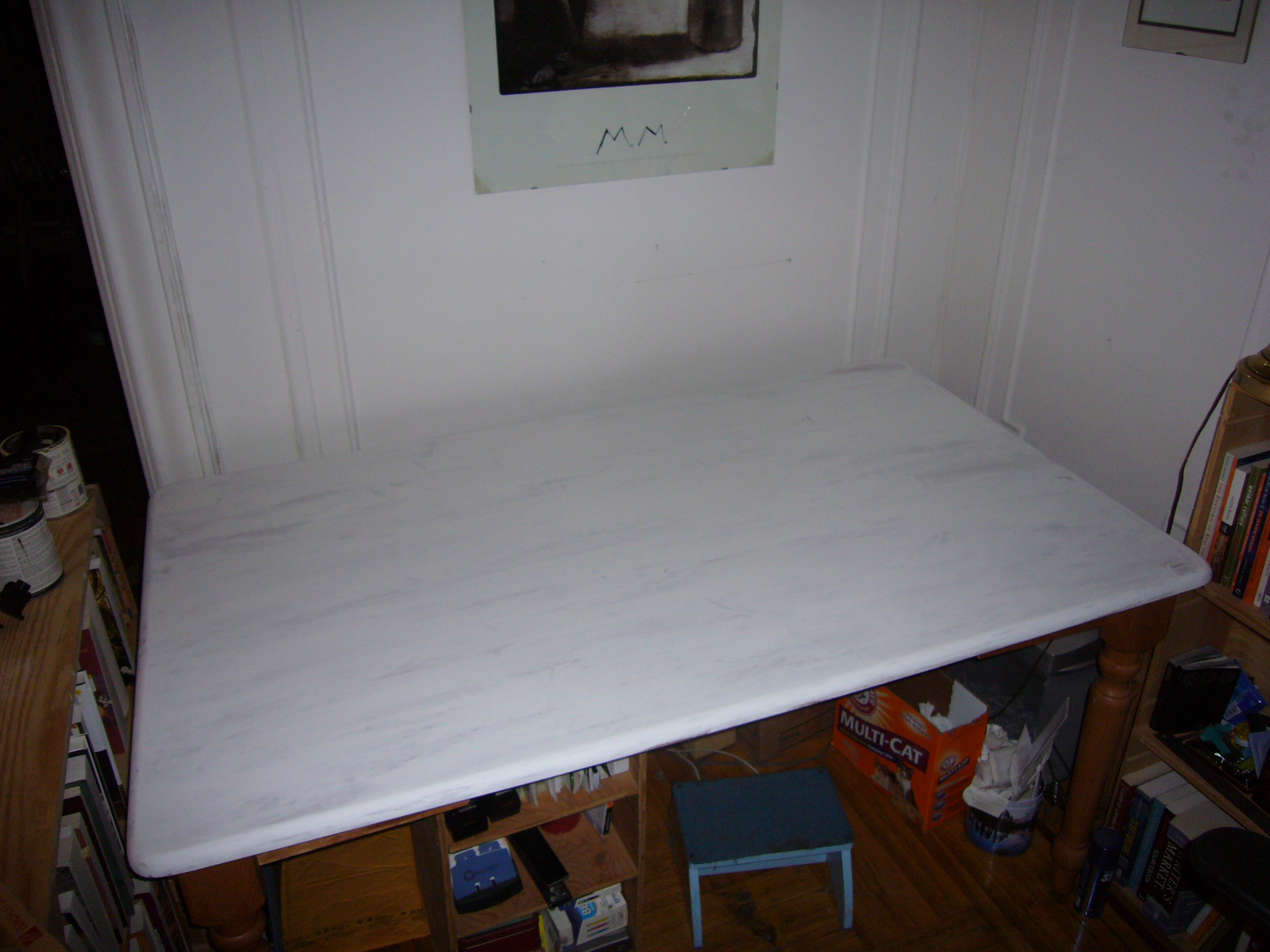
So when I got home from my very slow run through Prospect Park, I sanded down the top and primed it. Ta da!

Primed and ready!

Terribly exciting, I know. Almost as exciting as creating a large space of wetness with two kitties around.

(And no, I don’t keep the cat litter under the desk: I use the box as a makeshift garbage can. ‘Cause I’m cheap thrifty like that.)

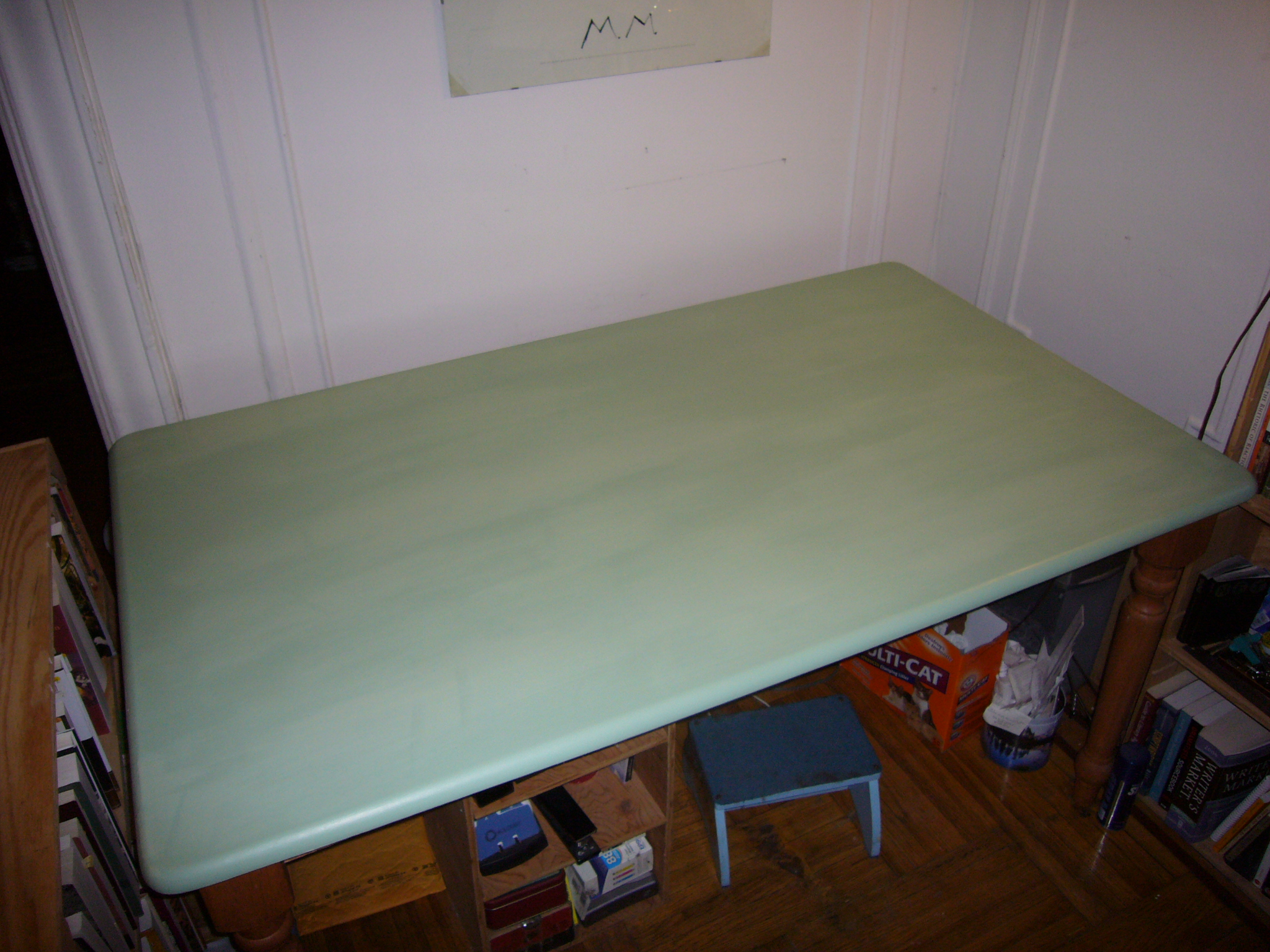
I’m going for something very light green—not mint (flashback to bad bridesmaid dresses)—but more olive or apple-y. I’ll see what I can manage with the paint I have.

Yup. It's painted.

It’s not yet dry, and I intentionally didn’t mix it thoroughly, so it’s a bit streaky.

If I can keep the cats off it for the next half hour or so, it should be fine.

So that’s what I did on the night of the first Tuesday in November in an even-numbered year.

Watched paint dry.