I hate you, you hate me

30 09 2015

This is a nightmare-in-waiting: a human-rating app.

And it’s called peeple. (Of course it is.)

“So, you can’t please everybody, but if you’re a business owner, or you’re a professional, or you’re that young urbanite or you’re that parent looking to make better decisions, you also deserve to see where you could improve,” [peeple CEO and co-founder Julia Cordray] said.

“Think of this as an ability to grow and get some honest feedback.”

Yes, that’s just what the internet is good for: honest feedback.

And if you sign up and decide you don’t like it? Tough.

“Let’s say we allow you to delete your profile and let’s say you are a person of questionable character. All the people of questionable character could hide from the app and then what’s the point?” said Corday, adding those on the app could see benefits for their good scores.

What would be the point, indeed?

And even I, the epistemological nihilist, shrinks from this:

“It doesn’t matter how far apart we are in likes or dislikes,” she tells some bro at a bar in episode 10 [of her YouTube series]. “All that matters is what people say about us.”

AAAAAAAAAAAAAAAAAAAAHHHHHHHHHHHHHHHHHHHHHH!!!!!!

h/t Shelby R. King, The Stranger


I got life

29 09 2015

So: “pinched nerve” might be a lay and not medical term, but it does describe a real phenomenon, in my case, an impingement upon the sciatic nerve.

No, I didn’t get this diagnosis from a doctor—there’s not much she could do, so why bother—but it’s pretty clear from my symptoms that my occasional lower back troubles can cause what is literally a pain in my ass.

If I want a more exact diagnosis than “o.l.b.t.”, then, yes, I’d need to see a doctor and undergo a variety of expensive (e.g., MRI) tests, but as a more exact diagnosis would likely lead to no greater precision in treatment—rest, time—there’s seems little point in doing so.

I am gonna have to get more ibuprofen, though.

I.

While I haven’t enjoyed in any way the pain from my grumpy sciatic nerve, I did take interest in the (non-pain) side effects of the jumped-up nerve, namely, the random twitching up and down my lower right side.

At one point early on I watched the middle toe of my right foot flutter like a drunk hummingbird. It didn’t hurt at all, and if I concentrated, I could stop the movement; in any case, after 10 or maybe 20 minutes, it stopped.

Sometimes my glutes twitched, sometimes, the muscles in my calf. It’d start, then stop, seemingly at random.

I still get the occasional muscle-shudder, but as whatever is annoying the nerve is slowly retreating, so to is the twitching.

II.

One of the reasons I love teaching my bioethics course is that I get to talk about human biology, which is so astonishingly jerry-rigged that I can’t help crowing “biology is so cool!”

Most of us Homo sapiens sapiens have 46 chromosomes occupying the nuclei of our somatic cells, but some of us have 45 and some have 47, 48, or even 49 (that’d be one of the varieties of Klinefelter’s).

A woman with Turner syndrome is missing a second sex chromosome (45,XO), and while she’s infertile and may experience some developmental delays, she likely will have normal intelligence and may live out a normal life span. On the other hand, a child born with a deficiency in the short arm of the 5th chromosome will be born with Cri-du-chat syndrome, which affects both her physical and intellectual development, and may leave her unable to communicate.

So, missing an entire chromosome might have fewer effects than missing a portion of an arm of chromosome. A man who is 47,XYY is likely to experience no effects whatsoever, 47,XXY will have Klinefelter’s (and thus be infertile), and 21,XXX (Trisomy 21 or Down syndrome) will experience profound physical and intellectual effects.

Oh, and some women are 46,XY.

Now, one of the things that can be inferred from this little recitation of chromosomal abnormalities is that the genes on these chromosomes are tremendously important, such that the genes on the short arm of the 5th chromosome are involved in aspects of our development that genes on the sex chromosomes are not; similarly, the Y chromosome is so gene-poor (~350) that doubling up on the Y has no discernible effect.

Then again, the few genes—most importantly, the SRY gene—that do remain on the Y are clearly important: their dysfunction, after all, can result in an XY woman.

The second thing that can be inferred from all of this is that biology is messy—I haven’t even discussed mosaicism or chimerism, or situs inversus or any of the other kinds of weirdnesses within us—and that the messes themselves are messy: sometimes they matter a whole lot, and sometimes not at all.

III.

So the first day my sciatic nerve commenced its protest it hurt to stand, was uncomfortable to walk, and running felt fine.

The second and third day, it hurt so much in the morning that shortly after rising I would sit down, gasping, from the screaming in my leg; after moving around a bit, however, the pain receded.

A couple of days I limped. Some days it hurt to put pressure on my right leg, some days it hurt not to put pressure on it. If I positioned my foot this way I was fine, that way, not; later, the fines were reversed.

I can walk quickly, but for the past 4 or 5 days, can’t run. Going up and down stairs was initially problem-free; now I grasp the railing.

Slowly, slowly, I am getting better: while the troubles migrate, they also abate. I was hoping they’d be gone by now, but I expect by next week, they will be.

IV.

Aging sucks.

V.

I’d rather not have gone through this and will do my damnedest to forestall a recurrence, but it does make me wonder what is going on beneath my skin.

Yes, I pay attention to my body, but usually when something is wrong I can trace it back to its source: I ate too much, didn’t stretch after a workout, wiped out on an icy sidewalk;  thus having linked effect to cause, I lose interest.

)And with migraines, well, they’re just SO irritating that I become preoccupied with the pain itself; the rare occasions when I get auras I am less fascinated than, well, irritated. Knock it off, shimmering lights, you’re blocking my view.)

In this case, I’m pretty sure I know what set off the latest back pain, but how that migrated down into the sciatic nerve, and how that nerve proceeded to respond to this trespass hopscotched around predictability. Why is my toe shaking? Why is my calf muscle clenching and unclenching?

What the hell is going on?

Oh, I know: what’s happening is that my body is now more assertive in letting me know it is unhappy with my treatment of it, i.e., that I’m getting old.

It’s not that when younger I thought I was in charge of my body, but, yeah, I thought I was in charge of my body.

I’m not humbled, but bothered, to learn otherwise, and I will not be gracious in relinquishing control.

It will be a fight to the death.


Sunday afternoon

20 09 2015

Do not put on icy hot just after getting out of the shower.

Lotion out of the shower makes sense: you’re naked, and your pores are wide open and ready to soak in that moisturing goodness.

Pores wide open and ready for mentholated cream? Not so good.

Lesson learned.

~~~

“Planned Parenthood is profiting from [women’s] pain and that’s what we’re standing up to,” said Lila Rose, who founded Live Action when she was just a teenager and has been working to discredit Planned Parenthood for years, said at the rally last Thursday.

Extending that logic:

  • Oncologists are profiting from [cancer patients’] pain. . . .
  • Pain specialists are profiting from [pained peoples’] pain. . . .
  • Rehabilitation centers are profiting from [injured peoples’] pain. . . .
  • Hospices are profiting from [dying peoples’] pain. . ..

I’m sure you can come up with your own.

h/t Wonkette

~~~

I haven’t read Timothy Snyder’s Bloodlands (it’s on the list!), tho’ I understand it’s been generally, although not universally, well-received, and have read only a few reviews of his lated book, Black Earth.

Thus caveated: While I have no beef with the contention that Stalin was as great a criminal-against-humanity as was Hitler, and that it is useful to compare the Nazi and pre-Khrushchev Soviet regimes, I am skeptical that the great crimes of Hitler, et. al. are the same as those of Stalin, et. al.

I am even more skeptical that the Bolsheviks, bad as they were, were somehow also responsible for Nazi crimes.

~~~

Funny how back pain can migrate into leg pain.

I don’t know what happened—is a pinched nerve even a thing?—but my minor back problems flared up earlier this week, then decided to migrate down my right leg for the weekend.

Oddly, however, while sitting or standing upright is painful, walking isn’t that much of a problem, and running is completely fine.

The bike, however? Fuggedaboutit.

Anyway, I had to take my food scraps to the Greenmarket in Grand Army Plaza yesterday (and yes, I really did have to, as my little bin was full-up), so decided to hoof it instead of either biking or taking the train. It was not a comfortable walk (made worse by blisters—honestly!), but it was completely worth it, for not only did I unload my food scraps, I was able to score my most favorite fruit of the fall:

The cortland apples are back!

So even tho’ I looked bad enough waiting for the 2 train home that a woman stopped and tried to convince me to sit down (“Thank you, but really, no it feels better to lean against the wall than sit”), the five pounds of apples I scored was totally worth it.

I just hope next week I’m well enough to bike for my apples.


I keep finding hate mail in the pockets of my coat

7 09 2015

Long ago I promised a follow-up to my various religious exemptions/one law/pluralism posts about how to preserve that pluralism.

This is not that post.

Instead, it’s a quickie follow-up to yesterday’s post about doing one’s job.

As I have mentioned ad nauseam, I am a hardliner when it comes to one’s work duties, namely, that if you’re unwilling, for whatever reason, to perform a job, then you should quit.

Yes, you can try to negotiate these duties, try to convince your bosses that their policies are wrong, but, in the end, if you can’t do the job, then you shouldn’t do the job.

The flip side of this, which I have only occasionally mentioned, is that what you do off the job should have no bearing on the job.

There might be some reasonable exceptions to this, but I’m pretty comfortable stating that those exceptions should be few and far between. You might be a racist piece of shit on your own time, but if you can keep it together while you’re on the clock, then that’s all that should matter.

Now, some might argue that someone who’s a racist piece of shit off the job is highly unlikely to keep it together on the job, but unless and until that person loses it, she should keep her job. Judge someone’s work performance by her work performance, and that’s it.

Furthermore, this oughtta be a law—and not just as a protection for the worker (who most needs it), but as a defense for the employer: I can’t fire someone you don’t like just because you don’t like ’em.

This, to me, is an obvious corollary to telling the Kim Davises of the world to suck it up: if there are limits to how far you may take your personal life into a job, then there are also limits as to how far a job may enter into your personal life.

This is not a position I would have taken when I was younger. Back then, I had notions of throwing my whole self into a job, of defining myself almost completely by the work I do. Now, however, while I do gain a sense of self from my work, I’m also aware of the necessity of boundaries—both as a practical matter and for my own mental health.

I really do love teaching, but I do it because I get paid. It’s a job which I need in order to pay the rent, and I don’t care for my employer to take into account anything about my ability to do the job except for my performance on the job.

And not that I have much going on, but I most definitely to do not want them poking around in my private life.

~~~

There’s a thing about living in a city in which you can see into your neighbor’s apartment or hear your neighbor’s conversations/sex/fights: You pretend that you don’t. Your (and your neighbor’s) privacy might be a kind of fiction, but it’s the kind of fiction that works in real life.

I think we should take the same approach to social media and on- and off-the-job behavior as well: If the person sitting next to you is fine at work, but after work engages in behavior you find repugnant or ludicrous, pretend that you don’t know. Just let it be.

A little bit of breathing room is good for all of us.


One love

6 09 2015

Given my One Law to Rule Them All stance, it’s really no surprise what I think of this whole Kim Davis situation:

Do your fucking job, and if you can’t do your fucking job, resign.

This is not even close to a hard call.

At least one good thing, however, and however temporarily, has come out of this: Sitnexto Kim Davis.

Now that is how you do parody.


It’s gonna be another long one tonight

6 09 2015

Where has the time gone?

A mere 365 nights ago was J’Ouvert, the annual midnight parade, and so it returns once again.

I try to be decent about this, I do, but come 4:30 in the morning and yet another band is pounding its way down Nostrand, and I get a little crabby.

Still, it’s a good neighborhood, it is. I tell myself this over and over: it’s a decent place to live.

Except the night before Labor Day.


This whole frigging place will be down to the ground

2 09 2015

I’m teaching Weimar this semester.

Two months ago—a month ago—I didn’t know that’s what I’d be teaching, but once I hit on it, I thought Yessssss!!

This is actually the 4th version of my Politics and Culture course. The first one, based on women and human rights, was terrible; the second one worked well, but after teaching it a few years, I got bored and redid the syllabus; the third version was okay, but it never quite came together, and I was never fully comfortable with the course.

So, time for yet another revamp.

My first thought was that I’d use Acemoglu and Robinson’s Why Nations Fail. While I had a few issues with their argument (as I had with the Nussbaum book I used for v. 2), I thought the book would work well for the course: it’s well-written, and, importantly, it had the kind of big theory that was missing from one of the books (Banerjee & Duflo’s Poor Economics) I used in v. 3. The students in that course responded when I gave big-sweep historical lectures, so I figured Acemoglu & Robinson’s big-sweep historical analysis would go over well with them.

Except: I couldn’t figure out what to use as an adjunct to the text. Why Nations Fail is all about political and economic development, and while (political) culture plays a role in their argument, I still wanted to round out the course with something else.

Only, I couldn’t figure out what that something else would be. I’d spent a fair amount of time over the past few months looking over my books and pulling one, and then another, and then yet another off the shelf, but I couldn’t settle on one. Then, at some point in mid or late July, I was peering idly at my history books, and I scanned across Richard Evans’s Third Reich trilogy.

Huh, I thought. Then, Yesssss!!

My first thought was The Coming of the Third Reich, then I thought, The Third Reich in Power, but then I went back to The Coming.

Weimar. Perfect. It’s politics and culture galore, is a subject which I’d been reading about off and of the past coupla’ years, and, most importantly, it was something that I was immediately excited about.

I was not immediately excited about Why Nations Fail.

And that’s when I remembered the lesson I keep forgetting: teaching something I’m dutiful about is a pain; teaching something I’m excited about is a gas.

It also helps to teach something which is more rather than less in my wheelhouse. I certainly have interests in political and economic development, but I’m not a political-developmental economist: I’m a theorist, and I want to know how and why ideas move people to act. Material conditions absolutely matter, but they are not determinative; I’m interested in that great gauzy space beyond the material, and how that works out in actual political life.

So why wasn’t I teaching that? Why was I abandoning something that I think also matters? Why wasn’t I taking theory—and politics—seriously?

Weimar gives me a bit of everything; hell, the glory of Weimar as a teaching subject is its too-muchness: economics and diplomacy and monarchy and fascism and liberalism and communism and violence and art and theater and so much promise and in the end, too much peril.

I’ve only taught one session so far (the class meets on Fridays), and we won’t really get into Weimar until the third week, but the students seemed into it. They might not know much about Weimar, but they certainly know something about what came after—Nazis on the march do tend to get one’s attention.

Anyway, I don’t know if this course will work or not, but really, I think it will. And I think the students will end up digging it, too.

In any case, it certainly can’t go any worse than the Republic itself.


Baby you can drive my car

19 08 2015

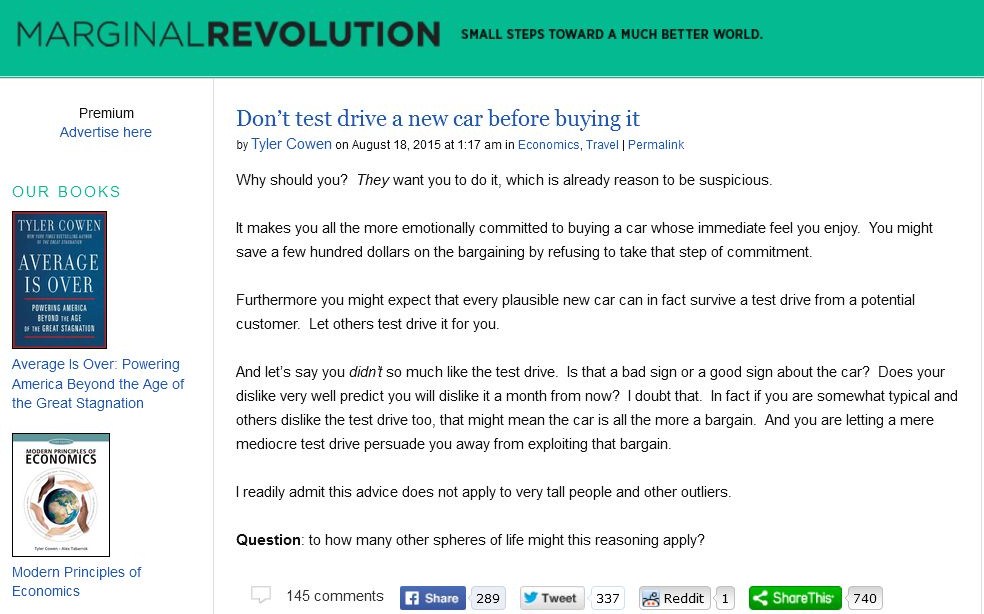
I’m someone who finds it hard to talk about economists without rolling my eyes. Good lord, they actually think models=life.

This is, admittedly,  mostly just interdisciplinary trash-talk, but then I read something like this. . .

test drive

. . . and I think I am not nearly skeptical enough.

~~~

I should note that I generally enjoy reading Tyler Cowen: he’s smart, well-read, strange, and willing to take curiously-premised positions to their bug-nut logical conclusions. (His colleague Alex Tabarrok, on the other hand, . . .)

I should also note that it’s equally possible that Cowen is a) entirely serious; or b) trolling his readers. Hard to tell, given his deadpan writing style.


If I had a rocket launcher

16 08 2015

Excuse me for the all-caps but:

MIKE HUCKABEE WHY DO YOU THINK YOU SHOULD BE IN CHARGE OF A RAPE VICTIM’S BODY??!!


Everybody knows the deal is rotten, 19

16 08 2015

When I was younger—much younger—I thought I’d get the kind of job I could really throw myself into, an all-encompassing career that would provide me with all of the pleasure and meaning I could want from life.

Touching, isn’t it, how little I knew.

Now, it could be said—has been said, by the likes of me—that my current inability truly to commit to my work (paid and unpaid) takes things in rather too far the opposite direction, but I do think that my unwillingness to commit to a Stakhanovite* work-ethic is generally more healthy than not.

Consider Amazon:

Every aspect of the Amazon system amplifies the others to motivate and discipline the company’s marketers, engineers and finance specialists: the leadership principles; rigorous, continuing feedback on performance; and the competition among peers who fear missing a potential problem or improvement and race to answer an email before anyone else.

Some veterans interviewed said they were protected from pressures by nurturing bosses or worked in relatively slow divisions. But many others said the culture stoked their willingness to erode work-life boundaries, castigate themselves for shortcomings (being “vocally self-critical” is included in the description of the leadership principles) and try to impress a company that can often feel like an insatiable taskmaster. Even many Amazonians who have worked on Wall Street and at start-ups say the workloads at the new South Lake Union campus can be extreme: marathon conference calls on Easter Sunday and Thanksgiving, criticism from bosses for spotty Internet access on vacation, and hours spent working at home most nights or weekends.

It must be admitted, of course, that Amazon would never hire, much less interview, me: I lack tech skills and corporate experience, so I am most definitely not the Amabot they’re looking for.

Some employees do relish the competitive atmosphere at Amazon, thinking that it makes them better, sharper, more able employees; that this kind of bionic work ethos won’t do much for the person they are outside of being an employee is, of course, irrelevant.

(As an aside: I used to that going to grad school was like sticking your head in a pencil sharpener: you do come out a lot sharper, but you also lose a lot in those shavings.)

And as loathsome as I find Amazon’s “purposeful Darwinism” practices—their treatment of employees who do exhibit human frailties is appalling—they seem to me more different in degree than in kind to many other workplaces. Google and Apple and Facebook might provide all kinds of goodies for their employees, but these aren’t these goodies simply the happy-clappy way to get those workers to spend more time at work?

Now, as an employee I’d rather work for someone who wants happy rather than frazzled workers, but really, I want to work at a place that knows its place in my life: important, but not everything.

I may not have much in my life (this is one of those above-mentioned issues), but I do at least have the possibility of having something more.

And that ain’t nothing.

~~~

*h/t to Chatham Harrison for this reference. My first thought on reading of the need for self-criticism was that that sounded Cultural Revolution-ist, but hey, given the contradictions of a company ethos that demands both that workers be self-critical and that they not admit of any doubts or lack of knowledge, why couldn’t it embody both Stalinism and Maoism?

And no, for the record, I don’t think Jeff Bezos is the bald offspring of Uncle Joe and Mao; I mean, there’s no record of him being a genocidal maniac, is there?