It’s too late, baby

12 01 2015

Not only am I lazy, I am also a bossy broad.

Bossy and lazy: and I wonder why I don’t date!

Anyway, Amy Klein writes in aeon about her reluctance to tell her 42-year-old friend that it’s too late to begin thinking about freezing her eggs:

What I really want to tell my friend is that if she is serious about having a baby, her best bet would be to go out to the nearest bar and hook up with a stranger – during her 36-hour ovulation window, of course. But I won’t tell her to sleep with a random guy, I won’t ask if she ovulates regularly, nor will I say anything else about the state of her ticking – nearly stopped – biological clock: it’s too delicate a subject.

To which I can only say: if someone brings up her ovaries to me, then I’ma gonna go ahead and tell her that thinking and freezing are not going to get the job done—although I’d recommend a sperm bank rather than the local pub.

Will I also tell her that chances are she’s already infertile? That would depend on the course of the conversation, and, in any case, I’d tell her to talk to her OB-GYN.

Klein is right, however, that most women don’t know that, for most of them, the fertility window is closed by the early forties, and that it begins closing in the late-twenties/early-thirties. Fertility rates do decline throughout the thirties (entering a period of greater variability in the late thirties), but, again after 40 the decline is precipitous.

And IVF won’t help—not if you didn’t create embryos before entering your fifth decade. Yes, some women do conceive their own children throughout their forties, but, as Klein points out, all of those well-known women birthin’ babies at 48 or 50 are either using embryos frozen some time ago or someone else’s eggs. Liza Mundy has more about this in her terrific book, Everything Conceivable:

Studies show that among ART [assisted reproductive technologies] patients who are forty years old and using their own eggs, there is a 25 percent chance of pregnancy over the course of three IVF cycles. The chances diminish to around 18 percent at forty-one and forty-two, 10 percent at forty three, and zero at forty-six.

In 2005, a group of doctors at Cornell surveyed IVF patients over forty-five who had attempted to conceive using their own eggs. Among women between forty-six and forty-nine, not one get pregnant using her own eggs. (p. 42)

And, it should be noted, the odds are even worse for poorer and non-insured women of every age, who may have had untreated medical problems which interfere with or nullify their fertility.

Mundy and Klein both note that a previous attempt by the American Society for Reproductive Medicine to raise awareness that the biological clock only has so many ticks in its tocks caused controversy among (hangs her head in sorrow) some feminist groups (well, the National Organization for Women), for the “pressure” such information would place on women, making them “anxious about their bodies and guilty about their choices”.

(Do I mention here that loooooong ago I was a member of the Sheboygan chapter of NOW? Those women, who fought to bring Planned Parenthood to the county, who had been harassed and threatened, would have hooted then-prez Kim Gandy out of the room for thinking they would have been afraid of a little information.)

Klein quotes Naomi Cahn, author of Test Tube Families, who notes that

‘the politics of reproductive technology are deeply intertwined with the politics of reproduction’ but ‘although the reproductive rights issue has a long feminist genealogy, infertility does not’. Discussion of infertility is threatening to feminists on two levels, she contends: ‘First, it reinforces the importance of motherhood in women’s lives, and second, the spectre of infertility reinforces the difficulty of women’s “having it all”.’

That is not any reason, however, not to spread the word as far and wide as possible:

‘Shunning that information about the relationship between fertility and age, however, ignores biological facts and, ultimately, does a disservice to women both in terms of approaching their own fertility and in providing the legal structure necessary to provide meaning to reproductive choice,’ writes Cahn.

. . .

‘It is only with this information that reproductive choice becomes a meaningful concept,’ Cahn writes. ‘Choice cannot mean only legal control over the means not to have a baby, but must include legal control over the means to have a baby.’

Exactamundo.

It is sometimes pointed out that it is unfair that men have no legal say in whether a women chooses to continue or to end a pregnancy—and maybe it is, but it’s also how it is. Similarly, maybe it’s unfair that men remain fertile throughout their lives but women do not—and maybe it is, but it’s also how it is.

So better to say how it is (and the earlier the better) than pretend otherwise, so women have the knowledge, and the time, to make the choices that make sense for them.

And if we’ve got to be a little bossy to get the word out, well, then that’s how it is, too.


I got life

8 01 2015

Stipulated: Adults get to make whatever boneheaded medical decisions about themselves that they want.

Stipulated: Adults do not get to make whatever boneheaded medical decisions about their children that they want.

Question: Ought a 17-year-old be able to make a boneheaded medical decision about herself?

Cassandra C. is a 17-year-old with Hodgkin lymphoma, a disease which, when treated with chemotherapy, has a high (80-85%) survival rate. Cassandra initially underwent surgery, then two rounds of chemo, before deciding that while she wants to live, she wants to do so without, in the words of her mother, Jackie Fortin, putting “poison” in her body.

It’s not a stretch for a layperson to consider chemo a poison: the patient ingests the drugs with the idea that they will kill the cancer without killing her, and it is the lucky, lucky cancer patient who isn’t sickened by this treatment.

But it is a stretch to think that there exists some other, effective, non-poisonous treatment for Hodgkin’s, not least because there is no good evidence of its existence. Some (#notall. . .) alt-med folks may think oncologists are in league with pharma companies to hide cheap and easy cures to nasty diseases, but I highly doubt there is a conspiracy of cancer docs to keep effective treatments away from their patients just so they can profit from their suffering.

In any case, if Cassandra were 18, she could cease the chemo in search of those non-poisonous treatments, but at not-quite-17-and-a-half, she’s been confined to medical ward by Connecticut state officials and forced to undergo treatment; the Connecticut Supreme Court just reaffirmed that decision by those officials.

Art Caplan (from whom I took a class when he was at Minnesota) wrote a brief editorial that 17 is 17—that is, not 18, and therefore unable to medical decisions on her own behalf. I get the technical point (1718), but I’m not so sure that the consequentialist argument Caplan goes on to make—Hodgkin lymphoma is treatable—ought to carry the day.

After all, if she turned 18 tomorrow, the lymphoma would remain just as treatable, and the absence of that treatment would leave her just as dead.

Cassandra told the AP that

it disgusts her to have “such toxic harmful drugs” in her body and she’d like to explore alternative treatments. She said by text she understands “death is the outcome of refusing chemo” but believes in “the quality of my life, not the quantity.”

“Being forced into the surgery and chemo has traumatized me,” Cassandra wrote in her text. “I do believe I am mature enough to make the decision to refuse the chemo, but it shouldn’t be about maturity, it should be a given human right to decide what you want and don’t want for your own body.”

It is about maturity, actually; the difficulty is determining what counts as maturity?

Is it just about age? Reach 18 years and you’re mature; prior to that, not.

That has both the benefit and drawback of simplicity. It’s a straightforward standard, but one which, strictly applied, seems nonsensical, ascribing a substantive ethical property to passage of time : “January 1 you’re immature, but October 1 you’re mature.”

Age matters—if Cassandra were 10, I’d think there was no ethical problem—but largely as a stand-in for other properties, including the ability to make decisions.

So is maturity about decision-making ability? Well, okay, but what does this mean? Is this about making good (by whatever metric) decisions? And what if someone repeatedly makes bad (b.w.m.) decisions?

If their adults, and those decisions are of a non-criminal nature, we say, Okay, but largely because most of us don’t want to live in a society where we don’t get make decisions about our own lives. We assert the procedural right to decide, regardless of the content of the decision, because we’d rather make our own decisions (good and bad) than have others make them for us.

But teenagers, man, teenagers get to make some decisions and not others, and figuring out what decisions they get to make often does come down to the content of those decisions. If the kid makes good decisions (as determined by the parents), he’s given the leeway to make even more; if not, then not.

And thus the Connecticut Supreme Court has judged the procedural ability of Cassandra to make her own medical decisions on the content of those decisions: it thinks she’s decided badly, and as a result, ought not be able to decide at all.

I get this, I do, but I am made uneasy by it.  What if she had a different disease, with a much lower (40 percent? 30?) survival rate? What if the treatment were more disabling over the long-term? Or what if she doesn’t respond to the treatment? Is there any amount of suffering from the treatment that would lead the hospital to stop?

Or will they only stop when Cassandra turns 18, and is free to decide for herself, whatever the content of that decision?

This is a tough case, and I don’t know that the Court got it wrong. I just don’t know if they got it right, either.


All things weird and wonderful, 49

17 12 2014

End of the semester, grading—and oh yeah, that whole Torture USA! USA! USA! gig.

So, a nudibranch:

Costasiella kuroshimae, by Lynn Wu

A tiny sea slug that looks like a sheep—yes, that’s exactly what we need.

~~~

h/t Cute Overload; more info & photos here


In the red, red sea

17 12 2014

We now know what we suspected and it’s all right.

Our government tortured and a good chunk of Americans are good with that.

Long pause as I contemplate this. And another.

One more.

Okay, then.

Jamelle Bouie is right that this should surprise no one:

It’s not just that Americans want a system that metes out punishment, it’s that—despite our Eighth Amendment—we are accepting of the cruelest punishment. And while it’s not legal, it exists and it’s pervasive. In theory, our prisons are holding cells for the worst offenders and centers for rehabilitation for the others. Inmates can work, learn, and prepare themselves for a more productive life in society. In reality, they are hellscapes of rape, abuse, and violence from gangs and guards.

[. . .]

If this is how we treat domestic prisoners—who, despite their crimes, are still citizens—then it’s no shock we torture noncitizen detainees, and it’s no surprise Americans largely support the abuse.

And thus, connecting punitive lash with punitive lash:

We aren’t living in “Dick Cheney’s America” as much as Dick Cheney is just living in America and thinking like an American. Here, we already believe our criminals deserve the brutality of our prisons. From there, it’s easy to think that our detainees deserve the depravity of our dungeons. That’s where he stands, and we stand with him.

So no one will be prosecuted, at least in domestic courts, and this may, even will probably, happen again.

And a good chunk of Americans are good with that.


Defenses down

16 12 2014

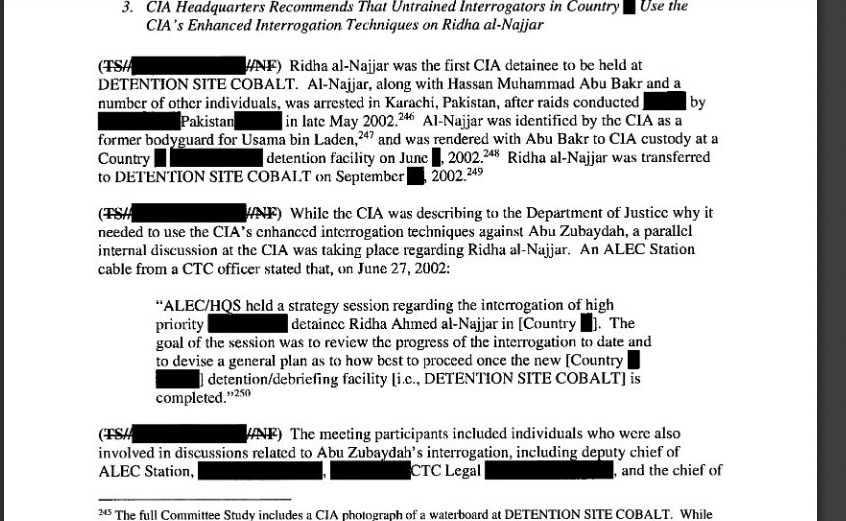
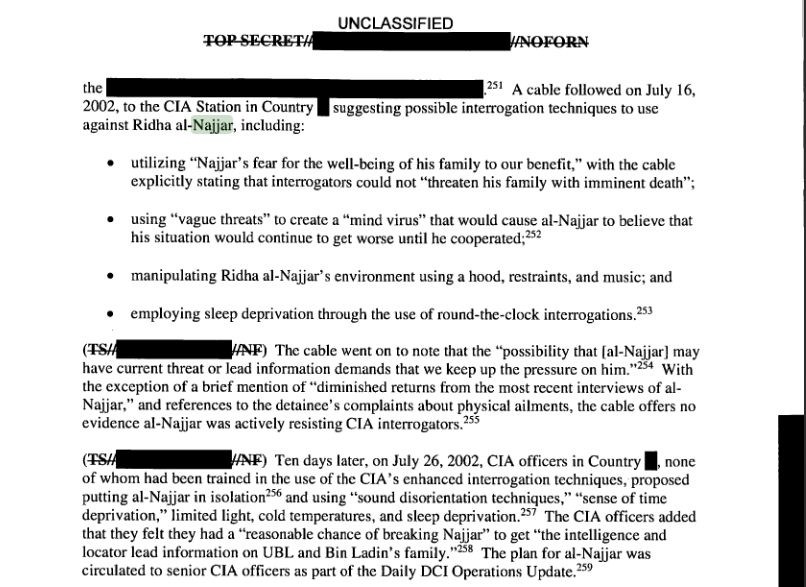
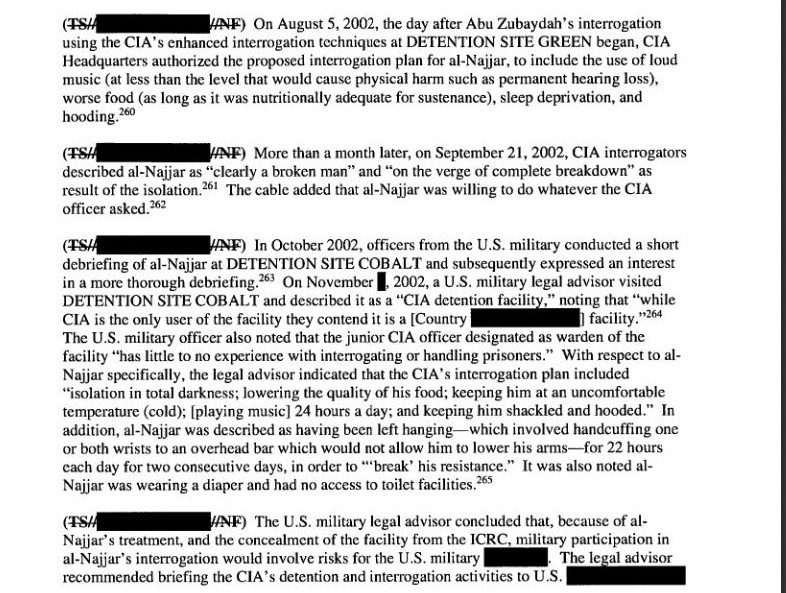
From pages 51-54 (77-80, pdf) of the Torture Report, a model for “enhanced interrogation”:

FireShot Screen Capture #005 - 'sscistudy1_pdf' - www_intelligence_senate_gov_study2014_sscistudy1FireShot Screen Capture #007 - 'sscistudy1_pdf' - www_intelligence_senate_gov_study2014_sscistudy1

FireShot Screen Capture #008 - 'sscistudy1_pdf' - www_intelligence_senate_gov_study2014_sscistudy1

FireShot Screen Capture #009 - 'sscistudy1_pdf' - www_intelligence_senate_gov_study2014_sscistudy1Yes, the CIA created a “mind virus” to convince a Najjar that his “situation would continue to get worse” unless he “cooperated”.

(“Cooperated”: Such a sinister meaning attached to such a benign term.)

They thought through the use of torture they “had a reasonable chance at breaking” him.

Breaking: a much more appropriate term.

And which they accomplished. They broke a man. Through isolation and sleep deprivation and hooding and exposure and hanging they broke a man.

And this ” ‘became the model’ for handling other CIA detainees at DETENTION SITE COBALT.”

A model for how to break a human being.


There is no blood around, see no sign of pain

16 12 2014

If you’re going to make an argument in favor of torture—and no, I will not be making an argument in favor of torture, even hypothetically—it seems the worst one is the one most often used: the ticking time bomb scenario.

What if you knew there was a nuclear bomb about to go off in New York City: wouldn’t you torture the suspect(s) in order to prevent the conflagration?

No. No no no no no no no.

Admittedly, I would neither torture nor approve of the torture of anyone under any circumstances—it’s one of the very few issues on which I’m an absolutist—but torture would seem to be least effective under these conditions.

Consider: the bomb is about (hours, days) to go off. If you are someone who is willing to die in order to kill hundreds of thousands of people, wouldn’t you be willing to outlast hours or days of torture? Or to lie repeatedly in order to forestall any efforts at finding and defusing the bomb?

The kind of person who’s willing and able to pull off the worst kind of terrorism is likely also the kind of person who’s willing and able to withstand hours and days of torture in order to make sure that bomb goes off.

I’ve spoken of my love for the mediocre movie The Peacemaker, but (and?) one of the things that makes no sense was Dušan Gavrić’s suicide. Here’s a man who went through all kinds of trouble in order to detonate a nuke in New York, and a couple of minutes before it detonates, he shoots himself.

Why not just talk until time expires? Mission accomplished.

Okay, so that’s a movie, but it seems like the assumptions beneath the ticking-time-bomb scenario are even less realistic than Nicole Kidman as a nuclear expert: that the bad guy who knows what the good guys need in order to stop the bad guy’s plans won’t just bullshit until time expires.

Give this to the psychopathic former vice president: at least he doesn’t bother with this particular bullshit scenario to justify the breaking of human beings.


Let the rain fall on your skin

11 12 2014

The USA Patriot Act issued by the US Senate on October 26, 2001, already allowed the attorney general to “take into custody” any alien suspected of activities that endangered “the national security of the United States,” but within seven days the alien had to be either released or charged with the violation of immigration laws or some other criminal offense. What is new about President Bush’s order is that it radically erases any legal status of the individual, thus producing a legally unnameable and unclassifiable being. Not only do the Taliban captured in Afghanistan not enjoy the status of POWs as defined by the Geneva Convention, they do not even have the status of persons charged with a crime according to American laws. Neither prisoners nor persons accused, but simply “detainees,” they are the object of pure de facto rule of a detention that is indefinite not only in the temporal sense but in its very nature as well, since it is entirely removed from the law and from judicial oversight. The only thing to which it could possibly be compared is the legal situation of the Jews in the Nazi Lager [camps], who, along with their citizenship, had lost every legal identity, but at least retained their identity as Jews.

Giorgio Agamben, State of Exception

The torture-cheerleaders are clear to state that the Bush Administration’s legal counsel cleared the techniques of torture—mainly by stating that these techs were not-torture—so it could be argued that the “detainees” were in fact covered by law, as “detainees”.

The torture regime of a decade ago was indeed a legal regime: by using the law to remove the protections of the law from those assigned “detainee” status, it covered those who would torture.

Hannah Arendt noted there is no particular dignity in the naked human being (although “naked” in this sense meant shorn of one’s membership in a state), which leaves that shorn human vulnerable to imprisonment, displacement, death.

The point, then, is the same: lacking status as a citizen, a prisoner, a person—as someone recognized by us—allows us to do anything to that non-person.

And so we did.


Just let the red rain splash you

9 12 2014

The executive summary of the Senate Select Committee on Intelligence torture report.

16 absolutely outrageous abuses detailed in the CIA torture report, as outlined by Dylan Matthews.

I was naïve, years ago, in my outrage at the torture committed by the CIA. Yes, the US had enabled torturers (see: School of the Americas) and supported regimes which tortured (see: US domestic surveillance and foreign policy), but somehow, the notion that torture was committed by US government agents seemed over the line in a way that merely enabling and supporting had not.

I don’t know, maybe US-applied torture was over the line in a way US-enabled/supported torture was not, and busting righteously through it busted something fundamental in our foreign policy.

But given, say, the Sand Creek and Marias massacres amongst the general policy of “land clearing” and Indian removal—policies directed by US politicians and agents—wasn’t it a bit precious to decry this late unpleasantness?

Naïveté, I wrote above. No: ignorance. I’d studied (and protested) 20th-century US foreign policy and ignored its 19th century version, the one directly largely against the indigenous people whose former lands now make up the mid- and western United States.

Ta-Nehisi Coates recently wrote that paeans to nonviolence are risible in their ignorance: Taken together, property damage and looting have been the most effective tools of social progress for white people in America. Yes.

A country born in theft and violence—unexceptional in the birth of nation-states—and I somehow managed not to know what, precisely, that birth meant.

I’m rambling, avoiding saying directly what I mean to say: there will be no accountability for torture. Some argue for pardoning those involved as a way to arrive at truth, that by letting go the threat of criminal charges we (the people) can finally learn what crimes were committed, and officially, presidentially, recognize that crimes were committed.

It is doubtful we will get even that.

Still, we have the torture report, and (some) crimes documented which were only previously suspected. Good, knowledge is good.

But then what? Knowledge of torture committed is not sufficient inoculation against torture being committed.

Coming clean will not make us clean.


I want to ride my bicycle

8 12 2014

The next time I whine-think Ehhhn, I don’ wanna take the train the gym and I don’ wanna sit on a stationary bike at the gym and It’s really not that cold out and I’ll just bundle up when I ride. . .

. . . I will remember this 30s-degree-gusty-winds day, with my dead-cold toes and quivering thighs and pissed-off tits and I will grab my fuckin’ MetroCard and a book for the bike and take the goddamned train to the gym.


Knights in white satin

2 12 2014

Racism just ain’t what it used to be.

Oh, sure, it’s evolved from “savages” and “primitives”, from “nigger nigger nigger” to “we need to cut this”, from Jim Crow to the Southern strategy to voter ID, and, of late, to “race realism” and “human biodiversity” and James-Watson-not-a-racist-in-the-conventional-way, but even the folk who hide behind economic populism and biological science would admit that there are racists in the USA:

They’re called Klan members.

Thus, as long as those race realists (and James Watson) aren’t marchin’ around in white robes or burning crosses on colored folks’ lawns, they’re not racists (at least not in the conventional way).

So what to do when someone posts a picture of a Klan member to his Facebook page and captions it “I’m dreaming of a white Christmas”—and then insists he’s not racist?!

I mean, the KKK is the white-gold standard of racism in America! If the HBD-ers (and James Watson) aren’t able to point to their non-membership in the Klan as evidence of their non-racism, however will they convince people of their good faith and disinterested interpretation of evidence?

The horror.

Or maybe I’ve been wrong all along, and this new KKK≠racism equation proves once and for all that racism no longer exists in America.

At least among white people.