She blinded me with science

17 02 2014

When to let go and when to hang on?

This is one of the conundrums ways I’ve come to interpret various situations in life big and small. I don’t know that there is ever a correct decision (tho’ I’ll probably make the wrong one), but one chooses, nonetheless.

Which is to say: I choose to hang on to the “science” in political science.

I didn’t always feel this way, and years ago used to emphasize that I was a political theorist, not a political scientist. This was partly due to honesty—I am trained in political theory—and partly to snobbery: I thought political theorists were somehow better than political scientists, what with their grubbing after data and trying to hide their “brute empiricism” behind incomprehensible statistical models.

Physics envy, I sniffed.

After awhile the sniffiness faded, and as I drifted into bioethics, the intradisciplinary disputes faded as well. And as I drifted away from academia, it didn’t much matter anymore.

So why does it matter now?

Dmf dropped this comment after a recent post—

well “science” without repeatable results, falsifiability, and some ability to predict is what, social? lot’s of other good way to experiment/interact with the world other than science…

—and my first reaction was NO!

As I’ve previously mentioned, I don’t trust my first reactions precisely because they are so reactive, but in this case, with second thought, I’ma stick with it.

What dmf offers is the basic Popperian understanding of science, rooted in falsifiability and prediction, and requiring some sort of nomological deductivism. It is widespread in physics, and hewed to more or less in the other natural and biological sciences.

It’s a great model, powerful for understanding the regularities of non-quantum physics and, properly adjusted, for the biosciences, as well.

But do you see the problem?

What dmf describes is a method, one of a set of interpretations within the overall practice of science. It is not science itself.

There is a bit of risk in stating this, insofar as young-earth creationists, intelligent designers, and sundry other woo-sters like to claim the mantle of science as well. If I loose science from its most powerful method, aren’t I setting it up to be overrun by cranks and supernaturalists?

No.

The key to dealing with them is to point out what they’re doing is bad science, which deserves neither respect in general nor class-time in particular. Let them aspire to be scientists; until they actually produce a knowledge which is recognizable as such by those in the field, let them be called failures.

Doing so allows one to get past the no-good-Scotsman problem (as, say, with the Utah chemists who insisted they produced cold fusion in a test tube: not not-scientists, but bad scientists), as well as to recognize that there is a history to science, and that what was good science in one time and place is not good in another.

That might create too much wriggle room for those who hold to Platonic notions of science, and, again, to those who worry that this could be used to argue for an “alternative” physics or chemistry or whatever. But arguing that x science is a practice with a history allows the practitioners of that science to state that those alternatives are bunk.

But back to me (always back to me. . . ).

I hold to the old notion of science as a particular kind of search for knowledge, and as knowledge itself. Because of that, I’m not willing to give up “science” to the natural scientists because those of us in the social sciences are also engaged in a particular kind of search for knowledge. That it is not the same kind of search for the same kind of knowledge does not make it not-knowledge, or not-science.

I can’t remember if it was Peter Winch or Roger Trigg who pointed out that the key to good science was to match the method to the subject: what works best in physics won’t necessarily work best in politics. The problem we in the social sciences have had is that our methods are neither as unified nor as powerful as those in the natural sciences, and that, yes, physics envy has meant that we’ve tried to import methods and ends  which can be unsuitable for learning about our subjects.

So, yes, dmf, there are more ways of interacting with the world than with science. But there are also more ways of practicing science itself.

We just have to figure that out.


It’s raining again

15 02 2014

Snowing, actually.

Which pleases me: snowing and winter go together.

(Unlike rain. Thursday it snowed—big, puffy, beautiful swirling flakes—and then it rained, melting those beautiful puffs into slush. February rain sucks.)

Anyway, I used to mock folks in southern climes who freaked out when they got an inch or two of snow–ha ha! Look at those fools spin out!—but I’ve mostly gotten over my weather superiority complex. I mean, I decompensate when the temp climbs hellward of 85 or 90, so who am I to lord it over those who shiver below 40 degrees?

And laughing at the Georgians or Carolinians who slide into barely-snowy ditches requires one to forget that everyone is an idiot during the first snowfall.

I didn’t truly appreciate this until after I moved to Minneapolis and got my first car (Plymouth Horizon hatchback, RIP: gave its life after a long road trip west). Yes, I drove when I lived in Wisconsin and of course learned to do doughnuts (easier on a rear- than front-wheeled car), and helped push more than one car out of snowbank. (I don’t remember if I ever drove into a snowbank; if not, that had more to do with luck than skill.)

Anyway, now that I was living in a city and driving my own car and paying my own insurance, I also paid more attention to those many other drivers as well as to my own driving. And I noticed that every November (or October: see Minneapolis) when the first snow fell, drivers acted as if they had never before had to deal with this outrageous phenomenon of icy dust billowing down from the clouds.

They drove too fast. They braked too late, and then stood on the brakes as their cars veered sideways down the street. They drove too closely to one another. And—my personal favorite—they’d only clear a portion of the front window and maybe, maybe, a bit in the back before hitting the road.

That’s some smart driving, right there.

After the first snowfall or two, however, most drivers would get the hang of it, as if some part of their brains awoke from their brief warm-weather comas to say “hey, dummy, watch out!”, and they remembered to clear off all of the window and the lights and drive as if snow and ice were, y’know, slippery.

Or just not drive at all. That was my preferred method for dealing with big snow: stay off the road until the plows came thru.

Of course, one could be cautious and still SOL. It might snow when you’re out, or you might have to drive, and in Minneapolis the side streets and sometimes even the main drags wouldn’t be plowed down to pavement, such that driving was sketchy long after a storm ended.

And sometimes you do everything right and it still goes wrong. I remember one night driving down a small hill on Franklin Avenue toward the intersection at Third Avenue, stepping on the brakes, and having the car completely ignore the instructions to stop. I pumped the brakes, steered the car straight, but no dice.

The light turned red, but that wasn’t going to stop me.

So I did the only thing I could do: I laid on the horn as a warning to drivers on Third and slid right on thru that intersection. Luckily no one was in front of me, so the drivers on Third simply watched my Plymouth ski on by before motoring forth.

No one got hurt, and nothing happened. Lucky.

Upshot: snow fucks everything up, and it takes experience (as well as snow plows and salt and sand trucks) to deal with that fucked-up-ness. Folks in the north get plenty of chances to learn, so it’s easy to feel smug about southerners who will get only one or two shots every couple of years to get it right.

We shouldn’t. Because everyone’s an idiot driving in the first snow, and even the experienced need luck sometimes.


Bad to the bone

12 02 2014

Good christ, do I make bad decisions.

It’s kind of astonishing how many truly bad decisions I have made, and how completely fucking clueless I am at the time I’ve made them that almost any other decision would have been better than the one I do go with.

I’m not a stupid person, so you’d think I’d have a handle on this decision-making thing. And I can be pretty good at helping someone else make decisions that make sense for them; then again, I’m not the one actually making those sensible decisions, so maybe it works out in spite rather than because of me.

And it’s not like these bad decisions lead to crazyfuntimes. Oh, they did, sometimes, when I was younger, when bad decisions were confined to evening or weekend plans and usually involved some sort of intoxicant: hanging on the bumper of Y’s car and skiing down the street in my topsiders; getting stoned in a stranger’s basement then rifling thru the cupboards for hard rolls and peanut butter; bringing approximately 100 times more booze than food on a camping trip to Mauthe Lake; accidentally starting a paper tablecloth on fire at Country Kitchen, and wrapping toilet paper around our heads and dancing thru the restaurant singing “Hare Krisna”.

(This last bit was a group effort—I don’t know that I was actually the one who tipped over the candle; in any case, I’ve been making up how awful we were to those waitresses by overtipping wait staff ever since.)

No, it was only when the stakes got larger did the decisions get both worse and less fun.

I started at Madison with the intention of majoring in political science and becoming a journalist. I declared the major early, and starting working at The Daily Cardinal my first semester. So far, so good.

But then I got to thinking that maybe I wasn’t cut out for journalism (even though I was totally cut out for journalism), and started snuffling around for something else to do.

Hence grad school.

No need to rehash my each and every bad grad decision, but you can be sure they were there and I diminished my prospects with each and every one.

(You want an example? I had a couple of editors sniffing around my dissertation, and one who made serious overtures to me to turn it into a book. Do you need to guess what I did? Nothing, that’s what I did.)

Blew thru two post-docs—two very good post-docs, with great colleagues and great conditions and which could have served as great launching pads for my career—with almost nothing to show for them except a desire to quit academia.

Such fine decisions.

Then the move to the Boston area. Christ. Next.

Then the move to Brooklyn (which involved multiple financially stupid decisions at both ends of the move), more bad job decisions, and, well, here I am.

I’ve known before of the low-quality of my decisions, but always had reasons for their badness: I was depressed, I was really depressed, I was getting over being depressed, I was so used to making bad decisions while depressed that I didn’t know how to make not-bad ones, I could only make decisions based on what I knew at the time. . . . Blah blah.

No, a coupla’ weeks ago I finally owned these shitty decisions, gathered them all into my arms and said Goddamn.

I don’t know what I’m going to do with the full recognition of this bundle of badness; it’s just possible that knowing how terrible I’ve been at making decisions that I’ll try harder to make better ones, that I’ll check myself with a reminder of how badly things have gone before.

Oh, and by checking with people who by simple fact of not being me will offer better counsel to me than I could to myself.

Two more things. One, that I am not stupid has probably helped to mitigate some of the bad effects of the bad decisions. And not every decision I’ve made has been terrible (which may have helped lull me into thinking I was better at this than I am), so while I’m not where I want to be, I’m not at the bottom of the well, either.

Two, I’m not at the bottom of the well. Those bad decisions may have tipped me this way or that, but tipping over isn’t always all bad. Sometimes it’s just not what I expected, and sometimes, the unexpected is all right.

It’s all right.


And I’m losing control

9 02 2014

This is shit, isn’t it?

I mean, I’m not a social psychologist, and even fellow political scientists doubt the soc-sci cred of theorists like me, but Jonathan Haidt seems to be siphoning way too much meaning out of a poorly-designed linguistic study.

To wit:

When I was doing the research for The Righteous Mind, I read the New Atheist books carefully, and I noticed that several of them sounded angry. I also noticed that they used rhetorical structures suggesting certainty far more often than I was used to in scientific writing – words such as “always” and “never,” as well as phrases such as “there is no doubt that…” and “clearly we must…”

To check my hunch, I took the full text of the three most important New Atheist books—Richard Dawkins’ The God Delusion, Sam Harris’s The End of Faith, and Daniel Dennett’s Breaking the Spell and I ran the files through a widely used text analysis program that counts words that have been shown to indicate certainty, including “always,” “never,” “certainly,” “every,” and “undeniable.” To provide a close standard of comparison, I also analyzed three recent books by other scientists who write about religion but are not considered New Atheists: Jesse Bering’s The Belief Instinct, Ara Norenzayan’s Big Gods, and my own book The Righteous Mind.

To provide an additional standard of comparison, I also analyzed books by three right wing radio and television stars whose reasoning style is not generally regarded as scientific. I analyzed Glenn Beck’s Common Sense, Sean Hannity’s Deliver Us from Evil, and Anne Coulter’s Treason. (I chose the book for each author that had received the most comments on Amazon.) [delinked two items]

Anyone else see the problem? He’s comparing three books explicitly against religion to three general right-wing texts, i.e., not three texts explicitly in favor of religion.

That’s some shit sampling right there, providing shit comparisons. If you want to compare the effect of a variable on x across two populations, then you need to hold everything constant except that variable: You need to compare anti-religion text to pro-religion texts.

Even a political theorist knows that.

And which had the most comments on Amazon? Uh huh. (Others at that second link point out problems with linguistic analysis generally.)

I am admittedly a skeptic of Haidt’s work, precisely over the issues of definition and control. I haven’t read The Righteous Mind so can’t comment on the arguments he presents there, but I have read other, shorter pieces by him and about his work. And while I do agree that American liberals and conservatives may—may—assign different priorities to different values, I think it’s just as likely that we assign different definitions to different values.

For example, libertarians and social-welfare liberals may both agree that fairness matters, but disagree as to what fair is. To the libertarian, fairness may mean being able to profit from the fruits of one’s labors; to the liberal, fairness may mean that every person has a shot at/be guaranteed a decent life.

Again, I haven’t read Haidt’s book, so it is entirely possible that he covers the definitional issue. It’s pretty basic, after all.

Then again, controlling your sample populations is pretty basic, too.


They say the best things in life are free

6 02 2014

I am not a subscriber.

I expect that I’ll become one; I’m kinda surprised and I haven’t ponied up already.

The Daily Dish. I’m talkin’ ’bout Andrew Sullivan’s Dish.

I read it every day, and often click over to one of the sites Sullivan links to. I like very much that he pays his interns and that he provides health insurance to his workers. And given my general “fuck you-pay me” ethos (tho’ that doesn’t quite match the situation, here), it makes sense that when someone whose work I read asks that he be paid for that work, that I pay him.

But I haven’t.

A big part is that I’m still able to read the bulk of his posts without clicking through. I know he reduced the number of free hits from 10 to 5 in any given month, but there’s still a lot that’s free. If he were even stingier with the words, I’d probably already have cracked open my wallet.

There are other reasons for my procrastination. Every time this past year I was thinking, Yeah, I should sign up already, he’d offer up some bullshit post (What’s the big deal with expecting retail/hospitality workers to fawn all over me? I’m so so brave for publishing Charles Murray’s shit-work on race and IQ, etc.) and I’d think “Fuck if I’m rewarding that.”

It’s not that I won’t pay to disagree or that I have to like everything he publishes. I don’t care about beards and his posts on his religious beliefs could be nominated for his own Poseur Alerts, but, whatever. And I do like the shots of his beagles. No, it was more a specific response to a specific post, as if sending electronic cash his way just after he posted something terrible was a kind of reward for that specific terrible post.

That may not make sense, but when you’re lookin’ for reasons to say procrastinate, just about anything’ll do.

Which leads me to my next point: I don’t think he’s a very good political analyst. He can’t separate out his own concerns from those of the candidate or of the exigencies of either a campaign or governance. He kept banging on about the debt and deficit—which, fine: his blog—but in arguing that Obama could make great political gains by tackling D&D he was just. . . wrong.

And, of course, he’s by turns amusing and irritating with his semi-regular emotional collapses  (alternating with the “meep meep” nonsense) regarding the daily fortunes of this president.

Then there’s the–uck–Clinton-spazzing. Jesus Christ. He barely held it together while Hillary was Secretary of State, but now that she’s no longer a part of the Obama administration he’s reverted to Bill&HillAreSatan and already frothing about 2016. *Looooooong sigh*

Finally, I am still deeply, deeply angered over the fact that those who supported and exhorted and castigated on behalf of the Iraq war have paid no price whatsoever. They’ve kept their jobs,  their t.v. gigs, they’ve made money on books and in speaking fees, and they’re still available to opine on the next new thing.

They helped to shove us into disaster and the worst that has happened to any of them is that they’ve had to say “Sorry”.

Sullivan has, of course, said “sorry” and made a great show of repentance—but as you can tell by the way I worded that last phrase, I don’t fully believe him. He says he feels bad, and maybe he does, but that’s because he should. He was part of a terrible venture, and he should carry that until the end of his days.

Oddly, it is in part that anger over his Iraq war advocacy that will lead me to subscribing: I want to read his “Deep Dish” piece on how he got it all wrong. I generally don’t bother with contempt-reading (hence my drawing back from Dreher), but I expect the experience of reading the piece to be grim.

I’m angry just thinking about it.

Still. And so what. Whatever else I think of Sullivan, I do think he’s honest, or at least that he strives for honesty. I like a lot of what he does, dislike some, and skip past the rest with an “Eh”. I don’t know if I’d enjoy sitting down to a meal with him—maybe, maybe not—but I don’t need to be besties with someone to appreciate what they do.

And, for the most part, I do.

So I will—subscribe, that is.

Tomorrow. Yeah, tomorrow.


All things weird and wonderful, 37

30 01 2014

Dancing bear! Real live honest-to-pete dancing bear!

Not in a circus—in the wild!

Photo by Nikolai Zinoviev

I don’t know if the story told by the photographer is true (and there are more pics at the link, above, so go see!), but he surmises that the Mr. Dancer was excited to see his long-lost sister.

Let’s see if my brother dances the next time he sees me. It’s been a few years, y’know.

h/t Cute Overload


Teacher teacher, can you reach me

30 01 2014

Classes have started again. Thank goddess.

I need the money (of course: I always need the money), but it’s more than that. While I’ve been working at home for the 2nd job, I just get. . . antsy before a new semester. Part of it is worry that my course will be cancelled, but even more so is the sense that my real work is in the classroom, so to be out of the classroom is, even if I have other work, to be out of work. My real work.

It’s taken me too long to get to this point, to know that, yeah, my real work is as a professor. Unfortunately, due to the many bad decisions I’ve made about my career, instead of being snugly ensconced in a nest somewhere in mid-level academia, I’m left to swing from semester to semester, hoping I can grab the next vine of courses just after I let go of this one.

(In 2011 those vines got yanked away a couple of times, and I crashed, hard. I won’t dig out from that financially until next year—if all goes well.)

Can I recover and manage to build some stability into my career? I dunno. You’ve only got so many years post-PhD to slide into the tenure track, and as I am some multiple of years beyond that time, I may have missed my chance(s).

But I don’t want to give it up, either. I enjoy teaching and am pretty good at it, and while I think academic publishing is a scam, I remain capable of solid research.

Oh, and have I mentioned that I am constitutionally unsuited for corporate work? Not that any corporation would have me.

I’ve gone round and round on this before, and have done nothing. Dmf has given me links to the, ah, Brooklyn Institute, I think, and there are plenty of non-CUNY institutions in the NYC area in which I could teach. (CUNY limits the number of courses adjuncts can teach any given semester & over the course of the year, so while I will send my c.v. to the campus closest to me, if I want more work I’ll have to go outside of CUNY.)

So there it is. I’ve finally figured out this is what I can do; now I need to just, y’know, do it.


All the little fishies come a-swimming to me

28 01 2014

With a whimper and a sigh, I will be dragged into social media:  I’ll have to join LinkedIn some time in the next month or so.

I’ve been working on this project (2nd job) which requires me to ferret out information on a particular group of people. Most of this info is more-or-less readily available, but some is behind various social media curtains.

To get a peek, I gotta hang my own curtain.

I’m not happy about it, but hey, if I’ma make my presence known, why not bare all and post a pic?

1970fish

Yep, that’s pretty much what I feel about the whole thing.


And all the times will keep on changing

25 01 2014

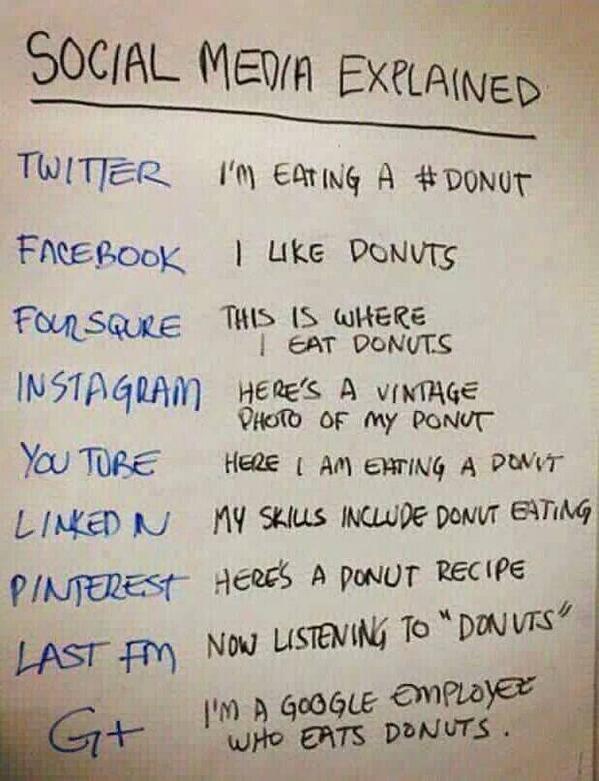
It tells you how out of touch I am that I actually found this useful:

@JamesManning4

h/t: PZ Myers (who notes that the one thing missing is “blog”—tho’ perhaps that’s too old media to include)


Everybody knows the fight was fixed.

25 01 2014

I was never much taken in by the calligraphy Zen master, and thought that if you need to remind yourself “Don’t be evil”, well, you probably weren’t that good.

Yep, that was about right.

The appropriate adage to accompany the lawsuits? Fuck you, pay me.

That, or Go to jail. Go directly to jail.

Or both, both could work.

~~~

h/t: Anna Minard, Slog