This cat
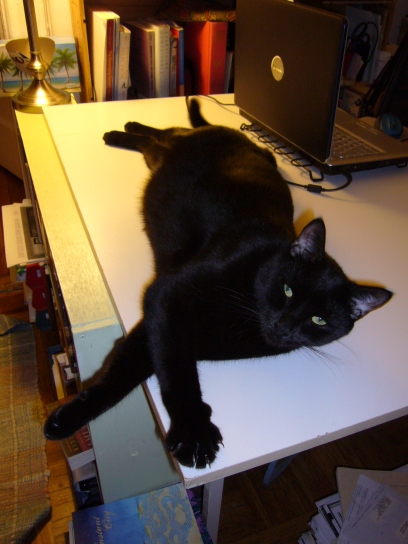
is afraid of this.
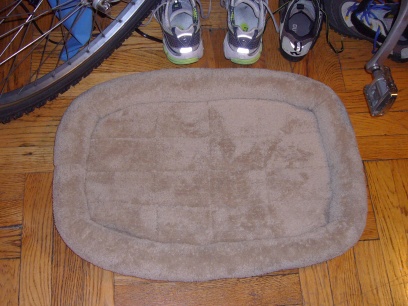
I do not understand.
He clearly likes the soft:

But only the human bed. Not the cat bed.
Strange boy.
This cat
is afraid of this.
I do not understand.
He clearly likes the soft:
But only the human bed. Not the cat bed.
Strange boy.
I’m too broke to be decadent—but if I had the money. . . ?
Well, I’m probably too boring to be decadent: couldn’t be trendy if I tried.
I’ll leave the Douthat-slaps (similar to a dope-slap, but administered with sacred sorrow) to Katha Pollitt (among the many, many, others), and be glad that others have waded through his muck so that I don’t have to.
Do allow me, however, this one obvious point: The reason some of us don’t have children is that some of us don’t want children. At all.
Not: don’t-want-children-because-want-something-else-more, but: don’t want.
The usual disclaimers: I like kids. I’m glad other people want to have kids, and I think our environmental problems have more to do with too much consumption than with too many people (although consumption and people are not, of course, unrelated).
So, yeah: Babies!
Just not for me.
That I can choose not to have babies for the mere reason that I don’t want them is, for any number of fertility-mongerers the real decadence. That is, it’s not that I want to live the Euro-trash life, but that I can choose, and because I can choose, I can choose wrongly.
In other words, it’s a mere hop, skip, & jump from choice to civilizational collapse.
There’s nothing particularly new about this equation—this is a standard reactionary-conservatism trope—but just because it’s old doesn’t make it any more correct or less irritating. I’ll skip the rant on why it’s irritating (it’s late and I’m erasing 10 words for every 5 I write, so, y’know), and, oh hell, I’m just going to bring this back around to me.
I chose not to have kids, but to focus on the choice is to miss the real point, which is that I never wanted kids. The choice depends on the desire, and it was never my desire to have children. I didn’t choose not to have children I wanted; in some sense, I didn’t choose at all, but merely recognized that I lacked what it took to be a good mother—namely, the desire to be a mother at all.
Taking away my choice on that matter would not have changed the desire, nor would incentives have made a difference. Sure, some women forced into motherhood may come to love it, and more social support might make a difference in the number of children one might have, but that still leaves some of us to say Nope, no thanks.
I take motherhood—parenthood—very seriously, and believe that if you’re going to have kids, you oughtta do it right.
Tough to see how you can do it right if you don’t want to do it at all.
Not everything that can be measured matters; not everything that matters can be measured.
This is one of those tropes that I periodically repeat to my students. (It’s possible that I came up with this wording, but given that the sentiment has been around a lot longer than I have, I’d guess that I swiped the line from someone else. [Pause while I search.] Ah, stolen: A variation on Einstein.)
Anyway, it’s a good line, although a bit dangerous for the classroom: My students are already disinclined to take statistics (despite my admonitions to do so), so suggesting that measurement has its limits might lead them to translate this to mean measurement is bunk.
Measurement is not bunk, but there are some phenomenon which cannot be captured by a nifty formula. Money, money can be easily measured, but why it matters beyond its utility is a question which requires knowledge beyond that of currency itself. It’s not that you can’t get responses to the question, but that those responses are so embedded within history and culture and politics and psychology that in order to elicit good responses, the questions must be informed by history and culture and whatnot.
Then there are some phenomenon which are damned near impossible to capture with any precision, in large part because they lack clear definition.
Love is one of those things. The best you can do is to try to identify the elements which you’d want to include in the corral, but even then some of those bits may flee over the fence while others might tunnel in and by gum it’s worse than herding wet angry cats in the presence of puppies and raccoons.
Still, the damned-near-impossibility of drawing any kind of definitive line around love does not mean it does not exist. I admit to my own agita regarding its role (or lack thereof) in my life, but that I can’t see it for myself does not mean it is not a real thing for other people.
Not only is it a real thing, it’s a real and powerful thing, and it drives people in all kinds of directions, including ’round the bend and over the cliff and up a wall. It matters, in other words.
Deidre McCloskey also thinks it matters, and, furthermore, that it ought to matter to economists that they have no good way of comprehending love or incorporating it into their theories.
I am, of course, not an economist, and I get just a bit too much pleasure bashing (in particular freshwater) economists for their oft-ridiculous assumptions regarding rationality and the maximization of utility. Nonetheless, McCloskey has peeled back a lid my fellow political scientists would also prefer kept securely in place:
The great Gary Becker of the University of Chicago, for example, thinks in this fashion, as do his numerous followers. He realizes that love — or as he usually styles it, with embarrassed male scare quotes, “love” — entails more than “caring” in his restricted sense: “If M cares about F, M’s utility would depend on the commodity consumption of F as well as on his own.
” But treating others as “inputs into a self’s utility function,” as Becker puts it, is to treat the others as means, not as ends. Immanuel Kant said two centuries ago in effect that your mother, if she is truly and fully loving, loves you as an end, for your own sweet sake. You may be a rotten kid, an ax-murderer on death row in Texas. You’re not even a high-school graduate. You give her “nothing but grief,” as we say. In all the indirect, derivative ways you are a catastrophe. And yet she goes on loving you, and stands wailing in front of the prison on the night of your execution. Economists need to understand what everyone else already understands, and what the economists themselves understood before they went to graduate school, that such love is of course commonplace. [emph added]
Political scientists don’t do love or humor—that’s another line I toss at my students—which is particularly unfortunate because politics is full of love and humor and every other kind of emotion. To the extent that we ignore the role of love in politics, we miss something crucial about the subject which we, for some reason or another, have decided to study.
~~~~~
One last bit: I was (and to some extent, still am) like Becker in that I put “love” and “caring” in those scary quotes, but Joan Tronto’s Moral Boundaries forced me to reckon with an “ethic of care” as a morally serious (as opposed to frivolous) concept. I’d borrowed the book about a decade ago on a recommendation from a friend, but recently managed to snag a used copy. I’ll write about it when I re-read it.
She’s now at the University of Minnesota. I wonder if I would have been smart enough to have engaged with her when I was there. As McCloskey notes, we unlearn so many things while in grad school.
(h/t: Andrew Sullivan, Daily Dish)
I will not win at Powerball tonight.
The jackpot is over 500 million dollars—over half a billion dollars—and inching even higher as those who usually don’t bother with the lousy odds join the regular assortment of dreamers and fools. And if no one wins tonight? Whoo-dog!
I was thinking of what I’d do with the winnings. This is something I do with disturbing regularity—think about cashing in on big money—so I have a general sense of “save some, spend some, give some away”, as well as a near-certainty that I wouldn’t renew my lease on my current apartment.
The cash payout for the current pot is estimated at 360.2 million, so after paying off my debts and buying myself a nice apartment in Brooklyn (yeah, I like Brooklyn, so why not stay?), I’d have a few bucks left over. Give some money to family, sure. Money to friends? I’d like to do that. And set up a foundation to give money to organizations which are doing good work: Planned Parenthood US & International, Médecins Sans Frontières, Oxfam, groups working in Iraq and Afghanistan, veterans organizations, and if there are any organizations helping kids with the transition out of foster care, I’d like to throw some bucks at them.
What else? Occupy Sandy, Red Hook Initiative, others helping folks recover from Hurricane Sandy. The Audre Lorde Project, a space for queer teens in Manhattan, took a hit and could use the help. And critters could always use a hand.
My alma maters: the Universities of Wisconsin and Minnesota. Money for undergrads at Madison, and for grads at Minnesota, and aid for mental health services for all students at both places.
Which reminds me: Dental care isn’t covered (why not?!) under the Affordable Care Act, and is usually expensive. If you’ve got a chipped or missing front tooth it can be damned difficult to find work, so I’d want some money to go toward any kind of low- or no-cost dental service.
But what do I know about money? I’d have to hire someone help me figure out how to dole out all of this money, as well as to set aside a few mil for myself. I’d like to travel, and maybe buy some property out west, and maybe in Québec. Huh, maybe B and her husband J could help me out with this. . . .
I told you I spent too much time thinking about all of this—all for something which will never, ever happen. It is foolish even to think about, much less spend money on.
You already know the punch line, don’t you? Yeah, I bought two tickets.
I almost turned off the radio.
I’m not a big fan of This American Life as it is—I don’t hate it, but I don’t go out of my way to listen to it, either—but this story, ohhh, I couldn’t stand it:
The Dakota War of 1862, the lead-up to and aftermath which led to decimation of the Dakota nation and dispossession of their lands.
The entire episode is devoted to the war, how it’s taught in Minnesota today, what it means in Minnesota, and by extension, the United States, today. If you don’t know the history, listen to it; if you do know the history, listen to it.
I half-knew the story, and made myself listen all the way to the end because I thought, Goddammit, you can’t turn away. You can’t stop listening just because it’s hard.
I used to have such a strong stomach for atrocity. It sickened and horrified and angered me, but I was driven by the twin senses that if others could live through it, I could at least read what they lived through, as well as the notion that maybe, somehow, such witness could be turned to good use. If attention were paid to genocide and abuse and injustice, such attention might lead to survival and protection and justice.
There’s something to that, I’d guess: The whole world is watching! is meant both to exhilarate and to warn. Amnesty letter-writing campaigns have apparently altered the conditions or lengths of sentences for many political prisoners. Human rights activism from afar can embolden those near, and efforts to get the State Department or the president to express concerns about this person or that group can make a difference.
At some point, however, I lost my stomach for atrocity, and whether as cause or result of my turning away, lost the belief that witness—or, at any rate, my witness—mattered. I turned away.
I can beat myself over this. After all, there’s a self-absorption in turning-away, a kind of thinking that my despair is the point, but, honestly, there was a self-absorption in the attention as well, a kind of thinking that my involvement could lead to justice. Kantian abstractions might appeal on the page, but as a practical matter, motives for even the most altruistic act are often mixed.
No, the problem with the despair is less selfishness than the closing out of possibility: doing nothing leads to nothing. Writing letters or e-mails or making phone calls or even just paying attention might not accomplish anything, but is anything accomplished without action? To act may be to fail, but the possibility of failure is not its certainty.
If I accept that as a general matter, for others, then why not accept that for myself, as well? I may not be a Kantian, but there are worse standards than act as if your will were universal law. Or, to bring it down to this cracked earth, if others can do it, why shouldn’t I?
Can I do anything about the Dakota War of 1862? Almost nothing. But if I think it mattered, if I think it matters today, for who and how we are as an American people, then I can do the one thing that is available to me: I can pay attention.
I can listen.
I hate writing, but I love having written.
I would never say that.
Having written is just fine—there is a satisfaction after finishing a long or difficult piece—but I don’t love it. And even with the satisfactions, there is also a kind of emptiness at the completion. I’m done is an occasion for melancholy and relief.
But writing? Hell yeah, I love writing. It’s even something beyond love: It’s as if I become who I am, that there is no distance between the being and the doing, that everything comes together in a moment of tumbling stillness. I disappear and am more there than I ever am, less a paradox than a transcendence, a clarity of purpose in which the purpose dissolves into itself.
Working out, on the other hand, yeah: I hate working out, but I love having worked out.
No, I don’t really hate working out, but I don’t really like it, either. I put up with it, because I don’t like what happens when I don’t. I want to be fit and reasonably trim and able to take care of myself, and so I work out. But the weightlifting and the bicycling and the stretching and all that?
Eh.
When I was younger I was fairly active, but I have no idea if I liked workouts or not. Maybe I did, or maybe I just didn’t think to ask whether or not I liked working out. I said I liked running, and, honestly, on my best days I still do like running, but did I really mean it? Did I really like lacing up the Brooks or Adidas or Saucony and wriggling into my jog bra and heading out to loop around the track or the neighborhood?
It’s possible, I guess, but this was probably a story I told myself as a way of crowbarring my sorry ass off the couch. I had an image of myself as more-or-less athletic, so I needed to say that I enjoyed partaking of athletic activities. Even if I didn’t.
Well, okay, I did like playing catch or shooting around, and I do enjoy taking bike rides with friends, but hauling myself on to my bike to lap around Prospect Park or over to the gym? Nope. Means to an end.
It’s good that I don’t hate weightlifting or biking, because I do like what they do for me: Nicer arms, stronger legs, increased endurance—and the sense that I’m not just a slug growing in Brooklyn.
But if I could accomplish all of that by napping? Oh, now that’s something I do enjoy.
I’ve mentioned my nuclear nightmares, haven’t I?
I had them fairly regularly as a teen and young adult, and they still pop up occasionally, but for the most part they’ve slipped out of my unconscious and lodge mainly in a side aisle on the fifth floor of memory.
Then Robert Farley at Lawyers, Guns & Money linked to the fascinating NUKEMAP by Alex Wellerstein, and that memory box popped open.
It’s so easy to use! Simply drag the target to your preferred neighborhood or type in a city, select a nuke from a dropdown list, and fire away!
I’m mostly not worried about nukes in New York, but since I do occasionally wonder what would happen if a terrorist exploded one in Manhattan, I decided to detonate a relatively small and crude device (10kt) in the Financial District.
The effects would be felt up to Little Italy and Chinatown and would reach Governor’s Island and Brooklyn Heights, but that’s it.
Not until the bomb reaches 300 kilotons would it hit my neighborhood, and then only with thermal radiation (which, it must be said, could set off a firestorm).
The biggest bomb? A hundred megaton “Tsar Bomba”, the largest Soviet bomb designed (although never tested). That would take out all five boroughs, over half of Long Island, large chunks of New Jersey, and even a bit of Connecticut.
Why mention this, and with such good cheer? Honestly, it’s cool, in a ghastly sort of way.
And it’s so remote. I remember when it wasn’t, when I had a real, hmm, if not fear, then a kind of resignation, that the world would end in a hail of missiles; now, I am no longer resigned to that end (tho’ don’t worry: there are many ways for the world to end!), and the fear is tamed. The nukes are, if not in cages, at least no longer MADly menacing the landscape.
Of course, then I watched the clip of The Day After Farley posted, and my cheer drained away. Guess I’ll have to nuke another city to get my mojo back.

 AbsurdBeats