I don’t want to spend the rest of my days/keeping out of trouble like the soldiers say

19 02 2011

So in the short time I’m a ghost. . . .

Tunisians drive dictator Ben Ali out of office.

Egyptians drive  dictator Mubarak out of office.

Jordan’s king fires cabinet, promises reform.

Yemenis gather to protest their government.

Bahrainis gather to protest their government, and are killed in their sleep.

Libyans gather to protest the leadership of the insane Qaddafi, are mowed down by snipers, and prevented from receiving medical care.

Iran’s pro-Ahmadi legislators get all shouty in their demands for death of opposition figures.

LiveAction doctors video shot at Planned Parenthood, slanders PP as enabling child sex-work.

US House of Representatives votes to defund Planned Parenthood.

US House of Representatives votes to continue Army sponsorship of NASCAR.

Senator Ron Paul wins CPAC presidential straw poll.

Wisconsin governor Scott Walker proposes bill to strip government unions of most of their reason for being, as well as to effectively privatize UW-Madison; the Republican-controlled Senate attempts to slam this though in less than a week.

Wisconsin Senate Democrats abscond from the State, preventing action on the bill.

Tens of thousands of public union members and their supporters gather at the Capitol [nb: an absolutely gorgeous building] in support of their rights and dignity, and in opposition to Governor Walker.

My 50-year old sister and public high school teacher attends her first protest ever. Has a ball, and calls to tell me about it.

Packers win the Super Bowl.

~~~

And because I have been a ghost, I have had no time to say what I wanted to say:

Go Tunisians! Go Egyptians! Go Bahrainis and Yemenis and Libyans and Iranians and Syrians and everyone everywhere who wants to be free and is wiling to sacrifice themselves for that freedom.

You are strong and brave and beautiful and fragile and all the more strong and brave and beautiful for your fragility.

Women of these United States, it is well past time that we took our own lives in our own hands.

I salute Nancy Pelosi and Gwen Moore and Jackie Speier and everyone else, male and female, who stood up for us on the House and Senate floors. But it is not enough.

It is long past time for us, for more of us, for me, to stand up for one another, to stand up for ourselves.

And for my sister, my nieces, my friends, Badgers, countrymen:

On, Wisconsin! On, Wisconsin!
Stand up, Badgers, sing!
“Forward” is our driving spirit,
Loyal voices ring.
On, Wisconsin! On, Wisconsin!
Raise her glowing flame
Stand, Fellows, let us now
Salute her name!

~~~

And the SuperBowl? That’ll do, Pack, that’ll do.


And the walls come tumbling down

20 01 2011

I may have mentioned once or twice or fourteen time before my fascination with ruins.

Well, check out the amazing series of photos displayed over at The Kingston Lounge of buildings of the now-abandoned Riverside Hospital on North Brother Island in the East River.

The site, which is dedicated to “guerrilla preservation and urban archaeology”, also contains shots of the Brooklyn Navy Yard, Creedmore State Hospital, and others, contains both amazing shots and commentary on the history of these sites.

This is the “interior of the coal house, facing east”:

This is beautiful, peaceful even.

This next shot, however, disturbs me:

According to the commentary, the hospital was re-purposed a number of times, the last, as a drug-rehab facility and school; this is from the small auditorium.

Why does this image, out of the many, many displayed on the site, disturb me?

I think it’s the flip side of the fascination: ruins imply both absence and presence, remind us that something was there—that people were there—and now they’re gone. I’ve been in wilderness areas where it is tough to find any sign of human presence; I know I’m not the first person in these places, but it’s also clear that these forests and deserts exist quite outside of us, that they are immune to our existence.

But ruins, ruins are about us. We wouldn’t, couldn’t hang on, we had to abandon what we had claimed; the ruins, standing in rebuke, outlast us.

Okay, okay, they are signs of our mortality—why does this shot dismay?

Perhaps because, unlike those photos of the nurses quarters or examination rooms, this is clearly a place of gathering; its devastation calls out allll gone.

All. Gone.

~~~

Someone on WNYC recently referred to “ruin porn” (this in regard to a book on an abandoned Detroit factory), and I guess I’m guilty of that indulgence.

It moves me, to see what we leave behind.

And, in the end, it soothes me that all we leave behind will, someday, join us in the ground.


When I break down just a little and lose my head

11 01 2011

Deep breath.

I don’t know if this is the first but I do plan for it to be the last time I talk about this.

This is about Jared Loughner. And me. And the one thing that might connect us: neither of us were committed for mental illness.

As mentioned previously, I do not know if Loughner is mentally ill, and I really wish so-called experts would quit diagnosing him over the airwaves. But mentally ill or not, his actions prior to the shooting have led to a fair amount of discussion as to whether he should have or could have been committed.

Here’s where I come in: A half a lifetime ago, I had a commitment hearing. It was not a pleasant experience.

The judge was fine, the court-appointed attorney was fine, even the room in the locked ward of the psychiatric wing of the hospital was fine. And I wasn’t even committed, tho’ I do think I had to agree to stay on the ward and do x, y, and z.

I was deeply angered at having been incarcerated in the psych ward in the first place, and for years afterward felt that the incarceration was both unjustified and unjust.

Hey, I just wanted to kill myself, that’s all, no one else. No big deal.

The details are, pfft, details. There were cops and handcuffs and then at the hospital, restraints (which I managed to pull off*)—all of which sounds ghastly and it was, but it was ordinary, too.

Ordinary in that the cops were decent, as were the hospital staff, and the ward was clean and everyone had their own semi-private rooms and it was probably as good as these truly shitty things get.

It sucked, yes, and it sucked because I needed to be there.

It took me awhile—years—to realize that corralling me into a psych unit was both just and justified.

So, zoom back out: Does this mean I believe that everyone with an untreated or refractory mental illness should be consigned to a psych ward?

No.

But while it might have once been too easy to commit people for too long (for-ever. . .), the problem now is that too many people—both those who want help and those who don’t—have difficulty getting that help.

That’s where the focus should be: on access to good treatment for mental illness. Any discussion about making involuntary commitment end must begin with that concern.

William Galston goes about this the exact wrong way:

The story repeats itself, over and over. A single narrative connects the Unabomber, George Wallace shooter Arthur Bremmer, Reagan shooter John Hinckley, the Virginia Tech shooter—all mentally disturbed loners who needed to be committed and treated against their will. But the law would not permit it.

Starting in the 1970s, civil libertarians worked to eliminate involuntary commitment or, that failing, to raise the standards and burden of proof so high that few individuals would meet it. Important decisions by the Supreme Court and subordinate courts gave individuals new protections, including a constitutional right to refuse psychotropic medication. A few states have tried to push back in constitutionally acceptable ways, but efforts such as California’s Laura’s Law, designed to make it easier to force patients to take medication, have been stymied by civil rights concerns and lack of funding.

We need legal reform to shift the balance in favor of protecting the community, especially against those who are armed and deranged.

Yes, the point of treatment is not the unwell, it’s the rest of us.

Think I’m misreading Galston? Well after arguing for an expanded list of people who should be held legally responsible if they have “credible evidence” of someone’s “mental disturbance” and don’t report it to “both law enforcement and the courts”—not emergency rooms, not health officials—he argues that “A delusional loss of contact with reality” (whatever that is) should be enough to begin the process of commitment.

To be fair, he does say this process should include “multiple starts with multiple offers of voluntary assistance”, which, if one doesn’t volunteer, could end with “involuntary treatment, including commitment if necessary.”

That actually would sound reasonable as a way to try to get help for people, except, of course, that’s not Galston’s real concern:

How many more mass murders and assassinations do we need before we understand that the rights-based hyper-individualism of our laws governing mental illness is endangering the security of our community and the functioning of our democracy?

That’s right: people sleeping on heating grates or hiding out in rooms or basements and unable to care for themselves or anyone else is not the threat to democracy, it’s that “mentally disturbed loners” might take a shot at a president or pop star or member of Congress.

I have absolutely no truck with murder and assassination, and believe that if better care for the mentally ill would lead to fewer violent crimes, that would be wonderful.

We’re not going to get that better care, however, if all that matters is the fear of the well and the punishment of the unwell.

Right now, punishment is the driving approach to mental illness. According to a 2006 Human Rights Watch report,

More than half of all prison and state inmates now report mental health problems, including symptoms of major depression, mania and psychotic disorders, according to a just-released federal Bureau of Justice Statistics (BJS) report, Mental Health Problems of Prison and Jail Inmates.

In 1998, the BJS reported there were an estimated 283,000 prison and jail inmates who suffered from mental health problems. That number is now estimated to be 1.25 million. The rate of reported mental health disorders in the state prison population is five times greater (56.2 percent) than in the general adult population (11 percent).

Women prisoners have an even higher rate of mental health problems than men: almost three quarters (73 percent) of all women in state prison have mental health problems, compared to 55 percent of men.

Galston should be pleased: we’re already locking up a lotta crazy folk! Too bad that they’re not getting treated once they’re in jail.

Prison staff often punish mentally ill offenders for symptoms of their illness, such as being noisy, refusing orders, self mutilating or even attempting suicide. Mentally ill prisoners are thus more likely than others to end up housed in especially harsh conditions, including isolation, that can push them over the edge into acute psychosis.

Would involuntary commitment have helped these prisoners? Again, if one follows Galston, the deranged should be reported to “law enforcement officials and the courts”, not to anyone actually in a position to help them.

And where would all of these people go, if not to jail?

According to Human Rights Watch, the staggering rate or incarceration of the mentally ill is a consequence of under-funded, disorganized and fragmented community mental health services. Many people with mental illness, particularly those who are poor, homeless, or struggling with substance abuse – cannot get mental health treatment. If they commit a crime, even low-level nonviolent offenses, punitive sentencing laws mandate imprisonment.

The new BJS report reveals that state prisoners with mental health problems were twice as likely to have been homeless and twice as likely to have lived in a foster home, agency or institution while growing up as those without mental health problems. Prisoners with mental health problems were also significantly more likely to have reported being physically or sexually abused in the past, to have had family members who had substance abuse problems, and to have a family member who had been incarcerated in the past. An estimated 42 percent of state inmates had both a mental health problem and substance dependence or abuse.

(See also: here, here, and here, or just run a search on “mentally ill prisoners”.)

I don’t think this is working. It’s just possible, in fact, that if there were better patient-centered options—options which could include involuntary treatment—that fewer mentally ill people would end up in jail. Good for them, good for us.

We can’t just jump ahead to involuntary treatment and commitment, however, before building up the infrastructure for all treatment, voluntary and not. It wasn’t until 2008 that the Paul Wellstone and Pete Domenici Mental Health Parity and Addiction Equity Act was signed into law, and even with that law, treatment for mental illness may legally go uncovered.

So let’s make treatment possible. Let’s make sure the vulnerable have a place to go where they can actually get help before we call on cops and judges. Only after we make sure treatment is actually available does it make sense to talk about laws to draft the resistant into that treatment.

There’s nothing easy about any of this, not least because some mental illness are just damned hard to treat, but if commitment is to be both justified and just, then it makes sense that in our rights-based hyper-individualist society that we actually pay attention to the individual at the center of the debate.

*This is why you should always wear a watch: if anyone tries to tie your wrists together or to something (like, say, the rail of a hospital bed), you can use the extra space provided by the watch to wrench and wriggle your wrist free.

~~~

Coda: I got lucky—although it sure as hell didn’t feel like it at the time—because I got care.

A person shouldn’t need luck to get care.

h/t The Daily Dish


Put down that weapon

10 01 2011

I don’t know Jared Loughner.

I don’t know his politics. I don’t know his mental state. I don’t know his background, his personality, his history of drug or alcohol use, or his genetic profile.

I don’t even know that he killed six people and shot twelve others, although, given the evidence reported thus far, it appears likely.

It appears likely that Jared Loughner is an assassin.

But that’s just one piece of this murderous political puzzle, isn’t it? Some have examined his online postings and concluded that he was widely read or maybe just trying to impress people with works he couldn’t understand; one woman Tweeted that when she knew him he was left-wing; some speculate on the influence of the anti-semitic American Renaissance or conspiracist David Wynn Miller; Andrew Sprung labels him a “sui generis make-your-own reality psychotic”.

Many others have noticed have noticed that this occurred in a poisonous political atmosphere, wherein Senate candidates talk about “Second Amendment remedies” and elected members of Congress call President Obama an “enemy of humanity”.

And the half-guv, of course, has her part to play, both in refudiating any role her noxious metaphors may have contributed to that atmosphere, and to serve as a rally point for those who insist that no one even consider politicizing these killings.

Sticks and stones may break my bones/but words may never hurt me.

What rot, for in what other media do we perform politics but in words? Of course words matter!

You don’t need to delve into the ontological dimensions of the speech-act to grasp that this is the primary way we relate to one another—that our language itself is a marker of our species. We are not only linguistic creatures, but we would not be who we are without language. And we would not have politics without language, without words.

Of course words matter.

That’s not all that matters. Loughner was able to purchase a semi-automatic weapon (which would have been illegal under a law which expired in 2004)  and carry it on his person, concealed, with no permit whatsoever.

Guns don’t kill people; people kill people.

True—in this case, Jared Loughner used a semi-automatic gun to kill six people.

Don’t suppose we should politicize casual access to deadly weaponry, either.

But Loughner was nuts, right? Suspended from school, scaring the hell out of his college classmates, a sui generis psychotic—can’t blame rhetoric and guns on this crazy man, could we?

I’m not trained in either psychology or psychiatry, and if I were, I hope I’d be disciplined enough not to diagnose someone I only read about in a newspaper. But I do have my own history of mental illness, and I do know how what I once called a “bad brew” of chemistry and history lead to acts of self-destruction great and small. I never tried to hurt anyone else, but it was very important to me that I hurt myself. And no, I didn’t consider myself crazy.

It made sense to me not only that I would kill myself, but that I should kill myself.

This decades-long belief didn’t come from nowhere: it came from the reactions of people around me to my erratic behavior, from romantic notions of the successful suicide, from my own constant intake of movies and books and television shows about depression and suicide, from The Thorn Birds (long story), and, of course, from my own depression and personality.

I was the one making the attempts, and I was the one who worked out the rather elaborate moral justification for my suicide, but I got help from the society around me.

No, society didn’t know it was helping me—I don’t blame society for my troubles—but it gave me the pieces I needed to construct a an overwhelming and destructive narrative of my life. It all made so much sense, then.

I don’t know what, if anything, makes sense to Jared Loughner. All I have are a very few inadequate pieces—violent rhetoric, weapon, possible mental illness—but enough to know that, even if this wasn’t a conspiracy, it certainly wasn’t sui generis, either.

h/t Daily Dish, Huffington Post, New York Times


Nothing changes on New Year’s day

3 01 2011

I don’t really do New Year’s resolutions. I mean, it’s not like I’m actually going to follow through or anything.

Nevertheless.

My life has been bumping rather than rolling along, and thus it behooves me to think, Hm, why might this be? And what could I do to smooth it out a wee?

So, plans, considerations—resolutions, if you will.

1. I will do dishes at least every other day.

When I live with other people, I’m pretty good about not leaving common areas (e.g., the kitchen sink) clogged up with my gunk, but, alone, well. . . hey, those dishes are all mine, and they’re rinsed, and, you know, I just ate cereal out of that bowl or drank water out of that glass. . . did I mention I rinsed?

Please.

I’m an adult, and not much of a cook, so it’s not as if I create a blizzard of dishes—which, actually, might be the problem. It’s really easy to let things go if it’s only a plate or a bowl and a few pieces of silverware. . . .

Regardless, this is a basic way to take care, so why not just take care. It’s not as if spending 10 minutes making dishes clean every two days is that onerous, anyway.

2. I will leave my apartment every day.

This is not an issue when I am fully or overemployed, but in my underemployment, I find it very easy to hunker down and fade away. The gym membership helps, but as I have no expectation of spending 7 days a week at the gym, I need to haul my own sorry ass out of the building and around the block or over to the park or wherever until I do hitch a  new ride in the job-o-sphere. (And if I manage to find a job wherein I work from home? Even more important to get the hell out.)

I have made this commitment before, but what the hell, it’s a good one, and worth trying again.

3. At least 5 days a week I will do one thing I don’t want to do but which needs doing.

This isn’t about the cleaning the cat box, which I don’t like doing but needs doing and already do, anyway; no, this is about going through files or organizing this or tossing that—clearing away the (metaphorical) cobwebs, if you will.

Again, I’ve tried doing something like this previously (if I could find the post about lists I’d link to it, but you’ll just have to trust me: I’ve written on this before) and have failed, but, again, it’s worth another shot.

4. I will open my mail as soon I get it.

I don’t this, and that’s bad.

I have hang-ups about mail (postal and electronic) and no, I don’t want to talk about it, but, well, there it is.

I am most likely to fail at this one first.

5. I will sit, and breathe, and try not to distract myself, for a little while every day.

Or this one—I might fail this one first.

~~~

There are so, so many things in my life which need changing, but many of those are big, or seem big, or are in any case currently beyond my will and/or ability to deal with. So I’m starting small.

Now, of course, if I fail at the small what are the chances I’ll tackle the big? Oh! Oh! I can answer this! Nil! Because I’m already failing at the small!

In other words, I gots nothing to lose.

~~~

I am unhappy with my self and my life. No, I’m not awful, but I’m not who I want to be, either.

Not that I know who I want to be, but I do know some of the pieces that I would like included in present and future versions of myself.

I’d like to pay better attention.

I’d like to be a better friend, to show up for people, in ways that matter to them.

I’d like to take more chances. On everything. And maybe, just maybe, if not on everyone, then on at least some-ones.

I’d like to learn something other than defense.

I’d like to stop making excuses.

Oh, and I’d like to be taller, please.

~~~

The list is not unreasonable (for the most part. . . ), but even now, I hesitate.Who cares about these things? Who cares that you want to do these things? What kind of pie-in-the-sky crap is this, anyway?

I don’t want to silence my inner critic—who would I talk to?—but it would be nice if I could get her to remember that a true critic doesn’t just chastise. Sometimes, sometimes, the critic applauds.

Or at least puts down her pen long enough to give a nod.

Yeah, a nod. I could live with that.


I’d like to stay and taste my first champagne

30 12 2010

The hills are quiet.

Agathe von Trapp, eldest daughter of George Ritter von Trapp, stepdaughter to Maria Augusta Kutschera, older sister to 9 siblings, companion to  Mary Louise Kane, died Tuesday at the age of 97.

Her alter ego, of course, was Liesl, memorably played by Charmian Carr from the 1965 version of The Sound of Music.

Here’s her signature scene from the movie (skip ahead to the :30 mark)

I never liked Rolf, even before I knew what Nazis were—he was a smug prig. And, of course, a Nazi. (I don’t even much like this scene—those lyrics!—but it would be a cheat not to show this.)

Agathe was not Liesl, and The Sound of Music was not a documentary; it also just possible that life was not as idyllic for the von Trapp children as was suggested by the movie.

I don’t care.

I love The Sound of Music. Love love love.

I saw it for the first time when I was around 6; it was playing at a cinema in Sheboygan, and my mom and grandma took my sister and me to see it. I was opposed going in—a musical? where they’ll be singing the whole time? how awful!—but boy oh boy was I a convert coming out.

Mountains! Singing! Adventure! A lake in the backyard! Julie Andrews! Bad guys! Escape from bad guys! Mountains!

Really, what’s not to love?

What cemented this adoration, however, was my role in my high school’s production of the musical. K. was Maria, M. was the Baroness, and I (eek!), I got my first speaking role as Brigitta, the daughter who makes her entrance reading a book.

(This matters because one night F. (Liesl) and T. (Louisa) and I went out for a little pre-rehearsal nip. By the time we made it to the auditorium, we we all roaring drunk—F., the driver, the drunkest of all. I was lucky in not having to march and march and march and hold the line, but even when I did finally make my entrance and take my place in line, I had difficulty (as did F. and T.) remaining erect. Some time later (and while rehearsing a different scene) F. was ordered off the stage by the D.-the-director, and when she refused to leave—screaming “I”m not drunk!”—D. high-heeled her way up to the stage and threw her off. T. and I thought it best to leave the auditorium at this point.)

I had a ball in this play, and not just because of the drinking. Play rehearsal was 6-10 MTTh, and after school until 6 on Wednesdays; as the opening approached, we had Friday night and Saturday rehearsals as well. All that time together, on stage and down front and in the green room and the wings and hallways and on the catwalk and in the way back of the auditorium, it was cozy and liberating all at the same time. The whole place was ours.

M. and I were already friends, but K. and I became quite close, as I did with F. and T. Since all of them were older than me, we didn’t have much to do with one another during the school-day, but the intimacy of the shared work remained. Almost all of us in the cast were theatre kids, weird, slightly disreputable (well, except for K., who was unimpeachable), and if we didn’t swagger like jocks, we did delight in our performing selves.

It was a wonderful time. Not perfect (see: F. getting tossed from the stage), and not without the drama of both adolescence and the high school theatre scene, but oh, we were all so alive, so willing to give ourselves wholly over to this production, and to one another.

I can’t live like that, not all the time, and maybe, now, not at all. But I’m glad I was there, I’m glad that it’s all still with me.

So Agathe, even though The Sound of Music was only barely your story, still, thank you, and rest in peace.


Oh, the weather outside is frightful

27 12 2010

An honest-to-goddess snow storm—whoo hoo!

Last year, if you recall, New York shut itself down preemptively, announcing on Tuesday before a single damned flake fell that the entire world would be closed on Wednesday. Hmpf.

Well, there were a few reports on maybe Saturday or Sunday of a possible blizzard, but it didn’t seem like that big of a deal. Maybe because it was over the Christmas weekend, maybe because kids wouldn’t be in school anyway, maybe I just wasn’t paying attention, but there was little hysteria.

There was, however, snow, blowing, blowing snow.

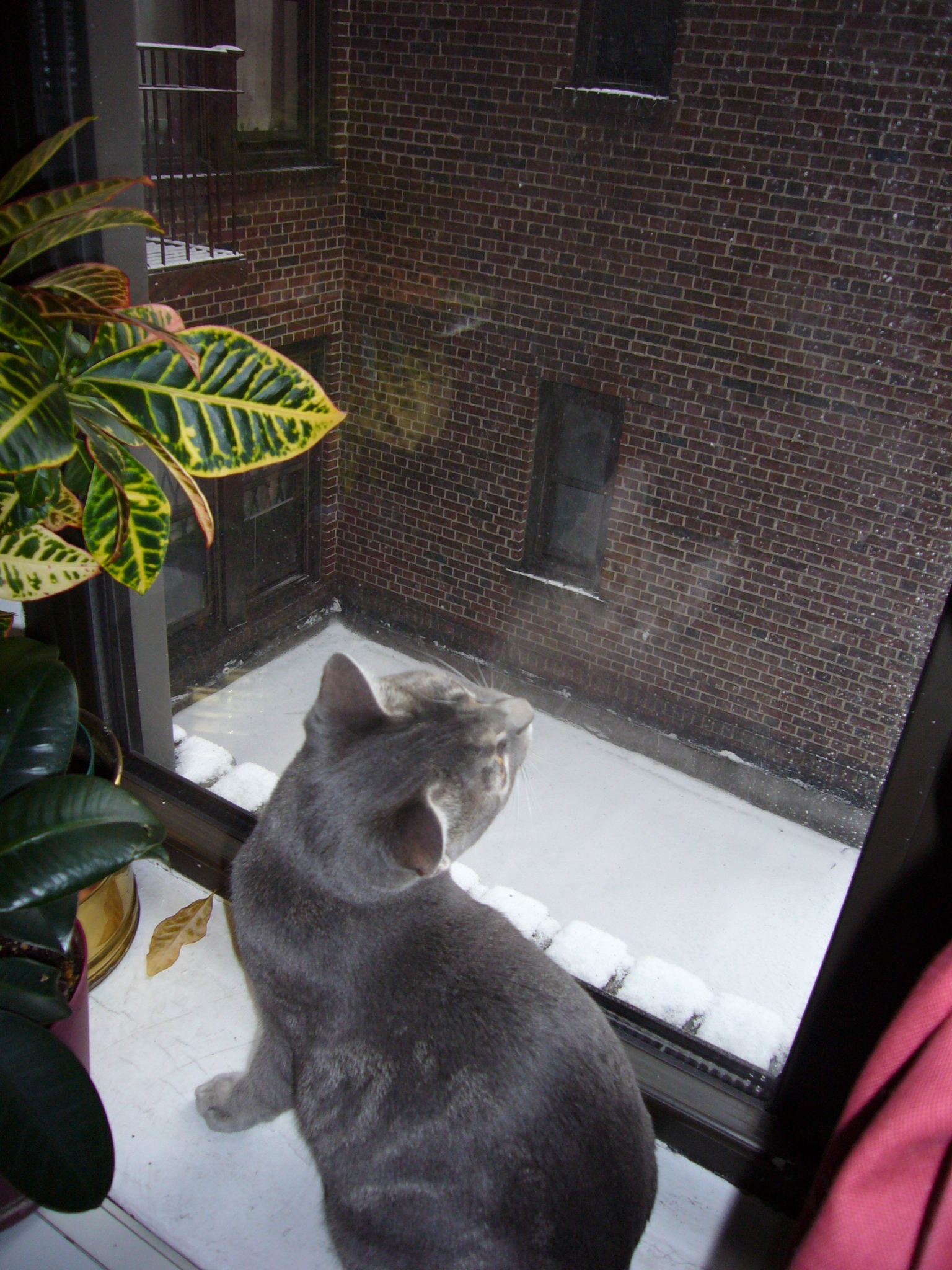
Trickster was either fascinated or flipped out by the initial sputterings from the sky:

After awhile, however, she got bored, and did what she usually does: sleep.

Jasper yelped in response to the howling wind, and stretched out his body full-length trying to whap at the snow (by the time I got the camera out he was, of course, nowhere in sight). He did, however, helpfully interfere in my attempt to get a shot of the wind-sculpted drift in the corner:

Thanks, kitty-boy.

The wind was quite the artist, turning what would have been gently heaps of snow into mini-alpine ridges:

I generally try to get out after a big storm—not too many chances to wear my snow boots!—but a hangover from the flu made it unwise for me to attempt anything more physical than, mm, blogging.

(Oh, I did also try to enter my grades, due today, on Webgrade, but either something was wrong with my username and password or something was wrong with the system, and so I failed. The appropriate response, regardless? Fuck me.)

Anyway, I have heat and hot water and am not stuck in an airport or at Penn Station or on a train—apparently a couple of Queens lines, complete with passengers, were bollixed for hours—so despite the flu-crud, I was content to remain in my wee apartment and look at the big ol’ windy and wintry world through my windows.


Don’t you ever get sick of being sick about it

20 12 2010

How may I be irritated? Let me count the ways:

*Irritation due to disagreement: This may be further divided into partisan (of any sort), preference-based, and personal disagreement, but it is just as likely that all three motivations may be at play (albeit at different levels of intensity). In any case, such irritation is usually merely irritating, i.e., uninteresting and unproductive—you say potayto, I say potahto—but can be dispelled if turned into a game.

*Irritation due to stupid arguments: The  person making the argument either isn’t trying or doesn’t understand or is so riven with emotion that she is un-able/-willing to put together a coherent argument.  Non-sequiturs, ad hominem attacks, and utter illogic abound in stupid arguments, which is what makes them simultaneously irritating and difficult to counter. Irritation may be expiated either by pounding the argument into oblivion or dissipated by walking away; while the former is more immediately satisfying, sometimes the latter is the only recourse.

*Irritation due to bad arguments: Similar to that caused by stupid arguments, this is a case in which there is at least a semblance of logic structuring the argument, but said structure is riddled with inconsistencies and bad evidence. The best antidote is continued conversation, which is possible if interlocutor is a reasonable person who is willing to repair his argument; at other times, one may have to find satisfaction in mending the argument yourself.

*Irritation due to bad-faith arguments: Again, similar to both stupid and bad arguments, but with the important proviso that the person knows her argument is shit and/or that she is fucking with the data, and doesn’t care. This is bad form in purely intellectual debates and deserves to be called out, but to be expected in political debates, where the point is to win. In the latter case especially it is important to keep one’s irritation in check (so as not to lose one’s head and thus the argument), but in the former case, one can channel the irritation into a kind of bemusement, and counter with one’s own ‘whimsical’ bad-faith argument (possible only if one hasn’t drunk too much).

*Irritation due to inconsistency/hypocrisy: Easy to spot in others, less easy to admit to in oneself, and damned well impossible to avoid if you spend any time at all thinking or doing. A fun charge with which to whack an opponent over the head, but rarely should too much be hung upon this, especially if it occurs on its own or as part of a stupid argument; point it out (or not), laugh if off, and let it go. On the other hand, if coupled with a bad or bad-faith argument, inconsistency and hypocrisy can heighten your overall irritation, and will likely have to be dealt with as one would deal with that caused by those bad[-faith] arguments.

*Irritation due to tone: The tone is usually either snide or condescending, or some variation thereof, and indicative of a sense of either inferiority or superiority. The best counter to this is absolute (even if feigned) sincerity in response, although the more likely response is either to adopt a similar tone or to escalate the snottiness. Such encounters rarely end well.

*Irritation due to crabbiness: This is self-generated, such that one is either looking for or finds trouble just because; can amplify other forms of irritation.

*Irritation due to material reality: Actually, just irritation due to physical discomfort, but this sounds so much more elevated, doesn’t it? Anyway, this may (but does not always) account for crabbiness, and  can be countered by band-aids, medicinal cremes, relevant medications, a lie-down, sleep, ice, a heating pad, and/or food.

*Update: Oh, and I forgot: Irritation due to peeve. Similar to crabbiness, but more durable, this re-/occurs when confronted with whatever niggle happens to set you off, e.g., “irregardless”, stuck zippers, indestructible plastic packaging, bad parking, etc. Little can be done about this, beyond chanting “breathe” to oneself and trying to let it go.

~~~

All of this was prompted by my irritation with both Andrew Sullivan and Dave Weigel. Both of these men are conservatives (each in his own way), so I wondered if my irritation was due simply to disagreement, i.e., because they’re conservative and I’m not, or due to something more substantive.

I think it’s mainly down to disagreement. I may not like how the argument is shaped or think that the conclusion is foregone due to Sullivan’s or Weigel’s predispositions, but the arguments themselves may be legit. Yeah, sometimes I think the tone (Sullivan!) is off or the evidence (Weigel!) thin, but these guys (well, Sully more than Weigel) offer thoughts worth considering.

On the other hand, I’ve pretty much stopped reading Will Saletan because, while I may agree with at least some of what he writes, I think he’s often condescending, and too often musters incomplete or shitty evidence and deploys rhetorical tricks in place of reason. I couldn’t read him without getting irritated—so I stopped reading him.

I try not to stop reading people/arguments/magazines/web sites solely because I disagree—that seems weasely. I hold the views I do because they comport with my principles, but, epistemological nihilist that I am, I can claim neither that the principles themselves are grounded in absolute truth nor that they lead necessarily and ineluctably to my views. As such, if I truly do want to understand a phenomenon, then I have to approach it from all sides.

However irritating that may be.


Cash money, ain’t got no use for you

18 12 2010

No no no no no no NO! No. No no no. NO!

In terms of public safety and national security, the sooner the world moves to a digital cashless economy, the better.

So says Professor Jonathan Lipow. To which I respond, well, you read my first line.

Consider the opening graf:

THE 500-euro note is sometimes called the “Bin Laden” — after all, Europeans may never see the 500 euro, but they know it is out there somewhere. Unfortunately, Al Qaeda’s leader and the 500-euro bill are connected in another way: high-denomination bills make it a lot easier for terrorists to operate.

Got it? A joke about a name actually reveals a deeper reality!

Although, exactly how high-denomination currencies make it easier for terrorists isn’t really explained so much as it is “analogized”:

Organized crime has always been a cash industry. In 1969, the Treasury stopped issuing $500, $1,000, $5,000 and $10,000 bills specifically to impede crime syndicates — the only entities that were still using such large bills after the introduction of electronic money transfers.

It is up to the reader to suss out the reason for big bills: My guess is that it’s a lot easier to store a load of cash if that load is a pallet-full rather than a room-full.

In any case, while it is clear that terrorists and other assorted bad guys [and presumably a few bad broads] prefer cash to credit because, as Lipow helpfully points out, one can collect and dispense cash without showing any ID whatsoever(!!!!) it is not at all clear that bin Laden and his henchmen [what a great word, by the way, henchmen: it even sounds sinister] are actually using those 500-euro notes.

But no matter: the point about the mob was just to reinforce that bad guys and dolls use cash, and that the government can make it harder for those bad guys (and dolls) to use lots and lots of cash.

(Did such actions lead to a lessening of organized crime? Well, no, since Lipow himself notes that drug traffickers pile up the cash, only now in $100 denominations. But that’s another column, right?)

(And for another aside: We should be grateful that after distribution about $19 billion in cash in Iraq and Afghanistan,

the military has gradually realized that the anonymity of cash makes it easy for terrorists and insurgents to smuggle in money and make purchases without a trace.

So the Treasure figured out in 1969 that cash was king among the kingpins, but it took the military 40 years to figure this out? Or is that, too, another column?)

Anyway. Lipow then tells us the solution to all these terroristic and trafficking woes is to move from actual to virtual cash, not just cell-phone based but, preferably, “smart cards with biometric security features.” He offers the charming example of the Universal Electronic Payments System:

In South Africa, the technology company Net1 now distributes social welfare grants to almost four million people. It’s simple: with a battery-operated, point-of-sale device akin to a credit-card terminal, money is transferred from one person’s card to another; during the process, the cards download and record each other’s transaction records.

Every few days, employees from the payments system head out to the villages and make their own money transfers, downloading the transaction histories of the cards they come into contact with, which contain the histories of the cards they interacted with, and so on. That data is then downloaded into the company’s mainframe, as a way of monitoring the flow of funds across the cards.

Best of all, the system can function offline and off the power grid, providing a secure means of payment under all conditions and without any geographic limitations. And the incremental cost of executing a transaction via this system is essentially zero. It is a promising model for the global economy.

It’ll be cheap, easy, and fun!

No, what’s important about this system is not any benefit provided to consumers, but that the crooks, absent the ability to accumulate funds off the books, would find their transactions open to audits:

In a cashless economy, insurgents’ and terrorists’ electronic payments would generate audit trails that could be screened by data mining software; every payment and transfer would yield a treasure trove of information about their agents, their locations and their intentions. This would pose similar challenges for criminals.

Because in a cashless economy, there’s no way—no way—these criminals could dodge a (gasp!) audit, amirite? And since electronic systems are by definition impenetrable, there’s also no way that these same criminals could smash their way through or tunnel their way under these virtual walls to hide, steal, or otherwise mess with these currency bytes, right? Right?

I’m snarking on Lipow, perhaps undeservedly—after all, I’m hardly a fan of either Al Qaeda or organized crime—but he hijacks the wheels (and grease) of the economy in service to the omnipresent national security state without a consideration for all of the other licit purposes of real-world currency, or any inconveniences (or worse) to people of that same world without cold, hard, cash.

Following Lipow’s example, I won’t bother actually to spell out all those inconveniences (Matthew Yglesias provides some possibilities in the link, above), but let’s consider some of those “or worse” scenarios.

  • You don’t have enough money to open a bank account, or enough of a steady infusion of funds to overcome any of the fees associated with low-money accounts. As a result, you are shut out of the economy.
  • You lose your e-cash-card (loss, theft, catastrophe) and have no way to access your account. No one can lend you money to tide you over, because the problem is not the lack of money, but lack of access to the money.
  • You are in an abusive relationship and need funds to get away. Abuser is able to track you through your purchases, or in some way interfere with your ability to access your funds.
  • The government doesn’t like you and slams down a gate between you and your money. (Think this can’t happen? Consider what happened to Muslim charities designated in some way as “terrorist”: their funds were frozen; search “muslim charities funds frozen” for examples. Or asset forfeiture when the cops think you’ve committed a crime; see here and here, among others).
  • The government doesn’t like you and pressures financial institutions to block your access to funds; see WikiLeaks.

The thread running through these possibilities? The loss of access, which can inhibit not just your purchases, but your purchase on the economy, your mobility, and your ability to engage in disfavored political activity.

Admittedly, the last three examples  could be used against me just as I used the only-partial-effectiveness of Treasury Dept. actions to halt crime against Lipow, to wit: these things are already happening in the cash-ready world. Unlike, Lipow, however, I don’t argue that this means we should get rid of all e-money and rely solely on cash.

The virtual economy is useful, which is one of the reason that so many of us have moved happily into it, i.e., we were neither suckered nor coerced into doing so. Common currency was developed, as Adam Smith pointed out, as a convenience to both buyer and seller (as well as a way for sovereigns to accrue and maintain creditable wealth), and while some might have grumbled at the loss of commodity-barter, it is likely that most others liked the fungibility and—wait for it—accessibility of currency.

In other words, currency gave its holder options.

This mix of actual and virtual money seems to me to offer money-holders a reasonable array of options. Don’t like holding cash? Go with the debit or credit card. Prefer shopping online? Ditto. Like being able to fish a buck or two out of your pocket to buy a slice of pizza or to toss into a busker’s guitar lid? Cash. Don’t want a store (or another household member)  to track your spending—or know it was you who bought something embarrassing? Ditto. Want the convenience of the card as well as the ability to buy and sell anonymously? Duh, both.

You can do variously nefarious things with cash, of course, as well as have variously nefarious things done to you, but so, too, with electronic monies. And I wouldn’t be surprised if it were more likely for you to be victimized electronically than, um, cash-ically—but I won’t push it.

So we make our choices—sometimes after much thought, sometimes with no thought at all—and do what we can.

I disdain the glib security-versus-liberty equations, not least because they are not necessarily opposites, and don’t necessarily have anything to do with one another; this particular “versus” implies a death-match which doesn’t necessarily exist.

“Necessarily” is the key term: Sometimes they are in relation to one another, and sometimes one does have to choose more risk in exchange for more freedom, and less freedom in exchange for less risk (although, even here, I question whether trading away one’s freedom will result in greater security—but I’ll leave that for another day).

Lipow, however, commits the opposite error: he doesn’t even consider that his quest for security could have any effect on liberty, large or small; in his eagerness to close off the options of criminals, he doesn’t much consider the effects on the options of the rest of us.

“Money’s destiny is to become digital,” he quotes an OECD report. But he and the report’s authors forget that money doesn’t have a destiny.

It has a use.

Which means we should, theoretically, have some say in how it is used.


Every man, every man for himself

16 12 2010

I grew up with nuclear dreams.

Nightmares, actually: Watching as the bombs rained down, fleeing from bombs, living after the bombs fell, wondering how long before we were all gone.

I know that in real life that ‘bombs’ are unlikely—in most places, a single bomb would be enough—but these were nightmares, not journal articles. In real life, I studied nuclear history, nuclear weapons, nuclear tactics. I learned about throw-weights and multiple independently targetable reentry vehicle (MIRV) and ICBMs and SLBMs, tactical ‘backpack’ nukes, yields, and blast radii. I was drawn and horrified, thrilled and terrified at the technologies and policies that could end it all.

I was also convinced that any attempt to survive nuclear war was foolish, a waste of money, and, most damningly, likely to lower the threshold of MADness. Since deterrence was found in this balance of terror, any attempt to diminish that terror with songs of survivability was, itself, mad.

As regards all-out nuclear war, I think that assessment holds.

But what of smaller-scale nuclear war, of terrorist tactical nukes? The world won’t end if one or two or three bombs are exploded (see: the world after the Trinity test, Hiroshima, Nagasaki, and the numerous test explosions since 1945), so why not try to increase survivability?

Somewhat to my surprise, then, I am not opposed to federal guides on how to live after a nuclear explosion.

The New York Times notes that the Obama administration, following steps taken by the Bush administration, is distributing information on how to survive a nuclear bomb. This information is based on models which, unexpectedly, showed that casualties could be greatly reduced simply by taking shelter immediately after the blast, thereby reducing exposure to radioactive fallout.

Physicist Brooke Buddemeier spoke at a recent conference:

If people in Los Angeles a mile or more from ground zero of an attack took no shelter, Mr. Buddemeier said, there would be 285,000 casualties from fallout in that region.

Taking shelter in a place with minimal protection, like a car, would cut that figure to 125,000 deaths or injuries, he said. A shallow basement would further reduce it to 45,000 casualties. And the core of a big office building or an underground garage would provide the best shelter of all.

“We’d have no significant exposures,” Mr. Buddemeier told the conference, and thus virtually no casualties from fallout.

This is not nothing.

Government at all levels in the US is unreliable: it may come through in prevention before and care after, but, then again, maybe not. And, as these guides note, even a fully enabled government may not be able to respond immediately after.

For better and for worse, the government is telling us, we’re on our own. For better and for worse, we have to take care of ourselves.