You’ve got to. . .cry without weeping

4 05 2009

I hate crying.

I don’t do it very often, which means that when I do cry, I don’t do it well.

It doesn’t make me feel better, I don’t feel cleansed, released, relieved, or in any way unburdened.

When I’m crying, there’s always a part of me saying, Well, shit, I’m crying, and I hate crying.

I have cried more the past 6 days than I have the past 6 years, maybe the past 16 years. I cried on the bus, on the train, walking down the street, at my desk, on my bed, in the shower, at the stove, while washing dishes, making coffee, and retrieving milk from the refrigerator.

Have I mentioned how I feel about crying?

I don’t know what to do with tears, not least because I don’t know what to do with what causes tears. I’m no good with sadness.

Depression, despair, anxiety, numbness, unhappiness, disgruntlement, dissatisfaction—got all those down. But sadness? A specific reaction to a specific event which cannot in any way be fixed? Nope.

In many ways, I’ve been lucky. My parents and siblings and their kids are all alive and well, as are all close friends, past and present. Yes, I’ve had pets who were taken away or who’ve died, but it’s been a very long time since I’ve had to deal with something other than a self-inflicted loss.

I’ve certainly inflicted loss, on myself and others. I’ve left jobs and friends and cities, and am number one with the romantic-relationship-ending bullet. One former friend, who a couple of years ago decided to punish me for my alleged misbehavior (a misunderstanding) told me not to contact him, not even to try to clear up the misunderstanding, that he would contact me when he was good and ready. Fine. The letter he eventually sent still hasn’t been opened, the e-mail, unread.

Shut it down and walk away. Bloodless.

It’s not that I don’t recognize the downsides of being a cold bitch, and most of the time, I’m just a regular bitch. But I’m comfortable with the distances of bitchiness, even as I sometimes think that distance itself is not always the most comforting. This is what I’ve chosen. Consequences.

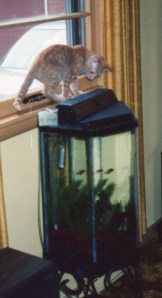
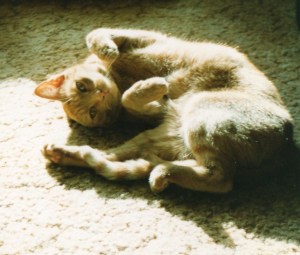
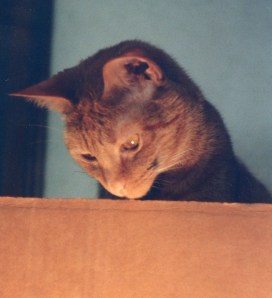
But now this, the mercy-killing of a cat who’s been with me almost all of my adult life. She leapt over my boundaries and into my lap even when I protested that I was reading or typing or just not in the mood. She didn’t care about my moods. She wanted to be scratched and held and at the center of my attention.

On cold nights she’d step over the blankets to sit on the sheet to the side of the pillow, and wait for me to lift the covers and let her in. And when I didn’t immediately do so, she’d paw at the covers, and if I still didn’t respond, she’d put her paw with her claws ever-so-slightly extended on my nose and remind me that if I knew what was good for me, I’d lift the fucking covers RIGHT NOW and let her in. Which I always did.

I’d bitch, but I’d always let her in.

And now she’s gone and I look at the box for the multi-cat litter and tear up, thinking, I only have one cat now. I open the fridge and look down at the floor, next to the heating pipe where she used to lay, and she’s not there. I lay in bed with Fat Cat on one side of me and the other side empty.

I used to wake up and pull both cats close and whisper ‘It’s good to wake up with two kitties next to me.’

No more.

So this is loss and it makes me sad and there’s nothing I can do about it except live with it.


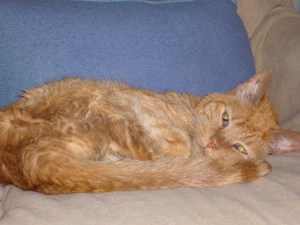
The lion sleeps tonight

2 05 2009

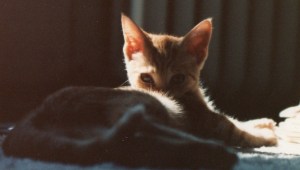
Skinny Cat is gone.

1991-2009

1991-2009

She—Chelsea, a.k.a. Sweet Pea—was a good cat.

I will miss her; I already miss her.


While I was watching/you did a slow dissolve

30 04 2009

Skinny Cat is dying. Kidney disease.

She’s home, now. I had to bring her home.

She’s not in any pain, the vet said. She’s not suffering.

Still, he said

I know. This is not unexpected. But I was not prepared, not today.

I wanted her home, for a little while longer.

Just a little while longer.


Is time long or is it wide?

29 04 2009

Skinny Cat is in the hospital.

She’d been having weight problems, but seemed to be getting better, i.e., gaining weight. I was sure of it.

Over the past couple of days, however, her behavior changed: While she continued to eat, she basically stopped moving except to get to the food dish and the litter box. She stopped climbing on to the chairs, stopped climbing into bed, stopped coming into the bedroom in the morning yelling at me to get my ass in gear and feed her the canned food.

So I spent the morning looking up and calling around to vets, finally finding one I could get to by bus and who would see her today.

The first thing he said, upon examining her and finding out how old she is—18—was, ‘You have some decisions to make.’

I find out tomorrow what kind of decisions they will be.


This is the last day of our acquaintance

27 04 2009

The whole world ending is only an abstractly-sad prospect. A particular person’s world collapsing is acutely so.

Jon Katz at Bedlam Farm has been chronicling the last days of a dairy farm, noting that he had been hoping to persuade the farmer, Jon Clark, to allow himself to be photographed.

Go, look at the photo of Jon Clark, posted at 9:02pm, April 26, and the other shots of the barn and the cows and the emptiness which follows after a man’s life has been tugged away from him.

I grew up in a small town in a dairy farming area. When I was a little girl I wanted so much to live on a farm. I loved animals and the whole idea of haylofts and horses and running through rows of corn.  Then I got older, and my loves shifted to theatre and partying and, oh yes, sleep. Still, when my high school friend K. asked if I wanted to help her with the evening milking at her family’s farm, I said sure. Hey, it’s all automated now, isn’t it?

Ha. Yes, there are milking machines, but each one has to be hooked up to each cow, and each teat has to washed before or after (or maybe both—I don’t remember) to prevent mastistis. Anyway, once you’ve managed to slip the suction cones over each teat, you have to plug the tube running from the cones into the overhead pipe, where the milk is sent streaming down the length of the barn to the milk-collection room. Given my vertical disadvantage, this was a challenge.

Hell, given my clumsiness, the whole operation was a challenge. K.’s family had, I don’t know, a hundred? a few hundred? cows, and the twice-a-day milkings each took a couple of hours (even when they weren’t, um, helped by the likes of me). Then, of course, there was the moving of the cows out of the barn and into the pasture and back again. And checking the chickens and feeding the horses. And the mucking out of the stalls, and the hauling of the piss-and-shit-layered hay out of the barn and into I cannot remember where.

Wheelbarrows: They seem like such a simple technology. Really, what could be harder to push around? Well, add a hundred or so pounds of whatever, and you keep it on the straight and narrow. At one point I had K. in the barrow, and I managed to steer so well she ended up in the shit trough. (Yes, she got me back.)

Farming is incredibly hard work, and family farmers especially always have to be concerned with prices and credit and commodities markets. For those of us who like both to eat and to take care of the animals (or whose products) we consume, paying attention to where our food comes from is not just paying attention to the animals, but to the men and women, boys and girls, who tend to them.

Men like Jon Clark, who loaded his favorite cow Sable into a truck and sent her away.


Walking in your footsteps

26 04 2009

REM’s It’s the end of the world as we know it or Lou Reed’s Fly into the sun (opening lyric: I would not run from the holocaust/I would not run from the bomb) are the more obvious titles to a meditation on the apocalypse, but what the hell, we here at AbsurdBeats like to mix it up once in awhile.

Where was I? Ah yes, little blue-green planet goes boom, death, devastation, et cetera, et cetera. It’s a great theme for books, and I have a particular weakness for B-grade movies about an imminently-imperiled or just-toasted Earth. I’ve also had my share of nuclear nightmares, and the movie 28 Days Later added zombies into the nighttime bad-dream rotation.

As a general matter, however, I don’t much worry about the end of the world. Oh, I’m not really joking when I tell my students that I’m glad I’ll likely be dead before the environment collapses, and I won’t be suprised (though I will of course be shocked) if a dirty bomb is lobbed into some urban center. And yes, I keep my eyes open to the damage microbes can do (thank you, Laurie Garrett, for that), and am not uninterested in reports of a nasty strain of swine flu flying around.

Still. If the world ends, it ends. It’s sad to think that we as a species would have blown our chance (and the chances of our fellow creatures) to have figured out how to join the universe, and that in ending ourselves we probably will have destroyed the evidence—the art, architecture, music, literature—that we were more than just violent and greedy idiots.

But this is a detached sadness: if we’re gone, there’ll be no one around to mourn or regret. Death is sad for survivors, not the dead themselves.

C. recently posted on her ‘go’ bag, a pack to which she’s been adding what she’d need to survive if she had to get the hell out of the city. It’s not a bad idea, and given my predilection for preparedness, I should probably put a pack together as well.

But, as I noted in a comment to her post, I have no desire to survive a truly world-ending event. To tramp down ash-laden roads, as do the father and son in Cormac McCarthy’s The Road, in search of some place beyond the fire? Forget it. Or to wait around a few days or weeks or even months for my skin to fall off? Pass. Maybe one shouldn’t go gently into that good night, but when the world ends, so do the good nights.

What of disasters which simply alter, but don’t end, the world? Rod Dreher at Crunchy Con isn’t exactly waving a ‘The end is near!’ sign, but he’s mighty interested in those who do. Sharon Astyk (at Casaubon’s Book) similarly waives any claim to apocalyptic thinking, but she’s preparing, nonetheless. Gather ye rosebuds (and corn and whatnot) while ye may, because the times they are a-changin’.

I dunno. I tend to skim those pieces on how This Time! we’re gonna be thrown back to the farm, what with this modern way of life collapsing under its own decadent, alienated ways and all. Neither Dreher nor Astyk is a particular fan of modernity, and each seeks a return to a less individualistic, more communal way of life. It’s not that I’m accusing either of actively wishing for The Big One, but they do sense opportunity in a series of little earthquakes.

I’m more po-mo than pre-mo, and have had my own arguments with modern theorists and my own criticisms of modern life. But it’s also the milieu of my life, and that of my friends and family, and we have been shaped by this modern world. Yes, I think there’s got to be a better way to live—but until I come up with that better way, for all of the inhabitants of this little blue-green orb, I’m not about to cheer the end of this fucked-up, violent, compromised, weird old world.

And if things change drastically? Well, that happens, periodically. Unless we do manage to blow ourselves to smithereens, we’ll manage with what comes next.

That’s what we do.


It’s an inconvenient time

22 04 2009

Fuck. Where did my week go?

Reading and papers and teaching and retailing and reading and papers and teaching and then more retailing retailing then more reading and papers and teaching. . . .

Fuck. Where is this month going?


What next Big Sky?

19 04 2009

I don’t Believe much, although I believe all kinds of things. And I don’t Dismiss much, although I dismiss all kinds of things.

Yes, the caps signify one of the Big Issues: Is there anybody out there? Or in here, or laying about. . . somewhere? Anybody?

I mostly don’t believe, although it’s a congenial, changeable kind of unbelief, one which ambles in no particular direction and avoids no particular consequences. There’s a god? Okay. No god? Okay.

Either way. It’s not as if I have much to do with the existence of God or gods, or that gods have much to do with me. Maybe they look in on us every once in awhile, beer in hand, munching nachos and commenting on those crazy Grabowskis or McFees or Olapundes. And then they go back to doing whatever godlike things they do over beer and nachos.

Okay, so that’s a bit cute. And I’m also fudging on the notion that any god(s)’ existence is separate from us: What if they only exist because we believe they exist?

That’s the conceit which underlies Neil Gaiman’s American Gods, a thoroughly enjoyable shamble through the back alleys of American beliefs and folkways. Some—many—of the old deities are nasty, and require a ritual of violence which, for the most part, has been smoothed away from contemporary religion. They’re not nice, and the people who invoke them aren’t always nice, but you nonetheless feel, along with the main character, Shadow, that the loss of these gods would, in fact, constitute a real loss. To forget the tricksters and warriors and shape-shifters would be to forget ways of being in this world, to lose mysteries and secrets and fortuna herself. And, in Gaiman’s world, the gods themselves are bereft, abandoned and small, trying not to disappear.

Even though I’m a big fan of reason, I’m not particularly surprised by my tender reaction to American Gods. As a child with an, mm, active imagination, my default position was that everything—and I mean everything—could think and feel. It wasn’t that I felt this way at all times, but that, when I wanted to, I could conjure up a sympathy with my favorite tree (an elm behind the garage, with a low branch for easy access) or cows in a field or the old cannon standing guard over the lagoon.

In fact, I don’t know that this was so much about my imagination as it was about childhood in general. Kids believe all kinds of nonsense—this is one of the delights and terrors of childhood—and readily share their stories with one another. And they learn not to share too much with adults, who at best indulge them and at worst tear their stories away and shred them. Grow up, they’re told.

As a child who experience the full range of delight and terror, I don’t particularly care to romanticize childhood. I like reason and explanation and science and the whole notion of demonstrable cause-and-effect. And I’m quite taken with the notion of chance and physics combining to form canyons, camels, and the cosmos.

But chance isn’t the same as fortuna, and the indifferent universe can disappoint as well as exhilarate. Most of the time I think, Well, we’re here for 70 or 80 years, and that’s it. If your life is to have any meaning, it’s up to you to make it, and even then, you might fail. Don’t count on anything beyond this world to bail you out of your sorrows, or let anything beyond this world to get in the way of your joys. Anything you have, anything you feel, anything you become is all here, is all you have.

And yet. And yet I think What if? I close my eyes and summon that child-sense of Isn’t there something more? You can see that in my writings today, that semi-constant questionof Is there something more? Wasn’t there something more?

I can’t put that there into words beyond the more; it is in fact beyond me, around me, running ahead and pulling up behind me. I walk under ladders and step on cracks and wish that there were ghosts and spirits and hope that not everything can be explained.


I was wrong

16 04 2009

I found the Harrison Bergeron story—by Vonnegut (of course!).

And it was about an egalitarian future, one defined by the lowest common denominator.

But Harrison wasn’t a trickster, and there were no marbles.

Dammit. Where are the marbles?


You can all just kiss off into the air

15 04 2009

Since the Femmes worked so well for me last night, why not again tonight?

The post title is offered in a kind of resigned cheer, a reminder to myself that for all my words about arguing and then eating pie, sometimes all one can do is argue. And then walk away. Perhaps waving a finger or two.

I’ve been teaching a democratic theory course, and have been using Amy Gutmann and Dennis Thompson’s Democracy and disagreement as my main text and whipping boy. They lay out an argument and a procedure for dealing with moral disagreement in politics. It appeals to my pie-eating sensibility, even as I distrust their bland, mm, blandishments on behalf of their version of democratic deliberation.

The distrust wins out. While the notion that morally serious people could find away around their disagreement appeals, it also repels: Let’s just all make nice, shall we? Or, to put it another way, I don’t think it works, and it conceals a fair amount of coercion, to boot.

The problem isn’t the coercion so much as it is the dishonesty regarding the coercion. There are winners and losers in politics, and pretending that the losers did not, in fact, lose—or forcing the losers to pretend that they didn’t lose—is to engender precisely the sort of dishonesty which leads to a repudiation of politics as such. Given that politics is one of the few ways we citizens have to disagree without killing each other, such alienation is dangerous.

No, don’t worry, I’m not about to head off into another rhapsody on the magical powers of politics. Rather, this is all a too-long preamble to a consideration of combox wars.

I’m a regular reader of and irregular contributor to the comments sections of a couple of conservative blogs, and even though I ought to know better, I am sometimes shocked—yes, shocked!—that reason and evidence do not always prevail.

Many issues, of course, do not turn on reason and evidence. You think the fetus is a person deserving of rights over and above those of the woman who carries it; I do not. You think that the alleged personhood of the fetus means it must prevail; I think that even if the fetus is a person, it does not automatically prevail.

I speak in terms of liberty and equality; you speak in terms of slaughter and dismemberment. And on it goes.

And when I suggest that we simply disagree, you call me and others like me murderers and Eichmanns and the worst this country has to offer. I decline to write (in the combox) what I think of you.

This isn’t a pity party for poor ol’ me, nor even a slam against the other side for their unreason, not least because my side (and, shockingly, I) have engaged in our/my share of unreason.

Nope. This is simply to note that reason has its limits, and passions its pleasures. Because as pissed as I can get at political opponents (see various rants), I also thoroughly enjoy ripping through the other side.

In addition to all my reasons, it’s also what makes me want to win, and to want to see you lose.

This, too, is politics: deep passion, surging forward, beaten back, never reconciled.

So, yes, let’s all make nice, shall we? And let’s be honest when we won’t.

*Post script

So y’all understand as I laugh about tea bagging and 2M4M and NOM, and hope as I rarely hope that the right somehow finds a way to make use of ‘tossing the salad’ and ‘watersports’.