You should wear with pride the scars on your skin

19 12 2011

Christopher Hitchens and Vaclav Havel died this past weekend.

Both men were writers deeply engaged in the politics of our time; one was more in love with words than ideas, the other, the other way around.

One man engaged in politics, the other, engaged in the engagement; both are worthy pursuits, but they are not equal to each other.

One man knew that, the other didn’t.

One was a hell of a s/wordsman, and I would have loved to have had the chance to have lost (as I would have) an argument to him. Fight above your weight class, I say, and Hitchens was certainly far above mine; losing to him would have been instructive, and if I could never have hoped to have bested him in argument, I could have applied the lessons of those beatings elsewhere.

But if I wanted to learn more than verbal fisticuffs, I would rather have sat down in a smoky pub with Havel. If Hitchens had great verbal reflexes, Havel was the far better reflector. He questioned, he doubted, he admitted the possibility of error in his steadfast search for moral clarity. He lived an absurd life, and was imprisoned by an absurd regime for pointing out its absurdity.

His stint as leader of Czechoslovakia, and later, as president of the Czech Republic, was not an unqualified success, and some of us were disappointed by his support for the Iraq war. He based that support on the grounds of the threat Saddam Hussein held for the Iraqis, not the Americans, and even that support was qualified, arguing that  “the international community has the right to intervene when human rights are liquidated in such a brutal way.”

I have some sympathy for liberal interventionism—the legacy of inaction in Rwanda—but even more suspicion; still, I can extend that sympathy to someone whose country was ripped apart by Hitler, then stomped on by the Soviets in 1968. Havel’s idealism got him through prison terms and decades of oppression, and if that same idealism led him to underestimate the Hobbesian in politics, well, I can still appreciate his admonition that Truth and love must triumph over lies and hatred.

Hitchens was a champion hater and, to be honest, I can take altogether too much comfort in my own contempts. I enjoy the fight, enjoy the hardness of verbal combat and in slamming back a volley aimed at my own head. I like to win—ohhhh, do I like to win.

But winning is not enough; what is the win for?

What is needed is something different, something larger. Man’s attitude toward the world must be radically changed. We have to abandon the arrogant belief that the world is merely a puzzle to be solved, a machine with instructions for use waiting to be discovered, a body of information to be fed into a computer in the hope that sooner or later it will spit out a universal solution.

. . . We must see the pluralism of the world, and not bind it by seeking common denominators or reducing everything to a single common equation. We must try harder to understand rather than to explain. . . . In short, human uniqueness, human action, and the human spirit must be rehabilitated.

From a speech before the World Economic Forum, 1992

I do not share Havel’s moral idealism, Havel’s hope, but I don’t think he’s wrong to tell us to look past ourselves, our interests and our fears, and to live in the full possibility of this human world.

I might have had fun hanging out with Hitchens, and been discomfitted by Havel, but I think the discomfitting is more fitting: unease propels me more than certainty ever will.



Rose, RIP

12 12 2011

Sad news from Jon Katz: his beautiful heroic no-nonsense hardworking lovely lovely lovely dog Rose died Friday night.

Last Photo: Rose, a celebration

My sympathies to Jon, Maria, and the Bedlam Farm family.

(Photo and caption: Jon Katz)


Geraldine Ferraro, Senator

28 03 2011

1935-2011

I was over the moon when Walter Mondale chose Geraldine Ferraro as his running mate.

We were going to lose. I knew it, but, like every political activist facing long odds, didn’t let that knowledge get in the way of hope.

And oh, at that monstrous rally in Madison, I actually had hope.

We had been killing ourselves getting ready for the rally. I was taking a full load of classes, but at every spare moment I was up at the office near the Capitol, painting signs, calling Democrats, tacking up signs—anything the harried advance team asked of me. (In return, I got a security pass which allowed me to roam the closed-off Capitol during the rally.)

The day was gray and foggy, but instead of detracting from the scene, the mist allowed us to believe that the crowds went on forever: as far as you could see, there were people, shouting, clapping, roaring us into believing that this ticket could actually carry all of us into the White House.

Ahhh, no.

But I still remember that feeling, that exhaustion and exhilaration and certainty and passion, even if I am no longer able to muster the requisite hope; even if I can no longer muster the requisite hope, I still remember the woman who was at the center of it.

She was. . . disappointing in her commentary on Barack Obama, offering blinkered words about race that she would have pounced on had anyone directed similarly sexist comments at her, as the first woman vice-presidential candidate.

If only she could have set her sights higher, the way she once raised them for so many of us.

So even as I accept the whole of her, I remember the best of her.

Rest in peace, Senator.

photo credit: Janet Hostetter/Associated Press


I’d like to stay and taste my first champagne

30 12 2010

The hills are quiet.

Agathe von Trapp, eldest daughter of George Ritter von Trapp, stepdaughter to Maria Augusta Kutschera, older sister to 9 siblings, companion to  Mary Louise Kane, died Tuesday at the age of 97.

Her alter ego, of course, was Liesl, memorably played by Charmian Carr from the 1965 version of The Sound of Music.

Here’s her signature scene from the movie (skip ahead to the :30 mark)

I never liked Rolf, even before I knew what Nazis were—he was a smug prig. And, of course, a Nazi. (I don’t even much like this scene—those lyrics!—but it would be a cheat not to show this.)

Agathe was not Liesl, and The Sound of Music was not a documentary; it also just possible that life was not as idyllic for the von Trapp children as was suggested by the movie.

I don’t care.

I love The Sound of Music. Love love love.

I saw it for the first time when I was around 6; it was playing at a cinema in Sheboygan, and my mom and grandma took my sister and me to see it. I was opposed going in—a musical? where they’ll be singing the whole time? how awful!—but boy oh boy was I a convert coming out.

Mountains! Singing! Adventure! A lake in the backyard! Julie Andrews! Bad guys! Escape from bad guys! Mountains!

Really, what’s not to love?

What cemented this adoration, however, was my role in my high school’s production of the musical. K. was Maria, M. was the Baroness, and I (eek!), I got my first speaking role as Brigitta, the daughter who makes her entrance reading a book.

(This matters because one night F. (Liesl) and T. (Louisa) and I went out for a little pre-rehearsal nip. By the time we made it to the auditorium, we we all roaring drunk—F., the driver, the drunkest of all. I was lucky in not having to march and march and march and hold the line, but even when I did finally make my entrance and take my place in line, I had difficulty (as did F. and T.) remaining erect. Some time later (and while rehearsing a different scene) F. was ordered off the stage by the D.-the-director, and when she refused to leave—screaming “I”m not drunk!”—D. high-heeled her way up to the stage and threw her off. T. and I thought it best to leave the auditorium at this point.)

I had a ball in this play, and not just because of the drinking. Play rehearsal was 6-10 MTTh, and after school until 6 on Wednesdays; as the opening approached, we had Friday night and Saturday rehearsals as well. All that time together, on stage and down front and in the green room and the wings and hallways and on the catwalk and in the way back of the auditorium, it was cozy and liberating all at the same time. The whole place was ours.

M. and I were already friends, but K. and I became quite close, as I did with F. and T. Since all of them were older than me, we didn’t have much to do with one another during the school-day, but the intimacy of the shared work remained. Almost all of us in the cast were theatre kids, weird, slightly disreputable (well, except for K., who was unimpeachable), and if we didn’t swagger like jocks, we did delight in our performing selves.

It was a wonderful time. Not perfect (see: F. getting tossed from the stage), and not without the drama of both adolescence and the high school theatre scene, but oh, we were all so alive, so willing to give ourselves wholly over to this production, and to one another.

I can’t live like that, not all the time, and maybe, now, not at all. But I’m glad I was there, I’m glad that it’s all still with me.

So Agathe, even though The Sound of Music was only barely your story, still, thank you, and rest in peace.


“We can do it!”

30 12 2010

Geraldine Doyle, model for this image, died Sunday. She was 86.

Rest in peace.

h/t New York Times


you have done well it’s time to rest

29 07 2010

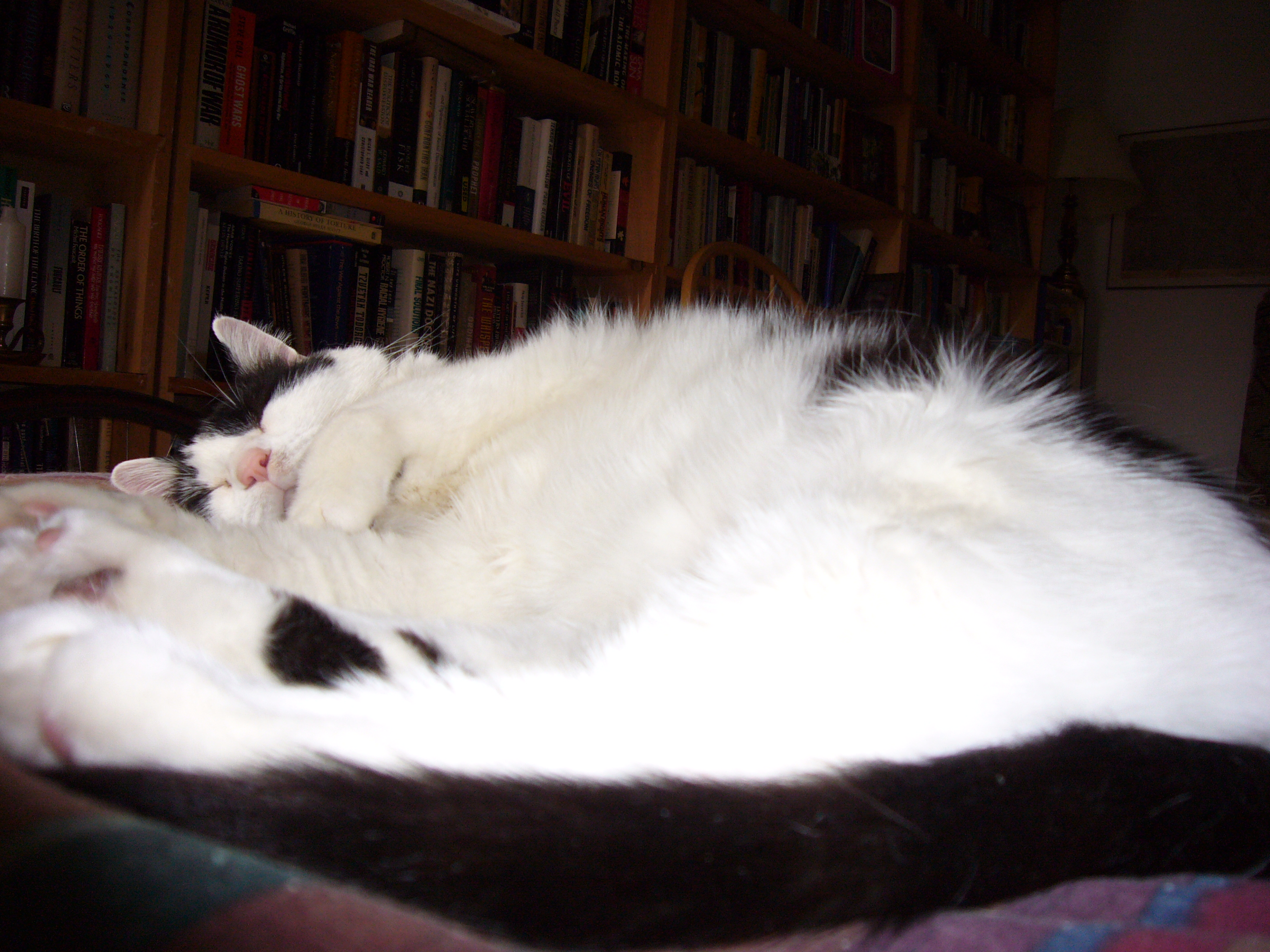
My beautiful Bean is gone.

Beanalea 1994-2010

Her name was inspired by a Jane Siberry song, ‘Everything Reminds Me of My Dog’: She has a line about Old folks remind me of my dog/My dog reminds old folks of their dogs (Barfy, Ruffo, Beanhead). . . . Bean! That’s it.

Chelsea had been driving my roommate and me crazy with her constant talk, so I thought another cat might help chill her out. I was in Minneapolis at the time, a couple of houses down from friends, and they went with me to the Humane Society to get a kitten.

We saw one group of kittens, then went into another room (the sick cat room, it turns out) for more. I had the name; I needed the cat to fit.

J., the driver, held up a long-haired black-and-white kitten and said ‘Get her! Get her!’ I didn’t want a long-hair, however, and demurred. (I did coerce convince J. to get that kitty herself; ‘Entropy’, she was named. Aptly.)

And then I found my Bean—full name, Beanalea—and took her home. She lived with Chelsea and me in three apartments in Minneapolis, one in Montreal, one in Somerville, and five in Brooklyn. She didn’t particularly like travelling, but she always settled in once we had, in fact, settled in.

Bean, Beanalea, Bean-goddammit (for a brief period when she was around 6 months), Binkins, Polar Bean, Lima Bean, Navy Bean, Gah-bahnzo Bean. . . she was my Bean.

My beautiful Bean.


Lena Horne, 1917-2010

10 05 2010

A grande dame has died.

This, of course, is the song for which she was most famous, but I fell for Lena Horne when she was on Broadway with her show ‘The Lady and Her Music”:

I was in high school at the time and don’t recall at all how I zoomed in on this show—perhaps it was because I was theatre-mad—but I damned sure couldn’t understand all that went into that performance. The earlier version is sweet, wistful, but the later one? That required some living.

No way did a small-town teenager understand. But as much as it scared me, I wanted to.

Of course, there’s also the Ed Bradley interview—the one he said that when he gets to the gates of heaven and asked what he’d done to deserve heaven, he’d say, Check out my interview with Lena Horne.

He ain’t kidding; I can’t find the whole interview, but here’s a smidgen.

(This isn’t working as an embedded vid, but the link should work—and you should definitely click on it, because it’s the best of the three links.)

I give the last word to the woman herself, from an interview twelve years ago:

“My identity is very clear to me now. I am a black woman. I’m free. I no longer have to be a ‘credit.’ I don’t have to be a symbol to anybody; I don’t have to be a first to anybody. I don’t have to be an imitation of a white woman that Hollywood sort of hoped I’d become. I’m me, and I’m like nobody else.”

(Credits: 20th Century Fox; Lena Horne: The Lady and Her Music; CBS; New York Times)


Dixie Carter, Rest in peace

12 04 2010

I know, Dixie Carter played Julia Sugarbaker, she wasn’t actually Julia Sugarbaker, but she did such fine damned job of it, the real difficulty is in finding which clip to play.

So I’ll offer a couple.

Crazy southerners:

Involuntary sequestration:

And sorry for the crappy quality, but this bit (near end of vid) of testifyin’—from 1987—is worth it:

Much better than another ‘No comment’.