Try to stay healthy, physical fitness

3 02 2017

Stand up! Fight back!

Yes yes yes: Good to remember, good to shout. Let us oppose this wretched administration in every way. But opposition is not enough.

I’m not saying anything particularly original, here. We’re riled up because the actions and policies of Trump, Inc. are an offense against our values, threats to our ways of life. Most of us out there yellin’ aren’t political nihilists, but seek to defend what matters.

And we—perhaps I should stop with the royal “we?—and I have to keep that close, that I am standing up for what matters to me as a citizen and as a human being, that I should not simply become the negative to whatever this administration proposes.

This doesn’t mean I think protesters or Democratic politicians should play nice, but that our dissent is not just about Trump or Steve Bannon or Jeff Sessions and their terrible policies, but about what we want our country to look like, to be.

I don’t know that all of us agree on that, which is fine, not least because I don’t know that all of us know. But if I am fine with obstruction as a tactic, it can’t be the entire strategy—that would just turn us into counter-Republicans. Our goals have to extend beyond NO.

That we should be “large” is something I’ve already mentioned: big-hearted and generous welcoming, confident and curious and capacious in our thinking, willing to take risks and just as willing to take care.

Hillary Clinton and the Democrats did a decent job of with the practicalities of how to build a better country—I and many others have our disagreements here and there, but there was a lot to work with—but I also think the Dems have coasted on a reassuring rather than compelling story of America, and that that wasn’t enough.

Trump has given the country his frightening, fearful, fractured, nasty vision of us. We have to say No! to it, to yell Stand up! Fight back! But that’s not enough, we also have to shout about what we’re fighting for.

Because we can’t just react to these wretches, to let them dictate our actions. In standing up, we have to stand on our own, and forge a new way.


We blended in with the crowd

31 01 2017

I’ve marched in enough protests to have lost count, but I admit that I’ve kinda lost my marching ways.

It’s not that I think marching is useless, not at all: it’s just that I’m lazy, and I find going to protests alone slightly depressing.

Still. I missed the NYC Women’s March (migraine, laziness, mood), but in reading about the many, many, many rallies from around the world, I was a little wistful. Also, I kept seeing the same refrain from women of color: All of these white women showing up for themselves; will they show up for anyone else?

And I thought: Good point.

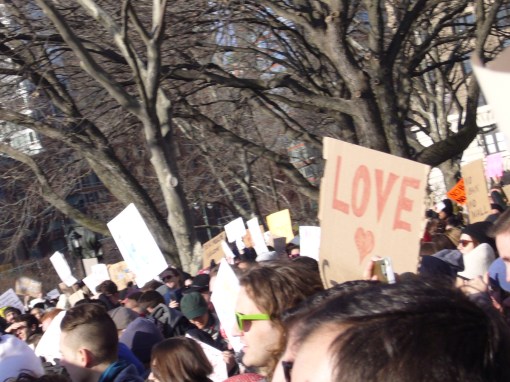
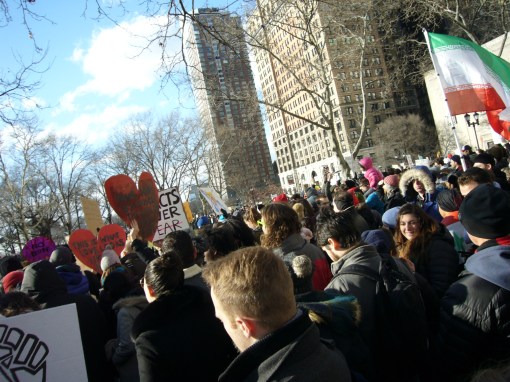
So, last Wednesday, when there was a rally for immigrants and Muslims in Washington Square Park, I jumped into my Docs and headed on ovah. As I mentioned on Twitter, it was bracing to stand with thousands of others and yell “Stand up! Fight back!”

Not depressing at all.

Then, this past Sunday, in response to the execrable executive order on refugees, travellers, and would-be immigrants, I joined even more folks for a rally/march in Battery Park.

005

011

014

Lotta good—short! rally speeches should be short!—speeches tucked into two hours, but I confess to ducking out at Rector Street a few blocks into the march (the third hour) to head back to the train. It’s gonna take me a bit to get back full protest stamina.

Oh, and did I mention that the route to the 2 took me down Wall Street and past the Trump Building?

Yeah, I flipped it off both coming and going. Petty, but satisfying in its pettiness.

Anyway, there’ll be more protests—Clio knows there’ll be more protests—and I’m working on rounding up some fellow marchers, but I showed up, and it felt good

It might even have done some good.


Packed up and ready to go

24 01 2017

Given the news coming out of federal agencies of stifled staffer communications as well as numerous instances in various Republican-led states of information disappearing from government websites, it is not alarmist to think that information which is currently available may end up disappearing.

If you, as I do, rely on these documents for your work (or whatever), I strongly urge you to download and save this information on your own devices.

I make use of a number of NIH docs, only some of which are easily downloadable as pdfs (which I did); the rest, I screenshot and saved as pdfs. Screenshot-to-pdf isn’t as good as a straight-up pdf doc, but it does allow you to preserve the information.

(I use the free Fireshot add-on, which is really easy to use; there are also others available.)

There are millions of documents which are currently accessible to the public; I dearly hope someone is copying over as many of them as possible.


Nazi punks fuck off

24 01 2017

So y’all have seen the video (or the many gifs) of Richard Spencer punched in the head, yeah?

Anyone conflicted by the sucker punch? Anyone conflicted by their lack of confliction over the sucker punch?

I’m not conflicted. Mind you, I wouldn’t exactly recommend sucker-punching Richard Spencer or any run-of-the-mill Nazi, but I took perhaps too much satisfaction in seeing that fist upside this guy’s noggin.

As an Arendtian, I’m leery of the introduction of violence into the arena of discourse, i.e., if you’re able to talk, do that—but what if your opponents don’t accept the terms of that discourse? What to do, for example, about a white supremacist who thinks ethnic cleansing gets a bad name, has advocated for the forced sterilization of black people, whose website ran an article called ‘Is Black Genocide Right?, and who is using the instruments of democracy to undermine said democracy?

What do you do with a guy who would get rid of you just for being you?

That longstanding dilemma in liberalism—how to deal with illiberalism—is longstanding precisely because there is no easy answer. I tend toward the civil libertarian view, which says tolerate the intolerant, because I don’t want the state to throw people in jail for bad views. Clear, direct threats—sure, but general espousal of an abhorrent world-view, even a Nazi world-view? No.

But what about in political society? How may we as citizens respond to our fellow citizens who would seek to strip us of our full status as citizens? If you (Nazi, ISIS fighter) say you want to get rid of ‘my kind’, can I hit you?

Legally, no. If I hit you and I get caught, I ought to be charged with assault.

And tactically, that might not be the wisest decision, for all kinds of reasons, not least because it could lead to greater violence, which will lead to the breakdown of politics right quick.

Finally, if you believe as fervently in politics as I do, then one ought to act politically, i.e., through speech and coordinated public actions, not violently.

Yet for all that, I honestly cannot condemn the guy who walloped Richard Spencer. This is one of those cases where the better angels of my nature are nowhere to be found.


Get you instructions, follow directions

19 01 2017

I’ve been pretty crappy in this whole RESIST! thing.

Yes, I wrote the letter(s) and yes, I keep thinking—thinking matters!—but I see exhortations to Do X! Y! Z! on Twitter, and I’m, like, Um. . . .

WELL, I’ve finally found something which suits my house-bound ways: I’m gathering information for the Resistance Manual, on online, open-source, er, source of resources. I’ve already added citations to the readings list, as well as plugged in data for Wisconsin, New Mexico, and Minnesota.

It’s all pretty basic, thus far, but you don’t get to the complicated stuff without that basic foundation, so I think I’m, y’know, actually contributing something.

(I’ll keep adding information to my Life during wartime page, if only because I have my own idiosyncratic interests that may be best kept confined to this here site.)

Oh, and I did, finally, manage to call my Congressfolk: Rep Clarke (Thanks for boycotting the inauguration!), and senators Gillibrand (About those Sessions/Price/DeVos votes. . . ?) and Schumer (Yeah, vote against Sessions! Yeah!). Schumer’s DC line was way busy, so I called his Manhattan office—hell, it all gets to them.

Like many people, I’ve developed a thing, which is to say, a problem, with calling people I don’t know. Pre-email I never would have won a cold-calling award, but now that there are ways besides actually phoning to people I don’t know I prefer. . . not to phone people I don’t know. It’s a bit of an issue.

Anyway, my friend T. mentioned that she’s programmed her politicians into her phone and I thought, Hey, that’s a mighty fine idea. Then, once I did that, I thought, Hey, why not actually, y’know, maybe, call ’em. So I did.

It was nothing, as of course the rational part of me knew. They don’t know who I am, they don’t care how eloquent I am, if they saw me on the train they wouldn’t point and giggle She’s the lady who stammered her comment, and they’re not writing Ms. Absurdbeats of Lefferts/East Flatbush called to say. . . .

Nope, all that mattered was that I gave an opinion on something the rep/senator did, and they noted that.

So, if you’re like me, not crazy about cold-calling politicians, don’t worry: they have people, and those people know how to write Right On! or Ugh! and then politely issue you off the phone and not think about you again.

And I bet that when I do call again, they ain’t gonna remember me—which is just how I like it.


Singing songs and carrying signs

17 01 2017

My Congressional representative, Yvette Clarke, is not attending the inaugural. Yay!

My senators, Kirsten Gillibrand and Chuck Schumer, are attending. And that’s fine, too.

I have, over the years (decades. . .) come to appreciate the importance of institutional norms and of the necessity of recognizing the peaceful transfer of power. That a nation is able to vote out leaders and peacefully replace them is an accomplishment.

That’s why I’m fine with my senators attending the inauguration. But why then cheer Rep. Clarke?

Because the President-elect has no interest in institutional norms, has stated his disdain for the notion of a peaceful transfer of power when the voting citizenry elected someone he didn’t like, and has barely acknowledged that he is, in fact, the president-elect of the entire nation, not just the minority that voted for him.

Regular folks (i.e., non-political scientists) are often frustrated by what they see as the hypocrisy of politicians—the paeans to “my dear colleague” in the Senate, the inclusion of members in the opposite party in the Cabinet, a partisan president vowing to rule for all of the people, etc.—but these gestures matter. They are way of saying politics isn’t war, and we are not enemies.

That matters. A lot.

So some Democrats will attend the inauguration to uphold the principle that we, however fractious, are a people, and we honor the institutions by which we are so constituted, and some will boycott to uphold that same principle.

That seems about right.


No time for dancing, or lovey dovey

10 01 2017

I’ve never been accused of optimism.

Well, okay, I was a happy happy kid, likely to believe that the Good will out, but nothing like a bout of life to kick the stuffing out of such positivity.

That said, I do think part of our political resistance ought to have nothing to do with politics at all, that it is not enough just to resist: we must celebrate the Good in the world. There should be dancing, and lovey-dovey: We want bread and roses, too.

~~~

In my piece on Modernity’s Ideologies I divided the response to the historical moment, Modernity, into particular worldviews (Liberalism, Totalitarianism, and Reaction), and extend the various ideologies out from those worldviews.

This can lead to a bit of confusion, insofar as I identify both Liberalism as a worldview, and liberalism as one of its ideologies. I’ve considered changing Liberalism to, say, Pluralism (which would then contrast nicely to Totalitarianism), but I think the term as I mean to use it is so entrenched in political theory that switching it up might simply lead to greater confusion. (I still might be convinced otherwise, but at this point, I’ve stuck myself with Liberalism and liberalism.)

What does this have to do with anything? Well, Liberalism can itself contain and tolerate a variety of illiberal elements, but its ideologies (liberalism, conservatism, and reform socialism) will generally seek to uphold and even further a Liberal worldview, even as they may, at times, be used to further what its opponents might argue are illiberal goals.

See, for example, disputes over whether business must serve all customers or if they may choose to turn some away. Those in favor of serve-all refer to principles of equality and justice, while those against might call on individual liberty and, yes, justice as well. These partisans are using Liberal values to advance/defend their particular ideology.

Now, various disputes about campus activists, safe spaces, trigger warnings, etc., often bounce back and forth between worldview and ideology, and often in ways which obscure the level at which the dispute is taking place. So, for example, someone like Jonathan Chait or Mark Lilla might chastise those campus activists as behaving illiberally, when it seems their real beef is that they appear to be acting against pluralism and tolerance, i.e., against Liberalism.

I’m not convinced of this, not least because I think Liberalism can also contain fierce partisanship and passionate, intemperate, even intolerant argument. I think, for example, that instead of smacking the activists as bad Liberals (which they probably could give a shit about, anyway), the tut-tutters should engage the argument at the level of ideology—by which I mean, actually engage the fucking argument instead of dismissing it as impolitic.

In other words, while I do think it’s necessary for liberals (and conservatives and reform socialists) to defend Liberalism, I also think that liberals (and conservatives and reform socialists) and anyone else gets to fight for what their version of the Good, and to do so without apology. If you disagree, fight back.

That, I would argue, is a great way to defend Liberalism.

~~~

But let’s get back to the fighting-for: we need to do more of this, without apology. I don’t mean nastily or triumphantly, but sincerely (jesus, did I just write that?) and profoundly and yes, even giddily.

As a bread-and-roses socialist, I want more dancing, more music, more art, more celebration of all we could possibly be. These are good, and part of the Good of human life.

This celebration needs a political grounding and goes beyond it—and in so doing, helps to justify the grounding itself. Liberal politics are often criticized—I’ve often criticized it—as deracinated, worn-out, and in its pure-procedural form, it is; but Liberalism is not just proceduralism, it’s also about possibility, an openness to what we can’t yet see. It’s about something more.

So let’s claim that, that openness and art and possibility, without apology.

I don’t want to reduce all of life to politics—too totalizing—nor demand that all celebrations celebrate all things—again, too totalizing. But when we have the chance to say, This is good, this song, this movie, this dance, is good, let’s take it.

When we have the chance to dance, let’s take it.


They’ll think that white hood’s all they need

6 01 2017

So, waaaay back in 2013 I wrote this:

So I’ve been turning over this thought in my head about the whiteness of the GOP and arguments (click here for a Crooked Timber post that has the various relevant links) that Republicans don’t have to worry about being the party of the pasty.

I think they do.

I don’t have this all worked out, but it seems that in order for the GOP to be the White Party they’re going to have to entice voters based on their whiteness, and I don’t know how many folks think of themselves primarily as white.

This is the crumbling underside of the default standard of white: regular [i.e., non-academic, non-race-politicized] white folks haven’t had to think about their whiteness. To bring them to you, you first have to bring them to their whiteness, convince them that their whiteness ought to be their primary concern, then further convince them that their candidates will do the most to preserve their white privilege.

Yes, whitey-first appeals have worked and will continue to work in a number of districts, but I don’t see how this appeal can be expanded, largely because I don’t know how much white folks who aren’t already racialists really want to be racialists. I think white-first appeals would turn them off, maybe make them less likely to vote Republican.

Most Americans don’t want to think of themselves as racists—even the racists don’t want to be seen as racists—and aren’t in a hurry to separate themselves (in their imaginations, at least, if not always in practice) from their fellow Americans. We’re not always large, but an awful lot of us aspire to be.

I don’t know, I’m probably talking out of my nose. It just seems like  focus-on-the-whites is a losing proposition with many of those very same whites.

Boy o boy, was that wrong. Mostly.

I was clearly wrong about the appeal of whitey-first (and what was up with my use of “racialist”?)—horribly, painfully wrong. Whatever votes Republicans may have lost prior to 2016 may be traced less to their appeals to whiteness than the covertness of those appeals: make it explicit, and you win.

Maybe.

But at the risk of being wrong yet again, I do think I got one thing right back then: I still don’t believe most white people want to think of themselves as racist.

Are many of them (us) racist? You bet! Do we want to be called racist? HELL NO.

As has been pointed out by just about every black and brown (and a few white) political commentators, calling a white person “racist” is about the worst thing you can do. Even people who post pictures of a Klan member and caption it with I’m dreaming of a white Christmas don’t want to be called racist.

Not that this is much a wedge between the enthusiastic racist and those tolerant of the enthusiasts (the racist-adjacent?), nor even a slender reed. More like an onion skin, and about as strong.

But there is a gap, however thin. And that unwillingness to claim racism gives those of us committed to anti-racism something to grab on to, to try to peel those people away from a tolerance of racism.

It’ll be damnably difficult. Many people think racism is bad, think of themselves as good, and in so doing, deny that they themselves are racist. They—we—take the accusation of racism personally, which creates both the incentive for denial and the chance to say I get it, you think of yourself as a decent person, so how about acting like it?

Trying to reverse an upside-down virtue ethics is not enough, of course: it won’t wipe out systemic racism or uproot the white supremacy entangled in the history of this nation, but I do think if you give people an out, if you tell them, You don’t have to be racist, and give them ways to fight against it—to act decently—then maybe, maybe, some of them will say, Huh, that might be worth doing.

I am not, of course, optimistic, and I don’t much hope, but nothing happens on its own. Tolerance for racism will not disappear on its own.

This is a task for anti-racist whites. As I noted on Twitter, people of color have had to carry the burden of racism for far too long, and for far too long, (thinking-of-themourselves-as-) non-racist white people have considered it enough not actively to have added to that burden. We thought non-racism enough. For too many us—and you betcha I include myself in this group—the fight has been optional.

No more: to be truly anti-racist, the fight must be seen as necessary. And this piece of the fight, confronting whites who are comfortable enough with racism, is our (white) burden, my burden.

I’m sorry it took a kick in the head, i.e., Trump’s election, to see this.


There are other ways of establishing authority

2 01 2017

Trump = Hitler? Nah.

Trump = Kaiser Wilhelm II? Hmmm. . . .

Consider:

From Christopher Clark, The Sleepwalkers:

Like Nicholas II, Wilhelm frequently—especially in the early years of his reign—bypassed his responsible ministers by consulting with ‘favourites’, encouraged factional strife in order to undermine the unity of government, and expounded views that had not been cleared with the relevant ministers or were at odds with prevailing policy. (p. 178)

More:

The Kaiser picked up ideas, enthused over them, grew bored or discouraged, and dropped them again. He was angry with the Russian Tsar one week, but infatuated with him the next. (p. 180)

We’ve yet to see the angry part, but it’s coming.

Wilhelm wasn’t content to fire off notes and marginalia to his ministers, he also broached his ideas directly to the representatives of foreign powers. Sometimes his interventions opposed the direction of official policy, sometimes they endorsed it; sometimes they overshot the mark to arrive at a grown overdrawn parody of the official view.  …

It was precisely because of episodes like this that Wilhelm’s ministers sought to keep him at one removed from the actual decision-making process. (pp. 180-81)

Not that those ministers’ decisions were always that great, either, but let’s see how much Trump’s advisers seek to, ah, shield him from having to make certain decisions.

It was one of this Kaiser’s many peculiarities that he was completely unable to calibrate his behaviour to the contexts in which his high office obliged him to operate. Too often he spoke not like a monarch, but like an over-excited teenager giving free rein to his current preoccupations.

Heh.

And Clark is rather more temperate in his assessment of the last Kaiser than either Barbara Tuchman or Margaret MacMillan. Tuchman portrays him less the ‘over-excited teenager’ than petulance personified; in The Guns of August she notes

Envy of the older nations gnawed at him. He complained to Theodore Roosevelt that the English nobility on continental tours never visited Berlin but always went to Paris. He felt unappreciated. “All the long years of my reign,” he told the King of Italy, “my colleagues, the Monarchs of Europe, have paid no attention to what I have to say. Soon, with my great Navy to endorse my words, they will be more respectful.” (p. 6)

Like Clark, Tuchman observes a preference for aggressive words over aggressive actions:

He wanted greater power, greater prestige, above all more authority in the world’s affairs for Germany but he preferred to obtain them by frightening rather than by fighting other nations. He wanted the gladiator’s rewards without the battle, and whenever the prospect of battle came too close, as at Algeciras and Agadir, he shrank. (p. 75)

The Kaiser was also unhappy when his diplomacy/bullying didn’t work, peeved at the Belgians for their unwillingness to be peacefully invaded, and outraged at the English’s willingness to take up arms against him:

The Kaiser, in one of the least profound of all comments on the war, lamented: “To think that George and Nicky should have played me false! If my grandmother had been alive she would never have allowed it.” (p. 130)

Trump and the Kaiser also share an overestimation of their own abilities: “I need no chief,” said the Kaiser; “I can do this for myself.” (p. 331)

MacMillan most savors her roasting of the Kaiser, titling her chapter on him in The War That Ended Peace with the quote “Woe to the Country That Has a Child for King!”, but also giving him his due as an intelligent, earnest man whose position meant that his passions were never disciplined.

Wilhelm had a tendency, largely unchecked because of who he was, to know it all. He told his uncle, Edward, how the British should conduct the Boer War and sent sketches for battleships to his Navy Office. (He also gave the British navy much unsolicited advice.) He told conductors how to conduct and painters how to paint. As Edward said unkindly, he was “the most brilliant failure in history.”

He did not like being contradicted and did his best to avoid those who disagreed with him or wanted to give him unwelcome news. As the diplomat Alfred von Kiderlen-Wächter said to Holstein in 1891, “He just talks himself into an opinion. . . .Anyone in favor of it is quoted as an authority; anyone who differs from it ‘is being fooled.'” (p. 66)

To be fair, a fair number of us tend toward that last particular bias.

The Kaiser, as the Eulenburg case so clearly demonstrated, was not perceptive when it came to character. Nor was he good at understanding the point of view of others. Eulenburg himself, possibly the Kaiser’s closest friend and one who loved him for himself, wrote in 1903: “H.M. sees and judges all things and all men purely from his personal standpoint. Objectivity is lost and subjectivity rides on a biting and stamping stallion.” He was always quick to feel affronted but frequently insulted others. (p. 68)

More:

Wilhelm was both lazy and incapable of concentrating on anything for long. Bismarck compared him to a balloon: “If you don’t keep fast hold the string, you never know where he’ll be off to.” Although he complained about how overworked he was, Wilhelm cut back significantly on the regular schedule of interviews with military chiefs, Chancellor and ministers which his grandfather had faithfully maintained. Some ministers saw him only once or twice a year. Many grumbled even so that the Kaiser was inattentive and complained if their reports were too long. He refused to read newspapers and tossed long documents aside in irritation. Although he insisted he would be responsible for the annual fleet maneuvers of his new navy, he lost his temper when he found he was expected to consult with his officers and work out the details: “To hell with it! I am the Supreme War Lord. I do not decide. I command.” (p. 76)

I do not decide. I command.

This goes on, as do all of these brief bios of the Kaiser—and I should not that I have yet not gotten hold of JCG Rohl’s highly regarded work on Wilhelm II—to offer up example after example of his self-regard, his insecurities, his bloviations, and his sincere belief in himself as a great leader and Germany as deserving of its place on the center stage of the world.

Two further things: One, it does seem that the Kaiser was sincere and not cynical, and that, perhaps, it might have been better had he been a bit more of the latter. He sought aggrandizement, yes, but as always tied to Germany. He may have been terribly wrong in his judgements, but there remained in Wilhelm II a naïveté that lends a kind of pathos to the man himself.

I see little sincerity in Trump, and if America is somehow not made great again, he will blame us for having failed him.

That said, whatever human frailties both men exhibit, they are unable to take them into account. They see themselves as masters whom others must serve, reserve the best judgements to themselves, and seem quite incapable of seeing others (whether as people or as nations) as having their own legitimate interests. They do recognize the interests of others, but solely in terms of their own interests, such that when they conflict, those others become enemies.  They dismiss complexity and the views of any which do not align with their own. The world exists for them, and to the extent the world does not agree, all the worse for the world.

Two, even after laying out these similarities, it must, however, be admitted that this kind of comparison is too easy. With so much information on both men, all it takes to make a comparison is to pull out those bits which, on the surface, appear the same. Whatever qualities these two men share are likely shared by other leaders, and their dissimilarities are easily trivialized. That I can not-implausibly write Donald=Wilhelm doesn’t make it so.

Still, there is that not-implausibility. I tweeted about this originally as a lark, a way to amuse myself on a December night, but whatever the caveats, I think a line can be drawn between Queen Victoria’s grandson and Fred Trump’s Queens-born son.

Not that there’s much comfort to be drawn from this. No, Trump’s not Hitler and his regime will not be a Nazi regime, but his authoritarian impulses—which, in an impulsive man, are rather worrying—can lead to an incredible amount of damage.

As the memorials across Europe can attest.


Nimble fingers that dance on numbers

27 12 2016

Alllla’ these motherfuckers bleating about the white working class, white men, working men, poor poor real white American working class men: shut up, shut the fuck up.

I’ve got nothing against white working class men—my dad was a white working class man! my brother! my brother-in-law! my neighbors and almost everyone I knew growing up! all white! almost all working class!—but I am sorely tried by all of these commentators telling ME that I need to be kinder, gentler, toward those poor poor real white American working class men.

It is fucking condescending.

I totally (well, maybe not totally, totally, but substantially?) understand why black people are tired of being told that they need to set aside their concerns for their own survival and focus on those PPRWAWCM; such counsel is white power in action.

But it’s also more than that: it’s a way for the non-working class white folks—men, let’s be honest, men—to demonstrate once again their superiority over every fuckin’ one.

Barack Obama was scalded for talk of bitter rural folks clinging to guns and religion and Hillary Clinton raked for drop-kicking some portion of the population into the basket of deplorables, but give some white dude a coupla’ column inches in the Times or Wall Street Journal and he’ll be lauded for his perspicacity in writing the exact same goddamned things.

Economic anxiety and fear and opioids and a disintegration of the American Dream and all are wrapped up in the soothing murmurs of I see, I see, as these pundits metaphorically pat their subjects on the head and assure them that It’s completely understandable they would feel this way.

Such horseshit.

This is, in the words of former Bush speechwriter Michael Gerson, the soft bigotry of low expectations.

Y’know all those working class men I mentioned, above? They weren’t all racists. My parents, with their high school educations, somehow managed to teach all three of their children that racism was bad, that it was bad to be racist.

Were/are my parents prejudiced? Sure. But they didn’t and don’t think that indulging that prejudice was anything that decent people did.

They didn’t expect any of us to be perfect, but they did expect us to be better.