We got computer

21 12 2016

So I’ll be collecting all of the sources and resources I’ve mentioned in these various ‘Life during wartime’ posts on the—hm, what should I call it? I KNOW—Life during wartime page.

Please do add any suggestions in the page’s comments (which I just enabled).

In the meantime, let’s listen to this series’s musical inspiration:

~~~

As I’ve said, I have no idea what’s going to happen next. The possibilities range from ordinary Republican (bad enough) to Oh holy hell-shit-fuck! and everywhere in between—and, honestly, given how little I now realize I know, anywhere outside of that range as well.

I tend toward thinking it won’t get as bad as it could possibly be (fascist takeover, nuclear war), but given that either of these are a rather plumper non-zero possibility than I, well, I would have thought possible two months ago, I have to keep them in sight—even if only out of the corner of my eye.

Reading about Weimar leads me (as I’ve banged on about repeatedly) to believe that we’re not Weimar, that the Liberal elements of our political culture are stronger and our democratic institutions sturdier than those German republicans were ever able to enjoy. And while we are a violent society, our levels of specifically political violence is, compared to Weimar, low.

But we are polarized, and a good chunk of our society—the economic sector—can’t be counted on as bulwark against authoritarianism: if they can make money off of this administration, they won’t oppose it.

Nor can we count on certain cultural institutions to take a stand in defense of Liberalism and pluralism.  It’s not at all clear that the news media will defend itself against attacks on it or on its reporters; a “scrupulous neutrality” may end up being more neutered than scrupled.

And Google, which used to think not being evil was important, refuses to adjust its algorithms regarding Holocaust denial (which has led to a campaign to fuck with that algorithm to drive the denial off the front page) and a search for “oven definition” offers this as the first item:
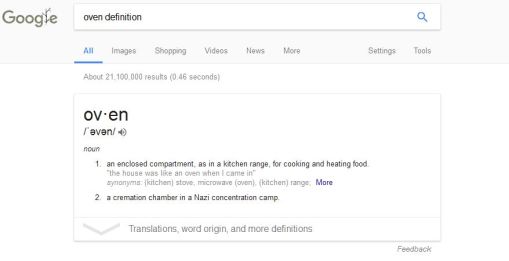
oven-googleYes, “a cremation chamber in a Nazi concentration camp.” Excellent, excellent. Right up there with Twitter reinstating the neo-Nazi Richard Spenser’s account,  or A&E’s planned series on the KKK.

And we on the left aren’t doing ourselves any favors with our sniping at those nearest to us rather than aiming our fire at the other side. I’m not against criticism (Santa Maria, I am not against criticism), but I’m seeing too much of the I WAS RIGHT/YOU SHUT UP variety and not enough of the What worked, what didn’t?

As Mark Twain is popularly attributed as saying, “It ain’t what you don’t know that gets you into trouble. It’s what you know for sure that just ain’t so.”

I don’t trust anyone who knows for sure why we lost, not least because I used to know for sure that Donald Trump would never be president. The sting to my ego, however, is nothing compared to damage to come—damage which will be even greater if we fight each other rather than the forces which threaten us all.


This ain’t no fooling around

17 12 2016

Militance does not require violence.

Stand up.

Don’t back down.


Can’t write a letter, can’t send a postcard

8 12 2016

I’m still (mostly) avoiding articles on that One weird trick! which won Trump/cost Clinton the election, mostly because I don’t trust anyone right now who is confident in her conclusions.

As I mentioned in my original election post-mortem, I think there are a number of variables which factored into Trump’s win and Clinton’s loss, and that the particular ordering of those variables likely shifted from state to state. Further, given that information is still coming in—any bets on what will ultimately be Clinton’s popular-vote lead over Der Donald?—we don’t even have all the pieces to begin trying to assemble these puzzles.

What can be done, however, is analysis of each of those pieces: how much did Clinton’s sex matter? what was the role of economic anxiety in voting? what is ‘economic anxiety’? etc.

And, of course, what was the role of the media? Well, that may only be theorized, never truly known, but one can at least look at the coverage, it’s shape and tone—which is exactly what the Shorenstein Center did.

This is only one study, of course, but it highlights the role of the negative in press coverage:

Negative coverage was the order of the day in the general election. Not a week passed where the nominees’ coverage reached into positive territory. It peaked at 81 percent negative in mid-October, but there was not a single week where it dropped below 64 percent negative.

Even those numbers understate the level of negativity. Much of the candidates’ “good press” was in the context of the horserace—who is winning and who is losing and why.

Negativity in and of itself isn’t a bad thing, but

The mainstream press highlights what’s wrong with politics without also telling us what’s right.

It’s a version of politics that rewards a particular brand of politics. When everything and everybody is portrayed as deeply flawed, there’s no sense making distinctions on that score, which works to the advantage of those who are more deeply flawed. Civility and sound proposals are no longer the stuff of headlines, which instead give voice to those who are skilled in the art of destruction. The car wreck that was the 2016 election had many drivers. Journalists were not alone in the car, but their fingerprints were all over the wheel.

There’s a lot more at the link—a lot more—so g’head and read it all.

Media folk will have to figure out for themselves what, if any, professional standards they wish to uphold in their campaign coverage, but it’s also damned clear that candidates must prepare themselves for another worst- (or even worst-er-) case scenario in plotting their own messaging strategies and tactics.

I have precisely zero advice on what those strategies and tactics should look like. Trump received a great deal of negative coverage, which (apparently?) didn’t hurt him; Clinton was also covered negatively, and it (apparently?) did hurt her.

Man, it’s tough even to figure out the affects of the coverage: how much did it really matter in any direction? I tend to agree with Rick Perlstein that it sure as hell didn’t help, but beyond that? Dunno, and dunno if anyone does know: I’m guessing there will be all kinds of regressions run over the next few years to try to tease out some kind of answer.

In the meantime, it might be worthwhile for current and would-be Democratic politicians to start dry-running different tactics right now to try to determine what works vis-à-vis the media—and if nothing works, what then.

Because they—we—have to be prepared. Even if it only matters on the margins, well, elections are won and lost on those margins.


I got three passports

7 12 2016

I live in a blue neighborhood in a blue city in a blue state: this has been an excuse for not acting politically.

Hey, I don’t have to do anything, my rep’s gonna vote right, my senators’ll vote (mostly) right.

But that ain’t right, and I need to step up. I’ve written one letter to each, and need to write or call regularly to say Hold the line! And with the mayor and my city council member, too.

Still, there’s more that could be done, especially when it’s important to hang the Trump anchor around and drag each and every Republican in the House and Senate. So I’m going to adopt a red district.

I grew up in a small town in Wisconsin, so I’ve decided to adopt James Sensenbrenner and, by extension, Ron Johnson. Johnson just won re-election and Sensenbrenner has held his seat forever, but what the hell: why not spend some time tracking each and every thing these fuckers do, then coordinate with some Badger Democrats? Besides, Tammy Baldwin is up for re-election in 2018, so I’ll see what I can do for her campaign. (Oh, and whoever runs against Scott Walker? You betchyer ass I’ll be all over that.)

Or, y’know, maybe coordinate with some Badger Democrats, first, and go from there.

I’m not much for marching, anymore, and I don’t need to track the media—there are enough media people tracking the media—so why not do something I can do? Research, hunting down and collating information, maybe a little analysis.

Is this something you, similarly surrounded in blue, can do? Try it! Pick a place at random! Pick a place where you once had a pleasing interaction with a waitress at a roadside diner! Pick the place of your first kiss or last kiss or where you think would be a good kissing place! Pick a town whose name you love saying out loud and figure out who represents it!

Then contact the local Dems and say Hi, I love the sound of your town and have some skills and would like to help you elect Democrats, what can I do?

Or maybe you’re shy and not sure you can call out of the blue, so do some work and publish it to social media or maybe send an abashed email saying Hi, I love the sound of your town and have some skills so here’s some work I did that I thought might help you elect Democrats.

You can contact state offices or if you’ve picked a place, find out the city or county party (I’ll be hitting up the Sheboygan County Dems).

Now, one of the things I’ll be doing is looking at similarly situated districts, see which ones are repped by Dems, then look at how that person won. I’ll dig into historic voting data, demographic data, census—the whole megillah.

It’ll also be worth looking at what Dems did in Nevada and North Carolina: Clinton beat Trump in Nevada and the Dems took the governorship from a Walker-level guv in NC, so there’s probably something to be learned from each.

Okay, I’m being a bit scattered, here: I’m neither an Americanist nor a statistician and I don’t quite know what are the best places to find this info. The Cook Political Report seems a good place to start, and I’ll poke around the US Census site; county-level date presidential election data is available in chart form here (click on “Detailed Results”) and as in an interactive map here. I’ll also be (re-) reading Jameson Quinn’s work with Center for Election Science (the first dispatch published here) for some guidance on how to make sense of the stats.

It’s a start, and while I might not know what I’m doing right now, I think I’ll get the hang of it as I go along. I’ll keep you posted—and hey, if you’re doing something like this or something not at all like this, lemme know!


Ain’t got no headphones

1 12 2016

What to do about white fragility?

I don’t think it’s at all necessary that everyone concerned about racism also try to understand why some people are racist (and why many more tolerate racists and racism), but some of us should.

That is, some of us white people in particular should—just as some of us male people should try to understand sexists and the folks who tolerate them—but even as someone who’s willing to try, I don’t know how much good it will do.

I mean, I want to understand because I don’t understand why you would feed the belief that other people are worse than you. Yes, I get it, seeing others as worse is pretty much the same as making yourself feel better (in both senses of that term), but why is better, better?

Anyway, before I go flying off into word-play, back to political matter at hand: does knowing why people are racist or believe in conspiracy theories or peddle horseshit help to combat racism/conspiracy theories/horseshit?

James Fallows, among many, many others, has noted the challenges for the media of dealing with a president-elect who lies, but what of citizens dealing with their reality-hamstrung fellow citizens?

We’re not supposed to call them out or confront them or criticize them for their shitty views—this just makes them mad and sad and defensive and won’t work anyway—so then what?

I think the first principle of any strategy is that of commitment, which is to say, militancy. If you are committed to anti-supremacism, then, goddammit, don’t back down from that, don’t apologize, and don’t act as if that commitment is somehow up for grabs. Speak and act forthrightly, and hold the line.

So that’s what one should do for oneself, but, again, what to do with others who are put off by anti-supremacism?

Some of them are themselves committed to supremacism, and should be recognized as such. Commentators who suggest we not be mean to the racists seem to operate on the assumption that if we’re all just nice enough, we can, eventually, all just get along. But no.

What of those less committed to supremacism/conspiracism/horseshittery? What’s the best way to wean them away from it? There seems to be a fair amount of social science evidence, centered on but not limited to studies of cognitive biases, that it’s damnably difficult to pull people out of their own asses, but it’s been done, right?

I mean, people convert from A to B or deconvert from B to C, leave cults, are disillusioned with someone/some movement which they formerly revered, so there must be some way or ways (which do not include kidnapping and abusive deprogramming) to nudge or seduce or yank someone out of a closed loop.

I like to win arguments—I REALLY like to win arguments—but this is less about winning arguments than opening someone to the possibility that there is even an argument to be had.


Walk this way, talk this way

27 11 2016

White people are mad that black people want to talk about race. Men people are mad that women people want to talk about sex.

White men people would prefer that women people and black people and Latinx people and queer people stop talking about things that white men people don’t want to talk about.

Or so it would seem from the latest volleys in the never-ending Wars of Identity, aka Battles of Political Correctness, aka Liberal vs. Illiberal Liberalism. I have some sympathy for all sides, although the greater part is with those who speak in the language of justice. That there is overreach on the part of the insurgents is to be expected—you don’t always know how far to go until you’ve gone too far—and should be confronted directly, and with some good grace.

Condescension is neither direct nor graceful, yet condescension is what Kevin Drum and Mark Lilla have on offer.

Drum argues that the term “white supremacism” is “faddish” and counter-productive: how can we get non-liberal people to take racism seriously if we keep talking about racism? Lilla goes back to the well to pull up yet another impression of identity-siloed collegiates, unaware of anything or anyone other than their own selves.

Neither discusses justice.

They do, however, talk about how all this talk about supremacism and identity is damaging to those who don’t like it. Pointing out everyday racism, says Drum, is like crying wolf: what will you do when The Racism really comes? And Lilla cautions that invoking whiteness is like saying Bloody Mary three times in a mirror: the incantation itself will conjure white-identity politics.

As if white-identity politics doesn’t already exist, as if The Racism isn’t already here. Lilla himself remarks that the Klan was an early manifestation of white-identity politics, but acts as if that manifestation were a distant island rather than the land itself. He wants a post-identity politics, one which appeals to Americans-as-Americans—as if Americanness is itself somehow innocent of history.

Note, too, the tactic both Drum and Lilla deploy: they seek to define the rules of liberal-left political engagement by decrying the efforts of others to (re)define the rules of liberal-left political engagement.

It is unsurprising that those who hold themselves above it all are unhappy with those who point out that they are, in fact, not above it all.

I noted at the outset that white people and men people are upset with non-white people and non-men people asserting themselves—this is, of course, an exaggeration. There are many white people and men people who recognize and are trying to understand that whiteness and men-ness are partial identities and what that means, among all the many other partial identities, and how they have been used in the unjust construction of those other partial identities.

Lilla wants us to get beyond identity—a desire which a suspicious hermeneut like me shares. But we don’t get “beyond” without recognizing “here”, a place in which some people historically have claimed a universal identity so as to define the particular identities of others, a place in which those with the particular identities are now seeking to define themselves, and claim themselves, as their own kind of people.

It’s a rough town, and a rough time, but we don’t get beyond without going through.


We blended in with the crowd

20 11 2016

Walt Whitman’s I contain multitudes gets its fair share of shares, and for good reason: it’s exuberant and ironic and sincere and boastful all at the same time, a declaration and excuse and an invitation to the tumult of life.

It’s easy to think of that tumult as a kind of playful churning, a shotgunning through rapids in which you are tossed and soaked but ultimately delivered, safely, to the sandy shore. It’s a ride, not a tsunami, not a hurricane; a volunteer thrill, not a crashing terror.

It is, of course, both.

I often forget this, that the multitude, the mix, the plural, contains not just joy but fear, that it’s not just a condition of freedom but the grounding of fear. I like to say about New York that we don’t all love one another, but we do, somehow, manage, mostly, to live with one another.

This is an accomplishment, albeit a fragile one.

Well, okay, not just fragile: there is a sturdiness to this and other places like this. There is a sturdiness to this country. But in taking for granted this sturdiness I have too often treated its fragility as a remnant, or mere theoretical possibility. I’d forgotten that if anything is possible, then anything is possible.

I don’t think we’re on the way to fascism, and do think that our many, varied, institutions, formal and informal, can serve as bulwarks against authoritarianism—emphasis on can. While inertia has its own force, there is nothing automatic in a defense of plural democracy: we have to act.

It’s hard, defending the tumult amidst the tumult. I don’t want everything to be political, everything to be are-you-with-us-or-against-us, even as I see the necessity of holding the line. I want to defend my side but since my side declares that everyone gets to pick their own side, do I end up defending those who would harm me?

I won’t hold to a principle which requires its own extinction, but neither will I abandon it for its practical difficulty.

This will take some doing, and some contradiction, too, probably. There is the theory, and the practice, and both will need some work.


We dress like students, we dress like housewives

16 11 2016

Two years, people, two years: 2018.

Yes, the presidential term is four years, but a) all of the House and a third of the Senate is up for a vote every two years; and b) there are state elections, including governorships, which are up for grabs in two years.

I live in a blue district in a blue city in a blue state, which has meant that in the past few years I haven’t paid much attention to off-year elections: I could do nothing, and my folks got (re-)elected.

Except, I don’t always know that these people were “my folks”. I mean, they were Democrats, but were they good at their jobs? Were they attentive to their constituents? Were they concerned with larger issues? Were they actually doing anything worthwhile, or just collecting a check.

So, what to do? Find out something about my city council member, state assemblyperson and state senator. Oh, and since I finally joined a party in this closed-primary state, I’ll have no excuse for not paying attention to the primaries as well.

And if there are no (good) primary challengers or if the candidates are alllllll right, then I can turn my attention to upstate candidates in need of help. The New York State Senate is controlled by Republicans, so if my own senate-candidate doesn’t need the help, then I’ll have to figure out some way to help someone who does.

That extends beyond just my state: if there are state or Congressional candidates in other states who could use a boost, then DO IT. For example, Louisiana Democrat Foster Campbell is in a run-off for a House seat against Republican John Kennedy. Yes, Louisiana is a red state, but here’s a man who’s got a shot as a blue. The Republicans are taking this seriously; so, too should Democrats and everyone who’s looking to advance any kind of non-insane/progressive/liberal/left agenda.

I’m broke, so, alas, I can’t do much. But if you can contribute: DO IT. Do what you can.

One more thing (for now): good people need to be recruited to run. I have no idea how to do this, but here’s the story of 26-year-old waitress and labor organizer Moira Walsh, who just won a seat in the Rhode Island General Assembly:

If you go to your boss and your legislator and ask for a raise and they say no, where do you go from there? That was the point at which I decided that if these people weren’t going to represent me, or even pretend to care that we were struggling, then they couldn’t really call themselves my representative, could they? That was when I started the process of running because I was tired of being told that they would tend to me later.

Walsh pretty much self-recruited, but note that she was prepared to do so via her participation in the labor movement, as well as the work itself:

I don’t consider myself a politician. I am just a waitress who happened to get pissed off enough to take a crack at it.

[…]

I felt like I had accidentally acquired all of these skills through waitressing that were setting me up for success in terms of the political world: being able to take some really awful comments with a smile on my face, remembering people’s names at the drop of a hat, walking six to 10 miles in a shift.

I spoke to a colleague earlier today about what to do with this terrible moment, and told her we had to grind it out: “Politics is the hard boring of small holes.” (That didn’t sound quite right to me, so I double-checked; the correct phrase, from Max Weber, is Politics is a strong and slow boring of hard boards.)

That’s what Moira Walsh, at age 26 did: she bored that hard board.

If you can be a Moira Walsh, do it. If you can’t support your local Moira: give money, knock on doors, call voters, register non-voters, design literature, drop literature, show up, do what you can.

One by one, bit by bit, we grind forward.


Transmit the message to the receiver

15 11 2016

After being knocked flat, then crouching, I’m back on my feet.

Still not listening to NPR, but I’ve managed WNYC and the BBC. It’ll come, it’ll come.

So, what are we to do?

My principles remain. I am committed to pluralism, committed to politics, and (I’ll try to be) committed to life beyond politics. I’m trying to be human. Politics won’t make us human, but it can make it easier or harder for us to become human. Let’s try to make it easier.

What does this mean? Since I’m a political theorist, I’ll be reading (natch) some political theory. I’ll also be reading some history, and anything else that can help me see what I do not see.

But not just that. If theories are to matter at all, they must be connected to actions. To that end, I sent the local offices of my representative and my two senators the following letter:

Given the recent election of a man manifestly unprepared to take over the presidency of this country, I understand that there is a great deal of discussion as to how much or how far the Democrats should go to aid or cooperate with President-elect Trump. This is indeed a difficult question, especially for those who value the institutions of government and who wish to mitigate any damage his administration will likely cause.

My suggestion to and to your Democratic colleagues: do nothing to help him.

He ran a hateful campaign predicated on harming large portions of the American citizenry, he could not be bothered to do the work to make the transition to the Oval Office, and he has selected a racist, sexist, anti-Semitic, anti-immigrant, anti-Muslim propagandist as his Chief Strategist. There is nothing in his actions to indicate he cares one whit about the people who voted for Secretary Clinton or anyone who did not enthusiastically cheer on his candidacy. He has done nothing to indicate he wants to be president for the entire United States.

In requesting that you do nothing to help the incoming administration, I do not also mean that you do nothing to help your constituents or this country. If he happens to put together a bill (e.g., the oft-mentioned infrastructure bill) which would injure no one and would do good, please do vote for it. Do what is necessary to fulfill your obligations to your constituents and to this country.

Those obligations, however, do not extend to aiding a man who would harm us. Yes, Mr. Trump will need a great deal of assistance if he is to rise even to the level of mediocrity. But let the Republicans, who selected this petty and careless man to represent their party, take responsibility for him.

Had Senator McCain or Governor Romney won the presidency in 2008 or 2012, I would have been distressed, but I would not have been moved to write a letter like this to you. Whatever my deep policy differences with these men, I doubted neither their experience nor their desire to do what they thought best for this country. I have no confidence whatsoever that the President-elect is concerned for anyone beyond himself or those within his inner circle.

(With all the necessary salutations and sign-offs and such.)

In doing this, I was following some of the advice of Emily Ellsworth,* a former Congressional staffer. Yes, she advises a phone call would be better, but late last night the letter seemed a good idea. As the weeks roll by, perhaps I’ll call. I’ll do what I can.

And that, dear readers, is what I suggest for those of you who are similarly distressed and looking for something to do: Do what you can.

There are all kinds of good ideas out there, some of which may make more sense to you than others. Do those. Don’t worry if someone is doing something else. Moving a country is a big damned deal and requires all different kinds of work. If you can’t stand to talk to someone who voted for Trump, don’t. If marching seems silly, don’t march. If you can’t stand to think about the national scene, look local. Wear a safety pin, don’t wear a safety pin—do what makes sense to you, and be kind to those on our side whose sense is different from yours.

I think the way through is by becoming large: big-hearted, broad-minded, and standing up and with one another whenever and wherever we can.

No, no compromise with racism and sexism, no compromise with hate. No compromise with the small and the mean. But we will have to invite to become large those who have taken refuge in the small.

I’m not ready to do this, not yet. If you voted for Trump, well, today I don’t want to talk to you. But some of us are going to have to, and maybe, down the line, I’ll be one of those who is able to.

But right now, I’m doing what I can.

~~~

What to do? Make contact:


Circus Maximus MMXVI: Hello darkness, my old friend

13 11 2016

So this is the end of the series—perhaps I should be using the Doors’s “This is the end” to mark the occasion.

The weekend after and I am still stunned. I still can’t listen to the news (WNYC & NPR), although I am reading plenty online. Reading is easier: as soon as I see something about THIS is the reason. . .  I know to move on. I laid out what I thought were the possible variables for Trump’s win and Clinton’s loss, accept that there might be still more; I don’t accept that anyone knows yet how to sort those variables.

I don’t. I have been knocked on my ass, and not have not managed to find my footing I don’t know much about the ground, either.

There were things I thought I knew. I thought I knew the extent of white supremacy in this country, thought most would, if faced with it, reject it. I didn’t think so many would just brush it aside, claim simultaneously that Trump was being both honest and that he didn’t really mean what he said, that the toxins he released weren’t that poisonous at all.

Maybe there’s something there, to be grasped: that those who embraced a racist didn’t want to be seen as racist. It is a slender reed.

So, what next? I don’t know.

What kind of president will he be? I don’t know.

Will he stick to his campaign promises? some of them? I don’t know.

Will he take the job seriously? I don’t know.

Will he turn over the day-to-day executive functions to his staff, to Pence? I don’t know.

Does he even want the job? I don’t know.

What kinds of judges will he appoint? I don’t know.

What kind of diplomacy will he conduct? I don’t know.

How will he react in crisis? I don’t know.

What will happen when he fails, as all presidents fail? I don’t know.

I don’t know the answer to any of these questions. The best possible answers are bad; the worst, are more than I can now bear to imagine.

But if one is to prepare, to resist, then all possibilities, the worst possibilities, must be imagined.