I can’t be the only who, when she saw this:

. . . immediately though of this:

When I lived in Minneapolis I used to gripe about “Minnesota Nice” by quoting the lines from Sondheim’s Into the Woods:
You’re so nice.
You’re not good,
You’re not bad,
You’re just nice.
Fake, I’d mutter, it’s all so fake. Nice is overrated.
Now, I have since come around somewhat to the notion of ‘It’s nice to be nice’, but only somewhat, and not particularly in politics.
Oh, sure, avoid, as Machiavelli warned, being hated (something Ted Cruz couldn’t manage to do), but virtù beats nice every time.
Thus, Hillary Clinton should take to heart the next lines—
I’m not good,
I’m not nice,
I’m just right.
—and go full hard-ass on the road.
Now, I do understand that Clinton has the reputation of being great one-on-one: warm, gracious, attentive, and wonderful at drawing people in. In front of a crowd, however, she lacks the looseness which would ingratiate her to that crowd. She’s fine, she rarely messes up, but she also rarely inspires or impresses.
So she should stop trying to impress anyone, and just go full on “I have come here to chew bubblegum and kick ass and I am all out of bubblegum.”
As to her opponent, well, Trump is a bullshitter, and as I’ve noted a couple of times previously, it is tremendously hard to respond to or pin any kind of responsibility on a bullshitter. Instead of going after the bullshitter—which forces you on to his territory—you just reject him outright.
You say “Nah”, and refuse to engage; roll your eyes and laugh; toss his words back at him with a heaping dose of “really?”
The great strength of the bullshitter is the unwillingness to take anything seriously; it is also a weakness which can be turned against him.
So Clinton should go full “No Bullshit”. It gives her a way to blunt Trump’s mad libs, and coolly to deride his seriousness while signalling her own, very serious, approach to politics.
It also allows her to admit “Nope, I’m probably not going to bring tears to your eyes, but you can bet your sweet bippy that Imma get the job done.”
And that might actually impress.
(ETA: credit for Into the Woods lyrics)
So, a coupla’ months ago I wondered why those who saw the Republican party as dysfunctional didn’t think to connect this dysfunction to an inability for the party to ‘decide’ on an acceptable nominee.
Which is a long way of saying: why didn’t any of us see Trump coming?
Apparently, one guy did: Norm Ornstein.
I had focused for so long on the growing dysfunction inside the Republican Party, and I believed that its leaders had generated an awful lot of the anger out there. And eventually, I combined that with the set of polls that we began to see that showed 60 to 70 percent support for outsiders and insurgents.
He lays Tiny Hands Trump’s triumph squarely at the feet of Republican leaders, where it belongs:
[I]f you forced me to pick one factor explaining what’s happened, I would say this is a self-inflicted wound by Republican leaders.
Over many years, they’ve adopted strategies that have trivialized and delegitimized government. They were willing to play to a nativist element. And they tried to use, instead of stand up to, the apocalyptic visions and extremism of some cable television, talk radio, and other media outlets on the right.
And add to that, they’ve delegitimized President Obama, but they’ve failed to succeed with any of the promises they’ve made to their rank and file voters, or Tea Party adherents. So when I looked at that, my view was, “what makes you think, after all of these failures, that you’re going to have a group of compliant people who are just going to fall in line behind an establishment figure?”
He traces the problem back to Newt Gingrich and his efforts to tear down Congress; I’d guess the problem goes back at least to Reagan—“The nine most terrifying words in the English language are, ‘I’m from the government and I’m here to help.'”—if not further, but clearly the Republican establishment’s willingness to rip apart the establishment goes back a ways.
What’s the appropriate cliché, here? Came back to bite ’em in the ass? Fanned the flames of a fire that consumed them? Something something boomerang something?
Whatever.
When you basically move dramatically away from what we call the regular order, when you almost debase your own institutions — you’re gonna find an opening for somebody who’s never been a part of it and who can offer you very, very simplistic answers.
It’s not that I blame the GOPper bosses wholly for Trump’s popularity—I think he did hit on some kind of whacked-out beat that got a lot of people clapping—but that they couldn’t be bothered to take him out when the taking was good.
And now they—and we—are stuck with him. Sad!
Ornstein also kicks at our profession:
Political scientists in some ways, just like journalists, pursue false equivalence. They do not want to suggest anything flatly or that one party is to blame. There’s a kinda cynicism whenever you suggest something might be different than it was in the past. “Oh, no, it’s always the same.”
[…]
And there’s a herd mentality too, I think. People glom onto The Party Decides and you look like a fool if you say, “Well, no, that’s not right” — because everybody believes it! I don’t know if I would call this a black swan moment, but people’s unwillingness to take a risk of breaking from consensus or believing that it will come out differently than it has before is pervasive.
Yeah, I followed that pretty much down the line. In my defense, I’m a political theorist, not an Americanist—but that line could also be turned against me: why so willing to follow along?
And I (still) do follow Jonathan Bernstein‘s admonition that any major party candidate, by virtue of being a major party candidate, has a shot at winning the presidency. As Ornstein notes
We do know that straight-ticket voting has increased dramatically. This to me suggests we’re not gonna have a 45-state blowout like Goldwater faced, or a 49-state one like Mondale or McGovern had. You’re gonna start with some states and you’re gonna start with 45 percent of the votes. Most Republicans are gonna come back into the fold.
Yep. And, Oh god.
Really, glad I’m not a Republican.
I’m mean—yeah, given my views, obviously—but at least I don’t think either of the Democratic candidates is a dumpster fire. I’m not particularly enthusiastic about either, but, like Rebecca Schoenkopf and the Wonketteers, I’m pretty much they’re both fine, they’re both good.
Which is to say: what I like about each is what I distrust about each: Clinton’s practicality and Sanders’s impracticality. I’d say Let’s try to merge ’em, but then we’d end up with someone like Rod Blagojevich: completely cynical and a little insane.
(As an aside: this horseshit about Clinton’s ambition to be president as somehow bad is, shall we say, pretty rich coming from the campaign of someone running for president. Yeah, I know this kind of petty shit crops up in all campaigns and from the best of candidates, but shees: still annoying.)
No, this is what we’ve got: two people who would have different styles of governing but who each a) care about good governance; and b) would accomplish about the same as the other. I’ve learned to keep my expectations low—please try not to make things worse and if you can make them even a little bit better that would be great, thanks—so unless Clinton or Sanders runs off screaming into the night, they’ll be fine.
Trump and Cruz, on the other hand, don’t meet even that basic non-screamer standard. Cruz creeps people out—his most enthusiastic non-paid supporters seem to be those who spend the least time with him—and Trump lacks even the barest competence.
Yes, Cruz is intelligent, and yes, Trump has a certain, um, panache, but when it comes to governing, neither much cares: Trump supporters want to burn everything in their quest for GREATNESS and Cruz’s, well, christ, those who aren’t supporting him merely to stop Trump are waiting on some kind of red-white-and-blue Rapture.
Which is to say, if I’m a Republican who wants a president who can actually preside, I’m lookin’ at these two and thinking, Oh, boy.
I’m not concern trolling: I think Republicans as a whole are getting exactly who they deserve, and if either of those whos didn’t have a shot at the presidency, i.e., a chance at wrecking things for the rest of us, I’d be clapping in glee.
Still, I do feel a bit of sympathy for the ordinary Republican who just wants someone who’s not a night-screamer, someone who’s just, y’know, fine.
Does wealth make people shitty, or does one have to be a shitty person to become wealthy?
Because why, if you have a bajillion dollars, can you not afford to pay your fucking taxes?
I’m broke, and I pay my fucking taxes. No, I don’t like it, but I don’t like it in a way that civilized person who recognizes that one has to pay to live in a civilized society doesn’t like it, which is to say, I bitch, and I pay.
But you, rich person, you apparently have so much money that you can’t afford to pay taxes or child support, you can only afford to pay some shitheel middlemen to hide your money for you.
How “entirely typical”.
I’ve half-joked before that political scientists don’t do either love or humor.
Plenty of political scientists are lovely and funny, but in our intellectual approaches to politics, we forget about passion and about the weirdness of political activity itself. Politics is about ‘interests’ and ‘resources’ and ‘distribution’, ‘policy’ and ‘governance’ and, oh yes, ‘power’. Some of us might speak of the ‘common good’ or talk about Aristotle vs. Plato, but in our rush to impose a rational structure across the sprawl of politics, we all seem to forget Hume’s admonishment that reason follows passion.
Yes, we attempt to come to terms with political ardor in terms of cognitive biases or philosophical error—which is fine!—but passion is not merely something to be explained away, but something in and of itself, which may in turn help to explain something (like politics) else—both explananandum and explanans, as it were.
This is a long way round to the point that those of us who study politics should not be surprised by passion, that people pick sides, and that they will defend—with words, with fists, with guns—what their (our) sides.
This isn’t an excuse for violence—for Hera’s sake, does that really need to be said?—but it is a defense of passion itself as a legitimate driver in politics. Unlike Hume, I do think reason may also be a driver, and just as passion may inform reason, so too may reason discipline—if only the expression of—passion.
But reason does not, should not, erase passion. Especially in politics.
cont.
If both order and freedom are necessary for politics, then how to reconcile them?
Hobbes said, in effect: you choose order, and whatever freedom may exist without disrupting order may, but not must, do so. Rousseau tried to bring the two together by denying that in a democratic society there is any conflict between them—one may speak unironically of being ‘forced to be free’. Locke sought a kind of middle way: you agree to the founding (representative) order which in turn allows for a wide, although not absolute, set of liberties.
These snippets do not, of course, do justice to these men’s thoughts, but do indicate the various ways early modern thinkers thought about how to build and maintain a truly civil society, that is, a society in which men may interact without violence.
Civility in politics, then, is less about manners than about the manner of our engagement with one another.
Now, that manner may also be a political matter: What kind of protest is acceptable? What are the appropriate venues of protest? How does one comport oneself while protesting? Are there forms of protest which are out of bounds? What if the protest overwhelms the phenomenon one is protesting? What if political speech intimidates protesters? What if protesters of political speech intimidate advocates?
Who is in the right and who is in the wrong?
And that question is where we go off the rails, thinking that the answer can be determined outside of politics itself. It can’t.
I tend to go far along with Arendt in positioning violence opposite of politics, but, Hobbesian that I am, I can’t completely deny its role in politics itself. If might makes right (and it does), then violence, as one form of might, can make right.
In the US political system there are supposed to be limits on violence in politics—that is a mythical part of our foundational order—but its use has often succeeded in containing insurgent (and non-violent) political acts. Almost every liberation movement in our country has been met with violence, both official and not, and has had to justify itself as worthy of its freedom to be political, that is, to be included in the political order itself.
That, by the way, is the radical promise of politics: that order can be challenged, upended, re-ordered, without bloodshed. That blood is so often shed demonstrates the practical limits of that promise.
cont.
Man, are we Americans bad at politics.
I don’t know if we’re uniquely bad, but we do seem to have some difficulty with the notion that disagreement (and expressions thereof) is normal.
I’m not just talking about the violence at Trump rallies, but also to violence at protests generally as well as meltdowns about campus politics. Disagreement over whether the best way to accomplish x is achieved by y or z is still acceptable, but disagreement over the fundamental means by which we prioritize x over p or decide that only y or z are worthy options is considered uncivil.
The very heart of politics—uncivil!
Granted, there are many plausible ways of understanding politics, and not everyone would go along with my Arendtian/Crickian view which places distinctiveness and pluralism at the center of political life. But if one accepts that a complex society will necessitate substantive differences amongst the members of that society, then the management of those differences will in turn be required to maintain both its complexity and functioning.
There are, as Crick notes, any number of ways for societies to deal with complexity, among them attempts to bring its various pieces into line and/or to suppress expressions of difference. It is only in politics, Crick argues, that the freedom which arises from and allows further complexity may be found and strengthened.
Or, as Madison somewhat more pessimistically put it,
Liberty is to faction what air is to fire, an aliment without which it instantly expires. But it could not be less folly to abolish liberty, which is essential to political life, because it nourishes faction, than it would be to wish the annihilation of air, which is essential to animal life, because it imparts to fire its destructive agency. …
The latent causes of faction are thus sown in the nature of man; and we see them everywhere brought into different degrees of activity, according to the different circumstances of civil society.
So, what Madison is resigned to and what Arendt and Crick celebrate is the endurance of difference and disagreement—and of politics to allow and make use of its expression.
Some leftists have argued that an open politics (of the sort often found in democracies) is merely reformist or bourgeois (as did the Communists in the Weimar republic), and thus fail to take seriously the radical possibilities contained within politics. Madison may indeed have been a conservative of a sort in wanting to limit what politics could accomplish in the new American system, but it was precisely because he saw that politics could be transformative that he sought to limit it.
And there is something to his conservatism, as well. As Crick noted, the first requirement of any system, political or otherwise, is to maintain order and thus provide security to its citizens or subjects. This is Hobbes’s basic insight: absent a leviathan, life is but a ‘war of all against all’, ‘solitary, poore, nasty, brutish, and short’. Fear matters, as does security.
But even as they matter, they are not all that matters, and the promise of politics is, pace Arendt, the promise of something more.
cont.
I’ve followed and enjoyed Jonathan Bernstein‘s disquisitions on American politics. I don’t always agree (his preference for the Madisonian presidential system, his views about money in politics), but he’s practical and open and good at linking to other political scientists.
He’s also been one of the leading proponents of The Party Decides thesis, which, to simplify matters immensely, argues that party insiders force discipline on the nominating process. I first reported on, then came to agree with, this notion, largely because what Bernstein wrote about it made sense.
Of course, “making sense” doesn’t equal “correct”, as we’re all seeing in the current contest, and which Bernstein admits:
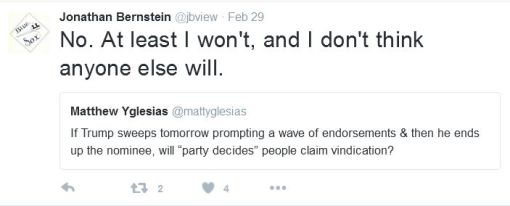
So, this is a not-at-all-direct prelude to the question: why didn’t Bernstein or other political scientists (or I) see Trump coming?
Another piece: Bernstein has been arguing, for years, that the Republicans at the federal level have become dysfunctional and (institutionally) irresponsible. He’s noted their disinclination to negotiate on bills which relate to their priorities, their unwillingness to vote on nominees which they themselves support to bureaucratic positions, and their indulgence of fantastical rhetoric.
And ‘the party’ has either a) been fine with all of this or b) unable to do anything about it.
Given that, why would Trump be a surprise?
Bernstein has been hitting Trump hard on his ignorance of how government works (see, for example, here and here, as well as on Twitter), but given that Republicans in Congress don’t seem to care much about governance, is it really a shock that Republican voters would support a guy who doesn’t care either?
So, given that Republicans have been acting like/unable/unwilling to discipline the nutters for awhile, and that Donald Trump is not that much of an outlier in the party, is Trump’s rise indicative of a breakdown of the-party-decides model—because the party itself has broken down in some significant way—or, perhaps, that the party has decided he’ll do just fine?

 AbsurdBeats