Circus Maximus MMXVI: Do ya like it like that?

9 03 2016

Five and a-half years ago I worried about the color of the sky in Sarah Palin’s world; half a year ago I suggested that Trump would only triumph* were he to keep on keepin’ on banging his own weird can.

So, two things: One, Ezra Klein is among the latest commentators to note that “he lies constantly and fluently about what his policies actually are.” Klein thinks this is a problem, and it is—just not for Trump.

It doesn’t matter that he lies or that he lies about his lies.

And. . . I don’t really know how one counters that.

*Well, okay, not really: I did say that he’d ultimately lose.

~~~

Of course, one reason that lies don’t matter, is that all too often truth = agreement and lies = disagreement.

May I give you New Hampshire State Rep. Susan DeLemus (R):

“I believe Donald. I am telling you, he says what I am thinking,” DeLemus said during a CNN focus group of Trump supporters that aired Thursday morning.

“We’ve got people in positions of power who I know for a fact are liars, liars,” she continued. “My president comes on the TV and he lies to me. I know he is lying. He lies all the time.”

Now, the Honorable Representative DeLemus is inarguably a nutter, but she’s saying plainly what others will only politely (or not so politely) suggest.

~~~

What this (not so politely) suggests, then, is that attacking a liar for lying will do little to peel support away from him.

So he has to be attacked from another angle. Senators Cruz and Rubio have done a bit of this, going after Trump for his business failures, which does seem to get to His Greatness. I’d guess dismissing him or openly mocking him would also rattle his bones.

The real question, however, is whether a rattled Donald is a Donald who loses support or, as some tiny bit of me still believes might happen, flips the table and flounces away.


Circus Maximus MMXVI: Damned I am

2 03 2016

I was wrong. Wroooooooooooongity wrong wrong WRONG.

I never thought Trump would get this far, or that the hated Ted Cruz would end up his main challenger.

I’ll hang on to my skepticism about him actually winning the nomination, but I must admit that the evidence is running ahead of my skepticism.

As to the general clusterfuck that is the GOP presidential process, I can only say: Y’all deserve this, every last bit of it.

And no, I ain’t helping you out, especially not with Dan Quayle lite.

As John Scalzi notes,

But somebody needs to do something! Well, yes. Those “somebodies” should have been the GOP, but it didn’t want to, and then when it wanted to it couldn’t, because it realized too late that its entire governing strategy for the last couple of decades, but especially since Obama came to office, has been designed to foster the emergence of a populist lectern-thumper like Trump. The GOP has made its electoral bones on low-information, high-anxiety white folks for years now, but has only ever looked at the next election, and not ever further down the road, or where that road would lead too. Well, it led to Trump.

And now the GOP wants a bailout, and people like Beinart and Strain are arguing we should give it to them, because the GOP is apparently too big to fail (and yes, this means that Trump is a festering ball of subprime loans in this scenario). And, well. …

… Saving the GOP from Trump doesn’t change the fact that the GOP is by conscious and intentional design primed to create more Trumps — more populist demagogues who will leverage the anxious discontent of scared and aging white people into electoral victories. That won’t be fixed. The GOP doesn’t want it fixed. It just wants the demagogue to be someone it can control.

Let it also be noted that Trump’s 1 1/2 main competitors hold terrible, terrible policy positions, so it’s not clear exactly why I should be worried that the hair-piece-of-racist-shit might beat the other two pieces-o’-shite. They’re all terrible.

No, my only interest is in beating whoever the GOP eventually barfs up, not in sticking my finger down my own throat.

h/t Shakezula, Lawyers, Guns & Money


Circus Maximus MMXVI: What’s goin’ on?

17 02 2016

I don’t understand. Many things, I don’t understand.

For example, I don’t understand why I’m so lukewarm about Bernie Sanders and somewhat defensive about Hillary Clinton.

I mean, I’m glad he’s in the race, I’m glad he’s yelling about the banksters, and I’m glad that he’s pushing Clinton to the left.

But I also think she’d be a better president than him. I think all some of the shit that turns people off about her—namely, her practicality and willingness to deal—are precisely what would make her a relatively effective executive.

Bernie’s reliance on a ‘political revolution’ to get shit done is. . . not going to happen.

But then I think, Kissinger—Kissinger!

And then I think, well, absurdist, y’all about the realism.

So, whatever. I don’t even know if I’ll be able to vote in the NY primary: I think you have to register for a party approximately 17 years before the primary in order to be eligible.

I should look into that.

And this, this I do not understand:

I mean, I get it, it’s a riff on Reagan’s ‘morning in America’  ad—

—but it. . . doesn’t work. At all.

I don’t know, maybe I’m missing the appeal because I’m not a  Republican primary voter, but, man, I don’t know why it would make someone want to vote for Rubio as opposed to, say, miss Ronald Reagan.

Also, I don’t understand why none of the other Republican candidates have figured out how to take Trump down. I don’t know why they’re afraid of him.

Yeah, he gets mean, but so what? You turn that against him, keep going after him and after him until he loses his fucking mind.

Well, okay, yeah. I should say: until he flounces off a huff, maybe overturning a table or smashing a chair on his way out.

Finally, do whole- (unlike me, half-) hearted Bernie supporters understand that if he wins the nomination he’s going to need everything that horrid Democratic establishment can cram into his campaign, and then some, if he has even a shot of getting elected?

I still think Clinton will be the nominee, but if it’s Sanders, then he’s going to need all of the help, all of the corrupting, connected, money-infested help, that he can get?

Because nobody, nobody enters–and exits–the colosseum without getting dirty.


Circus Maximus MMXVI: Hit me with your best shot

25 01 2016

This is terrific:

presidential-candidates-ranked-usefulness-bar-fight

I loves me some bar-fight imagery; when I had my last eye surgery I said (and if’n I ever get around to my next eye surgery, will say again) the bruises were from a bar fight.

Anyway, not every description is brilliant, but there are enough great lines to make it worth reading, and I think the author, Ali Davis, makes a good case for each of the rankings, and I like that s/he gives props to Lindsay Graham.

No, I’m not particularly a fan of Sen. Graham, but he gets entirely too much shit for not being He-Man, so yay, Davis, for turning that into a strength.

Anyway, there was never really a question as to who’d be number one, was there?

Plus, Clinton takes care of her own. If you’re on her team and you’re in a fight, she’s going to be breaking chairs over people’s backs. And I don’t know where she got that bike chain that she’s whirling over her head, but there’s no time to think about that now; just be glad you’re not the guy she side-kicked into the juke box.

There are all kinds of policy reasons to be disgusted with Clinton, but yeah, I can picture her swinging a bike chain above the fray before slamming it down hard on some jamoke’s noggin.

And I. . . kinda like that.

h/t Rebecca Schoenkopf


Everybody got this broken feeling, 21

22 01 2016

This is a piece about the not-so-curiously skewed understanding of security which marks our political discourse:

When you cannot be bothered to ensure that the sick can access health care, people die. When you cannot be bothered to stop corporations from polluting the earth, people die. When you cannot be bothered to monitor workplaces for the hazardous practices under which their employees operate, people die. When you cannot be bothered to protect citizens from a law enforcement apparatus charged with protecting them, people die.

But we rarely hear about these aspects of keeping Americans safe until a crisis like Flint emerges. The ongoing notion of safety in politics, absent something headline-grabbing like poisoning an entire city, is relegated to the foreign-policy sphere. And playing up threats from abroad, often of dubious relevance, numbs the nation to the numerous other ways in which Americans are put in peril every day. And of course, there are fewer special interests clamoring to protect water supplies and workplaces than there are defense contractors wanting to go to war against a foreign threat.

To which I can only say: hear! hear!

But it also points to the necessity of functional government, and of the taxes needed to sustain that government.

As such, whatever good Bill Gates, et. al., may or may not be accomplishing, that NGOs are stepping in to provide services like vaccination or education only points to the failure of government, be it due to corruption, war, or lack of resources.

I’m not necessarily opposed to such philanthropy in a misguided heighten-the-contradictions! way—the need for clean water or mosquito netting is an immediate one, and without them, as David Dayen noted above, people die—but the private provisioning of public services certainly does take pressure off of incompetent government.

It’s also worth pointing out that foundations such as Gates’s are possible because people are able amass incredible fortunes and, in the US, pay relatively low taxes.

To the chase: is Bill Gates responsible for poisoned water in Flint? No.

And yes, insofar as he has profited from a system which tells people that acclaim in one’s field and small fortunes are not enough, but that freedom if only possible if millionaires are allowed to become billionaires and that massive corporations require the protections of government which are disdained when offered to the poor.

We in the United States live in an incredibly wealthy society, more than able to pay for competent government; that our government is, as in Flint or Ferguson, so often is not reflects the dysfunctions within the polity itself—and one of the chief sources of that dysfunction is our unwillingness/inability to say Enough! to those who have way, way more than enough.


Free, free, set them free

19 01 2016

Consider:

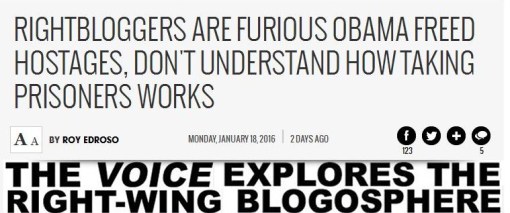
Village Voice hed

Why, it’s almost as if they would have preferred Ronald Reagan’s method. . . .

Via.


Circus Maximus MMXVI: Big time

18 01 2016

Former Virginia Attorney General and current Ted Cruz supporter Ken Cuccinelli, on New York values:

There’s lots of other things that go with that like cheesecake and big sandwiches.

Mm-hmmm.


Circus Maximus MMXVI: Dance this mess around

23 12 2015

I am old—I’ll hit a half century in 2016—so I have run out of patience for this kind of shit:

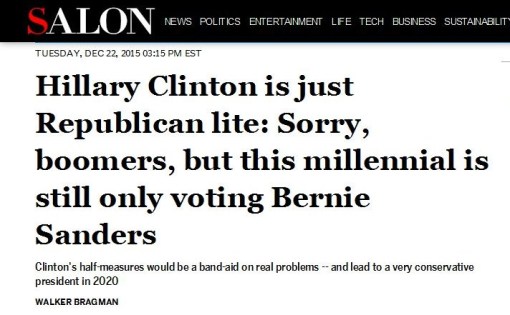
Hillary Clinton is just Republican lite

And, fucking hell, he had to make this a generational thing, as opposed to a self-satisfied-schmuck thing.

I’m not going to bother fisking Bragman’s “argument”, such as it is—Scott Lemieux at Lawyers, Guns & Money has been handling Bragman and others of his ilk quite nicely—but I do want to emphasize that when the 2nd-wave feminists argued the personal is political, this is not what they had in mind.

I get it: You don’t like Clinton. Fine. You don’t have to like Clinton. And the primary is the perfect place in which to register your preference for the senator from Vermont.

Hell, I plan to vote for Sanders (even if self-satisfied schmucks “feeling the Bern!” make me want to defenestrate my computer). And then I’ll go volunteer for the Clinton campaign.

You see, I know this election is not about ME ME M-FUCKIN’-E ME!

It’s about a chance to make things marginally better versus a chance to make things much worse, not just for me, but for folks in this country whose well-being ought to matter to any decent leftist.

Which the Bernie-or-bust bros, with their heads comfortably snuggled up their respective asses, are manifestly not.

~~~

Okay, so here’s where I also admit that I’m a hippy-hippy-forward-hippy-hippy-hippy-hippy-hippy-shake! hypocrite:

I voted for Nader in 2000. When I was old enough to know better.

Now, in my defense, I was living in Minnesota, which Gore had locked down, and I’m pretty (not, alas, absolutely) sure I would have sucked it up and voted for the vip had I lived someplace swing.

(And as an aside, if these Bern-burners live in states which are clearly in the tank for one party or the other, then, whatever, register your protest. But Bragman et. al. aren’t content simply with registering a protest: they loudly announce their preference any Republican to Clinton.)

But, yeah, I was pissed at Gore and even years into the Bush regime I liked to toss around the whole “he couldn’t even win his home state” bluster in response to (entirely appropriate) criticism of my vote.

I was an idiot. Not only would Gore have been a better president than Bush, he fuckin’ certainly would have been a better president than Nader. Who I voted for. For president.

Fuuuuck younger-me.

So maybe I’m particularly sensitive to these types “we’ll-show-’em!” of arguments because I am a convert away from them, and y’all know the converts are the most hard-core.

But it’s also worth pointing out how well that whole Gore Sucks movement worked out, how well that worked for the country, for the world—which is to say, calmly, quietly,

NOT FUCKING WELL AT ALL.


Who knows, tonight, we may lose the battle!

16 12 2015

How about some numbers?

I’m a theorist, yes, but when it comes to elections, you gotta talk numbers.

So how about some numbers for Reichstag elections 1919-1932?

  • January 1919 (percentage of seats; bold are Weimar Coalition 1919-20; after 1920, parties in minority)
    • Social Democrats (SPD) 39%
    • [Catholic] Center (Z) 22%
    • German Workers Party (DDP) 18%
    • Nationalists (DNVP) 10%
    • Independent Social Democrats (USPD) 5%
    • German People’s Party (DVP) 4%
    • Others 2%
  • June 6, 1920
    • SPD 22%
    • USPD 18%
    • DNVP 15%
    • DVP 14%
    • Z 14%
    • DDP 8%
    • Bavarian People’s Party (BVP) 5%
    • Communists (KPD) 1%
    • Others 2%
  • November 30, 1923 (seats)
    • DDP +DVP + Z 168
    • SPD 103
    • USPD 83
    • DNVP 71
    • BVP 21
    • KPD 4
    • Others 10
  • May 4, 1924 (percentage)
    • SPD 21%
    • DNVP 20%
    • Z 14%
    • KPD 13%
    • DVP 10%
    • German People’s Freedom  Party (DFVP) + Nazis (NSDAP) 7%
    • DDP 6%
    • BVP 3%
    • Others 6%
  • December 7, 1924
    • SPD 27%
    • DNVP 21%
    • Z 14%
    • DVP 10%
    • KPD 9%
    • DDP 6%
    • BVP 4%
    • NSDAP 3%
    • Others 6%
  • May 20, 1928
    • SPD 31%
    • DNVP 15%
    • Z 13%
    • KPD 11%
    • DVP 9%
    • DDP 5%
    • BVP 3%
    • NSDAP 2%
    • Others 10%
  • September 14, 1930
    • SPD 25%
    • NSDAP 19%
    • KPD 13%
    • Z 12%
    • DNVP 7%
    • German State Party (DStP, former DDP) 3%
    • BVP 3%
    • Others 12%
  • July 31, 1932
    • NSDAP 38%
    • SPD 22%
    • KPD 15%
    • Z 12%
    • DNVP 6%
    • BVP 4%
    • DVP 1%
    • DStP 1%
    • Others 2%
  • November 6, 1932
    • NSDAP 34%
    • SDP  21%
    • KPD 17%
    • Z 12%
    • DNVP 9%
    • BVP 3%
    • DVP 2%
    • DStP 0% (tho’ still held 2 seats)
    • Others 2%

The November 1932 were the last free parliamentary elections; after Hitler became chancellor in 1933, the fix was in, so while elections were held that year, they were in no way free. Even then, however, the Nazis couldn’t manage a majority: they received only 43.9% of the vote in the March 5 elections.

A coupla’ things to note about these numbers (helpfully provided by Fuad Aleskerov, Manfred J. Holler, and Rita Kamalova in their paper, Power Distribution in the Weimar Reichstag 1919-1933; note that they go on to analyze those electoral results and various governing coalitions):

  1. These are parliamentary election results, which may or may not have been reflected in who was chosen as chancellor—and there were alotttttta chancellors in this period.
  2. As noted in a previous post (as well as in bold, above), the Weimar coalition didn’t rule past 1920.
  3. A number of parties in parliament were, in fact, anti-parliamentarian: the rightist Nationalists (DNVP) most notably early on, and the Communist KPD and fascist NSDAP later.
  4. The two Catholic parties kind of straddled the republican line: The Center party (Z) was decidedly anti-left, but also valued their ability to participate fully in government; they moved to the right by the end of the 1920s. The Bavarian People’s party (BVP) was more conservative (and, obviously, found its power base in Bavaria) throughout this period.
  5. Finally, and rather importantly, look at those figures for NSDAP: After the failed beer-hall putsch in 1923, Hitler vowed he would take power via ‘legal’ means. Yet in elections from 1924-28, they were a marginal force in politics—the Nationalists were the main representative of the right in parliament. It was only after the onset of the Depression did the Nazis’ electoral fortunes improve.

That last bit is rather important: absent economic crisis, it is not clear that the republic would have fallen, nor that the Nazis would rise to destroy it all.

It’s an incredibly complex matter, complexities which I’ve barely touched on here nor in previous (and likely, future) posts, and which I’m still sorting out myself, but whatever other elements contributed to the end of Weimar, it’s nonsense to conclude that the republic fell of its own accord.

~~~

In addition to the Aleskerov, Holler, and Kamalova piece, I also relied upon Richard Evans’s The Coming of the Third Reich and Detlev Peukert’s The Weimar Republic for various electoral and party information.


We leave the door of Destiny ajar

14 12 2015

Superficially, one might see the resemblances between Weimar and the US:

  • the concern, even hysteria, over supposedly inhuman enemies
  • polarization in society
  • economic insecurity
  • sense of wounded nationalism
  • dizzying movements within the culture
  • distrust of government
  • violence

But even more apparent is the crucial difference between the two:

  • the acceptance of Constitution itself

This is crucial because, in Weimar, large portions of the polity never accepted the constitution, never accepted the republic.

Part of this was due to, as I mentioned, the post-abdication government’s acceptance of the Armistice, and of the signing of the hated Treaty of Versailles: the German public couldn’t believe it had lost, and considered the harsh terms of the Treaty unjust. That the loss of territory, control over industrial regions, and, of course, reparations, made economic recovery difficult only heightened the skepticism toward a government which had apparently allowed all of this to happen.

Not everyone felt this way, of course. While liberal parties never managed to hold a majority in the Reichstag after 1920, the Social Democrats, the German Democratic Party, and the Catholic Center Party did hold significant chunks of parliament throughout this period, with various liberals holding the chancellorship as well.

But even had the Constitution been configured differently—the chancellor was appointed by an elected president, he was not simply the leader of the majority party or majority coalition in the Reichstag—it’s difficult to see how the republic could have overcome the irreconcilable differences in the polity itself.

Germany was divided between the reactionaries (those who wanted to restore the monarchy), the conservatives (ranging from nationalist-bourgeoisie to militarists), and liberals (social democrats, liberal-bourgeoisie); tucked in amongst these were Catholic interests, which tended toward conservatism (fear and loathing of the left) but which also appreciated the chance to participate in governance; the Communists, which by the 1920s subordinated themselves to Moscow; and various fascist groups, which had almost no role in government but which fought and killed in the streets throughout the decade.

Finally, after 1925 and with the election of Hindenburg, the republic’s president was a man who loathed the republic.

But it wasn’t just the politicians and the parties (many of which had paramilitary arms which regularly engaged in violence), but the institutions of the state itself were cool to the republic. The civil service was thoroughly conservative, as was the judiciary as well as the army. Bureaucrats, judges, and military officials rarely attacked the republic directly, but they never accepted it as legitimate; in the case of the judiciary, they would often sympathize with rightists who were brought before the bench, and raising a “patriotic” defense was often the ticket to either acquittal or a lenient sentence.

So, for example, none of the surviving conspirators in the assassination of Foreign Minister Walther Rathenau served more than five years, and only one of the conspirators involved in the Kapp putsch served any time at all.

And, most famously, the man at the head of the beer-hall putsch in Munich, one Austrian corporal named Adolph Hitler (he didn’t become a German citizen until 1932), not only wasn’t deported, he was given free rein to speechify in court, and given only a five-year sentence in ‘fortress incarceration’—of which he served only a year.

The US polity is at least somewhat polarized (there is some controversy as to how much), but one touchstone for pretty much everyone is the Constitution: everybody who is anybody says they love it.

We don’t all love it the same way, of course, but does anyone think that the assassination of the Secretary State would lead to a sentence of less than 10 years? That the attempted armed overthrow of a state government (with the announced intention to overthrow the federal government) by a non-citizen would lead to prison term of merely 5 years? and that he’d be out after a year? and not deported?

In fact, for as violent a society as the US is, our violence is, largely, non-political. This hardly makes it benign (especially when perpetrated by officials of the state, i.e., the police), but neither the Democrats nor the Republicans have paramilitary wings and their members tend not to participate in assassination attempts of political figures.

Furthermore, when someone is killed for political reasons—say, a doctor who performs abortions—most political leaders will distance themselves from the act itself (even if they do express sympathy for the motive). Just as if not more importantly, prosecutors, juries, and judges tend not to wave away such murders.

In other words, whatever the problems with our republic, most citizens, most elected officials, and most of the members filling the institutions of government, nonetheless accept the structure of the government.

I am very critical of elected officials (say, some Republicans) who suggest that other elected officials (say, some Democrats) are illegitimate, in no small part because attacks on the existence of the opposition in government is an attack on the legitimacy of the government itself—a dangerous proposition for any member of government to take. But even with Joe Wilson’s “You lie!” and the birther conspiracies and Mike Huckabee’s intimations that the president is some kind of traitor  (Jesus FUCK, Huckabee!), I have no doubt that any attempt on the life of the president, members of his Cabinet, or of anyone running for president would be met by near-universal condemnation.

(Yeah, near-universal: there will always be those who celebrate assassination, and some of the public condemners might be private celebrators, but it would be understood by all that public glee at the murder of a public official punches one’s ticket to the fringe.)

Which is to say, as much as folks may dislike the government, it’s probably not going too far to say they’d dislike the violent overthrow of that government even more.

To be continued.