Hollowing out medicine (or, Leavitt is a bastard)

19 12 2008

Those fuckers have done it. Everybody knew it was coming, but it’s so egregiously bad that, somehow, I thought it might disappear into the trailing vapors of the soon-to-be-ex Bush administration.

From a story by David Stout, of the New York Times:

“Doctors and other health care providers should not be forced to choose between good professional standing and violating their conscience,” Michael O. Leavitt, the secretary of Health and Human Services, said in a statement on his department’s Web site.

The rule prohibits recipients of federal money from discriminating against doctors, nurses and health care aides who refuse to take part in procedures because of their convictions, and it bars hospitals, clinics, doctors’ office and pharmacies from forcing their employees to assist in programs and activities financed by the department.

Excellent. Never mind professional standards, fiduciary responsibility, and, oh, patient health and well-being. Nope, if you’re too wobbly, er, conscience-stricken to deal with birth control or IVF or emergency contraception or even letting a woman know that there’s this procedure known as (shhh!) abortion, and that the doctor down the hall might just be willing to provide you with one, you now have an executive-branch rule to NOT DO YOUR JOB. And still get paid, presumably.

I was never much of a fan of the so-called conscience rule (dating back to the 1970s Church amendments and to a 1996 directive), believing that if you choose to enter a particular discipline, then you agree to adhere to the standards of that discipline. This is particularly important in medicine, insofar as your primary duty is to your patient, i.e., not a theoretical construct but an actual, mortal, human being.

If you want to practice medicine, then you ought to think about what that entails. I briefly considered trying to earn a spot at the US Air Force Academy, but as my pop (who put in his own stint as an Air Force enlistee) pointed out, once you’re in, you do what you’re told. I don’t particularly like to be told to do anything, and the thought of carrying out the policies of the then-Reagan administration really didn’t work for me. My efforts ended with those stray thoughts. (For the record, I doubt I would have passed the psych tests.)

I’m not saying that all doctors have to perform abortions. However common a procedure, it’s a fairly narrow one, unlike, say, drawing blood or inserting a catheter. In other words, it’s pretty damned easy to avoid doing abortions. Not all doctors want to cut someone open, or examine children or work with old people; the appropriate response to these disinclinations, then, is to avoid surgery, pediatrics, and gerontology. That said, there may be times, however rare, when surgery, children, or old people are unavoidable: you then have a duty to care for that patient until you are able responsibly to hand that care over to another doctor. Along those same lines, then, it seems to me that knowledge of how safely to perform abortions should be a basic part of medical education—not even that every resident must induce abortion, but that each should know the process for doing so.

Still, mine is a minority opinion: the conscience clause for abortion seems pretty well set in American medical ethics. And I guess that as long as those who decline to do abortions are willing to refer a patient to a willing doctor, it is a reasonable compromise.

It is not clear to me (I’ll try to find this out) that the old conscience clause require such willingness to refer; what is clear is that new regs not only do not require this, they protect a wide variety of ‘health care providers’ from their refusal to assist in any way with procedures they find morally objectionable—including not only abortion, but also sterilization and the provision of contraception (including emergency contraception), and undefined research activities. (cf. p. 15 of the pdf doc in the above link).

I’ve only skimmed the document, so my rant is based more on impressions than a good, critical read. Key sections appear to be II. Comments on the Proposed Rule (pp. 13-  ; esp. 14-25 , 34-60, 68-77). Let’s just say that even this preliminary once-over is. . . GAH! I can’t even detail how fucking awful it is! Mealy-mouthed in its refusal fully to define or limit terms! Blandly dismissive of counter-conscience claims (and yes, Mr. Secretary, health care providers who perform abortions, prescribe contraceptives, and fill those prescriptions also have consciences!)! Condescending in its approach to patient concerns! Stupidly ignorant of how actual human beings make use of actual medical services! Derisive in its approach to informed consent and standards of medical care! And on and on and on. . . !

One more perverse invocation from an administration far more in love with its own mirrored image than the people it purports to serve.



Alive and kicking

17 12 2008

More or less. Troubles with the intertubes and grading and, mm, grading.

Lotsa thoughts, tho! More blather to come!

Can I save this post with a quote from Hamlet about ‘tomorrow and tomorrow and. . . .’

Damn. Can’t remember the whole thing. Still. Later.


Here is my blood shed for thee

13 12 2008

Last thing about Ainadamar (for awhile): Did I mention that after the performance I trekked up to Corporate Bookstore and bought two books on the Spanish Civil War?

Wait! There’s a reason for this! The libretto  included broadcasts from Radio Falange, and I wanted to know if these were the product of David Hwang’s imagination or actual transcripts. Here’s a sample (translated)

Our youth must be ready//to shed their blood generously/ for the sacred cause of Spain//Whoever is not with us/is against us//We’ll exterminate the seeds of the Revolution,/even in the wombs of their mothers//Long live death!

And later:

. . . And if we find them dead, we will kill them again. I give you permission to kill them like dogs, and your hands will be clean.

Well. I just started Anthony Beevor’s The Battle for Spain (c. 2006) so I don’t know if these are actual transcripts, but he does note, on p. 56 that the nationalist Foreign Legion, ‘Composed in large part of fugitives and criminals. . . were taught to be useful suicides  with their battle cry ‘Viva la Muerte!’‘ And, skipping ahead to p. 424, Beevor notes that ‘Ideological and religious invocations deliberately tried to make the violence abstract. . . . Carlist [nationalist] requetes were told that they would have a year less in purgatory for every red they killed, as if Christendom were still fighting the Moors.’

So much for the notion that Al Qaeda invented the (anti-)political cult of death.

In any case, I was seized by the notion of the ideological underpinnings of massacre. What makes it killing those who are not trying to kill you okay? It seemed—seems—a tremendously important issue.

But as I thought more about this, I remembered the work I did a lifetime ago in a human rights seminar in grad school. We were trying to theorize about human rights abuses, and, frankly, having a terrible time doing so. There were too many massacres, across all populated areas, from all different ethnic, religious, and ideological groups: how does one find a way through such a fog of data?

One key feature, as discussed by Leo Kuper in his book Genocide, was the dehumanization of the victims. They were a cancer, an infection, rats, insects—anything which not only removed them from their fellow humans, but which also made it a positive good to eradicate.

But the casting out of humanity of the victims is only part of the story; what of the killers? There have certainly been a number of studies of the sociology and psychology of mass killing—cf. Ervin Staub The Roots of Evil; Robert Jay Lifton’s The Nazi Doctors; Christopher Browning’s Ordinary Men, among others—but what of the specific ideological indoctrination? Robert Proctor gets at both the material and ideological aspects of Nazi scientists and doctors in Racial Hygiene, as does Benno Muller-Hill  in Murderous Science, but even these are more sociological than political-ideological.

What kind of ideology posits mass murder as a good? National Socialism was proudly genocidal, but does all fascism necessarily lead to the valorization of massacre? And Stalinism was clearly genocidal, but that seemed more cultic or psychopathic than ideological. (That said, Bolshevism wasn’t all sunshine and daisies, and Bolshevism clearly shaped Stalin. And no, I’m not one to think Lenin was somehow betrayed by Stalin: ol’ Vladimir may have been more pragmatic than Stalin, but he was a revolutionary, after all, with all the ruthlessness that implies.) The errors and crimes of Leninism and Stalinism are clear to me (if not their precise etiology), but Marxism is an ideology, if not always a practice, of liberation.

Capitalism? Certainly, in practise it has sanctioned the treatment of humans as ends rather than means, and there is plenty of violence woven into long history of the emergence from pre-capitalist economies and societies as well as colonization. And, oh yes, there were more than a few killings commited in the defense thereof during the Cold War. Yet, as with Marxism, as an ideology it pitches liberation.

Furthermore, I think it makes sense to distinguish between massacres, such as My Lai, and concerted extermination. It may make little difference to the victims of such massacres whether their deaths were the result of  a (morally, psychologically) chaotic situation or a fixed program, but as I’m trying to get at the programmatic content of mass murder, the distinction is important. In the former case it is a kind of criminal accident, a breakdown of ordinary operating procedures: Even if the soldiers or killers are not ultimately punished, the massacre itself must be explained [away] as something extrinsic to the (political, national) cause itself. In the latter case, however, massacres are intrinsic to the cause, necessary as both means and end.

Hm. I think that’s a part of it: an ideology in which death is not a mere (unfortunate) means, but a desired end. And this bifurcates: it is necessary and good to kill these others, as it is necessary and good for ourselves to die in battle against the others, and for ourselves.

So back to the ideology of death. Is this its own ideology, or a component of other ideologies? Can it be integrated into other ideologies? Does it require a belief in some kind of life [for the killers] beyond death?  And whatever its status as a freestanding or constituent part of another ideology, does the embrace of death mark the ideology as anti-political?

That last question, at least, I can answer: Yes. Politics is about the world, a particular kind of being-in-the-world which is predicated on human life (yep, Arendt again). To disdain such life is to disdain politics.

I’m not saying anything particularly shocking here: What violent dictator hasn’t asserted his triumph over politics? And while I think there is a political (i.e., worldly) agenda of Al Qaeda, from what I’ve read of bin Laden or Mullah Omar’s speeches, ideologically, they’re all about wiping out politics.

Sigh. Don’t know how much this helps me with the whole exterminationist-ideology thing, tho’.

Anyway, I did at least discover that one line from the opera is authentic. It is the response of the fascist Ramon Ruiz Alonso, to the question of the crimes of Lorca:

He has done more damage with his pen,/than others have with their pistols.


The Republic was a dream

12 12 2008

Still mulling the Ainadamar experience. The gathering-together for a purpose: the musicians and singers to perform, the audience to take in this performance. Yes, there was planning—practice, rehearsals—and those of us in attendance knew what was to be performed and who would perform.

But the. . . power? force? of the live performance is that it is live, i.e., that it is unpredictable, that anything could happen. Unpredictable is usually bad, insofar as it’s associated with things like falling lights or malfunctioning, er, wardrobes, or, as in the case of the Austrian actor, stabbing oneself with a real rather than prop knife. But what of the silence at the end of the performance? Is that usual? Why was it? Were we soaking it in? Waiting to hear if there’d be more music? Not wanting to clap ‘out of turn’? Just letting the moment be?

I don’t know. Any or all or none of the above. Regardless, it bound us all together, suspended us in a held breath, a silence both fraught and still.

I could not have imagined this. I could not have experience this in my apartment, or alone in that theatre. The performers threw themselves out there, and we could only marvel at their flight, and catch them at the end.

Am I making too much of this? No; I am making too little. It was as  mentioned in a previous post, and as I told Jtt.: The performers opened themselves to us, but I couldn’t open myself to them, not enough.

When I say the performers lay themselves bare, I don’t mean in every way. I knew almost nothing about them beforehand, and almost nothing after—performance ain’t group therapy. No, I mean a nakedness at the moment of performance, in the revelation of that part of themselves which was crucial to the performance itself. Sing Margarita, sing Lorca, sing Nuria and Ruiz Alonso, and bring yourself forth in bringing them forth.

It is an act of discipline and bravery.

I am sobered by all they brought forth, and my inability to respond in kind. I recognized this failing during the performance, as I kept yanking myself out of the moment. But it’s not just about ‘being in the moment’; there is also the willingness to let oneself be carried away by the moment. I wouldn’t, couldn’t, sustain that.

And yet, as I told Jtt., I could at least see this, I could see that being carried away isn’t always all bad. Carapaces and defenses and distances all have their place in my life—I do not yearn for my juvenile melodramatic self—but snark and detachment can get in the way of wonder.

I’ve joked with my students that political science doesn’t really deal with passion—‘we don’t do love’—and as such, misses so much of what drives people to meetings and demonstrations and to take part in all the scut work which is a necessary part of political action. And an analytic which doesn’t take heed of Arendt’s observation that politics happens when people gather together, that political power arises from that purposeful gathering, will miss both the passion and the purpose.

The gathering at Carnegie Hall this past Sunday was not a political one. But it was a reminder of the power of the gathering, of the purpose of passion.


For you are the one and the all

10 12 2008

A new crush: Kelley O’Connor, mezzo soprano. Or is it for Frederico Garcia Lorca, as portrayed by Kelley O’Connor? Sexy and doomed—irresistible.

Should I revisit the issue of crushes, limning the differences among crushes (from afar, either to know the person or to know the work; for a character, fictional or portrayed; or up close, as a friend-crush or get-naked crush)?

Nah.  Given the uncertainties of this latest bout of sighing—for the girl? for the girl-who-portrays-the-boy? for the boy (who himself liked boys)? for the portrayal of the boy?—I’ll forsake the excavation in favor of play.

Queer affections: so much fun!


Ainadamar

8 12 2008

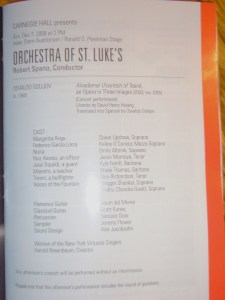
The musicians were tuning their instruments as we entered the auditorium. Some of them sauntered in, a violin or french horn in hand, others stood, and others sat and concentrated on the score in front of them.

It was my first performance at Carnegie Hall, and I leaned forward from my second tier seat to take in the sight. The space itself is relatively spare, for acoustical reasons, I’d guess, but it felt luxurious to be seated in a box with five other people. I’d brought Ricola to stem any inconvenient cough (tho’ later spied the overflowing bins of Ricola near the tops of stairs), and dug out my kleenex. I was prepared.

010

The concert performance, after all, of Osvaldo Golijov’s Ainadamar, about the death of Frederico Garcia Lorca (sung by Kelley O’Connor), about his life, and the life and sorrows of his friend and would-be protector Margarita Xirgu (Dawn Upshaw), would almost certainly make me cry. I hate to cry, and I cry every time I listen to the cd, but I can’t not listen to such beauty. And I did cry—when Margarita fails to convince Lorca to flee to Havana with her, when the Falangist Ruiz Alonso (Jesus Montoya) calls for the head (Ay! Entregeuenio, ay Dios mio, al cabezon!) of Lorca, and started crying when the guard (Kyle Ferrill) sings to Lorca to confess and didn’t stop until after the volley of gunshots ended. Oh, and (I thought I cried only three times), as Margarita sings out her death.

I came to Dawn Upshaw the way many of us non-opera (or new-to-opera) do, via Gorecki’s Symphony no. 3, ‘Sorrowful Songs’. I heard it in the movie Fearless, and paid close attention to the closing credits for the song. I was am (still) only very slowly making my way into opera, but I was caught by this music. Now, whether that was due to Gorecki or Upshaw, I don’t know, although I have pursued both the composer and the soprano.

The draw of this program was not only Upshaw, however, but also Golijov. I first read about his St Mark’s Passion many years ago (still haven’t heard it), and his name stayed with me. A few years ago I heard an interview with him, and the interview featured extensive excerpts from Ayre and Ainadamar. Oh! I think it was a dual interview, with both Golijov and Upshaw. Rekindle interest in Upshaw. Rekindle interest in Golijov. Buy the cds.

So I thought I knew what I was getting into today. (I brought kleenex, fer cryin’ out loud!) But I was tossed back in my seat by the power of the live performance itself. To sit in an auditorium with a few hundred other people and watch and listen to these men and women give themselves wholly over to the music, to us—oh, I had forgotten what it was to witness such fearlessness, to be enveloped by such naked sound.

There was no irony, no detachment in this performance. Yes, there is the physical distance between the stage and the seating, but Upshaw and O’Connor and Montoya (and Emily Albrink, as Nuria, Margarita’s student) did not stand back from their characters or this music. Conductor Robert Spano swivelled his hips along the sinuous line of Golijov’s music, which seemed distracting at first, but I came to see less as indulgence than his entire body responding to the opera. And at the end! I’d forgotten the great and furious charge of the orchestra at the end, and watched as the double-bassists bent over their instruments, following the movement down and across the strings.

So much more to say. The tenderness between Margarita and Nuria, as first Margarita leads her student, then the student holds up the teacher. The sexiness of ‘A la Habana’ as Margarita and Lorca imagine ‘alegria, coral y tambor, ay!’ And, noticing, as Margarita sings ‘Adios’, Lorca and Nuria, sitting off to the side, holding hands.

And the long silence at the end, as we all waited, waited, waited, before the clapping began.

To give oneself wholly over to the moment—that is a gift worthy of ovation.


Get offa my cloud

6 12 2008

Getting bogged in the blog.

I have in mind a couple of pieces (about abortion, morality and politics) in which I lay out a comprehensive argument, with arrows running hither and yon, connecting outliers to the center, blah blah, so as to capture as fully as possible the phenomenon under investigation.

Hah.

Bit by bit, I know. Still, I used to be able to pull my thoughts together for more than a paragraph or two, so my current impatience-slash-laziness (hm, what is the connection between impatience and laziness? I’ll have to blog on that. . . .), both feeds that distraction and increases my sense that I should do. . . something.

Anyway, a coupla’ good pieces on abortion and conscience clauses from Slate:

Dahlia Lithwick notes that so-called conscience clauses only run one way, that is, those who oppose abortion (and anything contra-conceptual) may opt out of their fiduciary responsibilities to their patients any procedures or conversations related to these matters, but those who do provide abortions have to read from scripts with which they disagree and know to be medically misleadling.

And William Saletan has more on the obsfucations surrounding the morning-after pill, involving, unsurprisingly, the substitution of religious for medical definitions. My take? Hey, if you want to make a religious argument about the status of the embryo or fetus, go right ahead. But don’t misrepresent that position as the scientific or medical definition.

Shite. Now I’ll have to blog on the relationships between science, medicine, and morality. And, oh, hell, let’s throw in politics.

Okay, one last thing: the William Ayers op-ed in the New York Times, and Obama’s interactions with Ayers. There’s a lot that’s provocative in this piece, but I want to pull back and consider the larger question of conversations/arguments in the public square.

I gotta go to work, but I want to argue that it is precisely in public that one is able to meet or even consort with those with whom one disagrees, or even finds distasteful. (Remember, I’m an argue-and-eat-pie kinda gal.) I wouldn’t invite a fascist into my home, but I’d certainly talk with her outside of my house.

Shit, this could all get quite complicated quite quickly, and I really do have to go. Would it make sense to say that the public is a more a space of freedom and the home more a place of judgement or discernment?

Nah, I didn’t think so. More on this. Eventually.

Hah.


Sing a song

4 12 2008

So I’ve used the same Poi Dog Pondering song for THREE posts. Yeesh. And I discovered this while checking to see if I used another title previously—which I had (neither post was published).

It’s not as if I don’t have enough song titles and lyrics to choose from. Yeah, ‘Sandra at the beach’ is explicitly about same sex love (‘no kinds of love are better than others’), but it’s not as if I require my posts and the titles or lyric bits to line up exactly. If I like a line, I use it—in this case, three times.

Gotta keep on top of things.

Shees.


Java jive

1 12 2008

Bit by bit. I keep forgetting that, but it’s bit by bit that one’s life settles into the ground.

I was in GradCity for over a decade (w/a year’s interlude in SouthwesternTown), and didn’t really notice how much I adapted to that city until long after I left it. The bus routes. The running and bike routes. This restaurant and that diner and the coffee shop on the corner and bourgie co-op and the militant co-op and the hidden beach with the nudists and the punks and the families and the men in suits (really!). My loop of used bookstores (starting at the cheapest one first, of course) and cd shops. The old Nat and the new (hated because new and then Oh My God It’s Fantastic!) pool and gym. The cheap movie houses and the really good-not-horribly-expensive theatre and the dive bars and wine bars and bars for groups and bars for couples. Mexican and Thai and Caribbean and Vietnamese and American soul and American diner food.

And friends. Pla and Pl and Pt and J and C and D and K and I and L and T and S and C and Js and R and Jn and god, I must be forgetting some.

Nostalgia? Not really. I didn’t like GradCity at all. Okay, my last two years there weren’t bad, especially since I had finished my dissertation and was lecturing or post-docking, but I used to complain (LOUDLY) of how much I despised the place.

But I had a life there. Bit by bit, I put together a life there. And now I live in a city which drives me around a freakin’ bend but where I really really (mostly) really want to make my home, and I haven’t yet figured out (switch to rock climbing metaphor) where are the cracks and footholds. Why not? Because I’ve been so busy trying to live in the entire freakin’ city that I’ve forgotten that I live in it in pieces.

I have tried forcing things, eagerly looking for ‘my’ cafe or park or neighborhood, but these things can’t be forced; they have to come on their own. They come when I go back to a cafe or shop or neighborhood because I’m drawn there—when the place catches on me, rather than me trying to grab on to it.

When I was a teenager my family travelled to New York on vacation, and in the midst of one of those scarifying bus tours (‘Look to the left, people, look to the left. If you don’t look to the left you won’t see it.’), we stopped at this amazing Episcopal church. I remember poking around and glimpsing, through a door, this stoneyard out back. A stoneyard! All of a sudden, the guide’s comments about this church being a work-in-progress slid into a literal, concrete, reality. This old craft in this becoming-building in New York City.

I remembered that when I moved to New York, and on a both very good and very bad day I took the train up to the Cathedral Church of St. John the Divine and rested in this large, still, space.

There’s more to be said about that, but I mention it because that’s one piece. (I have also tried forcing a relationship with this place as well—that’s a part of the more-to-be-said—but St. John’s stays with me, regardless.)

And there is another piece, as well, a coffee shop I found courtesy of Rod Dreher at CrunchyCon, where I can buy my dark roast free trade coffee—Porto Rico, on Bleeker just off W 3rd. It sounds dumb—why not just buy Paul Newman’s coffee at Target?—but I love the act of making these people, in this place, a part of my life.Yeah, it’s a wee out of my way, work-wise, but why let the work commute dictate all? Plans, and all that. . . .

Bit by prosaic bit. The poetry rises out of this.


Stay awake

27 11 2008

Given so much killing, this would not be the worst way to live:

027

(From a building across the street from Temple Emanuel-El, on Fifth and 65th.)

—–

So this is a bit of a cheat—I adapted this from a comment I left elsewhere:

I grew up in a small town in the Midwest, moved to successively larger cities, and now live in New York City.

Needing to get out of the house today, I bopped over to Manhattan and strolled through Central Park. It was a bit late—the light was low—but I could catch a few images of this grand and humble place:

01510211

(stretched this one out a wee)

(jacked the contrast on this one)

I wandered around the neighborhood east of the park for a bit, taking in the discreetly exclusive apartment building between Fifth, Madison, and Park, exchanging greeting with doormen leaning out of doorways, and peeking into warmly-lit restaurants serving dinner this Thanksgiving. This is the genteel and lovely New York of near-past movies, recalling generations of families lucky enough to live within those warm lights.

Not that most New Yorkers have done so, of course. This was (and is) a city of working people, crammed together in slouching tenements which call forth a history neither genteel nor lovely.

Still, it is as easy to fall in love with the romance of hard times as it is to yearn for a sepia-lit life overlooking the park. To live amidst the tumultuous grace of history!

One of the things I love (and mourn) about this place is precisely that sense of history: when I walk through the Financial District early on a Monday morning I see the old iron sconces on the side of one building, the Art Deco doors on another, and the amazing mosaic at the entrance to the ITT building. It’s all still there.

Except, of course, it’s not. The old tenants have moved out and a pharmacy or bank or Starbucks has snuck in, and where o where is the idiosyncratic New York I moved here to find? Where is our tumultuous grace?

It’s there and it’s gone. New Yorkers are constantly bemoaning the loss of the ‘real’ city, the one which existed when they were teenagers or first moved here or yesterday, the city which justified the high prices and the crowds and standing-room only train cars. But this is the real city, today, and while I wish there were still Italians in Little Italy and working-class Jews on the Lower East Side, there are Poles in Greenpoint and Russians in Brighton Beach, hasidim in Williamsburg and Crown Heights and mosques in Bed Stuy. The Hare Krishnas and Scientologists lurk in the Union Square train station, and I even saw one brave soul setting up a McCain/Palin table not too far from the saxophonist. People from California and Cameroon and Oklahoma and New Zealand are tucked into corners all over this city, criss-crossing and occasionally bumping into one another. There’s the Stonewall Bar and the Cathedral Church of St. John the Divine (finally fully open this Sunday) and the wrecked earth from the Sept. 11 attacks posed in Battery Park.

This city erects and erases and absorbs its histories and cultures, mystifying and horrifying and, finally, gratifying those of us who are still learning when to hustle and when to slow down.

Where is your tumultuous grace? It’s there and it’s gone, wherever you are. Pay attention, wherever you are.