In a town called malice

3 02 2017

nope not even close they haven’t even begun to absorb that there are real (as in physics and all not just public will/opinion) limits to economic growth, to employment, to pollution, wealth/resource extraction etc. —dmf

I was going to offer a short response to dmf, but decided to pull it out for a more considered consideration.

The short response is: yes, I agree. When I wrote that HRC and the Dems had done a decent job with the practicalities, I meant that there were some specific policy ideas (regarding, say, college and vocational education, job retraining, etc.) which would likely have done some good. Grand visions are grand, but how to build them?

That said, I agree with dmf that the Dems lack that grand vision which takes a hard account of the limits of our current economic and social standard operating procedures. Incrementalism has its place, is necessary. even, but it is not enough, and neither any post-Reagan Democratic presidential candidate nor the party as whole has offered a comprehensive strategy for dealing with the world as it is.

Despite occasional Democratic victories, the failure overall has been monumental.

I have my own ideas of what that strategy should be, as well as what could be some of the policies (again, some of which might be adapted from the 2016 Dem platform) which would put those ideas into practice. I’ll be tossing them out less with the sense that THIS IS IT than This should be in the mix—less from certainty, that is, than possibility.

I am certain, however, that that comprehensive strategy in service to a grand vision is necessary, not just to overcome the meanness of the GOP view, but to be able to comprehend how deep the troubles are.

We can’t get better if we don’t have a way to see how bad we are.


Try to stay healthy, physical fitness

3 02 2017

Stand up! Fight back!

Yes yes yes: Good to remember, good to shout. Let us oppose this wretched administration in every way. But opposition is not enough.

I’m not saying anything particularly original, here. We’re riled up because the actions and policies of Trump, Inc. are an offense against our values, threats to our ways of life. Most of us out there yellin’ aren’t political nihilists, but seek to defend what matters.

And we—perhaps I should stop with the royal “we?—and I have to keep that close, that I am standing up for what matters to me as a citizen and as a human being, that I should not simply become the negative to whatever this administration proposes.

This doesn’t mean I think protesters or Democratic politicians should play nice, but that our dissent is not just about Trump or Steve Bannon or Jeff Sessions and their terrible policies, but about what we want our country to look like, to be.

I don’t know that all of us agree on that, which is fine, not least because I don’t know that all of us know. But if I am fine with obstruction as a tactic, it can’t be the entire strategy—that would just turn us into counter-Republicans. Our goals have to extend beyond NO.

That we should be “large” is something I’ve already mentioned: big-hearted and generous welcoming, confident and curious and capacious in our thinking, willing to take risks and just as willing to take care.

Hillary Clinton and the Democrats did a decent job of with the practicalities of how to build a better country—I and many others have our disagreements here and there, but there was a lot to work with—but I also think the Dems have coasted on a reassuring rather than compelling story of America, and that that wasn’t enough.

Trump has given the country his frightening, fearful, fractured, nasty vision of us. We have to say No! to it, to yell Stand up! Fight back! But that’s not enough, we also have to shout about what we’re fighting for.

Because we can’t just react to these wretches, to let them dictate our actions. In standing up, we have to stand on our own, and forge a new way.


We blended in with the crowd

31 01 2017

I’ve marched in enough protests to have lost count, but I admit that I’ve kinda lost my marching ways.

It’s not that I think marching is useless, not at all: it’s just that I’m lazy, and I find going to protests alone slightly depressing.

Still. I missed the NYC Women’s March (migraine, laziness, mood), but in reading about the many, many, many rallies from around the world, I was a little wistful. Also, I kept seeing the same refrain from women of color: All of these white women showing up for themselves; will they show up for anyone else?

And I thought: Good point.

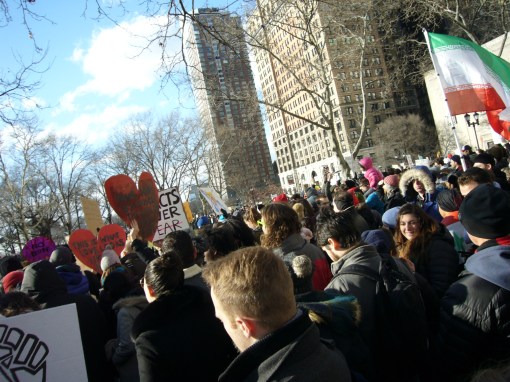
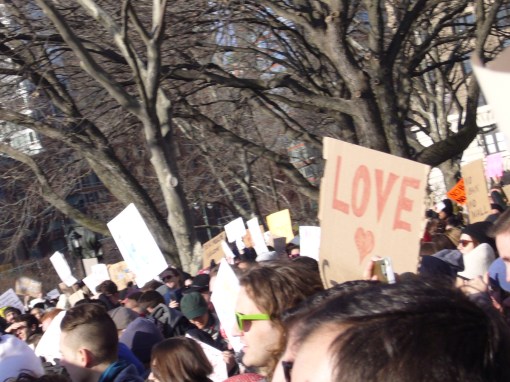
So, last Wednesday, when there was a rally for immigrants and Muslims in Washington Square Park, I jumped into my Docs and headed on ovah. As I mentioned on Twitter, it was bracing to stand with thousands of others and yell “Stand up! Fight back!”

Not depressing at all.

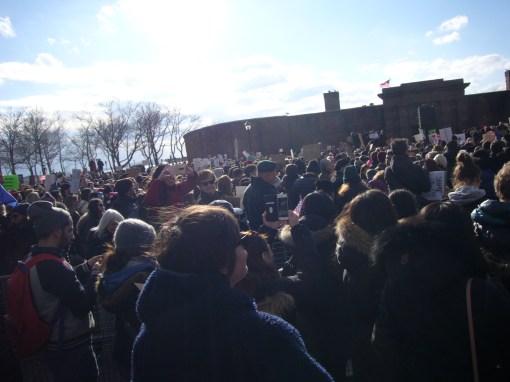
Then, this past Sunday, in response to the execrable executive order on refugees, travellers, and would-be immigrants, I joined even more folks for a rally/march in Battery Park.

005

011

014

Lotta good—short! rally speeches should be short!—speeches tucked into two hours, but I confess to ducking out at Rector Street a few blocks into the march (the third hour) to head back to the train. It’s gonna take me a bit to get back full protest stamina.

Oh, and did I mention that the route to the 2 took me down Wall Street and past the Trump Building?

Yeah, I flipped it off both coming and going. Petty, but satisfying in its pettiness.

Anyway, there’ll be more protests—Clio knows there’ll be more protests—and I’m working on rounding up some fellow marchers, but I showed up, and it felt good

It might even have done some good.


On a rooftop in Brooklyn

25 01 2017

Yesterday both cats scrambled to get on to the windowsill to gawk out at what I figured was a pigeon.

Well, it was, but not in the way I was expecting:

024

She really went to town on that thing:

023

She hung around, snacking, for a good long time, before lifting off with what was left of the carcass and leaving just a puddle of feathers behind.

I’m not a bird-watcher, so even with the help of various online guides I can’t be sure, but chances are that bird o’ prey was a red-tailed hawk. They’re pretty common in the city, but this was my first up-close-and-personal sighting.

Pretty cool.


Packed up and ready to go

24 01 2017

Given the news coming out of federal agencies of stifled staffer communications as well as numerous instances in various Republican-led states of information disappearing from government websites, it is not alarmist to think that information which is currently available may end up disappearing.

If you, as I do, rely on these documents for your work (or whatever), I strongly urge you to download and save this information on your own devices.

I make use of a number of NIH docs, only some of which are easily downloadable as pdfs (which I did); the rest, I screenshot and saved as pdfs. Screenshot-to-pdf isn’t as good as a straight-up pdf doc, but it does allow you to preserve the information.

(I use the free Fireshot add-on, which is really easy to use; there are also others available.)

There are millions of documents which are currently accessible to the public; I dearly hope someone is copying over as many of them as possible.


Nazi punks fuck off

24 01 2017

So y’all have seen the video (or the many gifs) of Richard Spencer punched in the head, yeah?

Anyone conflicted by the sucker punch? Anyone conflicted by their lack of confliction over the sucker punch?

I’m not conflicted. Mind you, I wouldn’t exactly recommend sucker-punching Richard Spencer or any run-of-the-mill Nazi, but I took perhaps too much satisfaction in seeing that fist upside this guy’s noggin.

As an Arendtian, I’m leery of the introduction of violence into the arena of discourse, i.e., if you’re able to talk, do that—but what if your opponents don’t accept the terms of that discourse? What to do, for example, about a white supremacist who thinks ethnic cleansing gets a bad name, has advocated for the forced sterilization of black people, whose website ran an article called ‘Is Black Genocide Right?, and who is using the instruments of democracy to undermine said democracy?

What do you do with a guy who would get rid of you just for being you?

That longstanding dilemma in liberalism—how to deal with illiberalism—is longstanding precisely because there is no easy answer. I tend toward the civil libertarian view, which says tolerate the intolerant, because I don’t want the state to throw people in jail for bad views. Clear, direct threats—sure, but general espousal of an abhorrent world-view, even a Nazi world-view? No.

But what about in political society? How may we as citizens respond to our fellow citizens who would seek to strip us of our full status as citizens? If you (Nazi, ISIS fighter) say you want to get rid of ‘my kind’, can I hit you?

Legally, no. If I hit you and I get caught, I ought to be charged with assault.

And tactically, that might not be the wisest decision, for all kinds of reasons, not least because it could lead to greater violence, which will lead to the breakdown of politics right quick.

Finally, if you believe as fervently in politics as I do, then one ought to act politically, i.e., through speech and coordinated public actions, not violently.

Yet for all that, I honestly cannot condemn the guy who walloped Richard Spencer. This is one of those cases where the better angels of my nature are nowhere to be found.


Get you instructions, follow directions

19 01 2017

I’ve been pretty crappy in this whole RESIST! thing.

Yes, I wrote the letter(s) and yes, I keep thinking—thinking matters!—but I see exhortations to Do X! Y! Z! on Twitter, and I’m, like, Um. . . .

WELL, I’ve finally found something which suits my house-bound ways: I’m gathering information for the Resistance Manual, on online, open-source, er, source of resources. I’ve already added citations to the readings list, as well as plugged in data for Wisconsin, New Mexico, and Minnesota.

It’s all pretty basic, thus far, but you don’t get to the complicated stuff without that basic foundation, so I think I’m, y’know, actually contributing something.

(I’ll keep adding information to my Life during wartime page, if only because I have my own idiosyncratic interests that may be best kept confined to this here site.)

Oh, and I did, finally, manage to call my Congressfolk: Rep Clarke (Thanks for boycotting the inauguration!), and senators Gillibrand (About those Sessions/Price/DeVos votes. . . ?) and Schumer (Yeah, vote against Sessions! Yeah!). Schumer’s DC line was way busy, so I called his Manhattan office—hell, it all gets to them.

Like many people, I’ve developed a thing, which is to say, a problem, with calling people I don’t know. Pre-email I never would have won a cold-calling award, but now that there are ways besides actually phoning to people I don’t know I prefer. . . not to phone people I don’t know. It’s a bit of an issue.

Anyway, my friend T. mentioned that she’s programmed her politicians into her phone and I thought, Hey, that’s a mighty fine idea. Then, once I did that, I thought, Hey, why not actually, y’know, maybe, call ’em. So I did.

It was nothing, as of course the rational part of me knew. They don’t know who I am, they don’t care how eloquent I am, if they saw me on the train they wouldn’t point and giggle She’s the lady who stammered her comment, and they’re not writing Ms. Absurdbeats of Lefferts/East Flatbush called to say. . . .

Nope, all that mattered was that I gave an opinion on something the rep/senator did, and they noted that.

So, if you’re like me, not crazy about cold-calling politicians, don’t worry: they have people, and those people know how to write Right On! or Ugh! and then politely issue you off the phone and not think about you again.

And I bet that when I do call again, they ain’t gonna remember me—which is just how I like it.


Singing songs and carrying signs

17 01 2017

My Congressional representative, Yvette Clarke, is not attending the inaugural. Yay!

My senators, Kirsten Gillibrand and Chuck Schumer, are attending. And that’s fine, too.

I have, over the years (decades. . .) come to appreciate the importance of institutional norms and of the necessity of recognizing the peaceful transfer of power. That a nation is able to vote out leaders and peacefully replace them is an accomplishment.

That’s why I’m fine with my senators attending the inauguration. But why then cheer Rep. Clarke?

Because the President-elect has no interest in institutional norms, has stated his disdain for the notion of a peaceful transfer of power when the voting citizenry elected someone he didn’t like, and has barely acknowledged that he is, in fact, the president-elect of the entire nation, not just the minority that voted for him.

Regular folks (i.e., non-political scientists) are often frustrated by what they see as the hypocrisy of politicians—the paeans to “my dear colleague” in the Senate, the inclusion of members in the opposite party in the Cabinet, a partisan president vowing to rule for all of the people, etc.—but these gestures matter. They are way of saying politics isn’t war, and we are not enemies.

That matters. A lot.

So some Democrats will attend the inauguration to uphold the principle that we, however fractious, are a people, and we honor the institutions by which we are so constituted, and some will boycott to uphold that same principle.

That seems about right.


No time for dancing, or lovey dovey

10 01 2017

I’ve never been accused of optimism.

Well, okay, I was a happy happy kid, likely to believe that the Good will out, but nothing like a bout of life to kick the stuffing out of such positivity.

That said, I do think part of our political resistance ought to have nothing to do with politics at all, that it is not enough just to resist: we must celebrate the Good in the world. There should be dancing, and lovey-dovey: We want bread and roses, too.

~~~

In my piece on Modernity’s Ideologies I divided the response to the historical moment, Modernity, into particular worldviews (Liberalism, Totalitarianism, and Reaction), and extend the various ideologies out from those worldviews.

This can lead to a bit of confusion, insofar as I identify both Liberalism as a worldview, and liberalism as one of its ideologies. I’ve considered changing Liberalism to, say, Pluralism (which would then contrast nicely to Totalitarianism), but I think the term as I mean to use it is so entrenched in political theory that switching it up might simply lead to greater confusion. (I still might be convinced otherwise, but at this point, I’ve stuck myself with Liberalism and liberalism.)

What does this have to do with anything? Well, Liberalism can itself contain and tolerate a variety of illiberal elements, but its ideologies (liberalism, conservatism, and reform socialism) will generally seek to uphold and even further a Liberal worldview, even as they may, at times, be used to further what its opponents might argue are illiberal goals.

See, for example, disputes over whether business must serve all customers or if they may choose to turn some away. Those in favor of serve-all refer to principles of equality and justice, while those against might call on individual liberty and, yes, justice as well. These partisans are using Liberal values to advance/defend their particular ideology.

Now, various disputes about campus activists, safe spaces, trigger warnings, etc., often bounce back and forth between worldview and ideology, and often in ways which obscure the level at which the dispute is taking place. So, for example, someone like Jonathan Chait or Mark Lilla might chastise those campus activists as behaving illiberally, when it seems their real beef is that they appear to be acting against pluralism and tolerance, i.e., against Liberalism.

I’m not convinced of this, not least because I think Liberalism can also contain fierce partisanship and passionate, intemperate, even intolerant argument. I think, for example, that instead of smacking the activists as bad Liberals (which they probably could give a shit about, anyway), the tut-tutters should engage the argument at the level of ideology—by which I mean, actually engage the fucking argument instead of dismissing it as impolitic.

In other words, while I do think it’s necessary for liberals (and conservatives and reform socialists) to defend Liberalism, I also think that liberals (and conservatives and reform socialists) and anyone else gets to fight for what their version of the Good, and to do so without apology. If you disagree, fight back.

That, I would argue, is a great way to defend Liberalism.

~~~

But let’s get back to the fighting-for: we need to do more of this, without apology. I don’t mean nastily or triumphantly, but sincerely (jesus, did I just write that?) and profoundly and yes, even giddily.

As a bread-and-roses socialist, I want more dancing, more music, more art, more celebration of all we could possibly be. These are good, and part of the Good of human life.

This celebration needs a political grounding and goes beyond it—and in so doing, helps to justify the grounding itself. Liberal politics are often criticized—I’ve often criticized it—as deracinated, worn-out, and in its pure-procedural form, it is; but Liberalism is not just proceduralism, it’s also about possibility, an openness to what we can’t yet see. It’s about something more.

So let’s claim that, that openness and art and possibility, without apology.

I don’t want to reduce all of life to politics—too totalizing—nor demand that all celebrations celebrate all things—again, too totalizing. But when we have the chance to say, This is good, this song, this movie, this dance, is good, let’s take it.

When we have the chance to dance, let’s take it.


It’s another round in the losing fight

6 01 2017

Yet again.

John Mellencamp might have seemed the go-to guy for the title of this post, but there’s something about Emmylou’s weariness that seemed more appropriate.

Anyway. Native Iowan and newsman Robert Leonard writes (in the Times, natch) about how the hard-working, conservative, Christian folk of rural Iowa view those of us beyond the cornfields:

They are part of a growing movement in rural America that immerses many young people in a culture — not just conservative news outlets but also home and church environments — that emphasizes contemporary conservative values. It views liberals as loathsome, misinformed and weak, even dangerous.

He goes on to note that these rural folk may be alienated not just from the fabled coasts, but the cities in their own states.

Overwhelmingly the blue counties are along waterways, where early river transportation encouraged the formation of cities, and surround state capitals. This is also where most investment in infrastructure and services is made. Rural Americans recognize that this is how it must be, as the cities are where most of the people are, yet it’s a sore spot.

Rural roads are crumbling, he notes, while lawmakers spend money to shave “a few seconds off a city dweller’s commute to his office”, where firefighters and EMTs are volunteers, and local police go begging.

Do note he offers no stats to back up these assertions, no graphs on spending patterns, nothing on relative need. He sees the potholes in the two-lane no-shoulder highways cutting through the fields, but not, apparently, in the on-ramps to the cities. “In this view, blue counties are where most of our tax dollars are spent, and that’s where all of our laws are written and passed.”

Note that he prefaces this with “In this view,” which suggests that the view and the reality may not match up, where, in fact, it’s likely that the view and the reality don’t match up. More money overall may be spent in cities, yes, but it is also the case generally (with some exceptions) that more money per capita is spent in low- versus  high-population areas.

That said, that perception that rural folks are getting jobbed is not uncommon. Hell, I remember as a kid watching the news out of Milwaukee and wondering Why don’t they say anything about what’s happening in Sheboygan Falls? We matter, too!

Of course, little newsworthy happened in Falls, then or now. Again, there are exceptions, usually when something terrible happens, as when a child died in a house fire trying to rescue her younger siblings (two of whom also died), but most of what happens in Falls is like most of what happens in Milwaukee: not newsworthy. It’s just that if the newsworthy only happens to 1 of 20,000 people, well, you’ll have more to talk about in places of 200,000 than in 8,000.

I knew that, even then, but resentment does not always welcome reason.

And it is true that services are more scattershot in rural areas (and I should note that Sheb Falls is not super-rural: Sheboygan is only a few miles away, and Milwaukee, less than an hour). There is no hospital in Falls, no paramedics, and the fire department is, indeed, staffed by volunteers—one of whom is my brother (who has also trained as a first responder). When I was in high school, a kid in my brother’s class, who lived out in the country, was slammed in the chest by a piece of farm equipment; the ambulance took, I dunno, half hour? 45 minutes? to get there. Too late, and Rocky died.

In New York City, a fire call that takes more than 10 minutes to answer is a scandal.

So , yes, low-population areas are less blanketed by visible services than high-pop areas, and in ways that do harm those in the low-pop areas. Leonard isn’t wrong when he notes “If I have a serious heart attack at home, I’ll be cold to the touch by the time the volunteer ambulance crew from a town 22 miles away gets here.”

But it is also true that low-pop areas are nonetheless serviced. Farmers are subsidized, as are roads and bridges, by urbanites in both the home states and elsewhere. And, of course, Medicare, Medicaid, and Social Security, along with mortgage tax deductions flow to people everywhere—although this is not always noticed. And those few who do still farm rely on those of us in the cities, or other parts of the world, to buy their products.

This country is highly politically polarized right now (although not, perhaps, for the reasons pointed out by JC Watts), but we are also tied together in all kinds of ways. The farmers need someone to buy their food, and the land-grant universities across the nation have performed research which has greatly increased agricultural productivity. And New York and LA and Chicago and Houston and DC are crowded with residents who moved there from those small towns.

Leonard notes that this movement into the cities contributes to the resentment by rural of urban folk, but doesn’t consider how this complicates the simply rural/urban narrative he outlines. I don’t live in Falls, will never again live in Falls, but I talk regularly to family and friends who still live in the area, and I plan on going back for visits for as long as I’m alive.

And, it should be admitted, hard feelings also run outward from city centers. I couldn’t wait to leave Falls, and for years and years I resented “having” to return. Yes, there were other things going on, but I flat-out disparaged my childhood town long after I left it. I’m now long over that, and enjoy my visits home—it’s still home, even decades after it’s been home—but I’d bet that not a few of my fellow Brooklynites have been happy to leave their small towns behind.

What does this all mean? I don’t know. I think that at least some of us should pay attention to the perceptions of those in rural areas, if only to figure out how to deal with it. But if I as a city-dweller am asked to consider the complexities of life in the outer boroughs (jk!) of America, then it seems only fair to ask for a similar consideration.

Folks in the boonies don’t want to be dismissed. That’s understandable. Neither do folks in the cities.