In the red, red sea

17 12 2014

We now know what we suspected and it’s all right.

Our government tortured and a good chunk of Americans are good with that.

Long pause as I contemplate this. And another.

One more.

Okay, then.

Jamelle Bouie is right that this should surprise no one:

It’s not just that Americans want a system that metes out punishment, it’s that—despite our Eighth Amendment—we are accepting of the cruelest punishment. And while it’s not legal, it exists and it’s pervasive. In theory, our prisons are holding cells for the worst offenders and centers for rehabilitation for the others. Inmates can work, learn, and prepare themselves for a more productive life in society. In reality, they are hellscapes of rape, abuse, and violence from gangs and guards.

[. . .]

If this is how we treat domestic prisoners—who, despite their crimes, are still citizens—then it’s no shock we torture noncitizen detainees, and it’s no surprise Americans largely support the abuse.

And thus, connecting punitive lash with punitive lash:

We aren’t living in “Dick Cheney’s America” as much as Dick Cheney is just living in America and thinking like an American. Here, we already believe our criminals deserve the brutality of our prisons. From there, it’s easy to think that our detainees deserve the depravity of our dungeons. That’s where he stands, and we stand with him.

So no one will be prosecuted, at least in domestic courts, and this may, even will probably, happen again.

And a good chunk of Americans are good with that.


Defenses down

16 12 2014

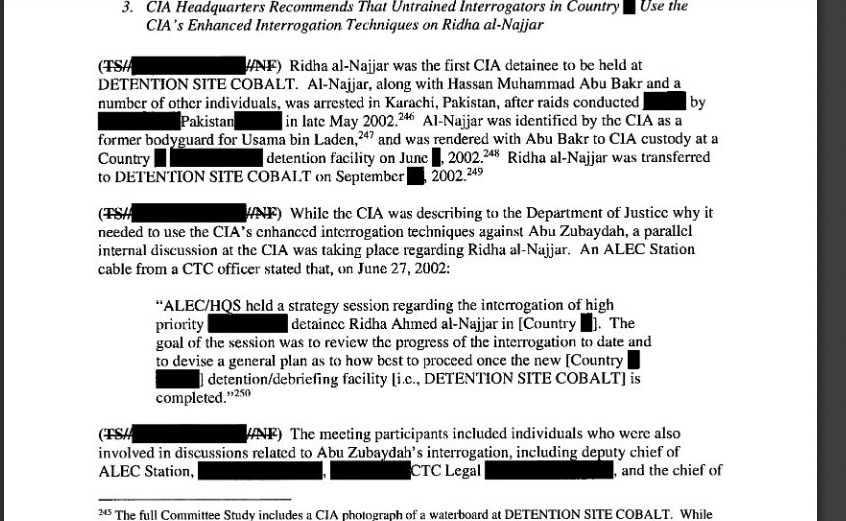
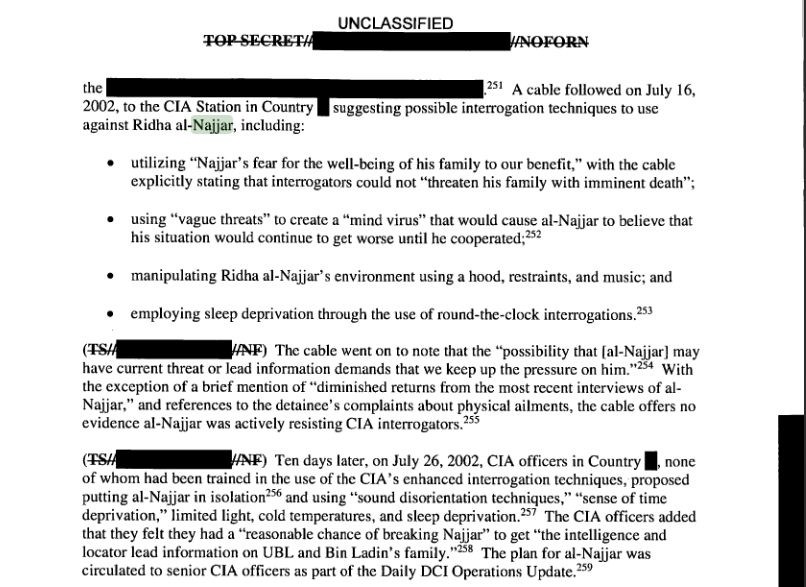
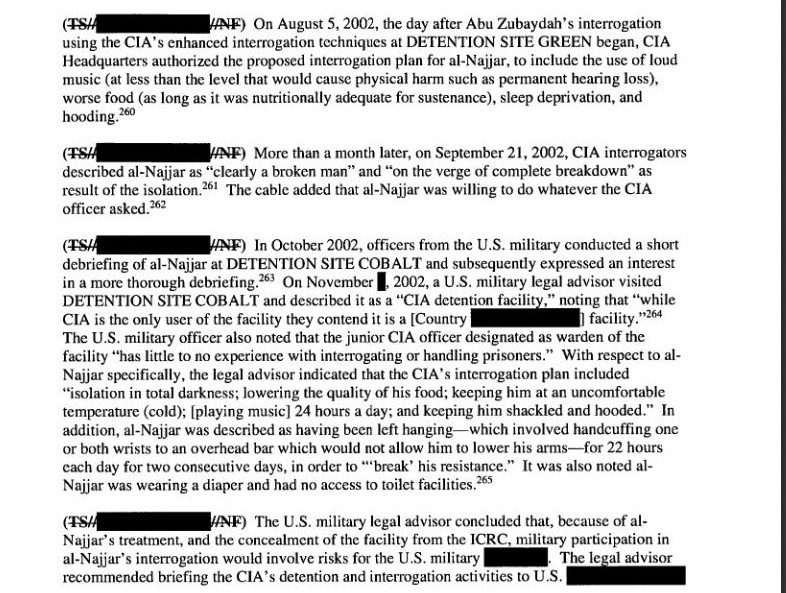
From pages 51-54 (77-80, pdf) of the Torture Report, a model for “enhanced interrogation”:

FireShot Screen Capture #005 - 'sscistudy1_pdf' - www_intelligence_senate_gov_study2014_sscistudy1FireShot Screen Capture #007 - 'sscistudy1_pdf' - www_intelligence_senate_gov_study2014_sscistudy1

FireShot Screen Capture #008 - 'sscistudy1_pdf' - www_intelligence_senate_gov_study2014_sscistudy1

FireShot Screen Capture #009 - 'sscistudy1_pdf' - www_intelligence_senate_gov_study2014_sscistudy1Yes, the CIA created a “mind virus” to convince a Najjar that his “situation would continue to get worse” unless he “cooperated”.

(“Cooperated”: Such a sinister meaning attached to such a benign term.)

They thought through the use of torture they “had a reasonable chance at breaking” him.

Breaking: a much more appropriate term.

And which they accomplished. They broke a man. Through isolation and sleep deprivation and hooding and exposure and hanging they broke a man.

And this ” ‘became the model’ for handling other CIA detainees at DETENTION SITE COBALT.”

A model for how to break a human being.


There is no blood around, see no sign of pain

16 12 2014

If you’re going to make an argument in favor of torture—and no, I will not be making an argument in favor of torture, even hypothetically—it seems the worst one is the one most often used: the ticking time bomb scenario.

What if you knew there was a nuclear bomb about to go off in New York City: wouldn’t you torture the suspect(s) in order to prevent the conflagration?

No. No no no no no no no.

Admittedly, I would neither torture nor approve of the torture of anyone under any circumstances—it’s one of the very few issues on which I’m an absolutist—but torture would seem to be least effective under these conditions.

Consider: the bomb is about (hours, days) to go off. If you are someone who is willing to die in order to kill hundreds of thousands of people, wouldn’t you be willing to outlast hours or days of torture? Or to lie repeatedly in order to forestall any efforts at finding and defusing the bomb?

The kind of person who’s willing and able to pull off the worst kind of terrorism is likely also the kind of person who’s willing and able to withstand hours and days of torture in order to make sure that bomb goes off.

I’ve spoken of my love for the mediocre movie The Peacemaker, but (and?) one of the things that makes no sense was Dušan Gavrić’s suicide. Here’s a man who went through all kinds of trouble in order to detonate a nuke in New York, and a couple of minutes before it detonates, he shoots himself.

Why not just talk until time expires? Mission accomplished.

Okay, so that’s a movie, but it seems like the assumptions beneath the ticking-time-bomb scenario are even less realistic than Nicole Kidman as a nuclear expert: that the bad guy who knows what the good guys need in order to stop the bad guy’s plans won’t just bullshit until time expires.

Give this to the psychopathic former vice president: at least he doesn’t bother with this particular bullshit scenario to justify the breaking of human beings.


Let the rain fall on your skin

11 12 2014

The USA Patriot Act issued by the US Senate on October 26, 2001, already allowed the attorney general to “take into custody” any alien suspected of activities that endangered “the national security of the United States,” but within seven days the alien had to be either released or charged with the violation of immigration laws or some other criminal offense. What is new about President Bush’s order is that it radically erases any legal status of the individual, thus producing a legally unnameable and unclassifiable being. Not only do the Taliban captured in Afghanistan not enjoy the status of POWs as defined by the Geneva Convention, they do not even have the status of persons charged with a crime according to American laws. Neither prisoners nor persons accused, but simply “detainees,” they are the object of pure de facto rule of a detention that is indefinite not only in the temporal sense but in its very nature as well, since it is entirely removed from the law and from judicial oversight. The only thing to which it could possibly be compared is the legal situation of the Jews in the Nazi Lager [camps], who, along with their citizenship, had lost every legal identity, but at least retained their identity as Jews.

Giorgio Agamben, State of Exception

The torture-cheerleaders are clear to state that the Bush Administration’s legal counsel cleared the techniques of torture—mainly by stating that these techs were not-torture—so it could be argued that the “detainees” were in fact covered by law, as “detainees”.

The torture regime of a decade ago was indeed a legal regime: by using the law to remove the protections of the law from those assigned “detainee” status, it covered those who would torture.

Hannah Arendt noted there is no particular dignity in the naked human being (although “naked” in this sense meant shorn of one’s membership in a state), which leaves that shorn human vulnerable to imprisonment, displacement, death.

The point, then, is the same: lacking status as a citizen, a prisoner, a person—as someone recognized by us—allows us to do anything to that non-person.

And so we did.


Just let the red rain splash you

9 12 2014

The executive summary of the Senate Select Committee on Intelligence torture report.

16 absolutely outrageous abuses detailed in the CIA torture report, as outlined by Dylan Matthews.

I was naïve, years ago, in my outrage at the torture committed by the CIA. Yes, the US had enabled torturers (see: School of the Americas) and supported regimes which tortured (see: US domestic surveillance and foreign policy), but somehow, the notion that torture was committed by US government agents seemed over the line in a way that merely enabling and supporting had not.

I don’t know, maybe US-applied torture was over the line in a way US-enabled/supported torture was not, and busting righteously through it busted something fundamental in our foreign policy.

But given, say, the Sand Creek and Marias massacres amongst the general policy of “land clearing” and Indian removal—policies directed by US politicians and agents—wasn’t it a bit precious to decry this late unpleasantness?

Naïveté, I wrote above. No: ignorance. I’d studied (and protested) 20th-century US foreign policy and ignored its 19th century version, the one directly largely against the indigenous people whose former lands now make up the mid- and western United States.

Ta-Nehisi Coates recently wrote that paeans to nonviolence are risible in their ignorance: Taken together, property damage and looting have been the most effective tools of social progress for white people in America. Yes.

A country born in theft and violence—unexceptional in the birth of nation-states—and I somehow managed not to know what, precisely, that birth meant.

I’m rambling, avoiding saying directly what I mean to say: there will be no accountability for torture. Some argue for pardoning those involved as a way to arrive at truth, that by letting go the threat of criminal charges we (the people) can finally learn what crimes were committed, and officially, presidentially, recognize that crimes were committed.

It is doubtful we will get even that.

Still, we have the torture report, and (some) crimes documented which were only previously suspected. Good, knowledge is good.

But then what? Knowledge of torture committed is not sufficient inoculation against torture being committed.

Coming clean will not make us clean.


I want to ride my bicycle

8 12 2014

The next time I whine-think Ehhhn, I don’ wanna take the train the gym and I don’ wanna sit on a stationary bike at the gym and It’s really not that cold out and I’ll just bundle up when I ride. . .

. . . I will remember this 30s-degree-gusty-winds day, with my dead-cold toes and quivering thighs and pissed-off tits and I will grab my fuckin’ MetroCard and a book for the bike and take the goddamned train to the gym.


Everybody knows it’s coming apart, 15

8 12 2014

Ironically, in seeking to curb the individual will to power in favor of equality, leftists invest their own subterranean desires for freedom-as-power in the activist state. In my view, the revival of the left depends on relinquishing this investment. We need to recognize that despite appearances the state is not our friend, that in the long run its erosion is an opportunity and a challenge, not a disaster. I don’t want to be misunderstood: I’m not suggesting that we stop supporting social security or national health insurance or public schools or antidiscrimination laws. If my immediate choices are the barbarism of unleashed capital or a state-funded public sector, the tyranny of uninhibited private bigotry or state-enforced civil rights, I choose the state. Or rather, I choose the social goods and civil liberties that are available under state auspices.The distinction is important, because the idea that the state gives us these benefits is a mystification. Basically [Charles] Murray is right: government does not cause social improvement. In actual historical fact, every economic and social right that we’ve achieved since the nineteenth century has been hard-won by organized, militant, and often radical social movements: the labor movement; the socialist, communist, and anarchist movements; the new left student movement; the black and feminist and gay liberation movements; the ecology movement. . . . The role of the state from the New Deal and the postwar compact till the start of its present no-more-Mr.-Nice-Guy phase was to manage potentially destabilizing social conflict by offering carefully limited concessions to the troublemakers.

. . . The government’s current rush to abandon any pretense of social responsibility ought to make this painfully clear: what the state supposedly giveth it promptly taketh away as soon as the balance of power shifts. In this case, of course, social power is shifting away from the national state itself; liberals and social democrats are still trying to board a train that’s already left the station.

In parallel fashion, the statism of the cultural left does not further equality so much as it reinforces law and order. . . . Insofar as the demand is to outlaw overt, provable discriminatory acts by employers, landlords, store, owners, and so on, it simply aims for public recognition that (pace [David] Boaz and Murray) discrimination is a coercive act as unacceptable as violence or theft. But the problem, from the social movements’ point of view, is that overt, deliberate discrimination is only the crudest expression of a deeply rooted culture of inequality. For many opponents of that culture, it has seemed a logical next step to invoke state power against patterns of behavior that reinforce white male dominance and exclude, marginalize, or intimidate vulnerable groups.

Actually, it’s a plunge into a dangerous illusion. The ingrained behavior and attitudes that support the dominant culture are by definition widespread, reflexive, and experienced as normal and reasonable by the people who uphold them. They are also often unconscious or ambiguous. A serious effort to crush racism and sexism with the blunt instrument of the law would be a project of totalitarian dimensions—and still it would fail. Transforming a culture and its consciousness requires a different kind of politics, a movement of people who consistently and publicly confront oppressive social patterns, explain what’s wrong with them, and refuse to live by them. . . .

It’s time for the left to become a movement again. That means, first of all, depending on no one’s power but our own. . . .

Ellen Willis, Their Libertarianism—and Ours, 1997

There is much which is provocative—in the best sense of the word—in Willis’s work, and much of her left-libertarianism with which I agree.

But she doesn’t confront the contradiction in her own essay: the gains of past movements, gains which she wouldn’t give up, were accomplished through the actions of that compromised, unfriendly, authoritarian state. She criticizes the right-libertarians for not recognizing the coercive power of the marketplace and warns leftists of the coercive power of the state, but merely criticizing parallel coercions does not in an of itself offer an escape from them.

Yes, by all means, we need a new, new-left movement (NL x.0?), a new vision of freedom and equality in which we live in “voluntary cooperation” with one another. But we can’t get their simply by dismissing either the state or the market as coercive—and not only because coercion (or, if you prefer, power) itself may be inescapable.

It’s nice to say we ought to rely on no one’s power but our own, but is that enough? And what if it isn’t? That is the dilemma, and the work.


Every day I write the book

7 12 2014

According to the Free Thought Project, the 15-year-old girl was a runaway who the police officer was attempting to apprehend.

As a witness filmed, the officer walked up to the girl and punched her, knocking her down. She then put the girl in a chokehold — even after the teen’s mother begged her and a second officer to stop, saying that the girl is asthmatic and has emotional issues.

“She just punched her in the face!” said the woman holding the camera.

As her legs kicked and flailed, the girl told the officers she couldn’t breathe, screaming, “Stop!” over and over, but they continued to pin her against the pavement.

The second officer said that everything his comrade did was according to police procedure and that if she’d wanted to the officer “could have shot her dead.”

And from the top. . . if doing things by the book would allow you to shoot an unarmed teenaged runaway, maybe you need a different book.

Source: David Ferguson, RawStory


Oh, God, please leave us something to breathe!

3 12 2014

h/t Carmiah Townes, Think Progress


Jean Béliveau, 1931-2014

3 12 2014

The most fair-weather of hockey fans (of which I am, sadly, one) and the most ardent fans of Montréal (of which I am, gladly, one) knows of the great Jean Béliveau.

Does it matter that I was introduced to him through a Jane Siberry song?

M. Béliveau, who sounds like he was in every way a great and good man, likely would not have minded.

He was 83.