Give me the gun

21 12 2012

Christ, is it even worth posting this?

I’m tired and crabby and have grading and have to get up early to work the second job tomorrow and do I really want to write—more to the point, do you really want to read what I write—about guns?

What the hell.

My views about guns haven’t much shifted from where I landed a decade or so ago: I’m not crazy about them, don’t hate them, and if I lived out in the boonies I’d have a shotgun, if only to scare off any big critters trying to get at my little critters. And the next time I go back to Wisconsin I’d like to try trap shooting or target shooting with my hunting-rifle-owning brother and brother-in-law.

So, guns: dangerous tools, useful in some circumstances, nothing more.

Except, of course, culturally they are so much more: Totems of freedom, penis-substitutes, toys for the uncivilized, power, markers of Real Americans, manly, gangster, and on and on and on.

That’s a big part of the problem, that instead of treating guns as dangerous tools, we polemicize them into ontological signifiers: To be or not to be, with guns.

Actually, that’s wrong: Most of us probably don’t polemicize them into ontological signifiers; most of us probably seem them as dangerous tools which it is okay to own and use in a properly regulated fashion. Go on and on about guns and you’ll be given the side-eye, but if you hunt or like to target shoot at the range, well, okay. And if you won’t buy your kid a Nerf gun because you think it promotes aggression, you might get an eye-roll, but, well, okay.

Honestly, I’m closer to the gun-control folks than the NRA (no kidding. . . ), but if you want to collect an armory in your basement in preparation for the apocalypse, well, it’s your dime.

There are a few steps you should have to follow, however: Every single person who owns a gun should have a background check, and perhaps should be licensed. Every single gun you own should be registered, and any gun you own which is not registered should be confiscated and you should pay a huge-ass fine for not registering it.

At the time of registration, you should have to take it to a licensed instructor and demonstrate that you know how to load, unload, fire, lock, and safely store the gun. And maybe when you fire the gun, the bullet should be collected and entered into one of the those nifty CSI-type databases.

(And for those, like me, concerned about civil liberties: Make the registration system dual key, i.e., the registrant is assigned a number, and that number is entered into the gun-owning database. In order to access the name behind the number, a search warrant would be required.)

If you sell your gun, you must file a transfer form with the gun registry. The new owner would then be required to file a preliminary registration application before the actual gun could be transferred. A background check would be performed in the interim, and once it comes back clean, the gun may be transferred, at which point the new owner would be required to complete the registration process. A reasonable fee—one which would cover the costs of the registry and the registration process—would be required.

If you sell your gun or give it away and don’t file a transfer form, if you lose it or it’s stole and you don’t inform the police, you would be open to large, large fines, and holds on any future firearms registration. If you are convicted of crimes which, if turned up in a background check would prevent you from owning a gun [for whatever period of time], you either have to surrender your guns to a licensed dealer for the duration of the n0-gun period, or you have to sell them. You’ll retain the right to petition the court for restoration of your gun rights, although further restrictions may be attached to them.

And tough laws for any crimes committed with guns? Yep, as well as laws for negligence, brandishing, and general stupidity. (For the latter I prefer those huge-ass fines, largely because I think we already lock up too many people, but short jail, as opposed to prison, terms might be warranted.)

States and localities will retain the right to impose further restrictions on ownership, and while I think concealed-carry laws are a menace, I don’t know that there’s any constitutional way for the federal government to override them.

The feds can and should ban certain types of weapons—as they already do with automatic weapons—as well as certain types of bullets. They might also retain the right to impose stricter licensing requirements for various types of weaponry.

Oh, and ban large-capacity magazines—anything over 10 bullets.

Others have mentioned insurance requirements for gun-owners, which some states might wish to implement or at least allow insurers to ask before offering home or life-insurance. Let the insurers add their own (reasonable) licensing requirements. Tax the shit out of bullets.

[Edited to add: And that law Congress passed awhile ago shielding gun manufacturers from lawsuits? Repeal it.]

The upshot of all of this: Recognize the existence of the [current interpretation of the] Second Amendment which allows for both gun ownership and gun regulation, and go from there. Recognize in law the difference between a bolt-action hunting rifle and a semi-automatic handgun or rifle, and recognize in culture the line between use of guns for one’s own enjoyment and that based on anti-social contempt.

It’s not enough, of course, to stop the gun violence in both our streets and our homes, nor is it enough to stop suicides or, maddeningly and sadly, periodic massacres. I think we’d all be better off if there were fewer guns—especially handguns—in this country, and I’m offended by arguments that we can’t live with one another without guns.

But I also believe if things are to get better—if we’re to kill fewer of us—we need to start where we are, and where we are is in a gun-laden and gun-positive place. We need to start treating guns as dangerous tools, and maybe, just maybe, down the line that’s all they’ll be.

Then maybe, just maybe, we’ll want fewer of them.


I can see you in the morning when you go to school

18 12 2012

Have I mentioned recently my. . . delight? satisfaction? relief—yes, let’s go with relief—that I live in New York City?

That’s because I don’t have to worry about my governor or mayor suggesting that teachers lock-and-load prior to entering the classroom.

Is it really any surprise that Texas Governor Rick Perry or Virginia Gov Bob McDonnell muses that the appropriate response to gun violence on school ground would be to increase the number of guns on those same school grounds?

Didn’t think so.

Cienna Madrid at The Stranger posted this response from a schoolteacher friend to similar musings:

Kids steal anything that isn’t nailed down in my classroom. In this school year alone, I’ve “lost”: 2 staplers, 12 whiteboard markers, 1 globe, 1 map, 1 copy of The Color Purple, 3 boxes of staples, countless pens and pencils, an apple, my deskplate, and a years’ supply of tacks. If I yawned long enough, these kids would pluck the fillings right out of my mouth and this guy thinks I should have a GUN in the CLASSROOM? Where the fuck would I securely keep a gun? Because I’m sure as shit not packing one on my person. and even if teachers are allowed to carry guns, then what? We’re all supposed to take marksmanship classes to learn how to shoot the damn things? How is this anything but a cheap way of turning teachers into unsworn police officers?

No. No. No. Teachers teach. Police officers police. And legislators are supposed to legislate. Maybe instead of trying to add to the burden of my jobs, legislators should take a crack at doing theirs.

I’m not worried about my students—who are not kids—stealing from me, but I”m right there on the whole “teachers teach” bit: that’s what we do, that’s the whole point of us.

Imma gonna go out on a limb here and speculate that those who want teachers to pack heat probably don’t, really, respect us.  As commenter Sly at Lawyers, Guns & Money pointed out,

According to conservative orthodoxy, I’m a parasite on the public’s dime who is only interested in indoctrinating the precious children of America into communism or atheism or whatever. I can’t be trusted to have any control over the curriculum I teach. I can’t be trusted to fairly and impartially evaluate my students, let alone my colleagues. I can’t be trusted to have collective bargaining rights. I can’t be trusted to have an objective view of governmental policy when it comes to my own profession.

But they’ll trust me to keep a gun in a room filled with children.

Allow me to add to the rant by noting that not only do they not respect teachers, they don’t respect what we do. Maybe they don’t respect us because they don’t respect teaching, maybe they don’t respect teaching because it’s performed by, y’know, teachers—but whatever the arrows of causality, they don’t bother to understand the first goddamned thing about teaching.

And what is that first goddamned thing? Teaching is work. It’s fucking hard work to try to do well and, on some days, just to not do it poorly.

I just finished the last session of a course which had kicked my ass all semester. It was the first time I taught this course, and as often happens with a new course, all of those things which seemed like good ideas while preparing the syllabus turn out to be bad or unworkable ideas as the semester progressed. About halfway through it became clear that things were falling apart, and about two-thirds of the way through I’d figured out how I could improve things for next semester, but in the meantime I had to try to salvage what I could so that the class wasn’t a complete waste of time.

Do you know what it’s like to know that you’re failing—that you’ve failed–but the best you can do is to try to prevent the failure from bursting into flames and immolating what few nuggets you did manage to pass along? Yeah, it sucks.

I’m actually pretty fortunate in that most of the time, I’m jazzed rather than drained by what happens in the classroom, but either way, it’s work. I think about and prepare and rethink and revise and prepare some more, all so that my students can get something out of the course, which in turn means that I can get something out of teaching them.

But hey, if what I do doesn’t matter, then all of that time spent pretending as if it does could better be spent at the firing range doing the real work of shredding paper targets or at SWAT camp learning how to somersault through a hail of bullets and turn up rightside firing at my attacker(s).

I’m a teacher, not a ninja, and that should be enough.


See how we are: gotta keep bars in all our windows

15 12 2012

A surprise, yes, but not as much as it should be: another mass shooting.

The shock, perhaps, was in the age of the majority of the murder victims. As President Obama observed:

The majority of those who died today were children. . . beautiful little kids between the ages of 5 and 10 years old. They had their entire lives ahead of them—birthdays, graduations, weddings, kids of their own. Among the fallen were also teachers—men and women who devoted their lives to helping our children fulfill their dreams.

Beautiful little kids, yes.

The on-average 30+ people who are killed every day in this country also were, years ago or perhaps just the day before, beautiful little kids.

I don’t know that’s there’s anything anymore can be done. Over 300 million guns in this country, and the first response to every damned mass shooting—and how terrible is it that word “every”?—is to say no, no, this has nothing to do with guns.

Over three hundred million guns, and maybe it is too late, maybe there is nothing more to be done but to prepare for the next shooting. Run the teachers and students and employees and customers through drills, train the doctors and nurses, prepare the counselors, militarize the police.

Unless, of course, that isn’t enough, and you think that  the problem is that not enough people were armed, that if only the teachers or the movie theatre ushers or the mall retail workers or the customers or the temple congregants had guns this all could have been prevented or stopped sooner.

Every person with a gun, every person a hero with a gun against every other person a villain with a gun.


“Abortion doesn’t unrape you”

13 12 2012

Trying to convince Americans to support a no-exceptions abortion policy?

Yeah, that’s gonna work.

(Sofia Resnick, The American Independent/RH Reality Check; h/t Cienna Madrid, The Stranger)


All things weird and wonderful, 27

12 12 2012

This cat

028

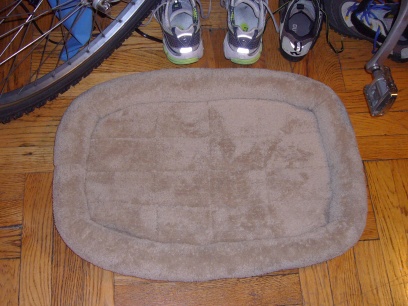
is afraid of this.

014

I do not understand.

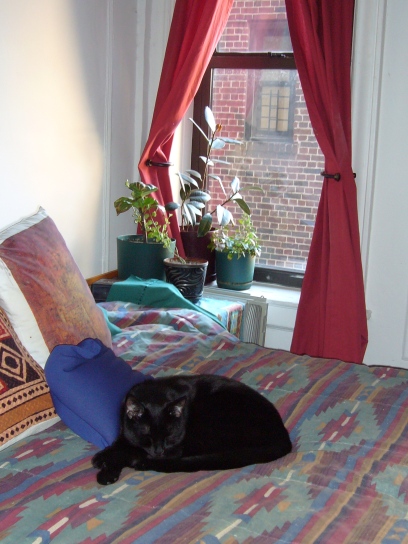
He clearly likes the soft:

005

But only the human bed. Not the cat bed.

Strange boy.


Talkin’ at the Texaco

9 12 2012

Quick (and not-so) hits:

I keep a list of books to find in the empty back pages of a 2009 pocket planner. The books aren’t listed in any particular order: I see a reference to (or given, perhaps by dmf) a possibility, and I scrawl it down. Since I do so much poking around The Strand, I look them up, find out where they’re located (Med Hist, Hist Gen, Amer, Pol, etc), and pen that in, boxing the location in different colors, to make it easier to see.

The fiction, however, I keep on separate pages. I go back and forth on fiction: sometime scooping up bunches, other times neglecting these books entirely.

I’m not quite sure why, but in the last few days it became very important to me to track down and list fiction.

There was, in particular, one book I wanted. I must have written it down, hadn’t I? No. In my 2012 Moleskine pocket planner? I found a number of others (The Age of Miracles, Brookland, Zone One, Forever) scrawled opposite a week in October, but not the one tickling me behind my ear.

It came out this past year, I thought. A story in which Saudi Arabia is the superpower, the US a backwater, Osama sulking in the background—something like that. The Stranger had written about it in the Slog awhile ago and, I thought, in the past few weeks, so I went to their Books section and clicked back into their archives. December, November, October. . . nothing.

Dammit.

What was the author’s name? Salim Ahmed? Salem Ahmad? Something like that. A search on Amazon brings me a number of nonfiction books, nothing close. To the Strand’s site, thinking it might be listed. . . somewhere. Found one that seemed interesting (Alif the Unseen), but not the tickler. Barnes & Noble—nothing.

Fuckit.

Back to the Stranger, back to Books, and a scroll back and back and back through the archives. I thought it might have been reviewed January, February, so set myself in, Trickster in my lap, for a slog, clicking on squinched entries to see if the book hid there, moving on, moving back.

K. Silem Mohammed! Was that it? It’s not that far (is it?) from Salim Ahmad?

No, Mohammed is a poet, not a novelist.

Back, back. Fran Lebowitz; Jan Berenstein, “Really Good Books About Lesbians”; Reverend America; David Foster Wallace; Katherine Boo; and. . . page 9, February 9, “The Reverse Jihad”: the book review of Mark Ruff’s The Mirage.

Mark Ruff?! Mark, not Salim? Ruff, not Ahmed?

Damn.

But I got it.

~~~~~

While scrolling back, I found this entry by Paul Constant, dated August 3, 2012, in which he writes

I know a lot of authors who get outraged over the consumer’s belief that they can decide what they pay for the piece of art that the author spent months—probably years—creating. They call it entitlement. (It’s not like the work is completely unavailable; Pogue could have bought a paperback for less than he spent for a pirated copy.) Many consumers believe that they should be able to access the work in whatever format they choose, and they believe that when they buy the work, they should be able to do whatever they want with it. (They accuse author’s estates and publishers of being greedy and out-of-touch.) I know the law says that there’s a right and a wrong here, but I also believe the law is hopelessly outdated when it comes to issues like this. I honestly don’t know what side I’m on, here.

I tend toward sympathy toward the authors (duh), but Constant pretty well sums up my own ambivalence.

~~~~~

I must have the only cat in the world who is afraid of cat beds.

*Jasper*

~~~~~

I’ve bitched about Rod Dreher before, will bitch about him again, and am bitching about him today.

Long ago (and far away) I read First Things, Christianity Today, and National Review Online with some regularity, partly to keep my secular-leftist self honest, partly to keep tabs. I fell out with both FT and NRO as they became less and less thoughtful, although I do read CT at least weekly, and have since added Tyler Cowen and Alex Tabarrock at Marginal Revolution to my teeth-grinding reading.

Still, I felt the need to keep up with some kind of thoughtful social conservative, and since I’d been reading Dreher from back in his BeliefNet days, I re-upped with him once he returned to blogging, this time at The American Conservative.

Dreher is thoughtful about a third of the time, and mildly-to-quite interesting about another third; that final third, however, is enough to make me reconsider reading him.

He writes well about himself and his own struggles, his family, and what he’s drawn to, but when writing “from the outside” of a phenomenon, he’s terrible: small-minded, close-minded, and mean. When he’s called out on his cruelty his defensiveness rises into bile, or when corrected on a crucial point or reminded of a double-standard, he’ll either double-down or ignore the commenter. When all else fails, he’ll bring out the sneering “you’re-making-too-much-of-this/can’t-you-people-take-a-joke” response.

All are on display in this post, ‘Buckwild’ and Self-Exploitation. The post for the most part is fine, but when he gets to the end, he pulls a classic Dreher move:

Nevertheless, to what extent does the framing of films like this, and the informed consent of its participants, ameliorate one’s moral squeamishness? Jersey Shore was about the sexy trashiness of working-class Italian-Americans from New Jersey. Buckwild is about the sexy trashiness of working-class Scots-Irish Americans from Appalachia. How would you feel if the next installment were about the sexy trashiness of working-class African-Americans from the south side of Chicago, or the sexy trashiness of working-class Hispanic-Americans from El Paso?

That last question is in and of itself is worth asking, but it’s a problem coming from Dreher because he loses his mind when he talks about race.

I don’t think Dreher hates black or brown people, and I have no reason to believe that he would be anything other than gracious to any black or brown person introduced to him. In short, I wouldn’t call him a racist.

And yet. And yet he has a hard time seeing that black people are a plural, not a singular, and he cannot seem to extend any sort of sympathy to those who would argue that racism is still a problem in this country, especially not to those who write from their own experiences.

Unless, of course, you’d count Steve Sailer. Sigh.

Anyway, read the comments, especially his response to those who bring up The Dukes of Hazzard and their car, the stars-and-bars sportin’, Dixie-horn-blarin’, General Lee, and the, um, particular cultural politics of that show.

Dreher’s not having it, not one bit of it.

Now, as I was re-reading the entry and the comments while writing this, I thought, this is hardly the worst of what he’s written—see George Zimmerman’s Bloody Nose, for example, in which his last line is Remind me, why, exactly, is George Zimmerman on trial?—but perhaps this is one of those cases where the more I read Rod on race, the less credit I’m willing to give him.

He used to go on rampages about those horrid gay activists with some regularity, but now, for the most part, he manages to confine himself to saving religion from queer marriage. He’s terrible when it comes to liberal Catholics, especially liberal nuns, and is a damned bully when it comes to trans folk (one faithful trans reader, also from his BeliefNet days, finally had enough and bowed out).

I guess this is all so enraging precisely because he has shown himself to be capable of reflection and reconsideration of what matters to him; that he is is not when it comes to that which matters to others betrays a deliberate meanness.

Perhaps that’s too harsh, perhaps there are simply limits to his reflectiveness, limits which he himself cannot recognize.

Given that I almost certainly have those same limits, albeit in different places, perhaps I have a third reason for reading him that I can add to the two above: as a reminder of the existence of my own blind spots, and that I need to look for what I cannot see.

~~~~~

End of the semester—naught but grading ahead.

Blogging will be more erratic than usual.


Baby, baby, please let me hold him

6 12 2012

I’m too broke to be decadent—but if I had the money. . . ?

Well, I’m probably too boring to be decadent: couldn’t be trendy if I tried.

I’ll leave the Douthat-slaps (similar to a dope-slap, but administered with sacred sorrow) to Katha Pollitt (among the many, many, others), and be glad that others have waded through his muck so that I don’t have to.

Do allow me, however, this one obvious point: The reason some of us don’t have children is that some of us don’t want children. At all.

Not: don’t-want-children-because-want-something-else-more, but: don’t want.

The usual disclaimers: I like kids. I’m glad other people want to have kids, and I think our environmental problems have more to do with too much consumption than with too many people (although consumption and people are not, of course, unrelated).

So, yeah: Babies!

Just not for me.

That I can choose not to have babies for the mere reason that I don’t want them is, for any number of fertility-mongerers the real decadence. That is, it’s not that I want to live the Euro-trash life, but that I can choose, and because I can choose, I can choose wrongly.

In other words, it’s a mere hop, skip, & jump from choice to civilizational collapse.

There’s nothing particularly new about this equation—this is a standard reactionary-conservatism trope—but just because it’s old doesn’t make it any more correct or less irritating. I’ll skip the rant on why it’s irritating (it’s late and I’m erasing 10 words for every 5 I write, so, y’know), and, oh hell, I’m just going to bring this back around to me.

I chose not to have kids, but to focus on the choice is to miss the real point, which is that I never wanted kids. The choice depends on the desire, and it was never my desire to have children. I didn’t choose not to have children I wanted; in some sense, I didn’t choose at all, but merely recognized that I lacked what it took to be a good mother—namely, the desire to be a mother at all.

Taking away my choice on that matter would not have changed the desire, nor would incentives have made a difference. Sure, some women forced into motherhood may come to love it, and more social support might make a difference in the number of children one might have, but that still leaves some of us to say Nope, no thanks.

I take motherhood—parenthood—very seriously, and believe that if you’re going to have kids, you oughtta do it right.

Tough to see how you can do it right if you don’t want to do it at all.


Love me, love me, say that you love me

2 12 2012

Not everything that can be measured matters; not everything that matters can be measured.

This is one of those tropes that I periodically repeat to my students. (It’s possible that I came up with this wording, but given that the sentiment has been around a lot longer than I have, I’d guess that I swiped the line from someone else. [Pause while I search.] Ah, stolen: A variation on Einstein.)

Anyway, it’s a good line, although a bit dangerous for the classroom: My students are already disinclined to take statistics (despite my admonitions to do so), so suggesting that measurement has its limits might lead them to translate this to mean measurement is bunk.

Measurement is not bunk, but there are some phenomenon which cannot be captured by a nifty formula. Money, money can be easily measured, but why it matters beyond its utility is a question which requires knowledge beyond that of currency itself. It’s not that you can’t get responses to the question, but that those responses are so embedded within history and culture and politics and psychology that in order to elicit good responses, the questions must be informed by history and culture and whatnot.

Then there are some phenomenon which are damned near impossible to capture with any precision, in large part because they lack clear definition.

Love is one of those things. The best you can do is to try to identify the elements which you’d want to include in the corral, but even then some of those bits may flee over the fence while others might tunnel in and by gum it’s worse than herding wet angry cats in the presence of puppies and raccoons.

Still, the damned-near-impossibility of drawing any kind of definitive line around love does not mean it does not exist. I admit to my own agita regarding its role (or lack thereof) in my life, but that I can’t see it for myself does not mean it is not a real thing for other people.

Not only is it a real thing, it’s a real and powerful thing, and it drives people in all kinds of directions, including ’round the bend and over the cliff and up a wall. It matters, in other words.

Deidre McCloskey also thinks it matters, and, furthermore, that it ought to matter to economists that they have no good way of comprehending love or incorporating it into their theories.

I am, of course, not an economist, and I get just a bit too much pleasure bashing (in particular freshwater) economists for their oft-ridiculous assumptions regarding rationality and the maximization of utility. Nonetheless, McCloskey has peeled back a lid my fellow political scientists would also prefer kept securely in place:

The great Gary Becker of the University of Chicago, for example, thinks in this fashion, as do his numerous followers. He realizes that love — or as he usually styles it, with embarrassed male scare quotes, “love” — entails more than “caring” in his restricted sense: “If M cares about F, M’s utility would depend on the commodity consumption of F as well as on his own.

” But treating others as “inputs into a self’s utility function,” as Becker puts it, is to treat the others as means, not as ends. Immanuel Kant said two centuries ago in effect that your mother, if she is truly and fully loving, loves you as an end, for your own sweet sake. You may be a rotten kid, an ax-murderer on death row in Texas. You’re not even a high-school graduate. You give her “nothing but grief,” as we say. In all the indirect, derivative ways you are a catastrophe. And yet she goes on loving you, and stands wailing in front of the prison on the night of your execution. Economists need to understand what everyone else already understands, and what the economists themselves understood before they went to graduate school, that such love is of course commonplace. [emph added]

Political scientists don’t do love or humor—that’s another line I toss at my students—which is particularly unfortunate because politics is full of love and humor and every other kind of emotion. To the extent that we ignore the role of love in politics, we miss something crucial about the subject which we, for some reason or another, have decided to study.

~~~~~

One last bit: I was (and to some extent, still am) like Becker in that I put “love” and “caring” in those scary quotes, but Joan Tronto’s Moral Boundaries forced me to reckon with an “ethic of care” as a morally serious (as opposed to frivolous) concept. I’d borrowed the book about a decade ago on a recommendation from a friend, but recently managed to snag a used copy. I’ll write about it when I re-read it.

She’s now at the University of Minnesota. I wonder if I would have been smart enough to have engaged with her when I was there. As McCloskey notes, we unlearn so many things while in grad school.

(h/t: Andrew Sullivan, Daily Dish)


The loser’s standing small

29 11 2012

Shocking, I know, but I did not win the Powerball.

Guess I’ll have to find another second job in January after all.

Damn.


I take my chances

28 11 2012

I will not win at Powerball tonight.

The jackpot is over 500 million dollars—over half a billion dollars—and inching even higher as those who usually don’t bother with the lousy odds join the regular assortment of dreamers and fools. And if no one wins tonight? Whoo-dog!

I was thinking of what I’d do with the winnings. This is something I do with disturbing regularity—think about cashing in on big money—so I have a general sense of “save some, spend some, give some away”, as well as a near-certainty that I wouldn’t renew my lease on my current apartment.

The cash payout for the current pot is estimated at 360.2 million, so after paying off my debts and buying myself a nice apartment in Brooklyn (yeah, I like Brooklyn, so why not stay?), I’d have a few bucks left over. Give some money to family, sure. Money to friends? I’d like to do that. And set up a foundation to give money to organizations which are doing good work: Planned Parenthood US & International, Médecins Sans Frontières, Oxfam, groups working in Iraq and Afghanistan, veterans organizations, and if there are any organizations helping kids with the transition out of foster care, I’d like to throw some bucks at them.

What else? Occupy Sandy, Red Hook Initiative, others helping folks recover from Hurricane Sandy. The Audre Lorde Project, a space for queer teens in Manhattan, took a hit and could use the help. And critters could always use a hand.

My alma maters: the Universities of Wisconsin and Minnesota. Money for undergrads at Madison, and for grads at Minnesota, and aid for mental health services for all students at both places.

Which reminds me: Dental care isn’t covered (why not?!) under the Affordable Care Act, and is usually expensive. If you’ve got a chipped or missing front tooth it can be damned difficult to find work, so I’d want some money to go toward any kind of low- or no-cost dental service.

But what do I know about money? I’d have to hire someone help me figure out how to dole out all of this money, as well as to set aside a few mil for myself. I’d like to travel, and maybe buy some property out west, and maybe in Québec. Huh, maybe B and her husband J could help me out with this. . . .

I told you I spent too much time thinking about all of this—all for something which will never, ever happen. It is foolish even to think about, much less spend money on.

You already know the punch line, don’t you? Yeah, I bought two tickets.