Never seen this picture before

1 02 2012

It’s Philip Glass’s birthday today.

I went through a period in grad school where I listened to this cd every day. It was not a good period. Did the music make it better, or worse? Or did I just ride it through?

Anyway, I like Glass, but wouldn’t mention his birthday were it not also my birthday. I’m not as old as the composer, but I almost certainly have more days behind me than in front of me.

It’s odd: to think of one’s life as more than half over but also simultaneously to realize I’ve lived a long time and I’ve got a long stretch in front of me.

I turn around and look at my life and say sing-shout My god, what have I done? but I don’t ever think, wow, that was quick. It’s been a trek, a slog, a marathon, a sojourn—anything but a lark.

Perhaps that’s the one upside to living so much of my life down: I’ve felt so damned many jolts and jangles on my wayfaring through the days that looking ahead the end does not seem near; a bumpy path is a long one.

No guarantees, of course—Mayan apocalypse 2012!—but absent the end of the world or a Newt presidency (do I repeat myself?), well, as Emmylou sang, I’ve still got a ways to go.


I’d like to sing a song of great social and political import

26 01 2012

I missed her birthday.

Not that she’d know, given that she’s been dead for over forty years, but I used to know and celebrate the day Janis Joplin squalled her way into the world.

I think I’ve written this before, but what the hell: My friend K. and I taught this to a half-busful of Forensic [speech, not mortuary] Society high schoolers on our way back from some tournament or another. It was dark, the bus was old, the trip long. And if our high-volumed rasping pissed off the faculty adviser, all the better.

Janis was like that: the big personality you could hide behind.

I fell for Janis in high school, aping her in drink (Southern Comfort, when I could afford it) if in nothing else: I couldn’t sing like her, had no appetite for heroin, and was never as outrageous as I would have liked to have been.

Janis was too much, in every way. She was too loud, too drunk, too high, and way too sexy for someone who in no way fitted any conventional notions of sexiness.

You could see that, too, in those old photos and reels of her performing. She knows she’s performing when she sticks out her tongue or her chest or when she struts across the stage. She’s covering.

She never thought she was enough, but man, when she snugged that mic up beneath her lip, her voice spilled out and over her and everyone who heard her and then all her too-muchness was just as it should be. No cover, then.

There she is, in all her feathers, a few months before her death.

Of course, that she died was part of the fascination for my teenaged self—she suffered for her art!—but it was the fight in her, even more so, even if back then I could only valorize the suffering-unto-death, not that she suffered in the fight to stay alive.

I was listening to her recently, and came across a line I used to write on notebooks and bathroom stalls: Tomorrow never happens, man, it’s all the same fucking day, man.

Janis Joplin, absurdist. She would have been 69.


Mayan Campaign Mashup 2012: Santorum’s choices

8 01 2012

In 1996, Rick Santorum’s wife Karen had a difficult pregnancy.

The health of the fetus severely compromised, she decided to undergo surgery to correct the problems; this surgery led to a life-threatening infection, which in turn led to a course of antibiotics which had the (known) effect of starting labor. Doctors then gave her a drug to bring the labor along, resulting in the early delivery of a 20-week old fetus the Santorums named Gabriel.

Prior to the surgery, Karen Santorum was adamant that she wanted doctors to do everything possible to try to save the pregnancy; even after she agreed to take the antibiotics, she and her husband hoped that the fetus could be saved, to the point that Santorum initially refused the Pitocin which sped up labor. However, Santorum admitted that had labor not resulted, she would—reluctantly—have agreed to an abortion to save her life.

The fetus, named Gabriel, lived for two hours. After his death, the Santorums took him home to their then-three (they now have seven) children so that they could  “absorb and understand that they had a brother.”

Karen Santorum later wrote on book on the experience, Letters to Gabriel, and the experience apparently reinforced her husband’s views against abortion.

Three points:

1. It is good that Karen Santorum had the choice to decide how to deal with a difficult pregnancy, including the choice to risk her own life.

The person who has to live with the consequences of any decision ought to be the one to make that decision.

2. It is a dicey matter to criticize how people mourn. Eugene Robinson and Alan Colmes have come in for a great deal of criticism for mocking the Santorums for bringing the dead fetus home. While both Robinson and Colmes seem more weirded out by rather than contemptuous of the Santorums, they both imply that Santorum’s action reflects poorly on his ability to lead.

I have nothing good to say about Santorum, not one damned thing, but I also strongly believe in judging public officials by their public actions. Even shitty politicians get to have a personal life, whatever the shape of that personal life may be.

And as an aside, I don’t know how weird it is to bring a loved one’s corpse home. In most cases, of course, this isn’t an option, but into the 20th century in the US many of us dealt with our own dead. Perhaps there were those in the community who were called upon to help wash and prepare the body, but death in the home was not uncommon.

And in some sense both the right-to-die and the hospice movements (which are usually in political opposition) have reacted against the depersonalization of death in their efforts to allow people a decent death at home. I am among those who would prefer to bring death home, to see death as the end of life, not separate from it. Whatever my view of the status of the fetus, I don’t know that the urge of the Santorums to bring what they considered their son’s body home is really all that strange.

It seems quite human.

3. Anything goes, winning is the only thing, whatever you can get away with—I don’t take back a word of it. While I might think it politically dicey to bring up Santorum’s actions in this matter, I don’t think it’s out of bounds, mainly because I don’t think anything is out of bounds. My own personal beliefs on the respect for privacy have nothing to do with observations on political tactics, and in political campaigns, anything that can be used, will be used.

This is even more the case when you refer to your personal life in order to score political points. If, like Santorum, you use you and your wife’s ordeal to buttress your political attacks on abortion, then you transform that ordeal into political fodder, fodder which may now legitimately raked over and flung back at you.

There’s a big foggy territory between the personal and public for politicians. Yes, their minor children (and grandchildren) are used in photo ops and they may make occasional jokey references to something that their kids said or heard, but such uses are stylistic tropes, and are generally ignored, as are generic references to family in order to humanize oneself. When the politician goes deep into, say, a family tragedy, whether we see the person as been courageous and honest or cynical and conniving, and how the story can be used politically, likely depends on our views of the politician in the first place.

This is where the the “can be used/will be used” meets the “whatever works”: Will going after your opponent’s personal life help or hurt your campaign? If bringing up his personal life helps you, you do it; if it is likely to spark a backlash and hurt you, you don’t. That’s it.

It is noteworthy that those who criticized the Santorums’ decision are pundits, not anyone connected to any campaigns. The other candidates or their strategists might also think this is (further) evidence for his unfitness, but they will keep their lips zipped because there is nothing to be gained and too much to lose. That calculus is what regulates their behavior—period.

The point is to win.


You should wear with pride the scars on your skin

19 12 2011

Christopher Hitchens and Vaclav Havel died this past weekend.

Both men were writers deeply engaged in the politics of our time; one was more in love with words than ideas, the other, the other way around.

One man engaged in politics, the other, engaged in the engagement; both are worthy pursuits, but they are not equal to each other.

One man knew that, the other didn’t.

One was a hell of a s/wordsman, and I would have loved to have had the chance to have lost (as I would have) an argument to him. Fight above your weight class, I say, and Hitchens was certainly far above mine; losing to him would have been instructive, and if I could never have hoped to have bested him in argument, I could have applied the lessons of those beatings elsewhere.

But if I wanted to learn more than verbal fisticuffs, I would rather have sat down in a smoky pub with Havel. If Hitchens had great verbal reflexes, Havel was the far better reflector. He questioned, he doubted, he admitted the possibility of error in his steadfast search for moral clarity. He lived an absurd life, and was imprisoned by an absurd regime for pointing out its absurdity.

His stint as leader of Czechoslovakia, and later, as president of the Czech Republic, was not an unqualified success, and some of us were disappointed by his support for the Iraq war. He based that support on the grounds of the threat Saddam Hussein held for the Iraqis, not the Americans, and even that support was qualified, arguing that  “the international community has the right to intervene when human rights are liquidated in such a brutal way.”

I have some sympathy for liberal interventionism—the legacy of inaction in Rwanda—but even more suspicion; still, I can extend that sympathy to someone whose country was ripped apart by Hitler, then stomped on by the Soviets in 1968. Havel’s idealism got him through prison terms and decades of oppression, and if that same idealism led him to underestimate the Hobbesian in politics, well, I can still appreciate his admonition that Truth and love must triumph over lies and hatred.

Hitchens was a champion hater and, to be honest, I can take altogether too much comfort in my own contempts. I enjoy the fight, enjoy the hardness of verbal combat and in slamming back a volley aimed at my own head. I like to win—ohhhh, do I like to win.

But winning is not enough; what is the win for?

What is needed is something different, something larger. Man’s attitude toward the world must be radically changed. We have to abandon the arrogant belief that the world is merely a puzzle to be solved, a machine with instructions for use waiting to be discovered, a body of information to be fed into a computer in the hope that sooner or later it will spit out a universal solution.

. . . We must see the pluralism of the world, and not bind it by seeking common denominators or reducing everything to a single common equation. We must try harder to understand rather than to explain. . . . In short, human uniqueness, human action, and the human spirit must be rehabilitated.

From a speech before the World Economic Forum, 1992

I do not share Havel’s moral idealism, Havel’s hope, but I don’t think he’s wrong to tell us to look past ourselves, our interests and our fears, and to live in the full possibility of this human world.

I might have had fun hanging out with Hitchens, and been discomfitted by Havel, but I think the discomfitting is more fitting: unease propels me more than certainty ever will.


Rose, RIP

12 12 2011

Sad news from Jon Katz: his beautiful heroic no-nonsense hardworking lovely lovely lovely dog Rose died Friday night.

Last Photo: Rose, a celebration

My sympathies to Jon, Maria, and the Bedlam Farm family.

(Photo and caption: Jon Katz)


All things weird and wonderful, 6

13 10 2011

Of the contemplative sort:

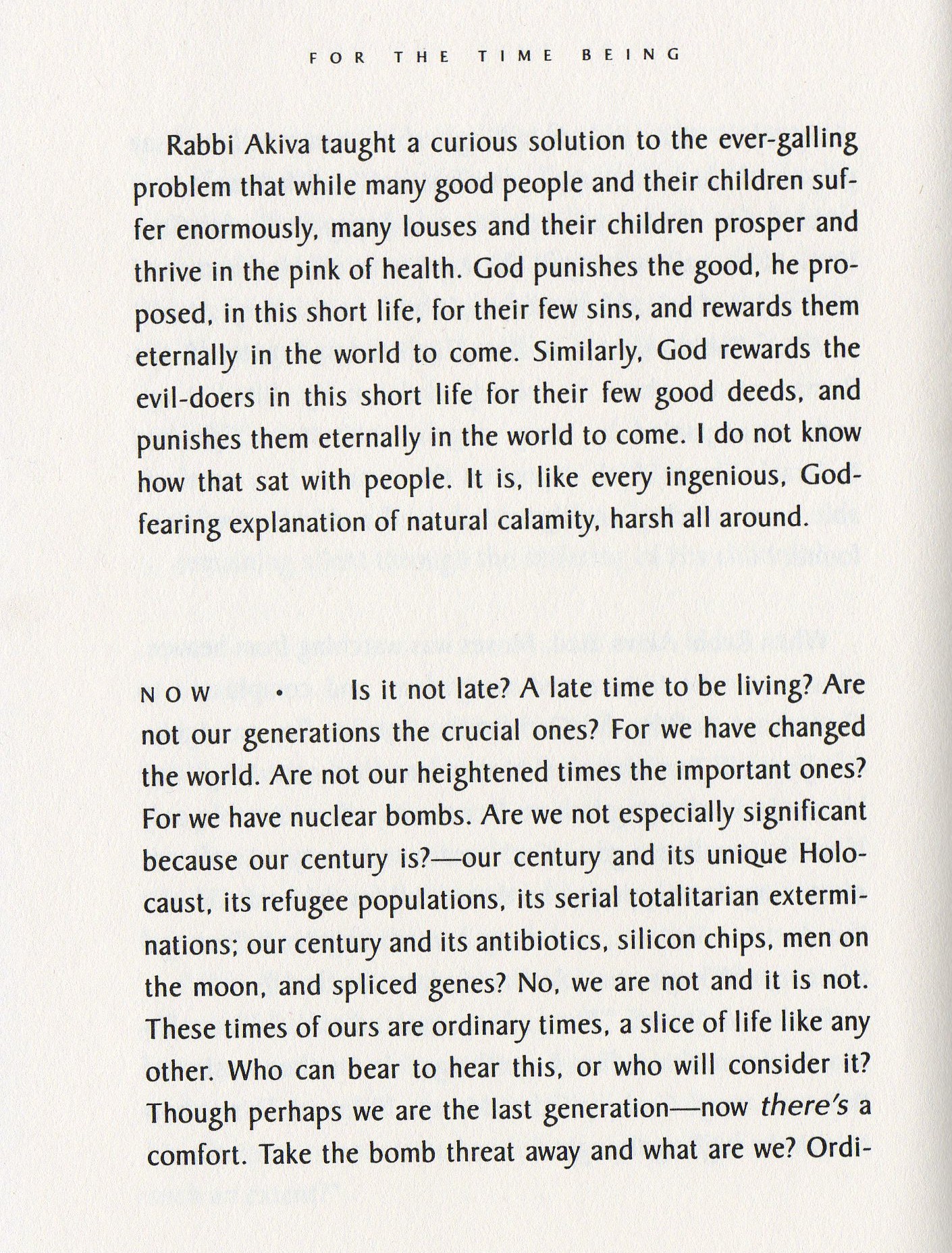
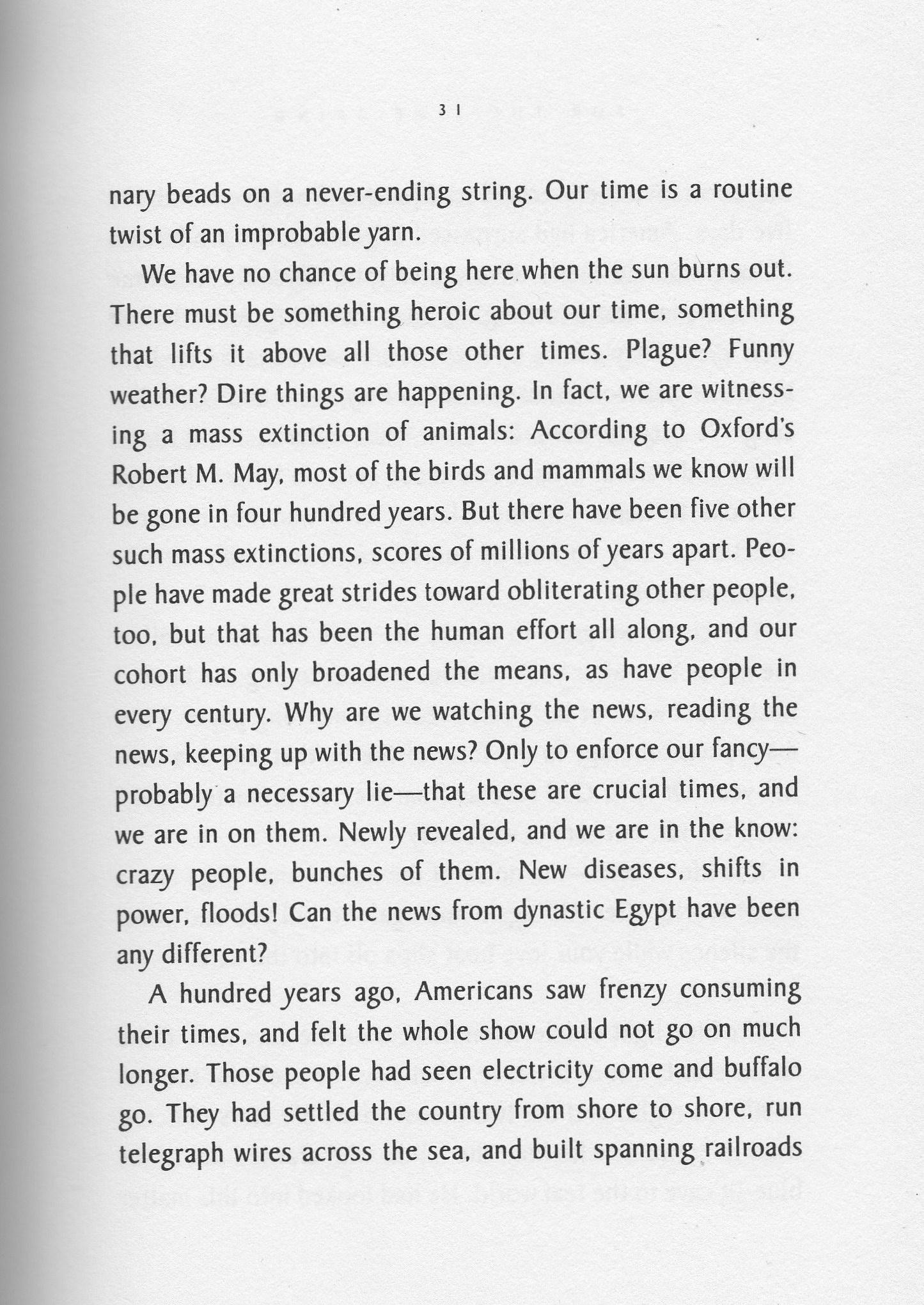
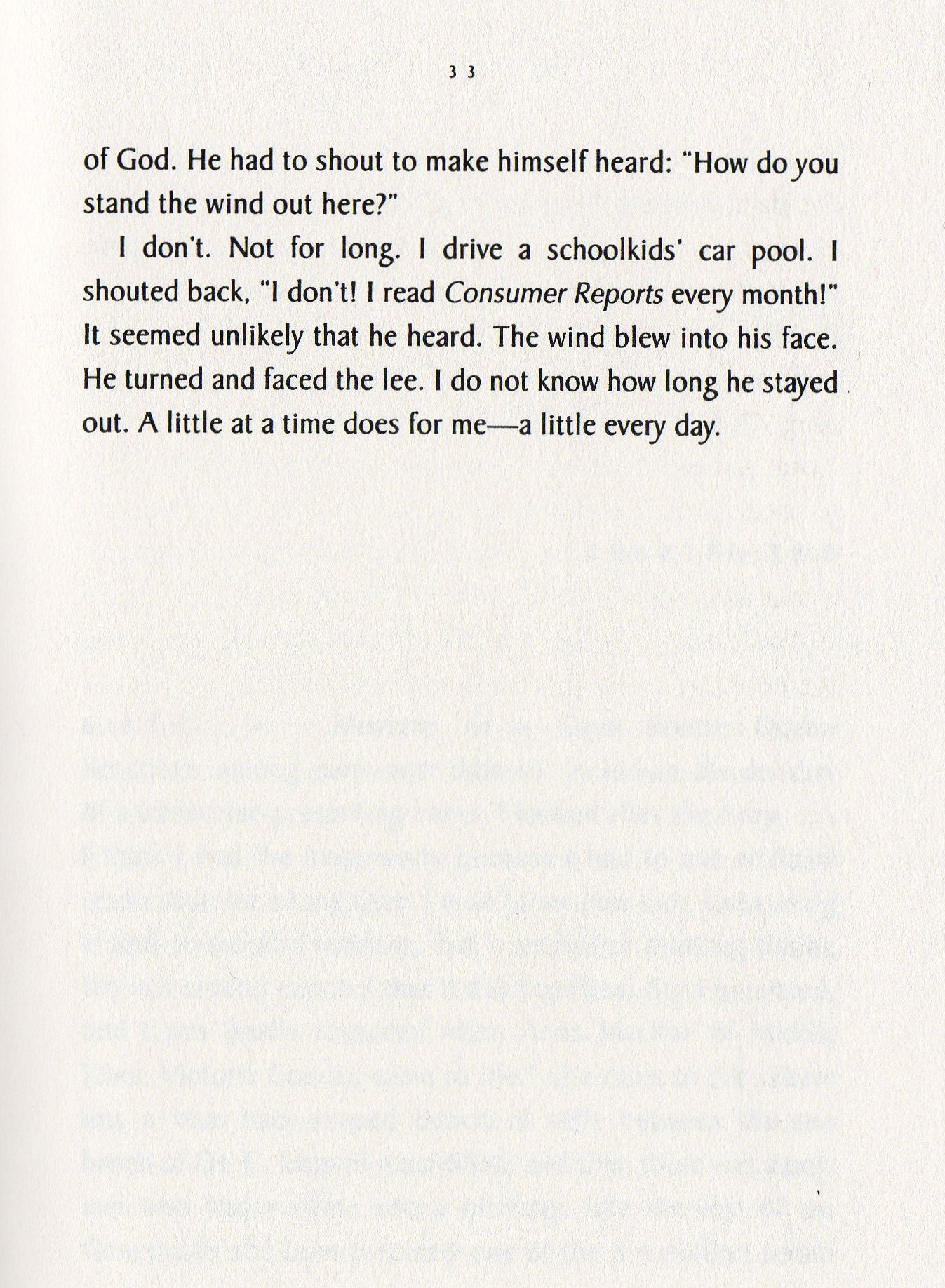
Annie Dillard, For the Time Being


Hippy hippy forward

6 10 2011

Question: How many of the pundits honoring Steve Jobs by praising his 2005 Stanford address, in which he recalls—

So I decided to drop out and trust that it would all work out OK. It was pretty scary at the time, but looking back it was one of the best decisions I ever made. The minute I dropped out I could stop taking the required classes that didn’t interest me, and begin dropping in on the ones that looked interesting. It wasn’t all romantic. I didn’t have a dorm room, so I slept on the floor in friends’ rooms, I returned coke bottles for the 5¢ deposits to buy food with, and I would walk the 7 miles across town every Sunday night to get one good meal a week at the Hare Krishna temple. I loved it.

—would extend a similar praise to regular ol’ drop-outs, hipsters, hippies, and assorted other losers for simply doing what they love?

There would, of course, be no pundit-love for Jobs had not

much of what I stumbled into by following my curiosity and intuition turned out to be priceless later on. Let me give you one example:

Reed College at that time offered perhaps the best calligraphy instruction in the country. Throughout the campus every poster, every label on every drawer, was beautifully hand calligraphed. Because I had dropped out and didn’t have to take the normal classes, I decided to take a calligraphy class to learn how to do this. I learned about serif and san serif typefaces, about varying the amount of space between different letter combinations, about what makes great typography great. It was beautiful, historical, artistically subtle in a way that science can’t capture, and I found it fascinating.

None of this had even a hope of any practical application in my life. But ten years later, when we were designing the first Macintosh computer, it all came back to me. And we designed it all into the Mac. It was the first computer with beautiful typography. If I had never dropped in on that single course in college, the Mac would have never had multiple typefaces or proportionally spaced fonts. And since Windows just copied the Mac, it’s likely that no personal computer would have them. If I had never dropped out, I would have never dropped in on this calligraphy class, and personal computers might not have the wonderful typography that they do.

This is no knock on Jobs; he noted that

you can’t connect the dots looking forward; you can only connect them looking backwards. So you have to trust that the dots will somehow connect in your future. You have to trust in something — your gut, destiny, life, karma, whatever. This approach has never let me down, and it has made all the difference in my life.

Dropping out and dropping acid worked for Jobs—good for him.

But all of those pundits who praise his vision, his courage, his fearlessness, what of those who fearlessly follow their visions into failure, mediocrity, or the abyss? What of those who crash on friends’ floors and dumpster dive for furniture and food and take classes just because and who have no impact on anyone beyond those friends?

Jobs was an eccentric obsessive who parleyed his obsessions into technological and financial success; had there been no success, there would be no praise for his unconventionality.

He ended the speech by citing the final issue of the Whole Earth Catalog:

On the back cover of their final issue was a photograph of an early morning country road, the kind you might find yourself hitchhiking on if you were so adventurous. Beneath it were the words: “Stay Hungry. Stay Foolish.” It was their farewell message as they signed off. Stay Hungry. Stay Foolish. And I have always wished that for myself. And now, as you graduate to begin anew, I wish that for you.

Stay Hungry. Stay Foolish.

Marvelous advice, but recognize that without success you will simply be thought a hungry fool.

_____

h/t to Andrew Sullivan, for his round-up of reactions, with Robin Hanson one of the skeptics


Letting the days go by

10 09 2011

I wasn’t there.

But I still have a story, so here it is:

I was in Montreal, and many mornings I rode my bike up Mont Royal before showering at the nearby medical building and heading to my office on Peel Street. The Biomedical Ethics Unit was still in the old red mansion on the west side of the street, and my office was on the ground floor, separated from the main office on the third floor. I had just walked in, maybe turned the computer on, when the phone rang.

I heard my mom, not recognizing me, asking to speak to me. She and my dad were scheduled to leave for their first-ever trip to Europe (I had long pestered them to go), so I wondered if something had happened with their plans.

The trip was cancelled, she said. All the trips are cancelled. What? I said, why? Are you rescheduling?

I don’t remember exactly what she said next, but something about planes, multiple planes crashing in New York, in DC, no one knows what’s going on, we might be at war, haven’t you heard?

Haven’t you heard?

I do remember standing in my office, one hand on my forehead, not comprehending what was being told to me. Not comprehending at all.

Then D., my fellow post-doc, filled my door-frame. Did you hear, he might have said. Something about planes, multiple planes, crashing in the US, A. has the t.v. on up in the office.

At some point I got off the phone and headed up. There it was. I don’t know how long I stayed, watching, before heading over to the Shatner (the student union) for coffee. The t.v. was on there. Students were crying. People were crying. I don’t know if they were Canadian or American. I don’t remember if I cried.

At some point I heard the borders were closed. Closed! I was locked out! I knew, not forever, but I started to know I was on the outside.

Later I was at lunch with the director of my unit (a dual citizen), a colleague, and that colleague’s girlfriend. The girlfriend got into it, I don’t remember over exactly what, but probably over the question of war. I do remember that I took an immediate stance against any immediate action. Let’s wait, let’s not make things worse. Something like that, probably something like that.

Oh, and probably something about how this probably connected to something the US had done. Yes, this was terrorism, and no, the people killed didn’t deserve it, but given how the US acts in the world, it shouldn’t be a surprise when the world reacts. Something like that, probably something like that, is probably what set off the girlfriend. Or something the girlfriend said set this off in me. I don’t remember the specifics, “who started it”, just that we got into it.

Later, not much time later, the director said to me, quietly, that perhaps it was too soon. And I thought, even if I didn’t say it (tho’ I might have said it), that we have to speak now, before everything hardens, and further thought isn’t possible.

Later, maybe later that day, maybe the next day, I rode back up Mont Royal, stood at the terrace near the top and looked toward what I guessed was New York. Could I see the smoke? Could it reach Montreal? Were we all now breathing in the dead?

Melodramatic, I knew, even as I thought it. Besides, everyone would breathe the dead, they would soar around the world and we’d all breathe in everyone’s dead, the way we always had, the way we never thought we had.

A week later I was at the border, a black strip of fabric hanging from my rearview mirror, on my way to see M. & E. in Vermont. I thought it might take hours; it took minutes. No problems, no problems at all.

M. was still working, so E. and I tooled around, running errands, before picking her up (or maybe we ran the errands after we picked her up; I don’t remember). We had to stop at a store E. hated, thought was terrible. “I wish a plane had crashed into that store,” he muttered, and then we both sputtered with laughter. We were terrible, laughing at a terrible joke about a terrible event.

Later, over a year later, hundreds of thousands of us marched down St. Catherine and Rene Levesque; millions around the world marched against the march to war. For naught. I watched the CBC in disbelief as the President led the Congress, and the nation, into war in Iraq. I couldn’t believe it: it was all so transparently false, so obviously wrong, they couldn’t actually pull this off, could they? Yes. And no.

There’s more, of course; ten years, after all. And while I’m in New York now, having not been then, my memories are of the outsider, still.

Which is why I told my story today; let tomorrow be the day for the stories of those who were there.


Osama bin Laden is dead; and. . . ?

2 05 2011

A few thoughts on the death of a murderous fanatic:

1. I am opposed to the death penalty, in every case. Thus, as I noted in a comment at TNC’s joint, I may be parsing matters to consider bin Laden not the subject of a criminal trial, but a casualty of war.

2. I don’t like facile comparisons of bin Laden to Hitler or Al Qaeda to the Nazis; whatever the totalitarian similarities, the differences, I think, are are even greater.

Nonetheless, this quote from Hannah Arendt’s Eichmann in Jerusalem came to mind:

[J]ust as you supported and carried out a policy of not wanting to share the earth with the Jewish people and the people of a number of other nations—as though you and your superiors had any right to determine who should and who should not inhabit the world—we find that no one, that is, no member of the human race, can be expected to want to share the earth with you. This is the reason, and the only reason, you must hang. [emph. added]

To want to cleanse the world of its inhabitants makes you an enemy of the world and its inhabitants and gives us license to treat you as such.

I don’t celebrate his death—“grim satisfaction” seems the appropriate cliche—but I do think a kind of rough justice was done.

3. There are concerns that this action will give the US cover to leave Afghanistan sooner rather than later. Would that this would be so.

4. The death of bin Laden matters. I say this not as an expert on terrorism but more generally as a political scientists: Even if the death were only symbolic—his operational role was said to have diminished greatly in the past few years—the symbolism still matters. In both war and politics, symbolism matters.

As to whether this will lead to a retrenchment or fracturing of Al Qaeda, well, either is a possibility. Bin Laden was apparently a charismatic figure, and his former number two (now presumptive leader) Ayman Al-Zawahri is not; that could matter in terms of holding together a far-flung criminal operation.

Or not: The cell structure of Al Qaeda may mean that those freelancers gathered under the Al Qaeda banner have long since left the base of The Base behind.

We’ll find out.

5. Some are concerned at what happens next.

As a general matter, I’m not concerned; something always happens next.

As for specifics,  I (somewhat surprisingly) again agree with Jeffrey Goldberg:

Television-based analysts are already asking if the killing of Bin Laden will provoke revenge attacks by al Qaeda. Is there a stupider question in the world? The implication, of course, is that now, al Qaeda will truly be pissed off at the U.S. Unlike in 2001, when al Qaeda was only marginally angry at the U.S.

He backs off that somewhat in later posts—yes, some terrorists may be moved to strike out in rage or grief—but as Al Qaeda was not much a political organization, that is, it was not an organization with which one could negotiate, any acts around it or in reference to it or against it would lead to a reaction.

That there are reactions does not mean there should be no actions.

6. There are domestic political implications of all this, but it seems small, today, to consider them.

7. To circle back around to the Arendt quote: Yes, I think she got it right.

There are a lot of reconsiderations of her work in light of a new book on Eichmann (The Eichmann Trial, by Deborah Lipstadt), but I don’t know that any of the old or new criticisms can erode the acuity of that judgment, which deserves repeating:

[J]ust as you supported and carried out a policy of not wanting to share the earth with the Jewish people and the people of a number of other nations. . . we find that no one, that is, no member of the human race, can be expected to want to share the earth with you.


The heaviness, the heaviness

17 04 2011

Family farms are amazing places.

You notice the barns, first (there’s always more than one barn), and, in Wisconsin, they tend toward the standard red. There’s usually a big barn, thirty or forty feet high, and then a smaller one, maybe around 20, 25 feet, and maybe another outbuilding, used for the farm equipment; there’s often a chicken coop thereabouts. If there’s not a silo, then there are a number of large cylindrical containers, and it’s not unusual to find a gas pump on the property.

The family farms I knew were dairy farms, and the milk-barn, where the cows went into their stalls twice daily for milking, tended to be low-ceilinged in the stalls area, although where the hay was kept there was, actually, a loft.

The farm house looked big from the outside, but it was usually quite cozy inside. The first floor would have the kitchen, a den, then maybe a formal living or dining room; the parents and kids’ bedrooms—and on these farms, there were usually a lot of kids—were on the second and third floors. Depending upon how large the family was, the younger kids would share rooms, and the older ones might have their own, or, they were all shared, divvied up by sex and age; maybe there were two full bathrooms.

Any trees on the property were near the house, or maybe there’d be a small stand to mark the edge of the property or on some spot where crops wouldn’t grow. Two-lane highways might cut through a property or serve as the dividing line between families; shoulders were gravel and often pitched steeply toward a ditch. If you came upon a tractor driving on the shoulder, you still had to swing wide around him, as the tractor usually trailed some equipment that spread across both lane and shoulder. It was rarely a problem; there’s not much traffic out on those country roads.

And there’s the smell. It’s almost always smelly on a farm, but it’s a clean smell, of manure and hay and dirt and animal, the kind you get used to and reminds you, simply, of country.

I’m thinking of one farm, in particular, as I write this, but it was the thought of another which prompted this post.

Jon Katz at Bedlam Farm posted on a 4-H visit to his mini-farm, for the kids to watch his farrier take care of his donkeys. Katz notes (correctly, I think) that urban and suburban parents today are over-protective of their kids, but that In farm areas, most families can’t afford to do that and don’t believe in it. In this and many other posts, he celebrates the hard and necessary independence of those farm kids.

Such hardy independence, however, has its risks.

As I read Katz’s post, all I could think of was RW. R. was in my brother’s class (two years ahead of me), and oh, was he a honey. He was popular with the guys, very popular with the girls, close to his younger sister J, who I later knew through theatre and track.

Word was she had to be sedated at his funeral.

R. was hit in the chest with a piece of farm equipment, and, being out in the country, was far from any hospital; by the time the ambulance got there—word was it got lost on its way to the farm—it was too late.

I think he was sixteen.

R. likely wasn’t doing anything on the day he died that he hadn’t done before, and, at sixteen, was certainly old enough to be doing anything that needed doing on that farm. He was one of those kids that Katz and I would both admire.

But as much as Katz wants to thrust the sweat and peeling paint and oh yes, the smell, into his viewers’ understandings of the family farm, as often as he cautions that there’s no such thing as a “no-kill” farm, as much as he wants us to see the hardness and the beauty of these places, the admonitions themselves often serve to turn that hard beauty into its own kind of light.

There is light there; he’s not wrong to see it. But not everything hard is beautiful and not everything beautiful is light, and sometimes what matters most of all falls beneath a heavy sight.