They certainly don’t make them like that anymore

16 08 2013

Yesterday I finally got off my butt and picked up a canister in which to store my compost-ables until I could take them to the Grand Army Plaza greenmarket for real composting.

On my way back from the dollar store—yes, I went all out on the container—I stopped momentarily to watch the road construction crew lay down a layer of red concrete. That moment lasted, oh, half-an-hour.

The city and various utilities have been upgrading the lines running under half of Nostrand, then building out pedestrian bulges as they reconstruct the torn-up lanes. During the day, what is normally 2-3 lanes of traffic is funnelled into a single eastside lane, as the lane closest to the western curb is worked on and a middle lane reserved for the construction equipment.

I wasn’t the only one leaning on the fencing, watching some of the men run their brushes and floaters over the concrete, while others shoveled the mix into a trench alongside the old roadway. I waited for the mixer to drop more of the sludge onto the prepared lane, but the only guy who wasn’t wearing the yellow safety vest, after yelling back and forth with a goateed man in, mm, his forties or fifties, sent the mixer away.

A dump truck and an excavator crept in where the mixer had been, and one of the workers directed the excavator driver to deposit dirt from the truck on the far side of lane. The goateed man flung a half-brick with a string tied around across the barrier at the edge of the trench, then, carried that string to the curb, roughing out a height. The dump truck and excavator reversed in tandem down the street, pausing to deposit dirt in the road bed (I’m assuming to create a slight slope down toward the curb). Later guy with a walk-behind compactor came through and tamped down the dirt.

The mixer returned, and as the drum rolled, I recalled a piece I had read somewhere (probably in the New Yorker, probably by John McPhee), on the time constraints on concrete mixing. The aggregate, cement, and water need to mix enough to integrate all of the components, but since it begins to set almost immediately, it needs to be disgorged tout suite (within 90 minutes, according to Wikipedia). It was around lunchtime, but it was clear that as long as the mixer was on the scene, the men would be shoveling, troweling, and smoothing instead of eating.

The drum rolled and rolled, the men standing around, rinsing off boots and equipment, and attaching extenders to the chute. (Given that one man could easily lift the 5-foot or so long chute, it was probably a composite plastic material, or maybe aluminum. Lightweight, in other words.) Then a couple of the guys signaled to the driver, and the red concrete began sliding down the chute. Immediately they began shoveling and troweling and brushing the concrete, and as the compactor finished its last run in the road bed, the mixer slowly moved south, pausing as the men swung the chute in an arc from curb to trench.

That was my cue to leave—I’d said to myself I would stay until the concrete began flowing again—but, honestly, I could hung on that fence and watched these men build that road to the end.

I don’t do physical work now—wielding chalk against a board doesn’t count—but I have in the past. My only summer home from college I got a second shift job at a foundry, working the punch press for lawnmower parts, leak-checking oil pans and oil-pan covers, and running the mill-and-tap machine for Pontiac power-steering plug brackets.

I hated that job, not least because, as a non-union gig, the pay was shit and the safety conditions somewhat less than desirable. That it was second shift also meant that when I was getting out of work all of my first-shift friends were at home in bed; while I got along fine with my co-workers (after a brief period of coolness toward the “college kid”, they allowed me to lunch with them), we didn’t socialize outside of work.

Still, near the end of my time there, I understood something of why, beyond just a paycheck, people might appreciate a job like that. There was a certain rhythm to the work. Here’s where you lined up to punch in, here’s where you lined up to punch out, here’s where you picked up your gloves and here’s where you tossed them. Head nod to these folks, a joke with those, and off to the machines. While I’m not much good with regularity, I got a glimpse of its pleasures, and why some might be reassured rather than boxed in by it.

There was also the pleasure at having a part in making something you can hold in your hand. I milled and tapped hundreds, maybe (tho’ probably not: I wasn’t the fastest on this machine) thousands of Pontiac power-steering plug brackets, with damn near each one of which ended up in a car. It was a thing I worked on, which was now working for someone else.

I like teaching and I’m glad to have a job which requires me to be so much in my head, but as much satisfaction I get from my time in the classroom or with my books, I can’t hold the thing I make in my hand.

When Matt Yglesias wonders why so many people bang on about manufacturing, when he suggests that food service (in which I’ve also put my time) be considered a part of the manufacturing sector, he misses the central point of manufacture: that you end up with a thing you can hold in your hand. Maybe he doesn’t get that, or maybe he doesn’t see why that’s important, but if you’re going to stand on a line year after year after year, the routine itself won’t be enough.

If you’re going to do the job, take pride—such an outdated concept—in the job, it helps to be able to pick a thing up and say, without irony or ideology, “I built that.”

That’s why I and so many of my neighbors were hanging on that fence, watching those men build a road. It was something we could see, something we would walk across or bike or drive on, something which had disappeared, and now, finally, was there.



Special, special, what do you get?

4 08 2013

Pressed on the topic of Hitler, Borges said that “of course I hate and loathe him. His anti-Semitism was very foolish.” This is hard to read because, although we should know better, it’s difficult to stop ourselves expecting wisdom from a person who happens to be a genius.

—Mark O’Connell

I used to believe that talented people were better people.

I wouldn’t have put it that way, back then, don’t know that I even knew I believed this, but I almost certainly did. If you were talented you were special, and if you were special, you were special all the way through.

I think this bias cuts through our celebrity culture, such that fame itself is a signifier of specialness. We want to meet, become friends with these celebrities, hoping that by virtue of being picked by someone special, we’ll become special ourselves.

I don’t want to push that too hard, not least because there’s also a knowingness about this desire, and jokes about “My boyfriend George Clooney” poke holes in the whole cloth of celebrity-dom. Still, why else would any of us who are not-famous and not-friends of the famous care enough about them to make them famous unless we though there was something more to them than [what led them to] the fame itself?

Anyway, it was well into adulthood before I even became aware of this equation, and while I’ve pretty much disabuse myself of the notion, those times that I have met famous folk (mostly actors, mostly while working at Big & National Bookstore), I’ve had to remind myself that they are just folks.

Yes, just-folks with name recognition, just-folks with talent, but when not on stage or in front of a camera, just folks, full stop.

Still, it must be said: I don’t tell my friends when I meet non-famous just-folks.


God save your mad parade

22 07 2013

So two things happened today: A future king of England was born, and my fan went out.

Naturally, I’m more concerned about the fan.

My parents bought me this fan when I was in college, lo those many years ago. Decades ago, actually, and it has moved with me from Madison to Minneapolis to Albuquerque to Minneapolis. . . well, you get the point: I’ve had it for a long time.

There was no obvious brand name—this sucker’s so old, it was built before companies thought to embed their brand on every available surface—but according to the sticker inside, it was made by Lakewood Engineering & Mfg., Co. of Chicago. (And, actually, when I got up to check the manufacturer, I noticed—for the first time ever—the name of the company on the fan-speed sticker. Subtle branding, then.)

It’s been a good fan. I’ve had to replace the knob, and over the years I’ve knocked out a few of the tines, but on low speed it’s very quiet and on medium, still pretty quiet. It’s been rained on and knocked over and dropped and had shit dropped in it, but other than a yearly cleaning, I haven’t had to do much with it other than pull it out of the closet and plug it in.

A coupla’ years ago I bought another box fan, but returned it because it was tippy and thin and loud even on low. I do have one of those dual-fan window fans (also from my folks), which I’m using now, but it’s not really a replacement for the box: not as big, and not as versatile.

I have, of course, tried fixing the fan—connecting wires broke, so I went in, stripped the cord a bit, pulled out more wire, and tried wrapping it around the connector piece (I have no idea what that’s called)—but while I was able to dis- and re-assemble the fan-speed module, I wasn’t able to get it to work. I know there’s electricity flowing (yes, I shocked myself testing the reassembly), so I’ll give ‘er another go later, but it’s just possible that I’ll have to break down and buy a replacement.

Goddamn. I really did want to keep this sucker working for another decade or so.

Oh, and for the royal baby? Well, as an avowed republican, I officially have no interest in the future king of England, but as a human being, I like babies. They had an apparently healthy baby boy.

That’s a good thing.

~~~

(And yes, at some point I’ll get back to more substantive posting, but I’ve warned you: my brain melts in the muck of July. Once things cool and dry out a bit, I should be able to string more than two thoughts together.)


Strange angels

17 07 2013

It happens about once a month.

Kitty boy changes where he sleeps at night: sometimes at the end of my bed, sometimes on the bedroom chair, sometimes on the small chest, and sometimes in the living room.

But with some regularity, in the middle of the night, Jasper will creep up on to my chest and purr and peep and squeak until I wake up enough to scritch him. And if the noises (or his weight or a misplaced paw) don’t do it, he’ll nudge around one of my hands until I bring it to his head, then he’ll settle in, a block of purring fur.

Okay, I don’t like being woken up, but he’s just so affectionate and. . . yeah, I’m a sucker, so yeah, he gets away with it.

Actually, the purring and blocking wouldn’t be so bad, but at some point he’ll get super affectionate and start to lick my chin or my neck, and I have to move my hand to deflect him—because I know that after the licks come the nips and then the chomps.

No, I can’t recall that Jasper—who I did once call the Vampire Kitty—ever has bitten my neck, but having had my toes be on the receiving end of the lick-nip-chomp routine, I ain’t taking any chances.

I don’t know what’s going on with him; it’s entirely possible he’s just being. . . cat.

Trickster, on the other hand, never bothers me in the middle of the night, but when the alarm goes off in the morning, or if she hears me stir, she’ll jump on to the bed or come up from the foot and sit, just sit, right next to me, waiting for me to wake enough to throw a pettin’ her way.

Of course, then she’s got this weird step-dance she goes through where she arches her back and circles around and smashes her head into my hand, to which I almost always respond, “weirdo”.

Whatever. Cat.

Cats.


I won’t recall the names and places of each sad occasion

9 07 2013

Twenty five years, a quarter century, almost half of my life—so far away, in so many ways.

I’ve mentioned before that I no longer recognize the desperately self-destructive person I once was, that on those rare occasions I read journal entries from later in my career as a failed suicide I think Jesus, I wrote this? Who writes this?

For twenty years, a fifth of a century, almost half of my life, I berated myself for my life, and in the midst of that fifth I tried, again, and failed, again, to end it. It would be over a decade before I would, finally, leave it all behind.

It’s been over a decade since I left it all behind.

These swaths of time, overlapping and flapping against one another, floating back into and obscuring past versions of myself.

This is the story of everyone’s life, I have to remind myself. Does anyone recognize who they were, then? Who sustains the same line all the way through?

Still, some lines are sustained, if even fictionally. There are pieces of memory I pick up and thread on to the knotted string I call my life, but I can barely remember who I tried to erase and what remains are these odd hard bits that nonetheless are unsettlingly warm in my hand.

Over a decade since I left it all behind, I cannot hold these strange remains for long without fear I will string them all together and back to that long dissolve. And so before I am too warmed I shake my hand and scatter those remains.

And so there are some ways I cannot know today of who I was before.

This is not a tragedy; this may not even be a loss. I wish I could know, nonetheless.


Devil was my angel

7 07 2013

Twenty five years ago today I was vacationing in lovely Chez Bedlam, watching Wimbledon, enjoying the respite from the Madison heat.

Well, okay, it might be a stretch to call a just-barely-voluntary (as in: do it or else) stint in a locked psychiatric ward a “vacation”, but I did watch Wimbledon and the ward climate, like everything else, was controlled.

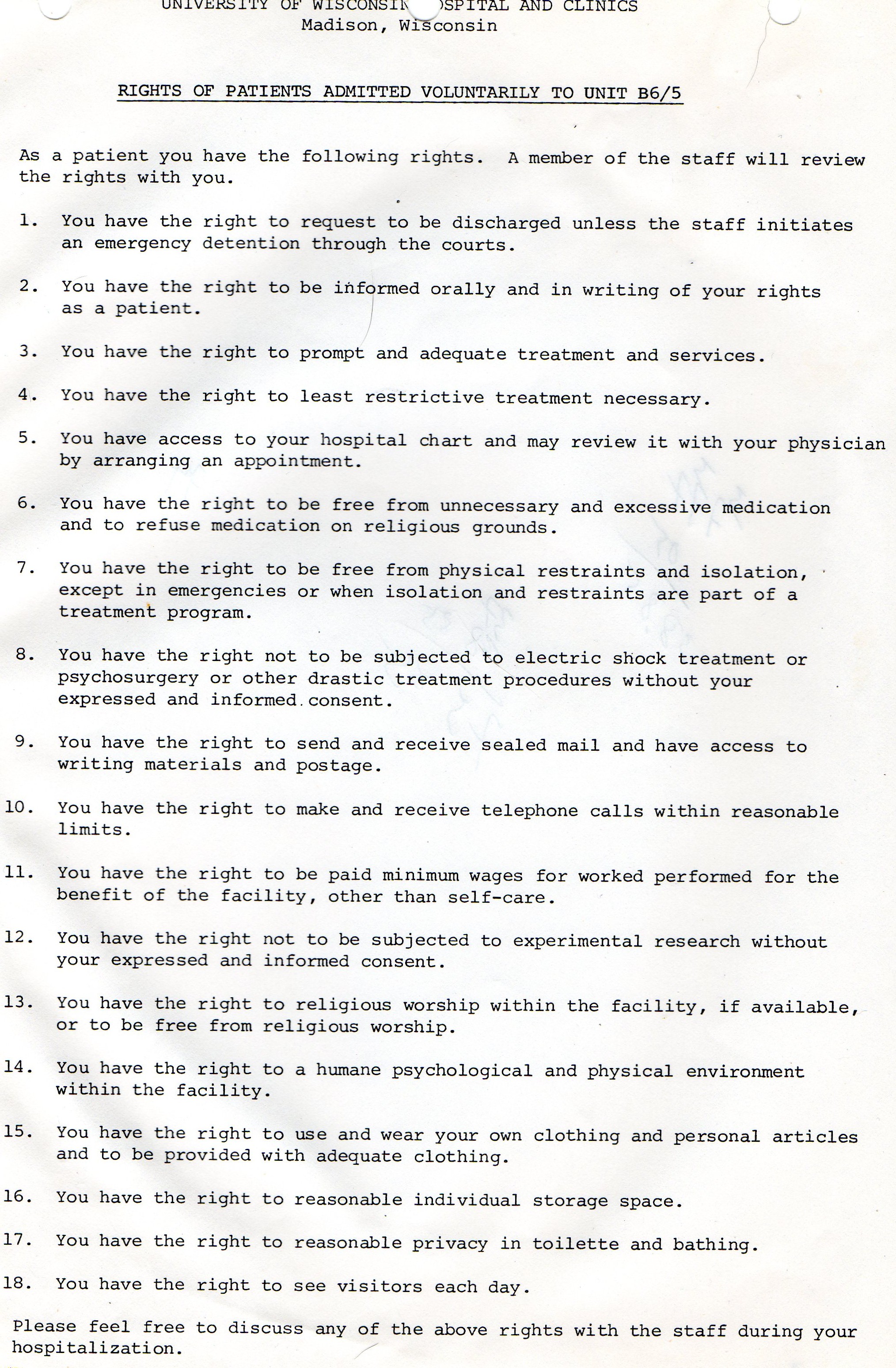
I’d first ended up in B6/5, as the unit was known, in June, and not voluntarily. I still have my “patient’s subject’s right” sheet for those detained against their wishes:

UW detained

I was first interviewed by the some/all of the staff (what fun!) the day after the cops deposited me in the ER. I don’t remember much about the interview—and, really, even in calling up the event I’m almost certainly altering it—but I do recall someone asking me (after I must have mentioned I’d been accepted to grad school in political science) if I thought I’d be or wanted to be president.

I’d snorted and said “No”. My therapist was the only one who laughed.

Everyone else was dead serious. I wonder if they were trying to figure out whether my distorted thoughts had extended all the way into delusion.

I did get the hearing, was represented by a competent attorney, and ended up staying, mmm, a week, maybe?

A coupla’ weeks later I was back, not in cuffs this time, but under the impression that had I not returned voluntarily the cops would know where to find me.

My rights as a voluntary admit were a bit more expansive:

UW voluntary

Friends did visit, bringing food and quite possibly a beer, and over the course of my two stays I made friends with J. who, unlike me, was not at all conflicted about wanting to get better. She wanted to be healthy more than anything, but it seemed like every time she managed to get a grip on the ledge, something would come smashing down on her fingers.

We stayed in touch for a few years afterward, but eventually fell away from one another. I have no idea if she’s still alive.

Anyway, no great scandal on the ward. ECT was suggested, but the suggestion was dropped at my vehement opposition. I was given an experimental drug, fluoxetine (brand: Prozac), but it made my legs shake and not much else, so that ended. I spent a few nights in the open containment rooms, got a few day passes, had a few good conversations with some of the nurses, and then I left.

And about a month or so after I left I was in Minneapolis, starting grad school.

Strange time, that.


Ice ice baby

5 07 2013

Made it through June, but the beginning of July and it all ends.

The a/c-free livin’, that is.

I don’t have any strict rules for when I put the box in the window, but when I can’t sit in my apartment without thinking how hot I am and I can’t sleep at night without heat interruptions,  it’s time.

Pre-a/c I used to just sweat and swear it out, waiting for the thunderstorm or front shift to blow through and restore me to sanity [oh hush, you]. I hated the steam bath, but ohhhh, the blow-through was divine.

Anyway, the other night the mugg couldn’t be budged by the fan and yesterday as the temp and dew point crawled skyward I said ‘Self, it’s time.’

The cats appreciate the cool, but as I’m the one paying the electric bill, I’m a bit grumpy about the whole thing.

Still, better grumpy than homicidal.


Move like that

30 06 2013

I get antsy.

I can go long stretches with a routine or an arrangement, and then. . . I get antsy. I toss things out, put some stuff into storage and pull other stuff out, and I move.

That used to be literal: Between college and the latter years of grad school, I moved on average of more than once a year.

There was that first year in grad school, with the screechy-horrid roommate who accused me of lying to her about. . . something, whereupon I decamped to a horrid, horrid apartment about 2 miles west on Franklin Avenue for a couple months. Then the woman who replaced me and the decent roommate kicked out the screechy-horror after she threw their kittens out of the apartment—they found tracks in the snow, but not the kitties—an invited me back in.

Oh, and there was Albuquerque, and that basement apartment that I had to leave after a week or two, into a room in the house of that nice, soft-spoken woman who turned out to be psycho when she wasn’t being nice and soft-spoken, then the duplex around the corner which my ABQ-cat Jomo broke out of with some regularity.

(Before I left Albuquerque, I found Jomo a home with a Los Alamos post-doc who wanted an indoor-outdoor cat. Figured he’d be happier on a ranch in the mountains than trapped in a Minneapolis apartment building.)

One place in Montreal, one in Somerville, then sublet in Prospect Heights,  room in Clinton Hill, apartment in Bushwick, room in Bed Stuy, and then, finally, my own place, in lovely Prospect- Lefferts Garden.

And this apartment is fine, it really is. I’d like a bigger place, but, for now, with my finances, this joint works out fine.

Still, I get antsy, and since I’m in no position to move, I move. . . my furniture.

It’s tough—small place, remember?—but I can shift around my desk and various wine-box shelves and swap out rugs. Can’t really do much with the bedroom: four bookshelves line the back wall, and while I have moved my bed NSE and W in the same position, it really only works where it is now (headboard south).

Anyway, I’m sitting in my living room watching Eureka (fourth season—new episodes for me) and thinking, Huh, I’d really like to change things up. But how? I’ve tried this and that and the other thing and, really, the way I had it was probably the best way.

Still. Antsy.

So I tried something else, that I hadn’t tried before. I don’t know if it’ll work, but, y’know, it’s the summer and I was antsy and I wanted to move and so I did.

My stuff, I mean.

And maybe, someday, my stuff, my cats, and me, into a larger place where I have many—or at least, some—different ways of how to arrange it all.


99.9 fahrenheit degrees

25 06 2013

Okay, it’s not quite that hot—just lower nineties.

Still, I have not yet put my air conditioner in the window, relying instead on a fan.

Why? One, I don’t like air conditioning.

Oh, I appreciate it when it’s sweltering enough to melt my face, but it is a brittle appreciation, one driven more by annoyance at the necessity of the a/c than a delight in the artificial cool it brings.

Two, I prefer fan-in-window cooling at night to that of the a/c. The fan, strategically aimed (well, okay, propped slant-wise in the window) at my bed, delivers an even cooling on a low hum throughout the night. The a/c, on the other hand, cycles on and off as the room warms then cools then warms then cools.

Not a nice even cool.

Three, I don’t like air conditioning.

What, have I mentioned that? Okay, um. . . yeah, so I don’t like a/c at night.

I’ve mentioned that, too? Well, the fan-in-window has worked the past couple of nights and has afforded me (or would have afforded me, had Jasper not been an asshole) delightful nights of sleep.

Four, I’m cheap. A fan costs less to run than a/c.

Five, it hasn’t, really, been that bad. I don’t like 90-degree weather, and while it’s been hot and humid, the weather has not devolved into the beastly, by which I mean: I can sit in my apartment with the fan and not constantly be thinking about how miserable I am.

Six, I’m teaching this month, so manage to be out of my apartment during the worst part of the day.

Seven, this heat wave is supposed to break tomorrow night. I can wait it out.

I’d really like to get through the summer without shoving the a/c unit into one of my few windows, but if the heat gets to the point where it immiserates rather than merely annoys me, then shove it I will.

The a/c into the window, I mean.

~~~

Warning: So begins the series of wailing-and-gnashing-of-teeth posts about summer. At some point there’ll be a post in which I announce I’ve cut off all my hair (probably titled ‘And then she cut off all my hair’)  and one, in August, in which I announce “I hate everything”. No, I’m not planning these things: I just know they’re gonna happen.


Take it easy

14 06 2013

Another dream about Madison.

It was so vivid, but, of course, it’s now all faded. I was in Madison, with T., in the Union (which, of course, was nothing like the actual Union) and near Lake Mendotat (which, of course, was nothing like the actual Lake Mendota: in my Madison dreams the shoreline is a coastline and lake scallops are oceanic waves), and when I awoke, I was so sad that I wasn’t living there.

Living in that dream-Madison would be so easy; I missed the chance of that Madison-dream.

Of course, that’s just what it was: a dream. Madison is a lovely town (when Scott Walker ain’t around, but it’s no longer for me. I may visit it again on my next sojourn to Wisconsin, and I set a part of my second novel in Madison, but as a real place, it’s not mine.

Part of this is my sense that to live there would be to ‘go backwards’, but more than that, I would always be looking for something beyond what Madison could offer.

This is not a knock on the joint: I’m restless, full stop, and thus unable to indulge he pleasures of staying put.

Then there is the fact that I am made uneasy by ease. Even assuming an identical level of financial uncertainty there as I have here, life in Madison would be easier in every way. You know those t.v. shows or books wherein newcomers are able to find a rich & quirky community life, with beloved hangouts and folks willing to tell-you-what? That would be possible in Madison.

Which is why I can never live there.

Okay, I could live there for a time—for a semester, maybe—but the idea that I would land there and stay there and stay there and there. . . no ma’am.

I’d wonder what I was missing, not just in the what’s-going-on-elsewhere way, but in the sense that ‘this is too easy: what’s the catch’? I always think there’s a catch.

I’m too skeptical, even suspicious, to live easy. This is not a wholly bad thing—looking for something more has its own rewards—but I miss out on the pleasures, and, perhaps, sorrows, of letting it be.

There is a whole other life which is beyond me, a something more available only to those who aren’t searching for that something more.