Sugar boy, what you trying to do?

30 10 2011

No more boy kitties; boy kitties break my heart.
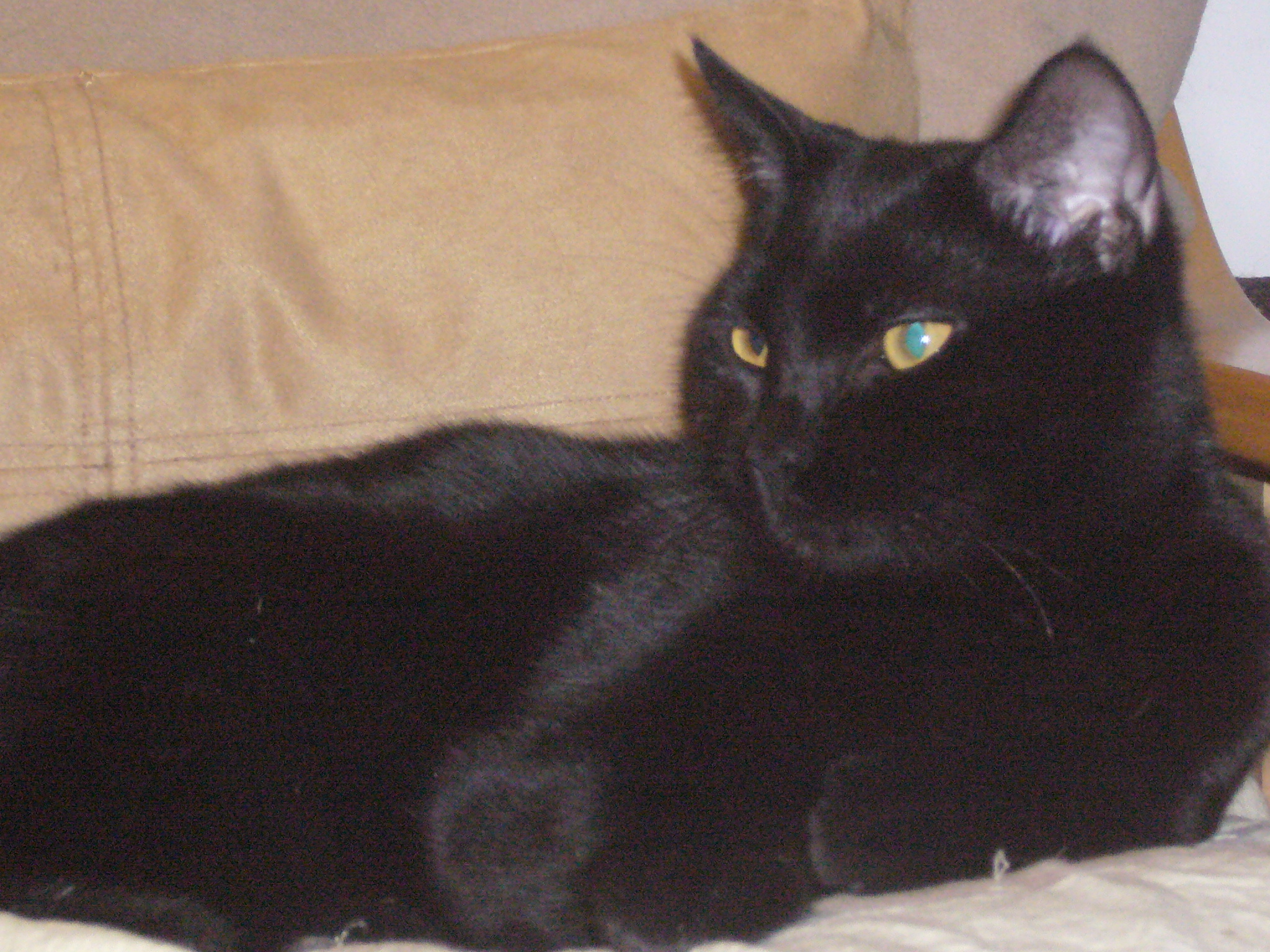
Chillin'. It's what all the cool cats do.

My particular kitty-boy, Jasper, is in the hospital, with a problem which particularly affects males. (My old cat Jazz died from this, although he was much older than Jasper. I swore then I’d never get another boy cat. So much for swearing.) The doc should be calling me shortly to let me know how the procedure (to unblock his ureter) went—I expect it went fine—and I’ll pick him up tomorrow.

Of course, he should be in the hospital for at least another day, but I can’t afford that. To be honest, I don’t know if I can afford the care he’s currently being given. If his bill comes in toward the low end of the estimate, we’re fine. If not. . . .

I have no idea how I’ll pay it.

And then, of course, there’s the after care, which I also have no idea how I’ll afford.

But he was crying and I was crying and as I asked C., what, I’m going to let him die because I can’t afford to keep him alive?

C. did do me the great favor of looking for 24h care and telling me about CareCredit. I qualified for it—it pays the vet and then I pay it—but not enough to cover all the costs. Had I known about this before, I might have been able to get him into the vet before it became a costly emergency.

[*Update* The vet just called. He came through fine, his kidneys are fine, and he’s awake and groggy. So yes I’m still hyperventilating about the money, but at least Jasper’s okay.]

So, if you have pets and not a lot of cash, get CareCredit before anything bad happens; then maybe you can afford to pay for the little bad before it turns into the big bad.

Like it did with Jasper.

_____

*Update2* I learned a bit more about low-cost vet care—which, again, had I known about sooner, I might have been able to prevent this. (Joyce at Safety Net/Pets  for Life was very nice about this, however, saying that this might have happened anyway. Thanks Joyce!)

So, for those of you in the New York City area, there are two (more) options you should know about:

  1. Safety Net/Pets for Life (ACC; updated site at Humane Society) at 917 468-2938. If you’re low-income or on public assistance, they can help you find vet care at a reduced price, as well as low-cost or free spaying and neutering. As I mentioned, I spoke to Joyce and she was very helpful.
  2. Low-cost vet mobile. This hits the different boroughs on different days; the one in Brooklyn parks at the Animal Care and Control site at 2336 Linden Boulevard every Wednesday from 10-6. They do everything but spaying/neutering (another mobile van does that) and extended hospitalizations. Intake exam is $25, with additional costs for other services. It’s a walk-in clinic for the most part, with appointments for surgeries.

I don’t have a contact number for the vet mobile, but if you’re in another borough you could call Safety Net for locations and dates.

I had looked previously for low-cost vet care, but somehow in my searches I didn’t find any of these services. Yes, I found the low-cost spay/neuter mobiles, but as I wasn’t looking for those services, I didn’t click on those links; had I done so, I might have also discovered the regular vet mobiles. And I  messed-up in not finding the Safety Net program. I don’t know what search terms I was using, but they were clearly the wrong ones.

Jasper’s care cost a fair amount of money, and, more importantly, a great deal of distress to him. Perhaps had I taken him in when the problem first hit, we might have been able to avoid this. Joyce tried to reassure me by saying, well, even a vet can’t necessarily prevent blockages, and he would have had to have been unblocked anyway.

Finally, even if you’re not in New York City, you might have a Safety Net/Pets for Life program in your area. The NYC one is apparently run through the Humane Society, but it also has a page on the Animal Care and Control page. Check your local animal care societies to see if its available near you. And get CareCredit (which doesn’t cost anything to apply for and keep it on hand), just in case.


Welcome to the working week

31 07 2011

So I finally got some work. A real job.

Or real-ish job. I’m not sure.

A guy I know got me a job in shipping/receiving on a construction site. I’m fine, more than fine, with that: I’m old school enough to thrill to the sheer bluntness, there-ness, of steel and concrete. I’ve never wanted to be an engineer, but I am fascinated how to make something appear where there was nothing, before.

So the work is real.

And I’ve worked receiving previously, so while I don’t know the specific procedures of this work site, I at least have a grasp of the general process.

Still, there are bits about this offer that are sketchy. I don’t want to go into precisely, but let’s just say I’m a bit skeptical about the promises made.

This skepticism was small, at first; hell, at first I was thrilled at the prospect of replenishing my drought-ridden bank account. But since then my questions have multiplied, and I’m not at all sure I’m going to get good answers to them.

My reaction then swung from thrill to terror: What the hell am I getting myself into? Is the job (i.e., the conditions under which I’d do the work) even real?

I’ve since calmed myself by saying, Well, I’ll find out. I’m slated to start tomorrow, so tomorrow or by the end of the week, I should have some sense of what’s happening. If it’s solid, I’ll stick with it; if not, I won’t.

It sounds dumb, but I really did need to remind myself that this job offer isn’t a prison term: I get to say, No, this isn’t for me.

Once I remembered that I have that option, I was able to shrink my outsized suspicions—this all happened so, even too, quickly and informally—to a reasonable skepticism. Now, instead of being either thrilled or terrified, I am merely uncertain.

I don’t particularly like uncertainty when it comes to the requirements of a job, but, again, I remembered that I am always uncertain when I start something new. I am good at ending, but not so good at beginning.

That’s how it is; that’s how it always is.

So I have questions about this job, some of which I  might not have about other jobs which have been offered after a more considered process, others which attend any new venture. Instead of assuming the answers, however, I’ll show up and find out for real.

That’s how it is; that’s how it always is.


Tomorrow you just don’t know

3 07 2011

Betwixt and between, once again.

My second summer session course was cancelled, which is officially Very Bad News: I need the money. But I’m also unofficially fine with this (even though I need the money).

I don’t understand my moods. Okay, yes, I get the anxiety about money and the omnipresent dread of my own existence blah blah, but calmness amidst this apparent calamity? Dunna understand, at all.

Perhaps the calm is due to some clearing out of things in my apartment, trying to create more space in my space, and the general satisfaction of wanting to change something and actually being able to do so.

Perhaps it’s knowing that I can earn some of that necessary money through Mechanical Turk. No, it’s not a career and nothing I’d want to do long-term, but it’s an alternative to sitting on my ass waiting for someone to call for an interview.

Perhaps it’s that I had a few things on my mind which have been sorted, at least for the time being. Instead of that head-space being invaded by the always-voracious anxiety, in this instance it’s simply allowed me to breathe.

Perhaps it’s because I’ve started writing—really writing—again. I think that bike ride with C. I mentioned a few posts ago really did signal a shift, which is a hell of a pleasant surprise.

Or perhaps I’m simply in massive denial, and once this delusion fades I’ll be filled with all my usual vexations and perplexations. Could be; probably.

But in the meantime I’m going to go with this.


Now give me money, that’s what I want

6 03 2011

Dr. Donald Levin feels bad.

The psychiatrist is no longer able to treat patients with talk therapy, is no longer able to meet with them for those regular 50-minute-hour sessions, no longer able to sit and take in the vagaries of human existence. Instead, he must limit himself to 15-minute increments, enough time to write a scrip for meds but not, alas, much time to get to know them, or even remember their names.

As he told a reporter from the New York Times,

“I miss the mystery and intrigue of psychotherapy,” he said. “Now I feel like a good Volkswagen mechanic.”

“I’m good at it,” Dr. Levin went on, “but there’s not a lot to master in medications. It’s like ‘2001: A Space Odyssey,’ where you had Hal the supercomputer juxtaposed with the ape with the bone. I feel like I’m the ape with the bone now.”

I had some sympathy for Dr. Levin. Insurers are stingy in reimbursing all types of medical care, and can be especially stingy in mental health care. Levin has to pay the bills, which means adjusting to a reimbursement system which pays him more and more reliably for those 15-minute increments than it does for the 5/6 hour.

But then I read this:

He could have accepted less money and could have provided time to patients even when insurers did not pay, but, he said, “I want to retire with the lifestyle that my wife and I have been living for the last 40 years.”

“Nobody wants to go backwards, moneywise, in their career,” he said. “Would you?”

My sympathy shriveled.

There is still a nugget of fell0w-feeling: The man has lost a way of life which was both congenial and supported him, and loss is loss.

The shrivel comes in, however, insofar as he made a choice: Psychotherapy or money, and he chose money.

A very practical choice, and not one to be gainsaid. After all, as the article pointed out, a psychiatrist can make $150 for three 15-minute med visits versus $90 for 50 minutes of talk therapy. Levin (with help from his wife, a former psychotherapist), now works 11-hour days and sees around 40 patients per day. They charge for missed appointments, faxed refills, and penalize for missed co-pays.

It’s quite a business they have set up, and the patients who spoke to the reporter seemed satisfied with their relationship to Dr. Levin.

But here’s where the shrivel comes in: Levin chose this business. Not a “free” choice, true, but most vocational choices are not. He could have chosen to continue to practice psychotherapy and forgo the money; he could have chosen to mix psychotherapy with the scrip mill, sacrificing some money but keeping some of the “intrigue” of the therapeutic relationship; or he could turn his office into a full-time scrip mill, in order to maximize financial returns—which is, of course, what he did.

He may lament the consequences of this choice, but, as he noted himself, he wanted the money. More than anything else, he wanted the money.

I don’t begrudge him that. Really. There is nothing dishonorable in what he’s doing, and, as noted, he appears to be helping his clients.

But I also don’t know why I should in any way care about Dr. Levin’s lament that “I had to train myself not to get too interested in their problems”—because doing so would mean he’d spend too much non-reimbursable time with them.

He might genuinely feel bad about his loss, but if so, he’s crying all the way to the bank.


They just use your mind and never give you credit

25 02 2011

I was once a ghost and am again.

It’s better this time around; more renumerative, too.

Before: I was a spectre in my own life, fading, unsure I was even there. It was different from despair, which was all too heavy, too real. To be a ghost was to float, untethered—sur-real.

That ghostiness was itself tethered to the despair; how could it not be, when despair so corrodes being that one is more absent than present?

But I’m not that kind of ghost today. No, the 21st century version is a job, a verb: “I ghost.”

Which is to say, of course: I ghost-write.

I don’t know that I ever thought I’d ghost, but when you put up an post in Craigslist advertising your willingness to write for someone else, well, you shouldn’t be surprised that you would be hired truly to write for (which is to say: as) someone else.

I am happy to be getting paid.

But I’m also quite happy to ghost, especially on a subject  (business) about which I care little. If I were asked to write on politics or bioethics or reproductive issues, it would be tough—perhaps not even possible—for me to pass my words off to someone else.

But business? Don’t care. Someone else has created an outline which I simply fill in. It requires work and effort and some creativity, but because it is so far away from my central concerns, I am able to treat it simply as work. I take it seriously because it’s easier for me to do a good job than if I were to scoff at the topic; I take it seriously because it’s important for me to do a good job.

If I’m going to do the work, why not do it well?

Besides, the gent for whom I’m working is nice and enthusiastic about the work and he pays me on time.  He  pushes a positive and ethical approach to the work he does, and is concerned that his recommendations have some basis in research and evidence. And while I can’t say too much about his type of business (non-disclosure agreement), I can say there is very little chance that his success is predicated on the harm of others.

Would I ghost for someone who profited from such harm?

I’d like to say No, but, honestly, if I were broke? Amazing what one can justify when one is in need.

That’s not currently an issue, and, inshallah, won’t be anytime soon. No, what I have had to justify is the ghosting itself.

How can you do that, a friend asked, friend-ily. Well, I said, it’s not about me, not my ideas, not my concern. It’s not creative—it’s technical, and simply involves a set of skills which I’ve deployed in other wage-situations. Writing may be drawn from something deep within me, but not always; as much as writing may not only express but also be a form a being, it is sometimes simply a skill, something I can do, and do well.

The writing I do here is a form of self-expression, as is my novel- and essay-writing. But ghosting? A job.

Not as exciting as haunting someone, but hey, at least it pays.


Just who is the five o-clock hero?

21 09 2010

I lost out on a job; I am so relieved.

I shouldn’t be: I should be freaking out. Yes, I’m still teaching, but that covers rent, nothing more. And I do have a bit of money in the bank, but not enough for me to be relieved instead of freaking out.

So why aren’t I freaking out?

One obvious reason is that I didn’t want the job. It’s at the same place I’ve been working, so I know people there, I like the organization well enough, and it’s an easy commute. Oh, and the job would have been fine, too.

I just didn’t want it. The pay would have been okay, and the work conditions not-onerous, and there are parts of the job I think I would have enjoyed. But I was worried—worried—that I’d be offered the position, and stuck in a sideways corporate position which was more comfortable than challenging. Yes, I could have paid for things besides rent with this job—no small thing, and why I would have felt I had to take it, had it been offered to me—but jesusmaryandjoseph did I move to New York City for. . . this?

Okay, so that’s over the top, and completely unfair to the job itself. But I did take risks to move here (some of which I’m still trying to pay off in the not-rent portion of my financial obligations), and at some point it seems a waste of that risk to settle for something merely because it’s safe.

Easy for me to say, I know: I don’t have a partner or kids or a mortgage, and safety and settling matter when there are people relying upon you. Risk calculation changes when you’re responsible for someone else.

I am responsible for no one else. Whether that’s good or bad matters less than the bare fact of it itself, which means if I am to take responsibility for myself, then I need to pay attention not just to my bank account, but to the whole of my life.

Truth be told, I’m not very good at that, and too often anxiety and fear cloud my sensibilities and make me uneasy to try—to risk—what I may actually be able to do.

This 9-5 job would have been a respectable reason for me to hold off on those risks, on those efforts, and I have no good faith that those efforts will pay off.

But Christ, all that it took to bring me here: isn’t it time to take a deep breath and go?

***

And on that point: listen to and enjoy Poi!


Friday poem (Sunday): Ratty Go Batty

25 04 2010

I fucking hate money.

I may have mentioned this antipathy previously, but as I’ve spent the past few months working 1 & 2/3 jobs and actually saving money and am still—STILL—awoken by fears of debt and bills, it’s worth emphasizing.

Yes, money is useful—I get that. Unlike Sue Lowden, who thinks bartering livestock for splints and surgery is a good idea, I find it much easier to stuff a few pieces of green paper than chickens into my wallet, and coins are certainly a more durable form of change than eggs. Even an anti-capitalist like me can agree with Adam’s Smith’s observations on the ease and convenience of a common currency.

But I hate having to think about it, having to worry over it, to be shaken from sleep by it. I work—more or less hard—and certainly a lot, but months of unemployment years ago have left me in a hole which narrows my views and shortens my breath.

Piss and moan, piss and moan, I know. Get back to work!

But before I do, a bit more kvetching, over the top and angry and sly and funny for being over the top and angry and sly, courtesy of Caroline Fraser:

Ratty Go Batty
Look what your God has done to me. —Dracula

What a joke, this planet. The inmates
running the asylum. See them
in their little cars, whizzing? Stop
and go! Riding the escalators, flashing

their shiny finery, hoarding,
hawking. Wearing dark glasses
indoors. The rest of the animals
continue rational, sleeping in caves

or nests in winter, pursuing food, marking
territory clearly. None of this
petulance. What can be done
to restore order? Give the government

over to the insects, for the tidy digestion
of all that dung, give the infants
to the higher mammals
with the softest fur. Let it be done.


And pickles are just pickles

29 11 2009

Russ & Daughters makes great pickles. Sour, with a corona of heat around the edge of each bite.

That’s a pickle.

Russ & Daughters is one of the remnants of the late 19th/early 20th centuries still living in the early 21st: they and Katz’s Deli (packed with tourists as I sidled by) are among the few outposts of the great Jewish neighborhood on the Lower East Side, each nailed into a corner on Houston.

They’re both north of the Williamsburg Bridge, and a few blocks beyond Delancey—does this make them a part of the East Village rather than the LES? I’m no umpire, here, but they’re tugged from behind by the LES; the other side of Houston heads toward a city far beyond the modesty of the LES.

Or former modesty. The Lower East Side is, as everywhere in Manhattan, bending under the influx of money and cool. Not completely—there are sites in the LES and even the East Village which are more rather than less dodgy, and few would argue that the F and JMZ lines are among the city’s best—but gentrification creeps on.

It’s Manhattan. The desire for the Next Great Deal will always out.

I shouldn’t romanticize either the East Village or the LES. I’ve been in some of those apartments, and they’re awful: tiny, dark, and likely to lack basic amenities (such as, say, a sink in the bathroom). The streets are close together, so lower level windows likely never see sun. And twenty-five years ago ‘Alphabet City’ was a warning against trespassing beyond First.

But they (and the Bowery—why not?) used to be places. Not always good places, but there was something more to them than just. . . well, money.

Money is dull. Don’t get me wrong—I could certainly use more of it—but in and of itself it all-too-often adds nothing but that which caters to it. It doesn’t have to be that way, but money makes it too easy to be lazy in one’s tastes. What can I get? What can I buy? What is everyone else getting and buying?

Lack of money is never dull. Poverty or fear thereof can certainly dull one’s sensibilities, especially in a city (or a country) where money is IT!, but sometimes, sometimes, the lack of money drives those so lacking to seek pleasures and meanings beyond that literal coin of the realm.

Again, I shouldn’t romanticize: So many of those who lived in and constituted the history of these neighborhoods scuffled and hustled and did whatever they could to escape those places. They wanted the money they saw flowing from the pockets of those living further uptown. And my own skepticism of community ought to force me to scrape away the sepia from what could be a violent and oppressive past.

But I miss what was there, what is gone. It’s in large measure the cheap nostalgia of the passer-by: the one who strolls through and marvels and doesn’t have to live in the dim and the dank.

But there was life beyond—within—the dim and the dank, a life unseen by the mere passer-by. The people who lived in these neighborhoods were visible in the streets, but there was something more which connected these people to the tenements and narrow streets and one another.

Perhaps it’s still there, or somewhere, in this city. Perhaps I need to open my eyes and see what’s here, now. There is always something more.


So when they ask me later, I won’t tell them how it’s going

8 11 2009

So much to do, so little inclination to follow through.

Grading. A kajillion papers. Or 70. Somewhere in there.

The papers aren’t long. If I start grading now, do some tomorrow night, then Tuesday and Wednesday, I’ll be fine.

Or I could just wait until Wednesday—night—and stay up too late and get too little sleep and plow through and end up kicking myself for being such a procrastinating idiot.

Hmmmm, wonder what I’ll do.

Then again, I punted on dealing with the whole credit thing, but  that’s taken finally been taken care of. For now. And If I get a real job, there’ll be no worries at all.

Of course, there are all these worries over getting a real job.

And I’m doing all I can to get a real job—ja, you betcha. Sure.

That’s on the list, eh? And we all know how well that whole list thing is going, right-o? Sure.

If only I were motivated by free-floating anxiety.


Gimme the ball, gimme the ball, gimme the ball—yeah!

25 10 2009

How should you regulate an activity in which damage is inherent to that activity?

Less abstractly, if certain positions in football necessarily lead to brain damage, what should be done?

Over at TNC’s blog a number of us were chewing over the implications of Malcolm Gladwell’s recent article on dementia in football players. Gladwell compared footballing to dog-fighting—a comparison which I’m not exactly sure holds—but the info regarding the high probability of long-term brain damage even for non-NFL players is worthy of further consideration.

Some argue that risk is inherent in all kinds of activities; that doesn’t necessarily mean such activities should be regulated. It’s a reasonable enough point, but it’s not clear that such a laissez-faire attitude is the correct one for this situation.

One, the football and practices fields are workplaces, and as such, are not the same as recreational places.  How is it okay to state that football players—most of whom have careers of less than 4 years—have to suck it up while we as citizens would never tell coal-miners or uranium workers to suck up cave-ins, black lung disease, and long-term radiation damage?

They’re adults, they’re getting paid—and better than any miner is is not an excuse to overlook the dangerous conditions of the workplace itself. Yeah, the minimum wage for rookies is $193,000 (and oh, what I wouldn’t give to make a minimum of even $93K), but is it acceptable to say If we pay you enough, it’s okay to damage you to the point after which it is difficult to enjoy the rest of your life? And if so, how much is ‘enough’ to take away the rest of that person’s life?

That the NFL Player’s Association has thus far done a shitty job of taking care of its members hardly excuses the NFL—or, for that matter, the NCAA (which is a racket deserving of its own post)—for putting its players in a situation in which the only way to do the job well is to damage oneself.

Which leads to the second point: There is a distinction between activities in which risk of damage is omnipresent to those in which risk of damage is necessary. Downhill skiing, rock climbing, bicycle racing, even, as Gladwell points out, professional auto racing, are all risky activities, but to succeed in these endeavors one only risks, but does not necessitate, damage. There is risk of a wipe-out on skis or a bike or in a car, but if you wipe out you probably don’t win. Success does not depend upon damage, but upon the avoidance of damage.

Success in football, however, requires damage. Some positions are risky in the sense of ski or bike racing—punting, say, or perhaps even quarterback—but others require the players face off and smash into one another play after play after play. To be an offensive or defensive linesman is to throw your large body against another large body, to prevent anyone from getting past you or for you to try to get past the other.

That’s the whole point of these positions: to try to hold or break the line.

Football doesn’t work without linesmen. And thus far there is no way to play the game without incurring damage to these players.

So what to do?

Beyond a call for further research, I don’t know. I’m a football fan, but, for many reasons, an ambivalent one. I don’t, for example, enjoy pro boxing, not least because I see damage with every blow. I don’t see the damage to these heavily-equipped and masked men, and as much I recognize the importance of the linemen, I pay more attention to the flash players—the quarterbacks, receivers, running- and cornerbacks. Whoo-hoo! I cheer, when my team scores.

And no, it’s not the linemen who score.

So, again, what to do? Dismiss the whole thing as unworthy of concern: These guys are meatheads. . .  They know what they’re in for. . .  Hey, at least they’re getting paid well. . . ?

Or recognize that players are in fact workers in a large and profitable enterprise and, as such, deserve the same consideration for their safety as is—or ought to be—for every other worker?