Millions of people living life as foes

14 06 2011

Be very glad I forgot how to grab a screen shot.

Yes, I know, I’ve done it before: something about print screen or using one of those Firefox add-ons and then crunching it through Gimp [thanks Ms Blithe!] to get a usable jpeg image to be posted to this unhumble blog. But last night when I went to grab a shot from Michele Bachmann’s I’m-running-for-president! website, I couldn’t figure it out and it was late and maybe this was just a way for my computer to say No suh! to that Bachmann image and, anyway, no Michelle Bachmann.

Thus: you should be glad.

That is, if you aren’t sobbing over the thought that this woman, while generally thought to have no shot at the nomination, is nonetheless considered to have the chance to pull the party (and thus the country) even further along the rails of the angry crazy train.

Which, honest to god, if forced to choose between Ozzy and Michele, well, I might just move back to Montreal since Ozzy is ineligible to be president.

Or just hunker down in Brooklyn with a lot of booze. A lot.

And maybe a few guns.

‘Cause that’s how it would be. Yeah.


You who are not-me suck

12 06 2011

I’m not much of a fan of the “all people not-me are stupid/evil/greedy/hypocritical/whatever” mode of observation, nor do I think much of the name-calling (sheeple, Repugs, libruls, etc.) which passes for witticism these days.

That said, there are those whose words and deeds do indicate a specific cast of mind which justly be called contemptuous of their fellow citizens:

1. Those who, like Rick Santorum and those who put up billboards blaming “the abortion industry” for killing black and Latino babies and every fucking politician who’s ever advocated, voted for, or signed into law mandatory fetal ultrasound,and bullshit non-medical medical scripts regarding the status of the fetus and the made-up [as opposed to real: there are real] risks of abortion, clearly do not think women matter.

Do not believe we can think.

Do not believe we know what’s going on in our bodies.

Do not believe we are capable of thinking about the future.

Do not believe we possess any decision-making powers whatsoever.

Do not think our lives matter.

On this last point, I give you Senator John McCain and his air quotes when talking about the health exception for abortion, and, even more recently, the former senator and current (or almost) presidential candidate Rick Santorum:

SANTORUM: When I was leading the charge on partial birth abortion, several members came forward and said, “Why don’t we just ban all abortions?” Tom Daschle was one of them, if you remember. And Susan Collins, and others. They wanted a health exception, which of course is a phony exception which would make the ban ineffective.

A “phony exception”: that’s nice. Because no woman has ever risked either her health or her life, has ever been disabled or killed as a result of a pregnancy or delivery.

(I do have to note this delicious bit of turnaround, however: the very same Hyde Amendment which prevents federal funding for abortion also bans states from blocking funding for abortions to terminate pregnancies resulting from rape or incest.)

2. The attitude of Paul Ryan and all the supporters of his budget plan, as well as those at the Heritage Foundation who proposed that the feds

Eliminate marriage penalties from federal programs. Married couples tend to be better off financially than their single or cohabitating counterparts. Policymakers should encourage such beneficial economic decisions by removing financial disincentives to marriage from tax and welfare policies.

As Matt Yglesias pointed out, “the basic logic seems badly flawed. Married people are better off than unmarried people, so we need to give the married people extra subsidies?”

The logic, however, is impeccable: those who have more should get more, those who have less should get less.

In both cases, there is a smugness regarding not only the rightness of one’s position but also contempt for those on the short side of that position.

Goddess knows leftists can be smug and contemptuous Fuck that. It’s late and this is a rant and I ain’t got the patience for a game of spin-the-sinner.

Stomping on people with less power than you in order both to keep them powerless and to remind them of your power over them says less about them than you. It says you’re contemptible.

It says you suck.

h/t Matt Yglesias, HuffPo, ThinkProgress


I didn’t want to do it

7 06 2011

I do not fucking want to write about Anthony Weiner—but here I am, writing about Anthony fucking Weiner.

He’s an idiot, and by this I mean: he’s an idiot.

Not a criminal, not a pedophile, not a man so vile he must be hounded out of Congress.

No, he’s a horny guy with poor horny-impulse control who as a high-profile warrior in our current political wars had to have known that taking him out (temporarily or permanently) would be a sweet, sweet success to combatants on the other side.

I do feel bad for his wife, but as I am not his wife, how his wife responds to him is really up to her. Not to me, not to anyone else.

I am not one of the recipients of his tweet-pics, and in no way have had any sort of relationship with him; how those women or the people who do have some sort of relationship with him is up to those women and others.

I am not (currently) one of his constituents, but if I were, I wouldn’t be demanding his resignation and, come the next election, if I thought he were the strongest candidate, I would vote for him.

And I think, really, his political future is up to him and his constituents, and whether they think his legal-but-idiotic actions indicate something political significant about his character or not may be one of the factors they consider in deciding whether or not to vote for him. That’s how it should be.

I may have mentioned once or twice or thirty times before that I care about policy. Policy policy policy. Shitty husband? Don’t care. Shitty mother? Don’t care. Asshole to your staff, kinda care, but I’ll take the asshole with the right (which is to say, left) legislative agenda over the sweetie with an authoritarian agenda. I might prefer that sweetie as a friend or neighbor, but as representative? No.

Nor would I in any way be shocked by a right-wing counterpart who cut her voting cards in a way exactly as I do. I’m irritated by do-as-I-legislate-not-as-I-do politicians, but I completely understand why a conservative voter might hold her nose and vote for the cheater/closet-case/hypocrite to prevent a non-conservative from winning.

I don’t have a whole lot of patience for those who excuse their side for engaging in the same behavior that they criticize in the other side, but even there, I get the rationale: My team is always right. (It’s a principle, I guess, albeit one rather absent of, er, principle, but tribalism has its role in both politics and sports.)

I’ve not-written an essay beginning with the phrase “Morality is ruining politics” for over a decade, but I actually do have a highly moral approach to politics: it is a morality based in the purpose of politics itself, which is to say, one rooted in the notion of the public good.

No, I won’t try to write that essay, here; instead, I’ll simply note that I take a compartmentalized as opposed to holistic approach to political character, that is, that I assign different moralities to different spheres of life. Yeah, this can lead to behavior at, say, work, which might appall one’s friends—compartmentalization my increase complication—and one line that could connect these different spheres is to strive, pace Aristotle, for excellence in each field, with the recognition that such excellence varies across those fields.

Virtue ethics folk tend toward holism: if you’re a wretch at home there’s likely spillover in other areas of life, perhaps to the point where moral failing in one sphere might disqualify you from participation in other spheres.

The problem with this approach is twofold: one, the evidence doesn’t support this (i.e., there’s plenty of evidence that bad people can do good things) and two, this assertion of one’s goodness can lead one to justify one’s actions on the basis of that goodness (or, good people can do bad things and excuse the badness of the act on the basis of the goodness of the person—a variation of the Euthyphro dilemma).

The virtue approach is particularly dangerous when comingled with power, to the point that one may rationalize truly horrific actions (see the history of abusive medical experimentation in the US, for example): Because we’re good what we do couldn’t possible be bad.

The compartmentalization approach isn’t perfect, either, and can lead to Gingrinchian rationalizations along the lines of I cheated on my wife because I loved America so much—although, on reflection, he’s actually engaging in a kind of reverse political-virtue ethics, to wit, I’m so good in politics you must forgive me for my private life.

Anyway, you can cover for political misdeeds using compartmentalized political language (my political convictions made me do it), but I also believe, in a way that I can’t quite articulate here, that the risks of unchecked abuse are lower with a narrow political morality than a wider all-encompassing morality.

In any case, I also think that the compartmentalized political morality approach works far better in a pluralistic society than in a more unitary one. We, the American people, do not share one comprehensive view of morality: we disagree not only on approach (comprehensive vs. compartmentalized—or, as I put in a long-ago post, the Legos-vs-coins approach) but on substance.  In short, the more points on which we demand agreement before we can work with one another, the less likely we’ll actually be able to work together.

And I think politics is a sphere for getting work done.

So if I ever move to Anthony Weiner’s district, my question to him will be: Are you getting work done?

If he is, and if I like the work, then what he does after work is really not my concern.


We can dance if we want to

10 05 2011

If I can’t dance, I don’t want to be a part of your revolution.

We want bread and roses, too!

Fuck ’em if they can’t take a joke.

Okay, so that last slogan may not have been associated with radical or revolutionary politics, but it should have. And while Free your mind and your ass will follow! could be read as a somber observation of the necessity of intellectual development in one’s liberation, set it to a beat with a thumpin’ bass and you get the right spirit.

Anyway, this is prompted by a New Yorker blog post by Sasha Frere-Jones on music and culture critic Ellen Willis. I’d heard of her—read encomiums to her upon her death—but hadn’t been much moved to read more about or by her.

I should read more of her.

Frere-Jones offers this excerpt of some emails by Willis’s friend Karen Durbin:

Ellen was that wondrous creature, an intellectual who deeply valued sensuality, which is why she wrote with such insight about rock and roll but also with such love. She respected the sensual; in a fundamentally puritanical culture, she honored it. She saw how it could be a path to transcendence and liberation, especially for women, who, when we came out into the world in the early to midsixties, were relentlessly sexualized and just as relentlessly shamed. Rock and roll broke that chain: it was the place where we could be sexual and ecstatic about it. Our lives were saved by that fine, fine music, and that’s a fact. [emph. added]

I’ve been lamenting the left’s  failures to offer any alternatives to our current deracinated culture—capitalism is flattening us into consumptive nothingness—without doing much beyond, well, lamenting.

But here’s a clue for us: remember the pleasure of liberation, remember that pleasure can itself liberate.

Here’s Richard Goldstein on Willis (also quoted by Frere-Jones):

Ellen was, more than anything, a liberationist. She taught me that gay liberation was an “epiphenomenon” of feminism, and that’s something I still believe. Finally, she believed that for any leftist agenda to succeed it has to be based on pleasure, on realizing desire. This is a lesson the left has largely forgotten; indeed, the right has appropriated it, though they use social sadism the way we used orgiastic ecstasy. Ellen would surely agree that we won’t see a revival of revolutionary sentiment until we learn to make it fun. In that respect, Ellen, Emma Goldman, and Abbie Hoffman are part of a lost tradition—radicals of desire. [emph. added]

I’m much better and winnowing down than opening up, much better with distance and critique and despair blah blah, and, for the most part, I’m okay with the distance and the critique and the despair and the blah blah.

But it’s not enough, not for me personally and certainly not for any truly radical politics. If we are to have a human politics, then we have to begin with us, as humans—in our mess and despair and failures and blah blah and in our pleasure and amusement and joy and ecstasy.

Okay, so I”m a little uncomfortable with the ecstasy, but I can certainly get behind humor and dancing and ever more laughter. And while I’m also uncomfortable with my own desires, I have to admit that I have not been improved by my suppression of them.

So let’s bring it back, the mess and the desire and everything else—not as a problem, but as a given.

~~~~~~

Books by Willis:


Abandon hope, all ye who enter here

7 05 2011

Foster children would be allowed to get clothing only from second hand stores

By Todd A. Heywood | 04.22.11 | 11:40 am

Under a new budget proposal from State Sen. Bruce Casswell, children in the state’s foster care system would be allowed to purchase clothing only in used clothing stores.

Casswell, a Republican representing Branch, Hillsdale, Lenawee and St. Joseph counties, made the proposal this week, reportsMichigan Public Radio.

His explanation?

“I never had anything new,” Caswell says. “I got all the hand-me-downs. And my dad, he did a lot of shopping at the Salvation Army, and his comment was — and quite frankly it’s true — once you’re out of the store and you walk down the street, nobody knows where you bought your clothes.”

Under his plan, foster children would receive gift cards that could only be used at places like the Salvation Army, Goodwill and other second hand clothing stores.

The plan was knocked by the Michigan League for Human Services. Gilda Jacobs, executive director of the group, had this to say:

“Honestly, I was flabbergasted,” Jacobs says. “I really couldn’t believe this. Because I think, gosh, is this where we’ve gone in this state? I think that there’s the whole issue of dignity. You’re saying to somebody, you don’t deserve to go in and buy a new pair of gym shoes. You know, for a lot of foster kids, they already have so much stacked against them.”

Casswell says the plan will save the state money, though it isn’t clear how much the state spends on clothing for foster children or how much could be saved this way.

(If you’re wondering if we’re really at the abyss, read the comments.)

Credit: The Michigan Messenger; h/t Fred Clark at slactivist


So sue me

2 05 2011

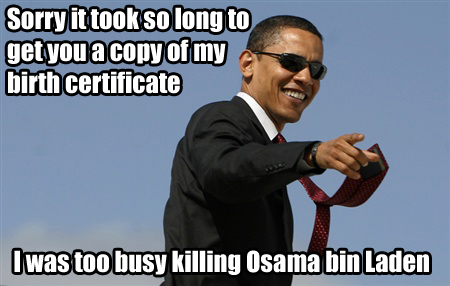
Okay, I said I didn’t want to get into domestic politics, but I ain’t pure; couldn’t pass this up:

(Credit: Andrew Sullivan, The Daily Dish)


Osama bin Laden is dead; and. . . ?

2 05 2011

A few thoughts on the death of a murderous fanatic:

1. I am opposed to the death penalty, in every case. Thus, as I noted in a comment at TNC’s joint, I may be parsing matters to consider bin Laden not the subject of a criminal trial, but a casualty of war.

2. I don’t like facile comparisons of bin Laden to Hitler or Al Qaeda to the Nazis; whatever the totalitarian similarities, the differences, I think, are are even greater.

Nonetheless, this quote from Hannah Arendt’s Eichmann in Jerusalem came to mind:

[J]ust as you supported and carried out a policy of not wanting to share the earth with the Jewish people and the people of a number of other nations—as though you and your superiors had any right to determine who should and who should not inhabit the world—we find that no one, that is, no member of the human race, can be expected to want to share the earth with you. This is the reason, and the only reason, you must hang. [emph. added]

To want to cleanse the world of its inhabitants makes you an enemy of the world and its inhabitants and gives us license to treat you as such.

I don’t celebrate his death—“grim satisfaction” seems the appropriate cliche—but I do think a kind of rough justice was done.

3. There are concerns that this action will give the US cover to leave Afghanistan sooner rather than later. Would that this would be so.

4. The death of bin Laden matters. I say this not as an expert on terrorism but more generally as a political scientists: Even if the death were only symbolic—his operational role was said to have diminished greatly in the past few years—the symbolism still matters. In both war and politics, symbolism matters.

As to whether this will lead to a retrenchment or fracturing of Al Qaeda, well, either is a possibility. Bin Laden was apparently a charismatic figure, and his former number two (now presumptive leader) Ayman Al-Zawahri is not; that could matter in terms of holding together a far-flung criminal operation.

Or not: The cell structure of Al Qaeda may mean that those freelancers gathered under the Al Qaeda banner have long since left the base of The Base behind.

We’ll find out.

5. Some are concerned at what happens next.

As a general matter, I’m not concerned; something always happens next.

As for specifics,  I (somewhat surprisingly) again agree with Jeffrey Goldberg:

Television-based analysts are already asking if the killing of Bin Laden will provoke revenge attacks by al Qaeda. Is there a stupider question in the world? The implication, of course, is that now, al Qaeda will truly be pissed off at the U.S. Unlike in 2001, when al Qaeda was only marginally angry at the U.S.

He backs off that somewhat in later posts—yes, some terrorists may be moved to strike out in rage or grief—but as Al Qaeda was not much a political organization, that is, it was not an organization with which one could negotiate, any acts around it or in reference to it or against it would lead to a reaction.

That there are reactions does not mean there should be no actions.

6. There are domestic political implications of all this, but it seems small, today, to consider them.

7. To circle back around to the Arendt quote: Yes, I think she got it right.

There are a lot of reconsiderations of her work in light of a new book on Eichmann (The Eichmann Trial, by Deborah Lipstadt), but I don’t know that any of the old or new criticisms can erode the acuity of that judgment, which deserves repeating:

[J]ust as you supported and carried out a policy of not wanting to share the earth with the Jewish people and the people of a number of other nations. . . we find that no one, that is, no member of the human race, can be expected to want to share the earth with you.


Geraldine Ferraro, Senator

28 03 2011

1935-2011

I was over the moon when Walter Mondale chose Geraldine Ferraro as his running mate.

We were going to lose. I knew it, but, like every political activist facing long odds, didn’t let that knowledge get in the way of hope.

And oh, at that monstrous rally in Madison, I actually had hope.

We had been killing ourselves getting ready for the rally. I was taking a full load of classes, but at every spare moment I was up at the office near the Capitol, painting signs, calling Democrats, tacking up signs—anything the harried advance team asked of me. (In return, I got a security pass which allowed me to roam the closed-off Capitol during the rally.)

The day was gray and foggy, but instead of detracting from the scene, the mist allowed us to believe that the crowds went on forever: as far as you could see, there were people, shouting, clapping, roaring us into believing that this ticket could actually carry all of us into the White House.

Ahhh, no.

But I still remember that feeling, that exhaustion and exhilaration and certainty and passion, even if I am no longer able to muster the requisite hope; even if I can no longer muster the requisite hope, I still remember the woman who was at the center of it.

She was. . . disappointing in her commentary on Barack Obama, offering blinkered words about race that she would have pounced on had anyone directed similarly sexist comments at her, as the first woman vice-presidential candidate.

If only she could have set her sights higher, the way she once raised them for so many of us.

So even as I accept the whole of her, I remember the best of her.

Rest in peace, Senator.

photo credit: Janet Hostetter/Associated Press


Reason will not save us. Or maybe it will.

13 03 2011

Like wiping an eraser across the land: The New York Times allows you to see before and after satellite photos of the devastation in Japan.

Stunning.

~~~

The planet does not care about us. Nature does not care about us.

Any care in this world begins and ends with us.

~~~

Errol Morris does not understand Thomas Kuhn.

Part of this non-understanding is due to Kuhn; part of this non-understanding is due to Morris.

(I am not the only one who thinks so.)

~~~

Judith Warner confuses the consequences of inquiry with inquiry.

Michael Bérubé is not confused, but did he really not understand the implications of epistemological nihilism?

I am not a genius—repeat, I am not a genius—yet even I, as a 2nd or 3rd-year grad student was able to suss out the political dangers of such nihilism.

I wrote a paper for a course on the philosophy of knowledge in which I (budding-but-not-yet-full-epist-nihilist) noted that the slipperiness of fact was a constant problem which must constantly be confronted. That “fact” and “evidence” and “reason” could be used as weapons meant that one must be ready to contest the deployment of such weapons.

This was a problem for me, for awhile: If everything is up for grabs, how can one move?

I solved this particular problem by moving.

Yes, there’s more, much more, involved than this, but this isn’t the place for an explication of my solution. I brought this up simply to signal my recognition that, yes, this is a problem.

I’ll try to dig out the particular paper, but I believe I used an episode of Star Trek: The Next Generation, in which Captain Picard is tortured by a Cardassian; his torturer, in an attempt to break him, wants him to say that there are five lights when there are only four. Upon his release, he turns to his torturer and emphasizes that there are, in fact, only four lights.

Later, however, he admits to Counselor Troi that he did see five lights.

Given that people can be coerced into not seeing what is in front of them—that truth as an intersubjective activity means that it is vulnerable to domination—means that truth is subject to political debate.

Upshot:  those of us invested in particular forms of and inquiries into truth must defend against assaults on those forms and inquiries.

I got this, as a smart-enough grad student, and I’d bet that I wasn’t the only one.

But Bérubé and Warner are shocked—shocked!—that  “it turns out that the critique of scientific “objectivity” and the insistence on the inevitable “partiality” of knowledge can serve the purposes of climate-change deniers and young-Earth creationists quite nicely.”

No shit, Sherlock.

Okay, so that wasn’t very nice. Bérubé  is a lit professor and was busy mining his own particular veins of concern; that’s one of the benefits of scholarship, after all: to forsake the surface and plunge below. Conversely, it was really not such a stretch for me, as a budding political theorist, to have recognized the political implications of anti-foundationalism.

Anyway, Bérubé is now aware that excavations below can lead to instability up top:  “[P]erhaps humanists [read: humanities professors]  are beginning to realize that there is a project even more vital than that of the relentless critique of everything existing, a project to which they can contribute as much as any scientist–the project of making the world a more humane and livable place.”

Just so.

There is more to this story, of course, not least of which is a defense of such excavations given the possibilities of instability; the short version is that the cracks were always there.

The long answer awaits.

~~~

What makes NPR liberal? What makes any media outlet liberal or conservative?

On the Media didn’t quite ask this, but in a segment with Ira Glass (who insists NPR is not liberal), they introduced the possibility that they will ask this question, as well as, perhaps, whether it matters.

Still would have liked to have heard them discuss O’Keefe’s edits of the vid.

~~~

I am old. I like to go fast.

That I put the “I am old” statement first tells you that I blame my age for my hesitations regarding speed.

Whatever.

I took my road bike out yesterday—first time in years—for a coupla’ spins around Prospect Park. Oh, every time I get on this bike I marvel at how quick it is. Unlike my road bike, this baby just sssshoooms when I crank the pedals.

That light narrow frame, those smooth skinny tires, the aerodynamism of the hunched-over posture. . . ack! That light narrow frame means it’s less stable! Those smooth skinny tires are apt to skip across the road! In my hunch I can’t see as well!

Ack!

No, I didn’t wipe out. (I will: I wipe out at least once every biking season, usually because I panic and can’t untangle my shoes from the clips fast enough. I try to have this happen away from traffic.) But the marvel at the speed competed with the concern that things are more likely to go wrong at speed.

Prudence is a fine thing, but so, too, is the exhilaration which follows recklessness.

Anyway, I’d rather not be afraid, and think that the more I ride the road bike, the less anxious I’ll be.

All the shit I have yet to learn and still, all the shit I have to re-learn.

Criminy.


Doomed: candy-assed conservatives and sniveling liberals

9 03 2011

Oh, please.

I had a nice long (eh, decently-lengthed) post about the NPR kerfuffle in mind, but the filthiness of my mood is hindering my ability to string coherent thoughts together.

So, lemme just toss a few of ’em out there, and let them scatter as they will.

  1. NPR guy Ron Schiller was dumb. Dumb for not recognizing that the Malign Pranksters are out to get everyone they don’t like. Dumb for not taking into account that NPR/Corporation for Public Broadcasting funds are subject of debate in Congress, and thus making them a likely target for such MP activity.
  2. NPR development staff was dumb for all the reasons listed in 1, and thus for not bothering to get information on a possible donor. (And development people, doncha want as much info as you can get, regardless, if only to make your own pitch more convincing?)
  3. Karma for Juan Williams? Eh.
  4. Karma for Juan William for Vivian Schiller? Eh.
  5. Schiller’s right: NPR would be better off without (i.e., freer) without federal funding.
  6. Schiller’s wrong: It’s ridiculous that the federal government buckles at the thought of liberals working for NPR.
  7. Schiller’s wrong: It’s ridiculous that the federal government buckles at the thought of NPR.
  8. NPR caved. This guy Schiller was out already, and NPR acted like a fucking Oliver Twist orphan before the cameras.
  9. NPR should have gone on the offensive and made a passionate argument in favor not only of public radio, but of public life in general.
  10. No one sticks up for public life in general.
  11. We on the left ought to stick up for public life in general.
  12. Everyone in an open society ought to stick up for public life in general.
  13. Can people who work for public agencies not have any opinions whatsoever?
  14. Can people who work in media not have any opinions whatsoever?
  15. Can people who work anywhere not have any opinions whatsoever?
  16. What about Juan Williams, again? Should NPR have fired him for his Muslims-scare-me remarks? Eh.
  17. How far can any employer go in basing employment and promotion decisions on private expressions of opinion?
  18. Does it matter that Schiller was on the job and expressing opinions?
  19. Does it matter that the opinions Schiller expressed were unkind to TeaPers?
  20. Does it matter that Juan William was not on the NPR job but his other job and expressing opinions?
  21. Why aren’t more people upset at this whole notion that any conversation might be filmed and used against you?
  22. Why aren’t more people skeptical of the Malign Pranksters, especially given their history of distorted editing and criminal activity (as in attempt to bug the office of US Senator Mary Landrieu)?
  23. I’ve been agreeing with Jeffrey Goldberg a little bit too often for my comfort level.
  24. Is there a difference between using undercover video to attack political opponents than to reveal (as in back-in-the-day 60 Minutes) wrongdoing?
  25. Given my strong beliefs in privacy, would it be wrong for me to advocate someone camping out at O’Keefe’s home or office and constantly following and taping him and all known associates?
  26. Given both my strong beliefs in privacy and the necessity of political hardball, is “fighting fire with fire” an appropriate  response?
  27. Given  my strong belief about the necessity of political hardball, is going on the offensive regarding our apparent inability to handle the fact that adults disagree about politics an appropriate response?
  28. Why is the phrase “candy-assed” (or, in G-rated form, “crybaby”) conservative not in wider use?

And those are just the thoughts I could untangle.

Fucking American politics. I mean, really.