Walls are encircling the land

30 03 2010

Oh, heaven: Terence McKnight on WQXR is broadcasting Dawn Upshaw singing Osvaldo Golijov’s Ayre.

This is not background music. This is not background anything.

The following videos were apparently shot in Frenchtown, New Jersey. Didn’t really watch them—the music is all.

This music is all.

Tancas serradas a muru


Nani

Wa Habibi


Friday poem (Monday): An Anatomy of the World

29 03 2010

Tuesday update: Sorry for posting a naked poem—Wordpress was all wonky last night.

Anyway.

I have, of late, become preoccupied with the medieval period in Europe history, or, more accurately, with the intellectual history of that long moment of transition between medieval times and modernity.

The ‘whys’ of a such a preoccupation I’ll save for another post. But given my current backward glance, a poem from that moment seemed appropriate.

John Donne is not, strictly speaking, a medieval poet: He was writing at the turn of and into the 17th century, a time which might be pegged as ‘early modern.’ But he fits into that long moment of transition during which old certainties about the place of God in nature were crumbling under the onslaught of observation and a kind of deistic theorizing. 

Three centuries later Yeats noted that ‘the center cannot hold/Mere anarchy is loosed upon the world’, but the intellectual revolutions of  the 17th century were in many ways far more unsettling than the political revolutions of the  20th: How was man to know who he was if his God were pushed into the recesses of the heavens, and mere mechanism replaced divinity and grace?

The section, below, from Donne’s elegy for a friend’s young daughter allows us entry into that disorienting new world—the world we now take for granted as our own. Reason and science and deduction will lead us forward, it was argued then (and now)—nevermind the past.

In mourning this young girl, however, Donne shows that a world without a past is a world without meaning; to take things apart may yield a new kind of knowledge, but it may also leave us dismantled.

from An Anatomy of the World

And new philosophy calls all in doubt,
The element of fire is quite put out;
The sun is lost, and the earth, and no-man’s wit
Can well direct him where to look for it.
And freely men confess that this world’s spent,
When in the planets and the firmament
They seek so many new; they see that this
Is crumbled out again to his atomies.
‘Tis all in pieces, all coherence gone;
All just supply, and all relation:
Prince, subject, father, son, are things forgot,
For every man alone thinks he hath got
To be a phoenix, and that there can be
None of that kind, of which he is, but he.
This is the world’s condition now, . . .


‘a woman who gives birth to a child is a woman first and a mother second’

23 03 2010

“Today, we’re told we’re not allowed to smoke, to eat unpasteurised cheese or seafood or even to a drink a glass of wine when we are pregnant. It’s time to stop all that.”—Elisabeth Badinter

This French philosopher and old-school feminist has plenty to say between drags on her cigarette.

“We’ve always been mediocre mothers here,” Badinter said (pointing out that in the 18th century French women farmed their children out to nurses “so that they could continue to have social lives and sex with their husbands”). “But we’ve tended to have happier lives.”

This is what all those so-called ‘Bad Mommies’ miss: they chastise themselves for not being perfect and miss the fun of such imperfection.

And, frankly, it wasn’t all being the kid of a mom who had better things to do than chase after you every goddamned minute of every goddamned day.

Freedom all around.

(h/t Slate)


Win!

22 03 2010

Yeah, I know this is everywhere, but what the hell, it’s a great shot:

Ain’t no hero-worship: just respect.

And Nancy Pelosi? Fuck yeah!

(‘Chill’ from PunditKitchen.com; h/t Ta-Nehisi Coates commenters; Pelosi: h/t Pandagon)


Friday poem (Sunday): Green Behind the Ears

21 03 2010

My antipathy toward summer is well-recorded, as is the splash-back of this feeling on spring.

I should like spring—time to get out and rediscover this city, the light, the green.

Pity I do not.

Kay Ryan reminds me to go gentle with this season, and all the springs we experience, and to live this spring as itself, and not just on the way to something else.

Still, for those for whom this is insufficiently celebratory, there is a bonus poem—a classic.

You know what it is.

But first, Ryan:

Green Behind the Ears

I was still slightly
fuzzy in shady spots
and the tenderest lime.
It was lovely, as I
look back, but not
at the time. For it is
hard to be green and
take your turn as flesh.
So much freshness
to unlearn.

——

The formatting doesn’t hold in html, but you still get it. Of course: e.e. cummings:

in just-

in Just-
spring          when the world is mud-
luscious the little
lame balloonman

whistles          far          and wee

and eddieandbill come
running from marbles and
piracies and it’s
spring

when the world is puddle-wonderful

the queer
old balloonman whistles
far          and             wee
and bettyandisbel come dancing

from hop-scotch and jump-rope and

it’s
spring
and

the

goat-footed

balloonMan          whistles
far
and
wee


Friday poem (Sunday): The Nude Swim

14 03 2010

Odd how people become friends.

The first cause is proximity: We’re seated next to each other in a first grade class, have lockers across the hall in high school, settle in the same dorms, go out drinking after the first grad seminar.

And work. We meet at work.

But I didn’t become friends with everyone from school or in college or grad school, didn’t want to hang out with everyone I ever met at the paper or food service or the restaurant or co-op or bookstore. Only some people were interested in me; I was only interested in some of them.

I have good friends in New York, which is one of reasons I like New York.  That I lacked such friends was among the reasons I couldn’t take Boston, that I left good friends was among the reasons I so fiercely miss(ed) Montreal.

And among my friends, here, is Cte. She is a singular personality, who draws clear lines around people: in or out. I’m glad I’m in, because she’s smart and witty and always willing to argue (and as little likely to concede as I am), and who holds on to those inside as strongly as she pushes off those on the outs.

Need I say that she rejects sentimentality and that her heart, while large, does not easily warm? Or that she fends off any kind of direct affection—she will let you buy her a drink—especially the physical kind?

In that, she reminds me of me, or at least, how I used to be. I’m less likely to sprout spikes at the intrusion of a hand on my shoulder, but there was a time when I would literally spin away from any human contact.

No, I was never physically or sexually abused: this was not PTSD. Nope, it was something much simpler, a way to control what I couldn’t understand, and thus couldn’t let any one else access.

I was afraid all the time. Afraid of myself, my volatility, my desire and contempt for comfort, afraid of what others could do to and for me. I was drowning and refusing to be saved, hating myself for wanting to be saved.

I took it out on my body. I didn’t hate my body, but it was just one more thing I didn’t understand. I wanted to live in my head—my mind, I thought, was strong—because everything else about me was beyond me, and because beyond me, weak. I thought if I could just deny enough of myself, I could eventually bring it under control.

The key was control. I couldn’t control my emotions, so I sought to deny them. And because those emotions could be sparked—I still don’t understand why this happens—by the touch of another, I sought to deny myself all touch.

No one who knows me today would call me touchy-feely, but I am much more free with a hug, a kiss, an arm around the shoulder. To be honest, at some point I had to force myself not to flinch, because such obvious unease only drew attention to that unease, and question-mark looks I’d rather not answer; the point, still, was (and occasionally is) to manage myself, to manage how others see me.

Yet I have also become more comfortable with touch. I am conscious of it, always, and far more at ease giving than receiving, but it is a relief, truly, when with people I know and trust, when with my friends, to not have to police every goddamned move.

So I wonder about Cte. I don’t know enough about her—surprise! she’s not one to go on about her life before, well, now—to know why she behaves this way, or that it is in any way a problem for her. She could simply believe that, for her, such physical interactions are unnecessary. She might get enough from the people around her just by having us be around her.

I admire her strength. And I hope that’s what it is.

This is all a very long intro to a not terribly long poem.

Anne Sexton was, famously, the best friend of Maxine Kumin, but it is not for the theme of friendship that I chose her tonight. No, it is for her extravagance, her unwillingness to shut herself off from herself.

(Given her emotional instability and suicide, perhaps it could be argued that a bit more willingness to turn away would have kept her alive. Or perhaps it would have led her to kill herself much sooner than she did. I don’t know, and it doesn’t much matter now anyway.)

Sexton wrote songs to her breasts and her uterus and about masturbation, so if I really wanted to push myself beyond my own boundaries—if I am less stiff than I used to be, I am still easily mortified by myself—I’d print one of those.

But this is the one that moved me, a poem about nakedness and ease, about the unexpected ways others may see us, and about the unexpected ways such sight can still us.

The Nude Swim

On the southwest side of Capri
we found a little unknown grotto
where no people were and we
entered it completely
and let our bodies lose all
their loneliness.

All the fish in us
had escaped for a minute.
The real fish did not mind.
We did not disturb their personal life.
We calmly trailed over them
and under them, shedding
air bubbles, little white
balloons that drifted up
into the sun by the boat
where the Italian boatman slept
with his hat over his face.

Water so clear you could
read a book through it.
Water so buoyant you could
float on your elbow.
I lay on it as on a divan.
I lay on it just like
Matisse’s Red Odalisque.
Water was my strange flower.
One must picture a woman
without a toga or a scarf
on a couch as deep as a tomb.

The walls of that grotto
were everycolor blue and
you said, “Look! Your eyes
are skycolor. Look! Your eyes
are skycolor.” And my eyes
shut down as if they were
suddenly ashamed.


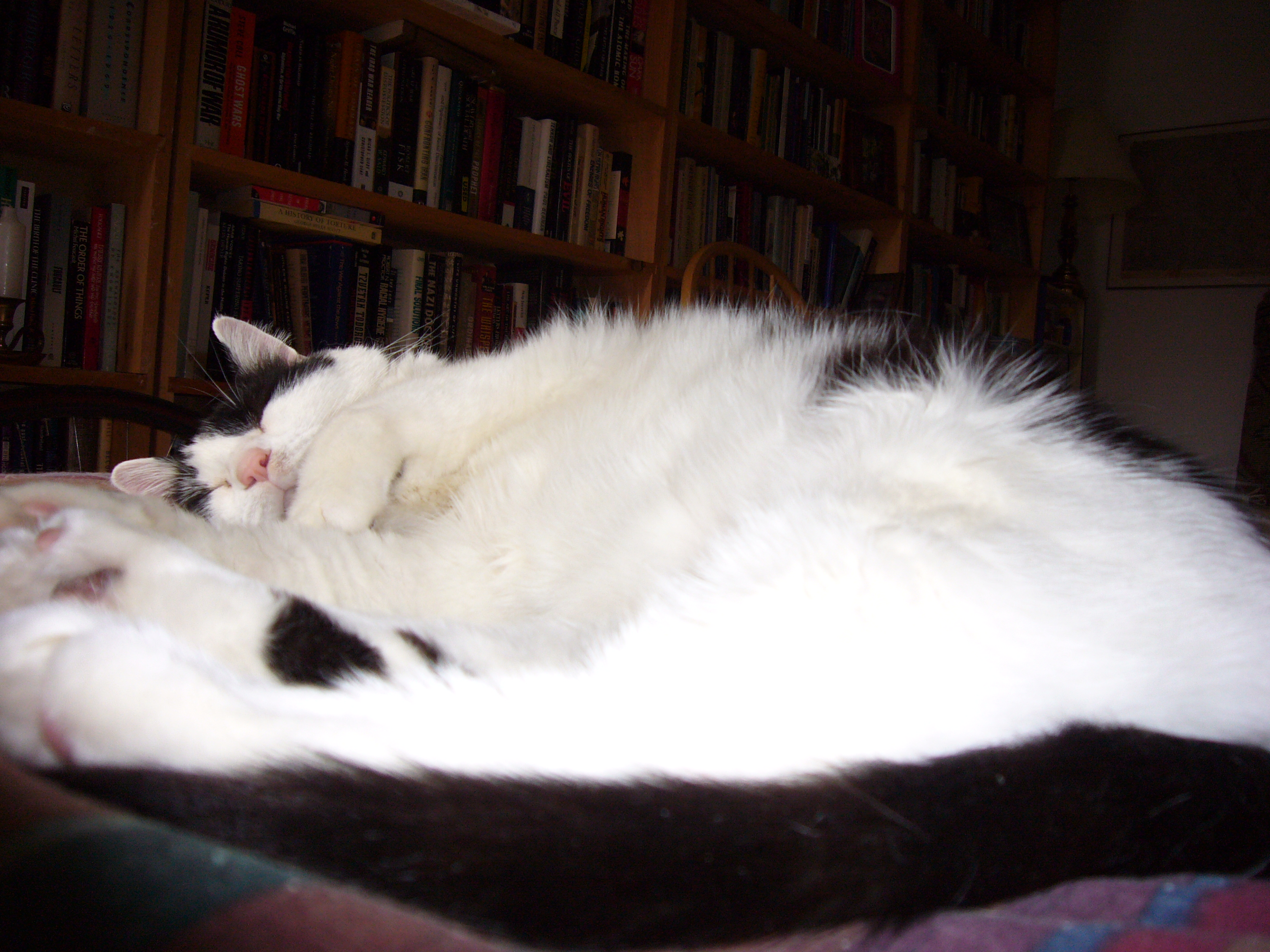


I watch you sleeping on the bed

9 03 2010

My beautiful Bean is sick.

Not desperately so, and perhaps not-imminently-fatally so, but she is ill, and it likely that this illness will at some point result in her death.

It pains me to say this, because I do not want my sweet old kitten to die, but I cannot ignore her decline.

Cannot. Will not.

I did ignore what was happening to Chelsea. It’s so clear, in retrospect, that she was sick for years, dying for months, and almost gone by the time I saw that gone was the best place for her. I spent money I didn’t have on a delusion that at 18 what little life she had in her was enough for a few more years.

It made the ending harder than it had to be for both of us.

So I won’t do that with Bean. I will see her, as she is, an old and sick cat. Oh, I’m doing what I can, within reason, to slow that decline, but at 15 1/2, ‘within reason’ amounts to home care and wishes.

Whether that decline is weeks or months or even a year, I have no idea.

But I’ll be ready, or readier, this time. Chelsea taught me that. Wishes or no, I have to see Bean clear.


Friday poem (Sunday): Our Ground Time Here Will Be Brief

7 03 2010

I’m having problems with time.

It stretches too much here then snaps back and contracts there. It never ends and I don’t know where it’s gone.

Nothing new about this, nothing unique to my life. Who is able, truly, to get hold of time and tuck it in her pocket and happily carry it with her, knowing it will bend and curve  and carry her through her days?

I’m being bowled over by time, undermined at and by that same time; I need to latch myself into it, surf it, live in and with it.

What other option is there?

Still, I haven’t been able to dig my fingers in, still, it slips through me, still, it leaves its marks and I am running and falling back at the same time.

Clearly, I need someone with a better sense than me. No time for exploration this week; I need someone durable and clear.

I need Maxine Kumin.

Our Ground Time Here Will Be Brief

Blue landing lights make
nail holes in the dark.
A fine snow falls. We sit
on the tarmac taking on
the mail, quick freight,
trays of laboratory mice,
coffee and Danish for
the passengers.

Wherever we’re going
is Monday morning.
Wherever we’re coming from
is Mother’s lap.
On the cloud-packed above, strewn
as loosely as parsnip
or celery seeds, lie
the souls of the unborn:

my children’s children’s
children and their father.
We gather speed for the last run
and lift off into the weather.