You’re going to carry that weight

15 03 2013

I dunnae understannit.

A month or so ago I was feeling fine—no anxiety, no dread—even though I knew I needed to pick up more work.

And then I picked up more work, so: mo’ better good!

But in the last coupla’ weeks, I’ve had this tight weight pressing down upon and squeezing my sternum.

That’s not what I don’t get: I know exactly why my torso is collapsing, as well as how to heave that ho offa me.

No, what I don’t get is why I don’t do what I need to do. It ain’t much—a bit of paperwork, an e-mail, maybe a phone call—but I don’t do it. Fifteen, thirty minutes, and I’m done. But I don’t do it.

I don’t do it.

Criminy.


Get back to where you once belonged

13 03 2013

One law to rule them all.

It ought come as no surprise that I give a Hard Look* to claims for religious exemptions to laws of general applicability: for all to be equal before the law, we must all be equally under the law.  To exempt someone from the obligations of law while simultaneously granting her the protection of  that same law is a form of favoritism which must be defended, not merely assumed.

Two points. One, this does not mean exemptions may never be granted. Exemptions are granted to religious institutions, for example, based on the freedom guaranteed in the First Amendment  (“Congress shall make no law respecting an establishment of religion, or prohibiting the free exercise thereof”). There are political and juridical tussles over the interpretation of these two clauses, but in the main there is a general sense that it is right and proper that the government not tell people how to practice their religion in terms of their religious ceremonies and their relationship to their fellow congregants.

Thus, churches, synagogues, mosques, temples, and sundry other religious institutions are exempted from laws regarding discrimination in hiring and firing of clergy and, for the most part, on working conditions. I may roll my eyes at arguments regarding the necessity of all-male clergy, for example, but I nonetheless agree that allowing the exemption to religious institutions is of no great concern to those outside of those institutions.

This, of course, is the case only insofar as the obligations of the religion apply only to the adherents of that religion. The free-exercise clause applies not only to congregants, but also to non-congregants, that is, you may voluntarily choose to align your behavior with your favored religious strictures, but you cannot force me to align my behavior to your religious strictures.

Point two: Certain religious institutions in the US are fighting for exemptions based on non-reciprocal understandings of religious freedom. What is new(ish) is not the non-reciprocal understanding—it wasn’t until the 20th century that the courts began to extend the protections of the First Amendment to (numerically) marginal religions, a process which continues, bumpily, today—but the fact that these institutions do, in fact, have to fight.

They can no longer wave the cross or the crucifix over every last act and expect dissidents, challengers, and the state to stop transfixed before them. There cannot presume exemption; they must defend it.

Rod Dreher, among others, bemoans the loss of status-entitlement of what he calls orthodox Christianity, a loss he sees as an erosion of religious freedom. That most Americans favor the use of contraception and increasingly favor same-sex marriage and equality for queer folk means that they are less willing to grant authority to those orthodox religious leaders—which means that they are less willing to grant legal leeway to those same leaders.

In this sense, I agree with Dreher that these churches and traditions are losing, but while he sees a loss of freedom, I see a loss of entitlement. John Holbo notes, correctly, that those who argue that religion deserves its entitlement rely on a notion of “an extra epistemic concession”, that is, that an argument ought to be granted respect or extra points because: Religion. It is in no way clear why this should be so.

And that’s the nub: in the past it rarely had to be made clear why this should be so; it just was. But now, for any number of reasons, that extra epistemic concession is no longer granted, with the result that the authority of those relying upon that concession has been degraded. “Because (God) says so” is no longer enough.

This hardly stops folks from trying to protect their entitlement. Since Americans do tend to respond to appeals to individual rights, the ground has shifted from authority to freedom. That a private business run by religious people might  be required to provide benefits (read: contraception) to their employees which they, the employers, find religiously offensive, is seen as an infringement upon their (the employers’) freedom.

Call it the Taco Bell defense.

Some nations do, in fact, have different laws for different religions. In India, for example, Muslim men may take multiple wives, but Hindu men may not. Martha Nussbaum offered a limited defense of such variation in Women and Human Development, but even this was more a practical concession to the historical and political realities of India than a ringing defense of the idea of This law for thee and That law for thou.

In the US, however, we had the opposite: throughout the 19th and into the 20th century, there was a default Protestantism, and it was only through decades of court fights that recourse to that default was diminished. The Catholic Church, often victimized by this default, was nonetheless able to take advantage of the authority offered to Christianity in general in order to assume its share of privileges in spaces beyond the church steps. Unsurprisingly, they seek to maintain that authority-based privilege.

Dreher, in recognizing the loss of authority, has argued that orthodox Christians make their stand on the ground of religious freedom instead, but absent the status granted by that extra epistemic concession, it is difficult to see why one individual ought to prevail over another in competing claims of the exercise of that freedom.

As so many have already pointed, why should the religious beliefs of the employers ought to matter more than that of the employee, the doctor over the patient, the pharmacist over the customer, or the taxi driver over the passenger?

Those who seek to protect themselves from offense have every right to do so: they get to make the argument in the political and cultural realms and in the courts.

They just don’t get to presume a win.

*h/t Robyn Anderson, who uses this term to great effect on Love & Hisses


God cries three times a day

12 03 2013

I don’t get it.

I mean, I do: the Bishop of Rome, Vicar of Jesus Christ, Successor of the Prince of the Apostles, Supreme Pontiff of the Universal Church, Primate of Italy, Archbishop and Metropolitan of the Roman Province, Sovereign of the State of Vatican City, Servant of the Servants of God, aka, the Pope, is the head of a church with approximately a kabillion and 3 followers and Demeter-only-knows how much land, cash, bullion, baubles, and breweries.

He’s got some pull in the world, I’m trying to say. (Anywhere else, I got nothin’ to say.)

Still, when I peer over the elbows of fellow 4-train travelers to scan the double-page spreads in their newspapers on the papal conclave, I think, Huh.

This seems more like Oscar coverage, or Fashion Week: a Celebrity Conclave for old men in red hats.

There are the reports on what Il Papa will wear (white, to go with the smoke, I suppose), what are the odds of Ouellet or Scola or Turkson (cf. the Sweet Sistine), will the new man (duh) be more of a manager or a spiritual leader because (heads nodding all around) what the papacy needs is someone to lift up the faithful while simultaneously cracking down on corruption in the Vatican and also getting rid of all of the abusers and their enablers and reaching out to victims and bringing light and love to the world.

That’s all.

If you threatened to withhold my morning coffee I’d agree to write out (as soon as you gave me back my java) all of the reasons why the Papal kaffeeklatsch Conclave is a substantive matter worthy of all of the media attention (and live blogs of what’s smokin’ in the Curia’s Faraday cage); I might even toss in for extra credit a meditation on why this matters to a heathen like me.

But, honestly, the media coverage strikes me as nothing so much as furrowed-brow gossip, and the event itself as just another version of Meet the New Boss. . . .

*Sigh* Some days I am a terrible social scientist.


Potato, potahto, tomato, tomahto

11 03 2013

It’s a bit of a pickle.

How does one—how do I—create the conditions for a good debate on an issue which I think is not debatable?

This is a 100-level class on contemporary issues—and the students are high school seniors, to boot—so the constraints on debate are different, stricter, than what I’d allow in a 300-or-above-level class. I can trust my experienced students to stretch themselves around and take apart emotionally and ethically tricky issues without worrying that they’ll become undone; I can trust that they’ll use, rather than lose, their minds.

(Of course, not every student bothers to stretch herself, but lack of engagement is, in this context, less problematic than over- or mis-engagement.)

I want the intro-level students to learn about these issues and learn how to think for themselves, but it’s a damnable paradox that I have to structure the hell out of the classes (trans: do a lot of underground thinking on their behalf) in order to enable them to think. I don’t want to steer them; I have to steer them.

So, anyway, specifics: how do I have debate about sexual equality when I don’t think this is debatable?

I’d never have a debate about racial equality in this course, so why a consideration of sexual equality?One response is that sexual equality is a conventionally controversial issue in ways that racial equality is not. Very Serious People (to borrow an epithet from Krugman) are allowed to harrumph on the “natures” of men and women in ways that would be decidedly non-kosher if applied to ethnicity.

It’s a real, live issue, in other words.

Another response is that I did a shitty job in defining the issue as “sexual equality” as opposed to, I dunno, something else. Difference and equality, maybe? Changing sex roles? With either of those approaches, at least, I could find good, solid arguments from a number of different sides, that is, I could encourage debate in ways that don’t insult logic, evidence, or my own (and my students’) humanity.

I did manage to find a few pieces which approach the issue from the difference/equality perspective, so the students leading tomorrow’s class should be okay. Still, it could have been better.

This is what I get for thinking We should talk about this without figuring out ahead of time This is how we should talk about this.


Working in the coal mine, work, work

10 03 2013

I blog for free.

I like the sound of my own voice, and, as I once introduced myself, I have lunch and opinions; so when something pops up, I go, Hey, what do I think of this? And then I blog about it, to figure out my thoughts.

I also write (as in: write draft-edit-edit-rewerite-edit. . .) for free, as in This is something that I have to do, and so I do it. I’ll put it on Smashwords and Barnes & Noble and Amazon and hope someone pays for it, but, really, the cash isn’t going to flow.

I do these for free, in other words, because it pleases me.

If you want me to please you, however, then you have to pay me. I’ll be nice if you ask, and I’ll be nice when you pay, but if you want me to labor and you don’t want to compensate me for the fruits of that labor, then (cue Harlan Ellison): Fuck you. Pay me.

Nate Thayer and an Atlantic editor kicked off this latest iteration of Pay the Writer when the editor asked Thayer not simply for permission to repost something he’d already written, but to re-write it. When he asked how much he’d get paid, this was the response:

We unfortunately can’t pay you for it, but we do reach 13 million readers a month.

You, editor, who are getting paid to work for a for-profit company, approached someone to work for you knowing that you couldn’t pay him for that work? And then you waved the exposure flag?

Some have criticized Thayer for publishing the editor’s name and e-mail address (e.g., in these comments) , but even privacy-crazed me think that if you approach someone in a professional capacity using your work e-mail, then, no, it’s not unreasonable for said work e-mail to be published. I wouldn’t have published the address—there be dragons in cyberspace—but this matter ought not be the takeaway from the exchange.

No, the takeaway should be: Don’t fucking ask people to work for you if you can’t pay them cash-money. The website gets 13 million readers a month? As Thayer noted in an interview, I don’t need the exposure. What I need is to pay my fucking rent.

Miz Emily, er, Emily L. Hauser noted in her blog that she has written for The Atlantic for free, albeit at her own instigation. While she was glad  to appear on the site,  the fact of that byline has opened no doors, nor has it led to a single offer for paying work — when editors talk about the value of “exposure,” I can only hope that they’re ignorant of what a chimera that is.

Alexis Madrigal at The Atlantic published a long piece on the economics of digital journalism, and he makes a number of reasonable points about its dismal fiscal prospects. Okay, it’s hard out there for an editor—but that doesn’t excuse your own attempts to off-load that difficulty on to freelance writers.

Madrigal is arguing, in other words, that the choices for a quality publication are all bad, but hey, whatchoo gonna do? I don’t like to ask people for work that we can’t pay for. But I’m not willing to take a hardline and prevent someone who I think is great from publishing with us without pay. My main point and (to be normative about it) the main point in these negotiations is this: What do you, the writer, get out of this?

And then he sighs again about the difficulties of his job. For which he is being paid.

I know that my posts get re-posted with some regularity—not because they’re so great, but because there are any number of auto-aggregator sites out there that scoop up anything and everything they see. I don’t really like it, but they do link back to my site, and they’re not asking me to do more work. For free.

Jessica Hische has this great graphic Should I Work For Free (which someone posted a link to in the comments on a like-minded John Scalzi post), and the upshot is pretty much: No.

And that’s pretty much my upshot, with the following caveat: If The Atlantic wanted to repost something which I had written for me own pleasure, then, sure, the exposure might be nice; I was, after all, thrilled when being Freshly Pressed led to an increase in my Absurd readership.

But if you want me to work to please you: pay me.


On and on, on and on, on and on

7 03 2013

For all the problems with his mention of Lochner and his unconcern about the use of lethal and surveillance techs on non-US-citizens and  his multitude of other shitty positions. . .

Rand Paul, after ending his filibuster.           Charles Dharapak/AP

. . . Senator Rand Paul did a solid in filibustering since-confirmed CIA chief John Brennan on the issue of presidential authority over the use of drones against American citizens.

And fie on those Democrats who didn’t support him. President Obama has been dreadful on drones, and there is not a little justification for those who claim that many Dems* who screamed about power grabs by President Bush are rather aggressively silent when it’s their guy doing the grabbing.

I’m not surprised by this silence, mind you, but goddamn Democrats, do you have to be so disappointingly and opportunistically predictable?

(*It is not fair to go after leftists and liberals in general, as this is among a number of issues about which various libs, commies, and other malcontents have excoriated Obama and the Dems.)

I’m sympathetic to (my old grad school colleague) Sarah Binder’s concern that “In an age of intense policy and political differences between the parties, no corner of Senate business is immune to filibusters.” And she notes that Paul’s talking filibuster overshadowed the threat-filibuster of the nomination of Caitlin Halligan to the DC Court of Appeals, which meant her nomination was blocked.

I was among those who, back when the Democrats were in the minority in the Senate, believed that the filibuster ought to be reformed; that the old asses of the Democratic leadership knocked back any chance of real reform at the beginning of this session is an ongoing irritation. I believe in effective and accountable government, and the way the filibuster has been all-too-often deployed hinders responsible government.

Still, if ever the filibuster were to be justified, this is it. Given the expansion of presidential power in the ever-expanding national security state—with the acquiescence of the majority of the members of Congress—Senator Paul’s willingness to take a stand on the matter of a presidential perogative to assassinate citizens ought to be applauded.

And so I do.


If you choose not to decide, you still have made a choice

6 03 2013

Do you become more or less of a crank the more real your anxieties become?

I’ve joked that I’m a privacy crank (even as I realize the, ah, complexities of worrying over privacy on a public blog), but I’ve felt pretty confident that I’d be able to balance my antipathy to any kind of tracking with desire to participate in a full social life. I accept cookies in order to access certain websites, but periodically clear my cache and browser history; I have a cell phone which I can use to text and *gasp* talk, but which doesn’t have a GPS. I search on Google, but not while I’m signed in to my job-related Google account (which, outside of work, I never use).

And I live and work and ride the trains of and walk around New York City, which has CCTV mounted in train stations and on the sidewalk. I don’t like the surveillance cameras, but as a small and plain person, I doubt very much that I’m camera-candy.

At least, that’s what I tell myself.

But it seems as if the chances of being both social and private are dissolving in the corrosive effects of a culture which wants only to “share” and technologies which enable such sharing. As Mark Hurst points out, while one could try to minimize the omni-info maw of social media, a technology like Google glasses sucks you in—whether you want to be so sucked or not:

Remember when people were kind of creeped out by that car Google drove around to take pictures of your house? Most people got over it, because they got a nice StreetView feature in Google Maps as a result.

Google Glass is like one camera car for each of the thousands, possibly millions, of people who will wear the device – every single day, everywhere they go – on sidewalks, into restaurants, up elevators, around your office, into your home. From now on, starting today, anywhere you go within range of a Google Glass device, everything you do could be recorded and uploaded to Google’s cloud, and stored there for the rest of your life. You won’t know if you’re being recorded or not; and even if you do, you’ll have no way to stop it.

And that, my friends, is the experience that Google Glass creates. That is the experience we should be thinking about. The most important Google Glass experience is not the user experience – it’s the experience of everyone else. The experience of being a citizen, in public, is about to change. [emph in the original]

Y’know those illegal cell-signal blockers? Would they work on something like this? If not, someone is working on countering this, right? Right?

Because, at some point, if you can’t legally opt out of this surveillance without opting out of society, those of us who want to be around other people without being subject to their tracking techs might want to consider, mmm, other ways to remain free social beings.

. . . . Yeah, I really am a crank, aren’t I?


Get up, stand up

5 03 2013

I’m not much for trigger warnings.

I’m not opposed to their use—I think bloggers who have a sense of their readership and who actively cultivate a “safe space” are justified in warning their readers—but I’m not someone for whom a safe space is a priority. I don’t actively try to cultivate an “unsafe” space, but I neither do I take care of my readers in terms of helping them to avoid topics which upset them.

I’m sorry if I do—that is not my intent—but as I generally take a chin-up and tits-forward approach to political and social matters, I presume my readers will as well.

Thus, my mixed reaction to Oberlin’s cancellation of classes in response to a series of racist incidents on campus.

On the one hand, I get it: take the time instead to address this as a collegiate community, make sure everyone is okay, safe.

On the other hand, I think: really? Cancel classes on account of some hateful assholes?

Back to the one hand: Some students undoubtedly are upset by the actions of the sheet-covered dipshits, feel targeted, threatened, and otherwise singled out. And other students are undoubtedly upset that these sheet-covered dipshits are wrecking their community by targeting, threatening, and otherwise singling out their classmates.

These students need to be supported by the administration and their fellow students in both public and private, and the racists need to be called out for the hateful shits they are.

However—and this is the other hand—I don’t know that dropping everything to have a campus-wide conversation “challenging issues that have faced our community in recent weeks” is the best way to go either. I wonder if this doesn’t make conversations about racism, sexism, and homophobia an emergency phenomenon, something to be dropped after the emergency passes.

Even more, I wonder if the emergency approach doesn’t somehow disempower students and faculty, as opposed to saying, We can—and will—handle this.

It’s also possible that shutting down the campus gives too much “credit” to the  hateful shits: Someone who parades across a campus with a long and honorable tradition on issues of equality in a fucking Klan outfit should be mocked for the troll s/he is.

And how should trolls be dealt with? If one can’t ignore them—and the Oberlin community probably can’t ignore them, not if if wants to support those who feel targeted—then they should be confronted, mocked, and in no way given any satisfaction for their shitty deeds.

Both hands: this is a tough call. I hate cancelling classes, but if Oberlin sees fit only to cancel a day or two’ s worth to address this, that’s not an unreasonable response.

But it would also be good if, as part of that not-unreasonable response, instead of focusing solely on the harm and the recovery, they offer a sense of resilience. Support those who feel threatened, absolutely, but also let it be known that the trolls who scrawl hate are small and mean and to be pitied rather than feared.

What was that old fake-Latin phrase? Nolite te bastardes  carborundorum—don’t let the bastards grind you down.

Those dipshits in sheets aren’t worth it.


Ain’t nobody’s business if I do

4 03 2013

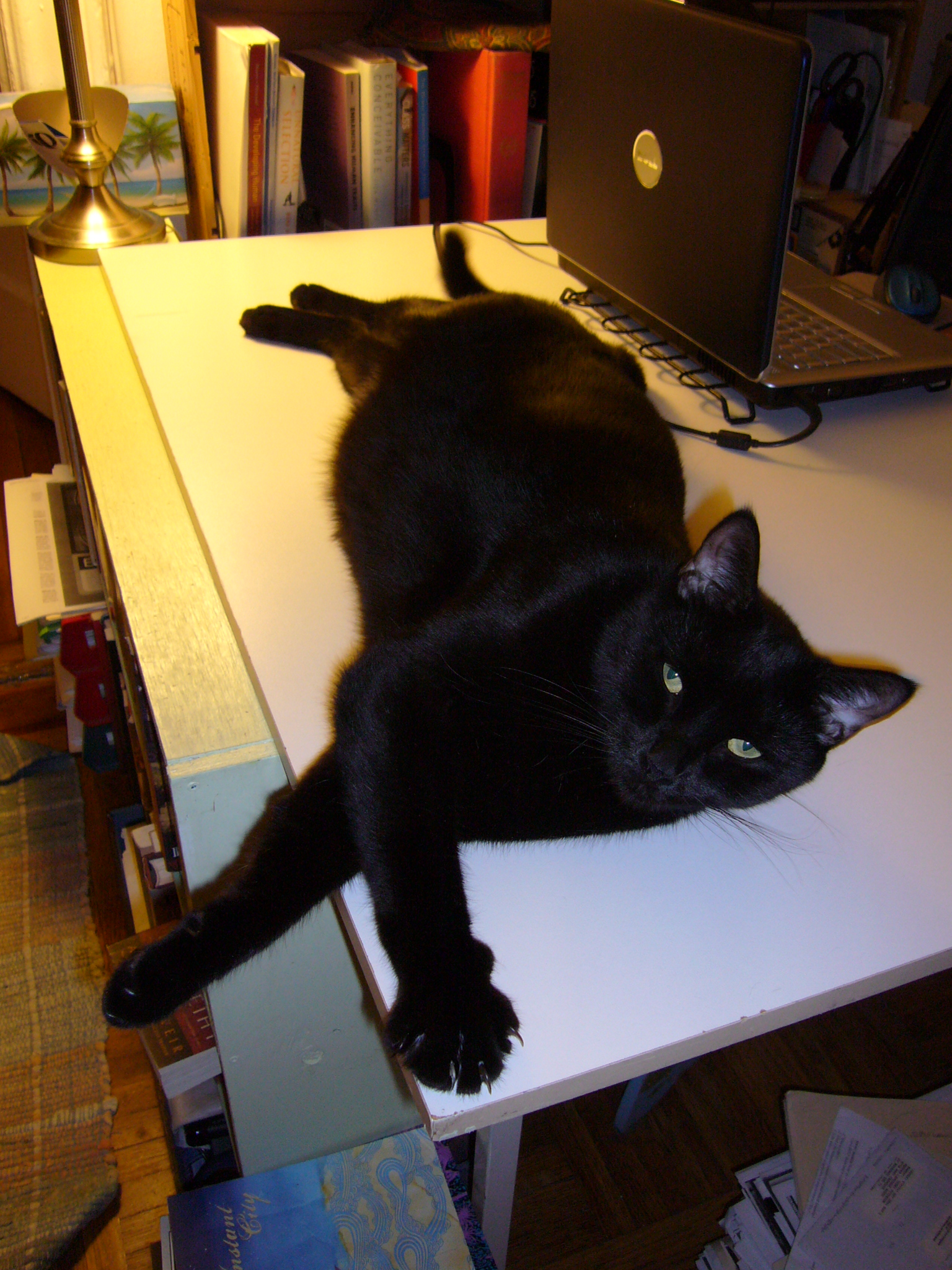
Remember when I mentioned that this cat:

028

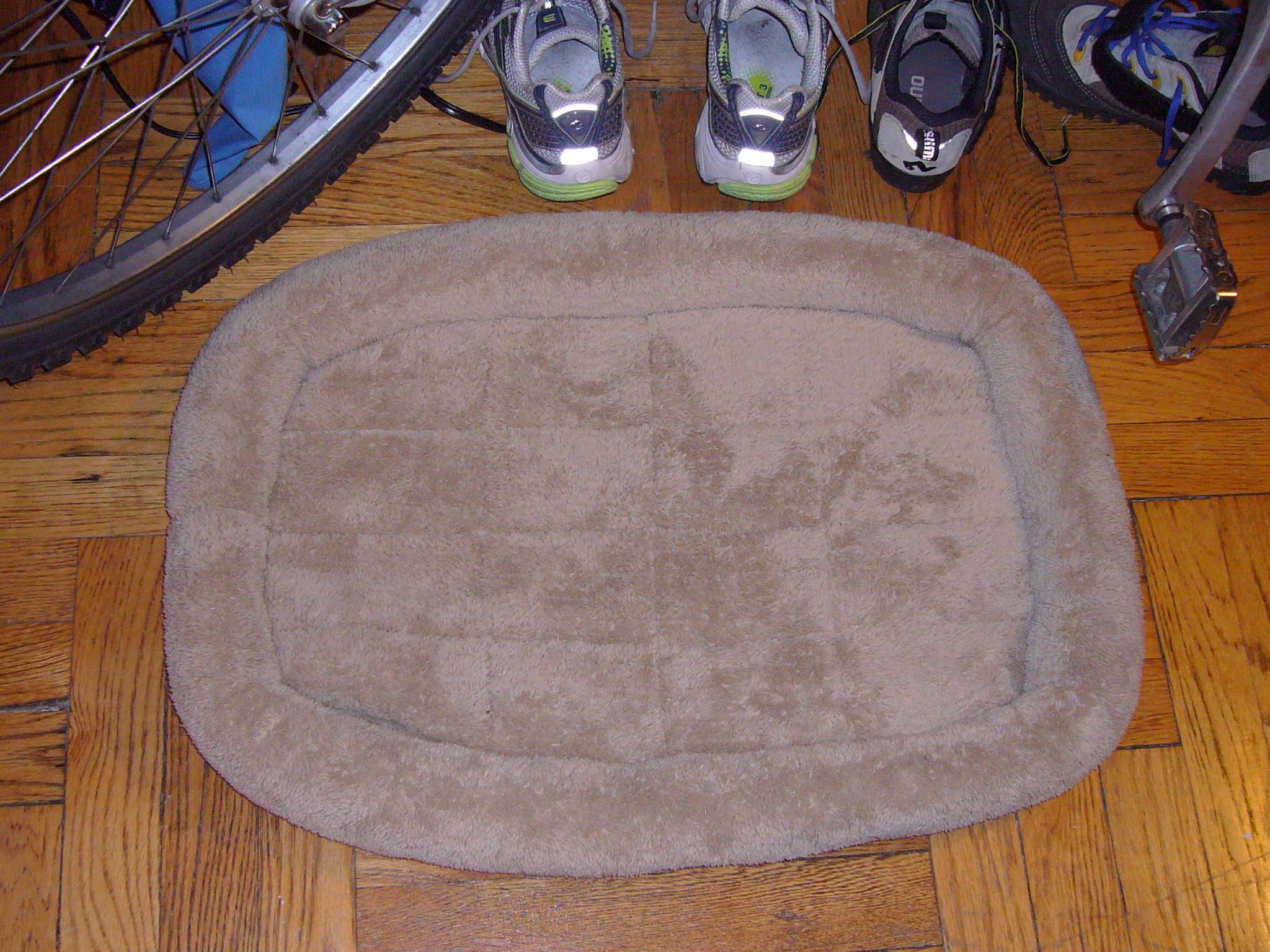
Was afraid of this cat bed?

014

Well, enough time tromping across one in order to chomp on Trickster. . .

001

. . . and he apparently determined that this particular cat bed won’t burn off his fur.

Thus:

004

Strange boy.