I press Execute

15 02 2017

What a pain in the ass.

Buying a new computer, that is, or, more directly, trying to figure out which computer to buy.

I’m going low-end full-on laptop (non-gaming), meaning something in the $500-700 range. I thought I’d found a month or so ago what I wanted to buy, but tonight as I was clicking around, I got caught up in this review and that and ohmymotherpuppinggoddess by the end I was convinced that no matter what I’d choose, I’d choose wrong.

Fuuuuuuuuck.

Anyway, I think I’m going to go with what I’d originally settled on. It seems to have the combination of features I want, it’s at the lower end of the price range, and, y’know, given that this baby is 8 1/2 years old, anything I get will be better and faster than what I’m used to.

So tomorrow (payday!), or Friday, I’ll finally hit BUY. Then I’ll worry. Then it’ll arrive. Then I’ll instantly love/hate it. Then I’ll get used to it and it’ll be fine.

All of this agita for . . . and it’ll be fine. Shees.


There are some who are in darkness

9 02 2017

First off, what is this shit? Few inches of snow and schools, CUNY close? If it’s safe enough for kids to go sledding, it’s safe enough for them to go to school.

I hate snow days: I put some effort into plotting out the syllabus, so missed days throws that off. Yeah, I do allow some slack, but I’d rather I, rather than the weather, were in charge of that flexibility.

(Straigtens shirt, smooths hair.) Back to bizness, and another hoisting-up of a dmf comment:

I remember when pol-sci/history types were going around telling us that Trump’s US was not the same as Hitler’s Germany (and I don’t think Trump is a fascist, too self-consumed for that) as if we knew which factors were the determinate ones in bringing facism to bloom, never struck me as being particularly verifiable, what would be the test of such assertions/speculations?

As one of those ranting that the US was/is not Weimar, I’d offer up the following as crucial factors:

1. History. The United States were created in rebellion against the British, and both the Articles of Confederation and the Constitution were written by those who prevailed in that rebellion. Slavery tore the country apart, but, again, with the victory of the Union and, crucially, the passage of the 13th, 14th, and 15th amendments to the Constitution, the US began a shift from United States to United States.

The Weimar republic, on the other hand, was borne of defeat, and its opponents never tired of blaming the republicans themselves for the loss the autocratic Kaiser and his generals, Paul von Hindenburg and Erich Ludendorff inflicted on the nation. The German populace was completely unprepared for defeat—the Kaiser himself thought well into fall that the Germans were on the brink of victory—and thus willing to entertain the notion that they were ‘stabbed in the back’. Not everyone accepted the Dolchstoßlegende, but the poison injected into the embryonic republic did weaken it.

2. Constitutional legitimacy. The US Constitution is widely and deeply accepted as legitimate across the political spectrum, although there are, of course, wide and deep differences as to the appropriate interpretation of said constitution. Those differences, significantly, break along whose interpretation is more legitimate, not whether the founding document is itself legit.

The Weimar Constitution, on the other hand, was never widely accepted, and the parties which ushered it into existence were themselves ushered out of power within a few years of its adoption. The Social Democrats and the German Democratic Party did serve in multiple governments between 1919 and 1932, but after 1920 elections, they never held the majority in the Reichstag. Further, after Social Democratic Friedrich Ebert’s death, the anti-republican Hindenburg took over as president; while he did little during the 1920s actively to undermine the republic, he did little to support it, either.

Which leads to the third point:

3. Constitutional structure. The German republic was, like the US, a federated one; unlike the US, however, the selection of the political leader was non-democratic.

Citizens did vote directly for members of the Reichstag (varying terms) and for the president (fixed 7-year term). Unlike in most parliamentary systems, however, where the majority party (the party with the best chance of forming a majority coalition) is offered the chance by a president or monarch to form a government and take over the prime minister’s/chancellor’s office, during Weimar the president could select whomever he wanted as chancellor.

This became an issue once Hindenburg took over. Given that he despised liberalism and republicanism and distrusted universal suffrage, he was loath to select a chancellor from the majority party/coalition. In fact, he was so opposed that he initially denied Hitler the chance to form a government which, as the leading party after the July 1932 elections, was his due. It was only after the failure of various conservative chancellor’s that he agreed to offer Hitler the chancellorship, along with only two (albeit crucial) cabinet posts.

Finally, the Weimar constitution under Article 48 gave the president emergency powers to suspend the constitution—a power which Ebert himself exercised rather too often—and which was used by Hindenburg and Papen to overthrow the Prussian state government; the coup was a death blow to the republic.

There is no equivalent power available to the US president.

These are the three most important factors, I think, in arguing against any kind of equivalence, but there are others as well. While the US is a violent society, the levels of political violence are in no way comparable to those of the Weimar republic: throughout the 1920s paramilitary organizations were aligned with all of the major parties, and they regularly engaged in brawls, intrigues, and, especially on the right, assassinations. Furthermore, the judiciary indulged right-wing violence—Hitler, a non-citizen, was nonetheless able to use ‘patriotism’ in his defense of the beer-hall putsch and to secure a light sentence—and the political parties routinely agreed to amnesty deals for their respective fighters.

Let me pull out that bit about the judiciary: it, like the civil service, the army, and most police forces, was hostile to the republic and unconcerned about its health. Many of those who served in these institutions, as well as in the universities, held to a notion of an ‘eternal Germany’ to which they devoted their loyalty—not the liberal-infested and hopefully-temporary republic; they were biding their time to a return to (authoritarian) normalcy.

In short, almost all governmental and a number of major civil society institutions were explicitly anti-republican and would at best do nothing and at worst abet those plotting to overthrow it. There are certainly those in the US who don’t accept the legitimacy of Democratic rule—see the Obama presidency, assaults on voting rights, or what’s happening in North Carolina—but there are institutional (largely although not solely judicial) barriers to wiping out the rights of Democrats and their sympathizers.

One last thing: As much as I don’t think we’re Weimar, I’m also not as confident as I was 4 months ago that we are exceedingly unlikely to become Weimar. I still consider it unlikely—there are far more buffers against collapse in the US than there were in 1920s Germany—but I admit that I will paying very close attention to those buffers over the next 2-4 years.

I was complacent before November 8, believing a defense of our republic unnecessary; no longer.




Let’s get it wrong

6 02 2017

November 8, I snapped: something fundamental in me, something I thought I knew, I did not.

Now, the consequences for the country—and, perhaps, the world—of electing a poorly-informed, thin-skinned, D-list celebrity are dire: ‘malevolence’ and ‘incompetence’ are fighting for descriptive supremacy of this GOP-administration-on-meth.

Just in case it wasn’t clear what I thought about all of this.

But there’s also the personal, intellectual side, and here the unpredictability is more promising.

As I’ve mentioned, I followed respected Americanists in understanding the 2016 elections, in particularly, their understanding of historic trends and of the polls. It was reasonable to do so, and for that reason, I don’t regret it. They, and by extension I, got it wrong, and that sucks—hard—but they were wrong on the margins in one of those exceptions in which the margins matter. Such error requires reconsideration, not the wrecking of an entire model (although how much reconsideration is for them, not me, to decide).

No, what I regret is that I only followed those respected Americanists, and discounted my own abilities as a theorist.

I’m not a great theorist—too much the syncretist to toss out something truly original—and goddess knows I’m not a great academic (haven’t published anything in years). But I am a pretty good theorist, and I let my failings as an academic blind me not only to my own skills as a theorist, but also to the insights that political theory and the humanities can bring to political phenomena.

I’ve tried to hold the line for political science and the social sciences generally as sciences, that is, as forms of inquiry into the human subject and human systems, but I’ve never considered political theory scientific. I (and not a few other theorists, I’d guess) cede the contemporary empirical observations to the quants and to those who follow closely Congress or the parties or the policy process, and let their regressions and outlines guide me in my judgements of the course of modern American politics.

Okay, this sounds snarky, but I don’t mean it to be: instead, I’m telling on myself for not having the courage of my own disciplinary convictions. I think quantitative analysis is useful, and limited, and that past is often, although not always, prologue, but when it came time to taking seriously what theory—what an analysis of rhetoric, of what may be animating partisan declarations, how various actions may be interpreted, how this fits, or doesn’t, with what Americanists were saying—I. . . didn’t.

I don’t know why. This may be due to the distance so many (although not all) political theorists have traditionally held themselves from contemporary politics, to the low esteem for theory everyone not a theorist has for the field, to the fact that I’m currently engaged in a project which has my head in centuries past—and I think all of that’s true.

But it’s also the case that I had inklings, anxieties, about this election that I dismissed. Now, the main reason for that dismissal is that I have anxieties about everything, so I work (to varying degrees of effectiveness) to dial it all down so I don’t find myself curled up under my bed with gin and the cats. But I also knew our social fractures were not just figments of my neurosis—see my various entries regarding ‘loaded dice’—and I didn’t collect those fractures into any kind of coherent skepticism of the ‘this is fine’ narrative.

Why not? Maybe because it’s all too impressionistic, reeks too much of Peggy Noonan’s ‘vibrations’ or comes off as political woo: the quants, after all, have the sharpness of their predictions (even as the best of them warn us of the fuzziness on the margins) and offer beguilingly ‘scientific’ understandings—proof! evidence! facts!—of electoral politics. Abashed by my own field’s meager offerings of ‘interpretations’, I was suckered into forgetting that ‘voting behavior’ and ‘party politics’ are themselves not the whole of politics.

Again, I don’t blame them for my willingness to follow and, again, I won’t stop listening to them. But I will return to what political theory can do, what I can do, and try to make sense from here. It will be, of necessity, more tentative, smaller, and much messier, but may offer the kind of clarity one can only find amidst the tumult.


In a town called malice

3 02 2017

nope not even close they haven’t even begun to absorb that there are real (as in physics and all not just public will/opinion) limits to economic growth, to employment, to pollution, wealth/resource extraction etc. —dmf

I was going to offer a short response to dmf, but decided to pull it out for a more considered consideration.

The short response is: yes, I agree. When I wrote that HRC and the Dems had done a decent job with the practicalities, I meant that there were some specific policy ideas (regarding, say, college and vocational education, job retraining, etc.) which would likely have done some good. Grand visions are grand, but how to build them?

That said, I agree with dmf that the Dems lack that grand vision which takes a hard account of the limits of our current economic and social standard operating procedures. Incrementalism has its place, is necessary. even, but it is not enough, and neither any post-Reagan Democratic presidential candidate nor the party as whole has offered a comprehensive strategy for dealing with the world as it is.

Despite occasional Democratic victories, the failure overall has been monumental.

I have my own ideas of what that strategy should be, as well as what could be some of the policies (again, some of which might be adapted from the 2016 Dem platform) which would put those ideas into practice. I’ll be tossing them out less with the sense that THIS IS IT than This should be in the mix—less from certainty, that is, than possibility.

I am certain, however, that that comprehensive strategy in service to a grand vision is necessary, not just to overcome the meanness of the GOP view, but to be able to comprehend how deep the troubles are.

We can’t get better if we don’t have a way to see how bad we are.


Try to stay healthy, physical fitness

3 02 2017

Stand up! Fight back!

Yes yes yes: Good to remember, good to shout. Let us oppose this wretched administration in every way. But opposition is not enough.

I’m not saying anything particularly original, here. We’re riled up because the actions and policies of Trump, Inc. are an offense against our values, threats to our ways of life. Most of us out there yellin’ aren’t political nihilists, but seek to defend what matters.

And we—perhaps I should stop with the royal “we?—and I have to keep that close, that I am standing up for what matters to me as a citizen and as a human being, that I should not simply become the negative to whatever this administration proposes.

This doesn’t mean I think protesters or Democratic politicians should play nice, but that our dissent is not just about Trump or Steve Bannon or Jeff Sessions and their terrible policies, but about what we want our country to look like, to be.

I don’t know that all of us agree on that, which is fine, not least because I don’t know that all of us know. But if I am fine with obstruction as a tactic, it can’t be the entire strategy—that would just turn us into counter-Republicans. Our goals have to extend beyond NO.

That we should be “large” is something I’ve already mentioned: big-hearted and generous welcoming, confident and curious and capacious in our thinking, willing to take risks and just as willing to take care.

Hillary Clinton and the Democrats did a decent job of with the practicalities of how to build a better country—I and many others have our disagreements here and there, but there was a lot to work with—but I also think the Dems have coasted on a reassuring rather than compelling story of America, and that that wasn’t enough.

Trump has given the country his frightening, fearful, fractured, nasty vision of us. We have to say No! to it, to yell Stand up! Fight back! But that’s not enough, we also have to shout about what we’re fighting for.

Because we can’t just react to these wretches, to let them dictate our actions. In standing up, we have to stand on our own, and forge a new way.


We blended in with the crowd

31 01 2017

I’ve marched in enough protests to have lost count, but I admit that I’ve kinda lost my marching ways.

It’s not that I think marching is useless, not at all: it’s just that I’m lazy, and I find going to protests alone slightly depressing.

Still. I missed the NYC Women’s March (migraine, laziness, mood), but in reading about the many, many, many rallies from around the world, I was a little wistful. Also, I kept seeing the same refrain from women of color: All of these white women showing up for themselves; will they show up for anyone else?

And I thought: Good point.

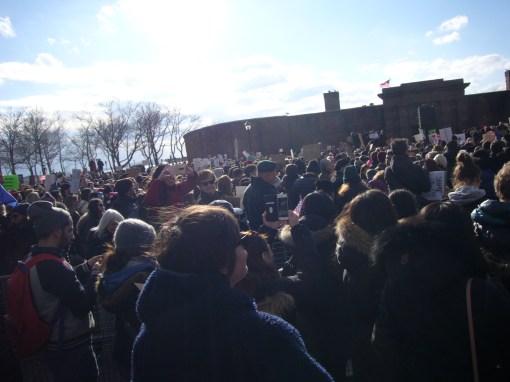
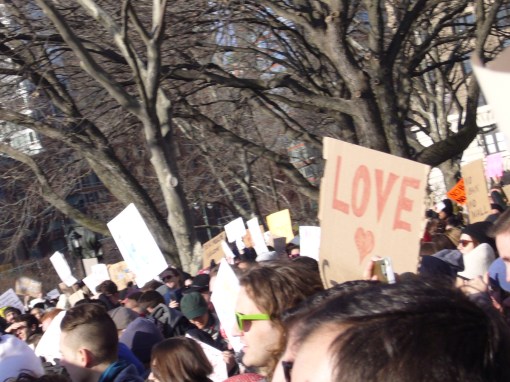
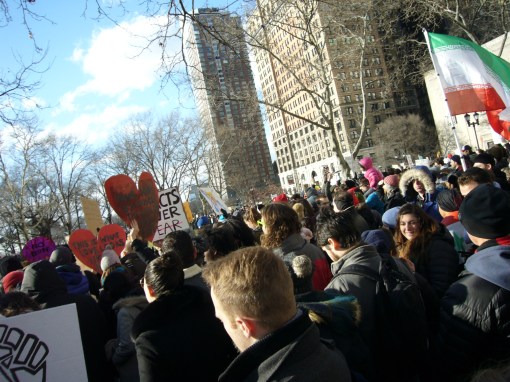
So, last Wednesday, when there was a rally for immigrants and Muslims in Washington Square Park, I jumped into my Docs and headed on ovah. As I mentioned on Twitter, it was bracing to stand with thousands of others and yell “Stand up! Fight back!”

Not depressing at all.

Then, this past Sunday, in response to the execrable executive order on refugees, travellers, and would-be immigrants, I joined even more folks for a rally/march in Battery Park.

005

011

014

Lotta good—short! rally speeches should be short!—speeches tucked into two hours, but I confess to ducking out at Rector Street a few blocks into the march (the third hour) to head back to the train. It’s gonna take me a bit to get back full protest stamina.

Oh, and did I mention that the route to the 2 took me down Wall Street and past the Trump Building?

Yeah, I flipped it off both coming and going. Petty, but satisfying in its pettiness.

Anyway, there’ll be more protests—Clio knows there’ll be more protests—and I’m working on rounding up some fellow marchers, but I showed up, and it felt good

It might even have done some good.


On a rooftop in Brooklyn

25 01 2017

Yesterday both cats scrambled to get on to the windowsill to gawk out at what I figured was a pigeon.

Well, it was, but not in the way I was expecting:

024

She really went to town on that thing:

023

She hung around, snacking, for a good long time, before lifting off with what was left of the carcass and leaving just a puddle of feathers behind.

I’m not a bird-watcher, so even with the help of various online guides I can’t be sure, but chances are that bird o’ prey was a red-tailed hawk. They’re pretty common in the city, but this was my first up-close-and-personal sighting.

Pretty cool.


Nazi punks fuck off

24 01 2017

So y’all have seen the video (or the many gifs) of Richard Spencer punched in the head, yeah?

Anyone conflicted by the sucker punch? Anyone conflicted by their lack of confliction over the sucker punch?

I’m not conflicted. Mind you, I wouldn’t exactly recommend sucker-punching Richard Spencer or any run-of-the-mill Nazi, but I took perhaps too much satisfaction in seeing that fist upside this guy’s noggin.

As an Arendtian, I’m leery of the introduction of violence into the arena of discourse, i.e., if you’re able to talk, do that—but what if your opponents don’t accept the terms of that discourse? What to do, for example, about a white supremacist who thinks ethnic cleansing gets a bad name, has advocated for the forced sterilization of black people, whose website ran an article called ‘Is Black Genocide Right?, and who is using the instruments of democracy to undermine said democracy?

What do you do with a guy who would get rid of you just for being you?

That longstanding dilemma in liberalism—how to deal with illiberalism—is longstanding precisely because there is no easy answer. I tend toward the civil libertarian view, which says tolerate the intolerant, because I don’t want the state to throw people in jail for bad views. Clear, direct threats—sure, but general espousal of an abhorrent world-view, even a Nazi world-view? No.

But what about in political society? How may we as citizens respond to our fellow citizens who would seek to strip us of our full status as citizens? If you (Nazi, ISIS fighter) say you want to get rid of ‘my kind’, can I hit you?

Legally, no. If I hit you and I get caught, I ought to be charged with assault.

And tactically, that might not be the wisest decision, for all kinds of reasons, not least because it could lead to greater violence, which will lead to the breakdown of politics right quick.

Finally, if you believe as fervently in politics as I do, then one ought to act politically, i.e., through speech and coordinated public actions, not violently.

Yet for all that, I honestly cannot condemn the guy who walloped Richard Spencer. This is one of those cases where the better angels of my nature are nowhere to be found.


Get you instructions, follow directions

19 01 2017

I’ve been pretty crappy in this whole RESIST! thing.

Yes, I wrote the letter(s) and yes, I keep thinking—thinking matters!—but I see exhortations to Do X! Y! Z! on Twitter, and I’m, like, Um. . . .

WELL, I’ve finally found something which suits my house-bound ways: I’m gathering information for the Resistance Manual, on online, open-source, er, source of resources. I’ve already added citations to the readings list, as well as plugged in data for Wisconsin, New Mexico, and Minnesota.

It’s all pretty basic, thus far, but you don’t get to the complicated stuff without that basic foundation, so I think I’m, y’know, actually contributing something.

(I’ll keep adding information to my Life during wartime page, if only because I have my own idiosyncratic interests that may be best kept confined to this here site.)

Oh, and I did, finally, manage to call my Congressfolk: Rep Clarke (Thanks for boycotting the inauguration!), and senators Gillibrand (About those Sessions/Price/DeVos votes. . . ?) and Schumer (Yeah, vote against Sessions! Yeah!). Schumer’s DC line was way busy, so I called his Manhattan office—hell, it all gets to them.

Like many people, I’ve developed a thing, which is to say, a problem, with calling people I don’t know. Pre-email I never would have won a cold-calling award, but now that there are ways besides actually phoning to people I don’t know I prefer. . . not to phone people I don’t know. It’s a bit of an issue.

Anyway, my friend T. mentioned that she’s programmed her politicians into her phone and I thought, Hey, that’s a mighty fine idea. Then, once I did that, I thought, Hey, why not actually, y’know, maybe, call ’em. So I did.

It was nothing, as of course the rational part of me knew. They don’t know who I am, they don’t care how eloquent I am, if they saw me on the train they wouldn’t point and giggle She’s the lady who stammered her comment, and they’re not writing Ms. Absurdbeats of Lefferts/East Flatbush called to say. . . .

Nope, all that mattered was that I gave an opinion on something the rep/senator did, and they noted that.

So, if you’re like me, not crazy about cold-calling politicians, don’t worry: they have people, and those people know how to write Right On! or Ugh! and then politely issue you off the phone and not think about you again.

And I bet that when I do call again, they ain’t gonna remember me—which is just how I like it.


Singing songs and carrying signs

17 01 2017

My Congressional representative, Yvette Clarke, is not attending the inaugural. Yay!

My senators, Kirsten Gillibrand and Chuck Schumer, are attending. And that’s fine, too.

I have, over the years (decades. . .) come to appreciate the importance of institutional norms and of the necessity of recognizing the peaceful transfer of power. That a nation is able to vote out leaders and peacefully replace them is an accomplishment.

That’s why I’m fine with my senators attending the inauguration. But why then cheer Rep. Clarke?

Because the President-elect has no interest in institutional norms, has stated his disdain for the notion of a peaceful transfer of power when the voting citizenry elected someone he didn’t like, and has barely acknowledged that he is, in fact, the president-elect of the entire nation, not just the minority that voted for him.

Regular folks (i.e., non-political scientists) are often frustrated by what they see as the hypocrisy of politicians—the paeans to “my dear colleague” in the Senate, the inclusion of members in the opposite party in the Cabinet, a partisan president vowing to rule for all of the people, etc.—but these gestures matter. They are way of saying politics isn’t war, and we are not enemies.

That matters. A lot.

So some Democrats will attend the inauguration to uphold the principle that we, however fractious, are a people, and we honor the institutions by which we are so constituted, and some will boycott to uphold that same principle.

That seems about right.