And fear the silence is the voice of God

19 09 2009

Legos or coins—which are you?

What, you don’t get what I’m referencing? Oh, that’s right, you weren’t in class this past Thursday.

As I’ve mentioned, I teach political science at a CUNY school, an endeavor which doesn’t pay much (or not at all: see previous post), but which I enjoy. Most of what I teach is pretty basic—100- and 200-level stuff (with occasional forays into the 300s)—which means I don’t usually get much of a chance to toss mind-blowing stuff at my students.

Except. . . except for the one lecture near the beginning of this particular 200-level course. I tell the students this will help them make sense of the readings, and I’m not lying, but, honestly, they could get by without this. I spend 60 or 75 minutes on this stuff because I dig it.

I begin by writing on the chalkboard the following:

The Good

Practical-reflective

Ontology

Epistemology

(Because I’m html-illiterate, I’m unable to show the arrows running up and down between the levels. Luckily, the chalkboard doesn’t require html.)

I like to explain this spatially: epistemology is deep in the ground, ontology is in the middle layers, the practical-reflective on the surface, and the Good out in the sky.

After the requisite this-would-not-pass-muster-in-a-philosophy-class disclaimer, I dive into epistemology, or, How do you know what you know. The stuff of late night conversations, drug trips, or too many viewings of The Matrix. It’s tricky, I note, not least because any answer you give can be parried with a ‘. . . but how do you know that?’ and lead to endless regress.

Above that is ontology, which I define existentially: as a matter of Being-in-the-world. The key question here, I note, is Who are you? How do you understand yourself, your relationship to others, and to existence itself.

The practical-reflective: this is where most of us live, with the main question What to do? The use of the practical often stands in for pragmatic, but in this case I use it in terms of practice, as in the practices in which we engage, of how we order the doings of our lives. These aren’t merely banal issues: what to do can involve questions of love, work, where to live, whether to have children, etc.—hence, the reflective part. (And, as I tell the class, it’s also the level of politics, of how to arrange ourselves vis-a-vis one another and any authority we choose to install over and above ourselves.)

Before ascending to the Good, I pause and note that at times of crisis the ontological may crack open, and people may question who they are and what they’re doing with their lives. (More rarely, they may tumble into the epistemological abyss, a place more mind-blowing than any intoxicant, and one best scrambled out of as quickly as possible. Voluntary spelunking in the epistemological is to be discouraged, especially if unaccompanied by a guide.) In any case, while most people don’t think of their lives in terms of ontology, the questions which arise from it are not unfamiliar. I then point out that while most of our work for the course will deal with the practical-reflective, we will occasionally bounce down to the ontological—or up to the Good.

Finally, then, the Good. This term is taken from Plato, and denotes an eternal, fixed, reality—the Really Real, the True. Given that most people on the planet are religious, I point out, the Good is often understood in terms of God or gods*. It is that around which people orient themselves, or seek, or toward which they aim. Understandably, then, contemplation of the Good can affect how one approaches the questions at the other levels as well as how one acts.

(*The main secular competitor to god/s may be nationalism, with very strong versions allowing the nation to stand in for the god/s; less common would be an utter devotion to science and methodological naturalism. There are likely other ideological permutations as well.)

At this point, I gesture toward the arrows running along side of this little chart. One happens at one level can affect what happens at other levels, both up and down, but not necessarily so.

And thus, the Lego-vs-coin question.

For some people, the four levels are locked tightly together, as if they were Lego blocks. Knowing the Good can tell you how to act in the world, how to understand yourself in that world, and how you know anything at all. It is a comprehensive vision.

I’ll give at this point the example of the devout Christian who has a very strong sense of God, who tries to live her life according to her understanding of God, who thinks of herself as in this world but not of it, and who knows what she knows because God allows her to know. Even if her understanding is imperfect or she is occasionally confused, she nonetheless allows for very little light between the levels.

For others of us, however, the relationship between the levels is less certain; we have at best partial visions. I’m an epistemological skeptic, I’ll admit, and am not sure if we can know anything, not even, against Descartes, whether we exist. This past Thursday I analogized the levels to lumps in a bag, shifting and bumping against one another, but I think the better analogy is that of coins. Yeah, I can stack them on top of one another, but they don’t lock in, and they can be fairly easily scattered.

I didn’t go so far as to state that followers of the Good are all Lego-folk, and agnostics, coin collectors—and not just because that would  have taken me away from the point of this exercise (which was to tie it all back into political analysis). I think the predisposition to Legos or coins is a temperamental one, and that this temperament has no necessary relation to belief or skepticism.

(Okay, so dogmatic skepticism is difficult to square, but it’s also clear that devout believers may  carry a doubt or a humility great enough to prevent any lockdown. In any case, if it is temperamental, it’s not clear how much it can be changed.)

The students are popping in with questions and comments all throughout this exercise, and when we finish with the Good, usually one student will ask But what if we don’t all have the same Good?

Yesss! This leads rather nicely to a discussion of the theory we’ll be examining for the next month or two, and how it seeks to create framework for development which allows individuals to choose their own versions of the Good, and which discourages the imposition of any, one, version. Onward to politics!

This is all very nice, you might say, but I’m not your student, so why are you telling me this?

Because I’ve been preoccupied of late with matters which, I realize, are related to Legos and coins, and I don’t know that I could have approached them in this blog without sketching out the underpinnings of that approach.

Of course, now that I’ve so sketched them, it’ll probably be awhile before I bother with the matters themselves.

What can I say? My coins have scattered.



It’s a rich man’s world

15 09 2009

The Dean is the problem.

The Dean—who almost certainly doesn’t have to wait until the next pay period to buy an unlimited metro card, or refill his prescription, or hit up Target for some basics—apparently has a chunk of PAFs sitting on his desk, just. . . sitting there, waiting for his signature.

Almost fifty of us won’t get our regular paychecks until October 8. Then, of course, with the tripling of our usual gross pay, we’re at risk for getting taxed as if that 3X paycheck were our regular checks.

Happily, the woman in charge of payroll (who nobody deigned to inform of the problem), told me that I could get an advance on my Sept 10 paycheck this week, and an advance on my Sept 24 paycheck on the 24th. It’s not for the full amount, unfortunately, but it will pump some blood into my bank account.

Furthermore, The Woman in Charge had the right attitude, when I mentioned that the Dean was the source of the problem. If I could halt their direct deposit for a couple of pay periods. . . she muttered.

Then she told me that she’d help me avoid the tax whammy by altering my deductions for the October 8 paycheck, then switching it back to my regular deduction for the next pay period.

I like this woman.


Anything you can do, I can do better

12 09 2009

Who would you like to see together?

Don’t be perverted—not like that! No, more along the lines of Here are two people who I’d love to see do whatever it is they do, together.

I was watching  clip of k.d. lang singing a Leonard Cohen song, and thought, Man, I wonder what she’d sound like with Cassandra Wilson?

Two amazing vocalists and interpreters, together.

So, my first duet: k.d. lang and Cassandra Wilson

Then again, I’d long thought that it would be great to listen in as Hannah Arendt and Edward Said argued.

Thus, the first duel (albeit a friendly one): Arendt and Said.

Who else?

  • Arendt and Rosa Luxemburg
  • Frederick Douglass and Malcolm X
  • Arendt and Malcolm X
  • Malcolm X and Bernard Lazare
  • Janis Joplin and Cass Elliot
  • PJ Harvey and Patti Smith (definitely a duel)
  • Godspeed You! Black Emperor and Dawn Upshaw (Really. Have you heard her on Golijov’s Ayre? The woman can sing anything.)
  • Eddie Cochran and The Clash
  • Brett Favre (back in the day. . .) and Randy Moss
  • Martina Navratilova (back in the day. . .) and Serena Williams
  • k.d. lang and Lizz Wright
  • Kate Bush and Leonard Cohen (just for the hell of it)
  • Marvin Gaye and Joni Mitchell (hot and cool, together)

Who else?

I can’t be the only one who wastes her time thinking about this kind of thing. . . .


All that is now/All that is gone

12 09 2009

It wasn’t my city then,

Mark Lennihan/Associated Press

Mark Lennihan/Associated Press

but it is now.


Money money money

10 09 2009

I hate worrying about money.

It’s so dull.

Yes, I find money unbearably dull, and only think about it because I have to. It is not an end, to me, but a means to an end: housing, travel, entertainment, etc.

But money for money’s sake? I’d rather have a nap.

Unfortunately, I can’t not think about money, mainly because I don’t have enough of it.

Why not? I work—two jobs, even! But paperwork got screwed up at my main job and what should have been a bump in my bank account is a message from payroll that ‘we don’t have your PAF.’

And there’s not a goddamned thing I can about this. Oh, I mentioned it to the chair, and the secretary got on the phone and left messages, but, really, I’m hosed.

Do what you’re supposed to do. Follow the rules. Fill out the paperwork, sign your name, do the work.

And still, you’re hosed.

I’m not the only one, of course. Anyone whose ever been ‘downsized’ or ‘outsourced,’ the people who paid for insurance only to have discovered when they needed the coverage that, really, the coverage was. . . not. The workers who invested in the pension fund only to find out, too late, it was looted, or built over fraud. Hosed.

I’m lucky, at least. I will, eventually, get paid (tho’ I’ll get nailed in the taxes for a double paycheck), and I do, at least, have work.

(The whole Bank of America thing? I may be well and truly fucked, there. But I’m beyond anxiety on that, and thus utterly unable to talk about it. After. . . .)

Even knowing my monetary anemia is temporary, however, does little to dull that horrific combination of rage and despair, otherwise known as helplessness.

Do what you’re supposed to do. Follow the rules. Fill out the paperwork, sign your name, do the work.

And don’t be surprised if none of it matters.


Yesterday’s a day away

7 09 2009

It’s about time.

All those boxes of files, the folders full of print outs of journal articles, cut-outs from newspapers, clippings from The New Yorker and The Nation, transcripts from The NewsHour (and before, the MacNeill/Lehrer NewsHour), Gina Kolata and Elizabeth Farnsworth and Lawrence Wright. Time to go.

Start easy: start with the ‘Media/Polls’ box. There’s only one of those, and you know you want to get rid of those, right? You haven’t looked at its contents in six years, not since you left Montreal, not since you threw a shovelful of dirt over the remains of your academic career and lit out for your life.

One box, shouldn’t take long. One less to cart to wherever it is you’ll go next. And it’s on your list.

The first folder: ‘Media–to be filed’. What? I thought these were mostly polls, old and outdated and easily disposed of, save for pulling out the staples or off the binder clips and reshuffling the paper for reuse as the back end of lecture notes. Gallup and Roper and whatnot.

But here’s a piece by Sallie Tisdale, and another by Annie Dillard and another by an old colleague, Carl Elliott. Carefully annotated with publication date, volume, number. Haven’t read any of these likely since I yanked them out of Harper’s and The Atlantic 7, 8, 12 years ago.

Next up: Cloning. All the Times‘ pieces, the television transcripts. Here are a few pieces by Leon Kass, my Pilot-penned scrawls arguing with him in the margins.

Here is the stillborn promise of books never to be written, articles never to be submitted. Here is my dead career, never carefully tended, finally abandoned to die, mummified in filed slices.

And my career as an academic is dead, no question about it. Oh, I stroll through the cemetery regularly as an adjunct, but ‘adjunct’ is just another term for dead-end job.

I know this. I know this. I knew what I was doing six years ago, even if I didn’t know the consequences of what I was doing, even if I had no idea what I was doing. Still, I knew that the slow climb from assistant to associate to full professor was not for me, that I would not end an emeritus.

Even now that I know the consequences, I can’t say I was wrong to have dropped off the tenure track. Sure, I might even have managed the climb, secured myself in some out-of-the-way department somewhere, but it wouldn’t have been my life. A role, only.

It will be good for me, finally, to have finished with these files, to have disarticulated the stories and narratives within. But I know they meant something, once, that they mattered, once, and it grieves me to put it all behind me.

I will feel lighter, when I am done, however heavy I feel now.

Lighter, yes.


Watching the tide roll away

6 09 2009

I am the most undisciplined person in the world. The world! The universe! The MULTIVERSE!

Okay, maybe not the multiverse. Maybe just in my apartment.

Where I live alone.

(The cats? They’re cats! They do want they want.)

Lack of discipline differs from laziness—tho’ I am, of course, also prone to laziness—in that the problem is located in the lack, not in the effort. Properly harnessed, I can work like the dickens.

Left to roam free, however, and I simply wander, nose about the field, and am apt to lie down for good, long, nap.

As an occasional phenomenon, this is not only not a problem, but even a delight. As a regular occurrence, however, it doesn’t refresh, but enervates.

Low-key folk may welcome enervation, but I am not a member of that particular tribe. It’s not—exactly—that I’m high-strung, but I am restless, ambitious, and voracious. I need to do.

I’ll avoid the whole doing-vs-being discussion (for now), noting simply the fulcrum for  balance may be set differently for me than it is for others: I need a fair amount of doing to make sense of my being.

Unfortunately, I’m shit about doing unless forced. The mere need, in other words, is insufficient motive.

Fortunately, I can respond to the flimsiest of force, especially if that force makes a kind of sense. A self-made list is indeed flimsy, but it also makes sense: Here are the things I want to accomplish. It sets out in physical form tasks I set for myself, makes it separate from me, and gives me a means of satisfaction when tasks are completed, i.e., I get to cross them off the list.

I don’t know why it’s satisfying, and I don’t care. It makes sense because it works for me, even if the underlying reasons for why it works remain murky. I don’t need endless epistemological iteration of the appeal of list-making and crossing-off, I need something to get my ass in gear.

‘Working model’ or ‘beta-version’ or ‘jury-rigged’ or ‘throwing spaghetti at the wall’—whatever. It’s a means, not an end.

Now, not everything is on the list. I don’t need to put things like ‘brush teeth’ or ‘clean litter box’ or ‘eat’—these are sufficiently habitual and/or vital that they carry their own force. (And besides, I’m not that pathetic.) Nor do I need to remind myself to read for my courses, print out notes, or grade: the requirements of teaching keep me in line. Ditto with wage-work generally.

And I don’t need any (well, not usually) prompts to keep in touch with friends. Pleasure has its own rewards.

The only kind of work for which I need no external constraints is writing. When I want to write, I do, and once I start writing, I almost always want to continue writing. I think this is partly due to knowing that I’m pretty good at writing, partly that it’s not hard for me, and largely because I write to find out what happens, i.e., I’m curious, and that’s enough to drive me on.

This is also why I don’t sketch out what I’m going to do in advance. As I paused in writing this post, I was thinking about writing my dissertation, and how different writing that was from writing my novels. Yeah, duh, but there’s something central to both types of writing: not knowing how it ends. In fact, I had a hell of a time writing my dissertation as long as I thought I knew all that I would think about the argument. I had to tell myself that I did not, in fact, know how the dissertation would ‘end’, that I had to let it play itself out. It was only then that I was actually able to sit my ass down and write the thing.

So writing I can do because writing is something I can do.

Pitching and selling what I write? That’s on the list.


Making a list

4 09 2009

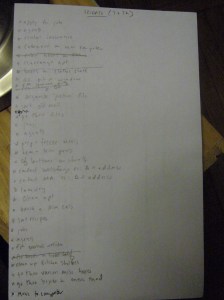
This is what it’s come to, a rolling to-do list:

Pitiful, I know, but jesusmaryandjoseph, it works for me.

And at this point, I need to try anything that might maybe possibly work for me.


Pass in time

31 08 2009

It’s been almost 4 months.

I teared up when I typed that.

You see, while I can talk about her life, I cannot talk about her death without tears.

I know she’s no longer here, but it is an outer knowledge, something I keep away from me.

I have to make room for her, all of her, in me. Life and death and everything.

If I want to be able to remember without tears, then I have to bring her back in, even with the tears.

‘Just a cat’, I know.

But oh, how I miss that cat!


Driving sideways

28 08 2009

I’m losing my mind.

Nothing serious; I’m simply losing touch with reality.

Shall I rephrase that?

I know what color the sky is in the—not my—world. It has just turned August 28, 2009 in New York City. Rain is expected later in the day. When I wake up, it will still be August 28, 2009 in New York City.

So there’s that.

But there’s also the oft-denied undeniability of a life in pieces. Yes, that would be my life.

I don’t want to over-emphasize two things, but I often do what I don’t want:

1. The visit of friends whose lives are more or less whole served notice on a life which is not.

2. That I have never properly learned how to live has not only caught up to me, it has long since overtaken and even lapped me.  (How long will I use this excuse? How long you got?)

Now, as to the first matter: It is true that normal life in NYC is unlike normal life in most other places in the US. Thus, it is normal for these friends to have homes and husbands and regular paychecks and paid vacations and pension plans.

True, there are some places in NY where this is also normal, but this town is big enough to encompass more than one normal. Thus, it is normal to have roommates found through craigslist and odd jobs and to sweat about money and to think of less than 400 square feet of living space as adequate.

If my friends blinked about this juxtaposition of normals, they were kind enough to do so when I wasn’t looking.

As to the second point, well, what more is there to say beyond the profession of ignorance? If it were an argument I could analyze it; if it were a recipe I could cook it.

It is neither. It is a kind of blankness, a lack which offers no clues on how to approach it. Animal, mineral, or spirit?

‘Just do it.’

Okay. But what, exactly? I understand the just, but what is the it and how am I to do it?

Too many questions? Is this why I’ve been told I think to much?

But this isn’t a question of too much thinking, nor or not enough. It is precisely a question of what and how.

So, Ms.-Fancy-Pants-PhD: what do you want and how do you propose to get it?

I want a life that makes some sense.

I have no idea what that means.

Which means I have no way of knowing how to achieve it.

Smaller, more concrete: I’d like to make enough money not to have to worry about it. I would like a job which is more than adjunct and temporary. I would like to take a dance class and re-up on my pottery. I would like to meet more people. I would like to date. I would like to sell my novel. I would like to write more than I do. I would like to be able to leave New York City in August.

Okay, now we’re on to something: Talk to departmental chair about a medium-to-long term teaching contract. Apply promiscuously for jobs. Apply promiscuously for agents. Write more.

Primary, secondary, means and ends, causes and consequences. See, that’s not so hard, is it?

It shouldn’t be.

Practical—I can be practical. I enjoy the theoretical-practical—hang my queries on these!—but the real-practical, the this-is-your-life practical, mmmm, that’s where the dissipation begins.

This-is-your-life: the theoretical-real-practical. But I have neither theory nor reality nor practice. A deductivist trapped in induction.

Einstein: It is the theory which decides what we can observe.

Francis Crick: The point is that evidence can be unreliable, and therefore you should use as little of it as you can.

Crick, again: There isn’t such a thing as a hard fact when you’re trying to discover something.

So not only do I not know where to look, I can’t trust what I can and cannot see.

Still, what theory accounts for my pitiful finances? That, my dear, is all about practice, and is evidence of poor career decision-making.

Still, one shift among the subatomic particles, and idiocy becomes vision: See, e.g., When I sell my novel. . . .

Still, count on nothing. The evidence is unreliable.

Still, such unreliability can be spur, possibility.

I don’t have to drown in it. (Which ‘it’? the evidence, the unreliability, the lack—you name it.) I am tired of treading water.

But I took advanced swimming lessons. I can tread water a long time.

Someday I will swim.

(Credit/blame for this post’s styling to Jeanette Winterson)