Everybody knows the dice are loaded, 2

22 07 2014

Ariella Cohen, on “poor doors”:

Extell, on Manhattan’s Upper West Side asked the city to approve a plan for a 33-story luxury condo with a separate entry for the tenants residing in the publicly subsidized rent-stabilized units, which will be segregated from the rest of the building into a section facing the street while the luxury units will face the Hudson River.

This address isn’t the only one with citizen-subsidized egress segregation, but the overall numbers remain low, if only because, as Cohen notes, it’s hard to retrofit old buildings with separate-because-unequal entrances.

Still, one gets the sense that if it were possible, it would be more popular among the penthouse set. David Von Spreckelsen, a poor-door developer, defends the tender sensibilities of the wealthy living in tax-subsidized mixed-income housing:

I think it’s unfair to expect very high-income homeowners who paid a fortune to live in their building to have to be in the same boat as low-income renters, who are very fortunate to live in a new building in a great neighborhood.

Take it away, Jean-Jacques:

[I]f one sees a handful of powerful and rich men at the height of greatness and fortune while the mob grovels in obscurity and misery, it is because the former prize the things they enjoy only to the extent that the others are deprived of them, and because, without changing their position, they would cease to be happy, if the people ceased to be miserable.

~~~

It’s tempting to end on Rousseau, but Cohen makes an important point in her ending: such segregation is not inevitable. It was enabled by policy, and can be undone by policy.


Everybody knows the dice are loaded, 1

20 07 2014

Yeah, a new series! On the rationale and ravages of capitalism! Whoo-hoo!

Okay, most of the time it will just be quick hits, highlighting (mostly) where the pointy head of the stick pokes through the socio-economic skin and (sometimes) efforts to break that stick. And every one in a while I’ll try to stitch these bits together in an attempt to make my own sense of where we are and where we’re going.

Yep, there are others out there manifestly more qualified than I am, who’ve made long and deep study of political economy (and who I’ll crib from—with credit!—when I remember to look as needed), but I want to try to puzzle my way through this by thinking politically, not economically.

That’s some artificial line-drawin’ I’m doing there, I know, but I’m drawing in pencil, so it’s okay.

So: onward!

~~~

These two are pretty self-explanatory:

*Paul Carr: New San Francisco billboard warns workers they’ll be replaced by iPads if they demand a living wage

(h/t karoli, Crooks & Liars)

*David Ludwig, Obama Unveils New Initiative to Encourage Private Funding of Public Infrastructure

(h/t Paul Constant, The Stranger)

~~~

A bit of comment:

*Joe Pinsker, The ‘Facebook Cop’ and the Implications of Privatized Policing

Pinsker is apparently an optimist, because he concludes In all likelihood, the cop Facebook is funding will likely exert a positive force on the area, checking in on wayward kids and improving emergency evacuation procedures.

Which is an odd conclusion, given that immediately following this he notes private entities whose objectives diverge from the public’s can apply the law as they see fit. Who does Facebook’s security team pay attention to? Who do they ignore?

And I would add: What of our rights against their actions?

*Brendan Kiley, In Addition to Those 14,000 Layoffs, Microsoft is Tightening the Screws on Its Vendors and A Note from the Trenches of Microsoft Vendors and Permatemps

Temporary nation! Whoo-hoo! As a worker-mercenary myself, I can only confirm the delights of livin’ the free labor life—tho’ I must admit that I’m not completely free, union-bound as I am.

*Megan Rose Dickey, How Much Uber Drivers Really Make

Surprise: not as much as promised.

The real reason, tho’, that I picked this one out, is that the phrase “sharing economy” makes my teeth itch.

When Uber and Lyft and Airbnb and TaskRabbit are all grouped into some kind of happy-clappy “sharing economy”—sharing! it’s good! didn’t your mother teach you to share?—what is oh-so-gracefully elided is that these are really examples of the fee-for-service brokerage economy.

Uber, et. al., are brokers: they broker the relationship between provider and client/customer and take a fee for that service.

One the one, capitalist, hand, this isn’t bad: people are getting paid; on the other, socialist, one, these kinds of services demonstrate how far capitalist relations have penetrated and commodified human relations.

~~~

Deserving much comment, which I may or may not eventually get around to providing:

Kathleen Geier, Sarah Jaffe and Sheila Bapat, What Do the Recent Supreme Court Decisions Mean for Women’s Economic Security?

Esther Kaplan, Losing Sparta

~~~

How to fight back: Together! Solidarity!

Ansel Herz, Anti-Foreclosure Protesters Block Sheriff’s Eviction of Disabled Veteran in West Seattle

He will probably end up losing his home, because the law favors the house.

Still, it’s good to fight back, if only to remind ourselves we can fight back.


O the dragons are gonna fly tonight

17 07 2014

I.

I understand the difference between unintentionally and intentionally killing someone, I do.

I understand that Hamas fires off rockets with the intention of killing Israelis, military & civilian alike, and I understand that the Israeli Defense Force fires missiles into Gaza with the intention of killing Hamas fighters, and in so doing, unintentionally kills civilians.

I get it: the purposes are not the same.

But.

When you are aware that your intentional actions will lead to large numbers of unintentional deaths, well, then it’s hard to see how much that lack of intention matters to the unintentionally dead, or to the families of the unintentionally dead.

Or to those of us witnessing the bodies of the unintentionally dead.

II.

If the Malaysian airliner was shot down unintentionally, accidentally, does that make it okay?

III.

I understand, really I do, the thinking behind the statement that Hamas are responsible for the civilian dead in Gaza: were they not to insist upon firing rockets into Israel, it would not be necessary for Israel to fire missiles into Gaza.

But the fact remains: Israel fires missiles into Gaza.

The fact remains: Israelis missiles killed those boys on the beach.

IV.

You may argue, if you wish, both that Israel is morally responsible in its attempts to limit civilian casualties and that Hamas is completely responsible for civilian casualties.

You may argue that, if you wish.

But if Israel is not responsible, then how is it responsible?

V.

I don’t know what I would do, how I would think, if I lived in Tel Aviv, Gaza, Hebron, or Jerusalem, if it were me, transplanted from my junior one-bedroom in Brooklyn to an apartment in Israel or the Occupied Territories.

If it were me, would I call those territories occupied, which they are, or would I call them Palestine, which is what some want them to become?

(Judea & Samaria? No: it is still me.)

How would I understand Israelis, Palestinians? the soldiers, the militants, the terrorists? the politicians? the underpaid academics, the cafe-goers and olive farmers and scientists and tour guides and those for whom the land is their home, their everything?

The kids, the families, anyone at a beach in July: that I understand.

VI.

From where I sit, in my junior one-bedroom in Brooklyn, it is clear: this must stop!

But of course. How obvious is that observation. How useless it is.

How many people disagree, by agreeing to its extremes; who seek for it to continue, without end, until it all can be finally ended.

Who don’t care what it takes to get to that final end, how much and how many will be destroyed.


Which side are you on

15 07 2014

A few more short thoughts on recent Supreme Court decisions, and some connections between them:

1. That mashupCorporations are people, my friends, and some people are more equal than others—is a distressingly apt line:

Two recent U.S. Supreme Court rulings—AT&T Mobility v. Concepcion and American Express v. Italian Colors—have deeply undercut these centuries-old public rights, by empowering businesses to avoid any threat of private lawsuits or class actions. The decisions culminate a thirty-year trend during which the judiciary, including initially some prominent liberal jurists, has moved to eliminate courts as a means for ordinary Americans to uphold their rights against companies. The result is a world where corporations can evade accountability and effectively skirt swaths of law, pushing their growing power over their consumers and employees past a tipping point.

2. Is the Court’s contempt for labor leading or following a more general social contempt for labor?

3. Remember, reproductive labor is the first form of labor, the basis of all other labor.

.

And one non-Court related note:

I will never be an orthodox Marxist—I lack the optimism required of the orthodox—but if you want to understand the political culture in the US today, you’d do worse than to start with the domination of capital over our entire political-economy.

This doesn’t mean that all is determined by capitalist relations, that there is no autonomous space for politics and culture, or that there is no resistance to capital.

But it does mean that you can understand a lot if you understand that if capital is up against any other interest—labor, community, environmental, educational, safety, public—capital almost always wins.

If capital has no interest, then the politics is up for grabs.

We are left fighting over scraps.


The Revolution is just a t-shirt away

15 07 2014

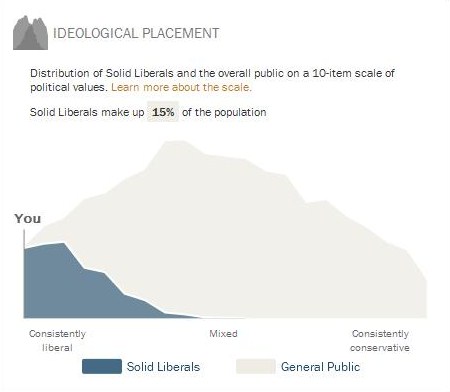
Now this is a real shocker:

pewquizgraphic

I know, I know, it was only twenty-three questions and hardly captures all of my views about policy and politics, but would the result be much different were there fifty questions? a hundred?

Yeaaahh, no.


It’s time for sex with strangers

8 07 2014

Consequence-free sex is a fantastic idea, and I am wholeheartedly in favor of (more of) it.

And to all of those who think such sex is a terrible idea, that women/whores/sluts (but I repeat myself. . .)  should just keep their legs closed, I say:

I agree!

Women/whores/sluts should not have sex. . . with people who think women should not have sex.

Win-win!


Are we not men

2 07 2014

I freaked out about Hobby Lobby a few months ago, so while I was pissed at the ruling, by the time it arrived I was all freaked-out.

There’s a shit-ton of good (and lousy) commentary out there about the ruling—which means I’ma gonna pass on Fisking Alito’s decision (which, by the way, Supreme Bad-Ass Ruth Bader-Ginsburg does just fine in her opinion, beg. on p. 60) and tick off a few hits:

1. This decision is terrible for equal protection of the law, offering an out from laws of general applicability, based on the sincerely? insincerely? held beliefs of those seeking the out.

Yes, Alito & Kennedy say, No, no, that’s not what we really mean, but whether or not they are sincere in their meanings, that will be the practical effect.

2. It is difficult to see how the courts and the Court can avoid favoritism in choosing to exempt contraception-banners but not transfusion- or psychiatry-banners. [see point 3, pp. 5-6]

Which means they either engage in favoritism, allow Congress to engage in favoritism, or allow the exemptions.

3. It is not at all difficult to see why contraception was singled out as exempt-worthy but transfusions and psychiatry might not be.

Guess! Guess!

4. Given how weird and not-wonderful our politics has become, this ruling may actually work against religious conservatives, and will be used (likely to some effect) in campaigns against Republicans.

Religious conservatives have done a pretty good job of complaining how wee and woebegone they all are, under assault from the gay agenda and atheist meanies and a hostile Obama administration—which complaints, however ginned up, did form out of a juniper seed of fact: a majority of the country now accepts gay marriage, some atheists are mean, and Obama has pushed hard on protections for LGBT folk.

So, religious folks on sexual matters: on the defensive.

Now, however, those same religious folks may lose their “underdog” status and may—may—be seen less as bullied than bullies, or at least as above the law.

Which, y’know, they are.

5. This decision really is bad for women, not just because it makes it easier for employers to deny contraceptive coverage to them, but because it further segregates “sexual health” from “health”.

And no, I’m not even going to begin to link to all of the idiots who think sex is dirty or nasty or not somehow an integral part of human being.

6. This decision, combined with the Harris v. Quinn decision chipping away at public sector unions, is bad for everyone.

As Sarah Jaffe noted,

Attacks on all workers’ rights often come first through attacks on those deemed less important workers. When we decide that birth control isn’t a pivotal issue because it only affects some workers, or that homecare workers’ loss is not a loss for us all, we leave the door open for the next attack.

7. From another angle, it is difficult to see how an expansion of the rights of the corporate person is good for corporeal persons.

This last point deserves more thought, thought which I don’t have right now. Let’s just say that it seems that as the rights of one expands, the other contracts.

~~~

h/t Erik Loomis at Lawyers, Guns & Money for the Jaffe link


Wait a minute honey, I’m gonna add it up

30 06 2014

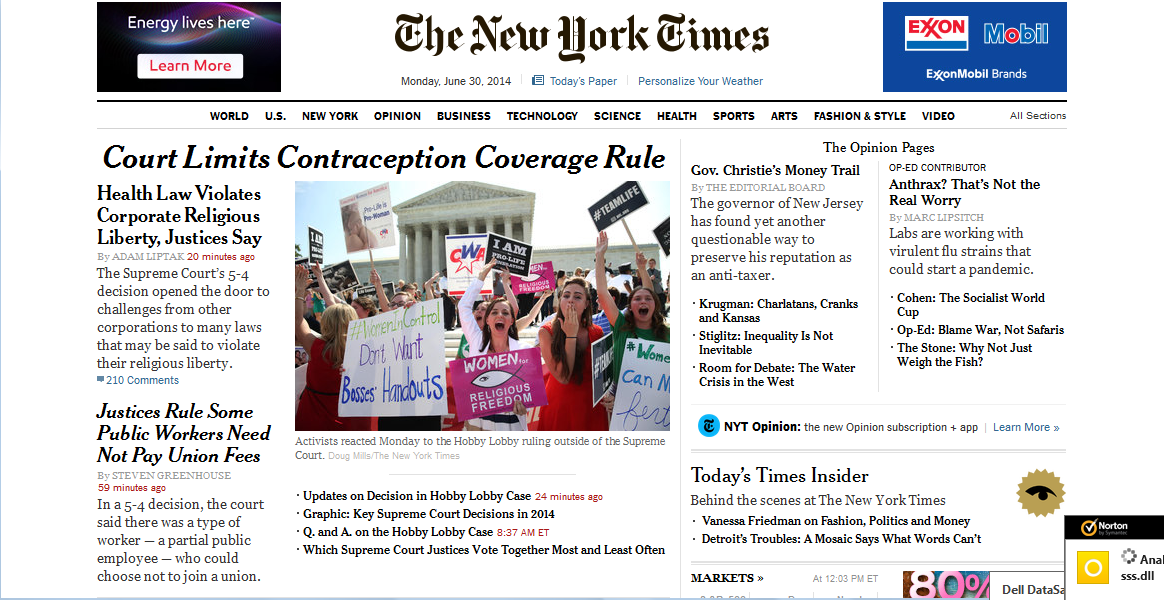
Jesus fucking christ.

FireShot Screen Capture #001

Unions screwed, women screwed out of protected screwing.


Get up, stand up

25 06 2014

I look forward to SPEAKER OF THE HOUSE OF REPRESENTATIVES John Boehner filing a lawsuit against President Obama for, uh, presidenting.

After all, what other options does the SPEAKER OF THE HOUSE OF REPRESENTATIVES  have in dealing with a president?

Sure, it’s possible that some incompetent bastard who slid thru the confirmation process might allow the suit to go forward, but it is far more likely that the judge, after s/he stops laughing, would gavel down the suit and yell at the SPEAKER OF THE HOUSE OF REPRESENTATIVES to get out of her/his courtroom, quit wasting everyone’s time,  go back to Congress and do his job.

Hell, I’d pay five bucks for a seat in the courtroom to see that happen.


Just gonna have to be a different man

17 06 2014

I am admittedly ambivalent on the prospects of Hillary Clinton running for president.

I’d dearly love to see a woman president, but if I thought Russ Feingold had half a chance in Hades of becoming prez, I’d vote for him in a New York minute.

She’s just too. . . conservative for me to get hepped up about her.

(That said, if she’s the nominee, you can be damned sure I’ll vote for her over Ted Cruz or Rick Perry or Scott Walker: “voting while sighing” is preferable to “smashing an icepick thru my eye socket”.)

In any case, she’s received a fair amount of (mostly negative) press on her tetchiness with Terry Gross, and, honestly, her inability to give a decent answer to mildly skeptical questions about her “evolution” on gay marriage is ridiculous. She changed her mind, it’s clear she changed her mind, and yet this woman who had adopted a wonderfully FuckIt attitude while Secretary of State somehow froze up when confronted with that known aggressor Gross.

Not that it’ll matter. She might get some grief about it in the primary, but chances are her opponents will also have “evolved” on the issue and will be unwilling to press her too hard. If she makes it to the general, it won’t matter at all: many Americans who today favor same-sex marriage probably had the same views about the issue in the 1990s as Clinton did, and thus won’t hold her changing views against her.

Hell, they might even feel reassured by her vagueness about exactly when and why her views changed, not least because the course of their own change is similarly vague.

Those of who pay attention to politics often want some kind of consistency or thru-line in their candidates and politicians; we want, in some weird kind of way, for them to be better than us—or, vainly, for them to be good enough to deserve our support.

But we’re not normal—most people don’t pay attention to politics—and it’s not at all clear that the characteristics we prize or deplore in politicians matters much to the folks who don’t tune in to the race before that last Labor Day before the election.

And for better and for worse, they’re the ones who’ll have the final say on who the next president is.