Circus Maximus MMXVI: See them on the beach or in New York City
8 11 2016Comments : Leave a Comment »
Tags: B-52's, presidential campaign
Categories : Uncategorized
Willkommen!
14 12 2015Fucking hell, ONE DAY after I make the absolutely authoritative and IRREFUTABLE argument assertion that the US is not Weimar, and Jeffrey Goldberg’s Twitter stream puts me on to this:
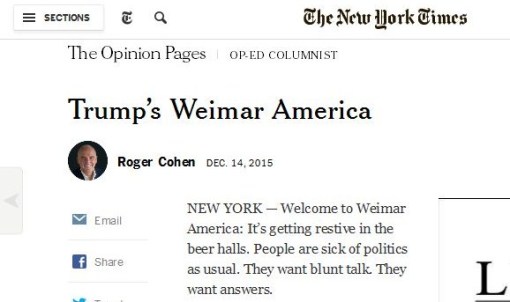
No. No no no no no no no. Annnnnnnnnnd: No.
Question: Does Cohen state in any way how the US is like Weimar? He does not.
Oh, he goes on about anger and antipathy and xenophobia and bombast—as if these were new things in US politics—but says next-to-nothing about what Weimar was about.
The one thing he does mention, hyperinflation, he (correctly) dismisses: hyperinflation hit Germany in January 1923 (really, the inflation was bad even in the latter half of 1922), but by the following year was under control.
(Which is to say: those who think hyperinflation in 1923 => Hitler in 1933 are incorrect.)
So let’s look at Weimar, if only briefly.
The first thing to know is that the republic was formed out of the corpse of an authoritarian empire, an empire which lasted less than 50 years. Some conservatives had hated Bismarck’s Reich, believing the realpolitik behind its inception too cold, too practical; they wanted an expansive Empire, one which would compete with the UK and France, and which would dominated Europe.
At the onset of war in 1914, Germany failed in the former task, but it certainly was the strongman of the continent: it was the most populous state, and had the largest economy. The Kaiser’s government vacillated in its attempts to restrain the Hapsburgs, but when war came, the population was ecstatic: they were certain they would win, and that the glory, and riches, of victory would be theirs.
The government and the General Staff of the Army encouraged such thinking and then, as Germany’s fortunes turned in 1918, discouraged any counter-message through suppression and censorship; the Kaiser himself was only told of the need for surrender in September.
Oh, and can I pause here to note what shits were Generals Paul von Hindenburg and Erich Ludendorff? They’d set up what was basically a ‘silent’ military dictatorship in 1916, and when their tactics failed, they disclaimed any responsibility for those failures. Hindenburg went on to testify, twisting the words of an English writer, that the German army had been ‘stabbed in the back’ and Ludendorff—such a shit—set up any following government for failure. According to Detlev Peukert,
he pressed for the formation of a new government, which would have to concede Germany’s defeat and accept the likely peace terms that would follow, from the majority parties in Parliament: the Social Democrats, the liberals, and the [Catholic] Centre. The eventual effect of this cynical manoeuvre, which absolved the ruling conservative and military leadership of responsibility for the consequences of its own failed war policy, was to inflict on the democratic parties the odium of the notorious Dolchstoß [stab-in-the-back], directed by stay-at-home-politicians against the fighting soldiers in the trenches. (The Weimar Republic, p. 27)
(Ludendorff, you will not be at all surprised to learn, was also involved in the 1923 beer-hall-putsch, although the court acquitted him. He was sidelined after an unsuccessful run for the presidency in 1925 (Hindenburg won), but remained involved in far-right politics until his death in 1937.)
Now, I’m spending a lot of time on this, and we haven’t even gotten to the republic itself, but the point is, that republic was targeted by its enemies even before it was born—and those enemies came not from outside of Germany,* but from its very center.
To be continued.
~~~
*Okay, not entirely true: German Communists, inspired and later directed by the Bolsheviks, were also opposed to the republic—they did, after all, attempt a revolutionary coup in early 1919—and they created no small amount of trouble for the republicans once the new government was established. Still, whatever power they had in the cities and in industrial areas, they had little power in the apparatus of the state itself.
n.b.: I updated what had been “1924 =>. . .” to “1923”.
Comments : 1 Comment »
Tags: Germany, Hindenburg, Ludendorff, Politics, USA, Weimar, World War I
Categories : Uncategorized
Circus Maximus MMXVI: We are the sultans
7 12 2015Now, I’m not one of those who thinks Trump is a fascist*, largely because I have a(n overly?) strict definition of fascism, though I do concede that he’s plucking those führer chords pretty hard.
Still, this is brilliant:
h/t Jeffrey Goldberg
*At the most basic level, I think fascists are highly ideological, which Trump is not: he’s merely opportunistic. This isn’t to say one can’t be a cynical fascist—Göring comes to mind—but he lacks any ideology beyond “winning” and himself.
I think the better descriptor for his politics is Juan Linz and Alfred Stepan’s concept of sultanism:
[A] sultanistic ruler characteristically has no elaborate or guiding ideology. There may be highly personalistic statements with pretensions of being an ideology, often named after the sultan, but this ideology is elaborated after the ruler has assumed power, is subject to extreme manipulation, and, most importantly, is not believed to be constraining on the ruler and is relevant only as long as he practices it.
Doesn’t that sound like Trump to you?
But like I said, still a brilliant photo crop.
Comments : 1 Comment »
Tags: Alfred Stepan, Donald Trump, fascism, Juan Linz, sultanism
Categories : Uncategorized
What are words for
14 07 2015I don’t get it. I mean, I understand it’s a way of telling someone to take a flying leap, buzz off, fuck off, beat it, but why bother with such a dull (in both senses of the word) epithet? “Go fly a kite” isn’t the sharpest retort one could fire off, but at least it has the bite of the k and the t to make it sound a little nastier than it is.
It’s rounded and bland, and “pound sand” is just, pffft, it’s the verbal equivalent of punching a pillow when angry: the jab dissipates into a mound of mush.
If you don’t want to swear (really?), “beat it” works perfectly well: the two syllables go up and down in short order, a sharp point aimed dead at the target. Crack!
Yeah, that’s what a rebuff should sound like.
Okay, other phrases oot and aboot online: “no more fucks to give” and “because fuck you”.
I like both of these formulations, mostly because I like the attitude contained therein, but, like the aforementioned “batshit crazy”, bemoan their overuse.
“Just sayin'” was okay in small—teeny—doses, but it’s been fire-hosed everywhere online. “Fixed that for you” could, sometimes, be clever, but mostly it’s just tired and kinda jerky.
There are words and phrases which I like very much and think deserve wider use—but, like the hipster who only loves the songs no one listens to, I fear that were these terms to spread, the thrill of them would be gone.
So I guess that’s a way of sayin’ keep sayin’ “just sayin'”: better a phrase I don’t much care for than one I do flattened across the cyberverse.
Just, stop with the whole pound sand thing, okay?
Comments : 4 Comments »
Tags: go pound sand, overuse, words
Categories : Uncategorized
Circus Maximus MMXVI: If you complain once more
15 04 2015By the Fata Morgana, what is Peggy Noonan ingesting?
I don’t usually read Noonan—Charlie Pierce and Wonkette provide sufficient wrap-ups—but I caught an excerpt of her column in which she complains about the unfairness of the media:
Two points on the general feel of the 2016 campaign so far.
One is that in the case of Mrs. Clinton we are going to see the press act either like the press of a great nation—hungry, raucous, alive, demanding—or like a hopelessly sickened organism, a big flailing octopus with no strength in its arms, lying like a greasy blob at the bottom of the sea, dying of ideology poisoning.
Republicans know—they see it every day—that Republican candidates get grilled, sometimes impertinently, and pressed, sometimes brusquely. And it isn’t true that they’re only questioned in this way once they announce, Scott Walker has been treated like this also, and he has yet to announce. Republicans see this, and then they see that Mrs. Clinton isn’t grilled, is never forced to submit to anyone’s morning-show impertinence, is never the object of the snotty question or the sharp demand for information. She gets the glide. She waves at the crowds and the press and glides by. No one pushes. No one shouts the rude question or rolls out the carefully scripted set of studio inquiries meant to make the candidate squirm. She is treated like the queen of England, who also isn’t subjected to impertinent questions as she glides into and out of venues. But she is the queen. We are not supposed to have queens.
I honestly thought Pierce and the nasty good folks at Wonkette were exaggerating when they referred to her, uh, louche style, but now I’m wondering exactly how many lotuses she eats prior to laying down in front of her keyboard.
Marco Rubio had a pretty great announcement in that it made the political class look at him in a new way, and a better way. I have heard him talk about his father the bartender I suppose half a dozen times, yet hearing it again in his announcement moved me. I don’t know how that happened. John Boehner is the son of a barkeep.
I. . . it’s. . . Good goddess, who writes like this?
Okay, sorry, I got distracted by the vapors wafting off of her. . . thoughts. The real point in bringing this up is to bang away on one of my favorite pots: Fairness doesn’t matter in electoral politics.
It doesn’t matter if Noonan is correct in her assessment of the mild treatment of Clinton (she is not) and that GOPpers will be subject to the cruelest and most unusual punishment by the media (if only), because fairness itself doesn’t matter.
I get the complaints, I do—I hated Ronald Reagan and thought he skated from the ill consequences of his policies, and considered the press’s treatment of Al Gore juvenile (and I still don’t understand how Joe Biden gets away with what he does)—but in the long march to the presidency, the agita over media slights or mis-magnifications is itself misplaced.
Sure, it allows you (if you are Peggy Noonan) to fill column space with psychedaelia, but the candidates themselves can’t get bogged down in the media mire: whining about the news-meanies isn’t going to get the non-tribal voter to the polls.
And that’s the whole point of the campaign: to get the folks on your side to show up, and to prod those who aren’t on the other side (and maybe a few who are) to drag their asses to the polls and pull the level or draw the line or punch the screen for you.
Who knows, maybe in Noonan’s marmalade-sky world, slurring about fairness makes its own tangerine sense. But on that hard, hard campaign trail, it doesn’t matter.
Winning matters. That’s all that matters.
~~~
h/t Shakesville
Comments : 2 Comments »
Tags: fairness, Hillary Clinton, media, Peggy Noonan, Politics, presidential campaign, winning
Categories : Uncategorized
Where are you
8 03 2015Dammit.
Where are my grad files?
I was going to write a post wherein I quoted something from a paper I wrote on Habermas, but when I went a-hunting for that paper, I found nothin’.
Nothin’.
Yes, I’ve tossed out a lot of files since I moved into lovely Prospect-Lefferts Garden, so it is just barely possible that in the frenzy—well, okay, not frenzy, but maybe in my zeal to unburden myself—I pitched all of my Minnesota papers, but I doubt it.
I mean, I still have the files from my undergrad years, so it is highly unlikely that I would have been cavalier toward my grad work.
Almost everything that I did recycle was stuff that could be replaced, namely, scholarly articles; the rest was meaningless.
As much as I didn’t like like grad school, I don’t consider the work I did without meaning, and I can’t see myself getting rid of work that helped me to form my thinking. An article copied from Political Theory can be called up online; the papers I wrote in the class on Marx cannot.
SO WHERE ARE THEY?
It could be at my parents’ house, in the attic, but why would I leave my grad work in the attic and haul the box of undegrad work to Brooklyn? It’s not that everything I do makes sense, but that makes more non-sense than, well, hauling a box of undergrad papers to Brooklyn.
I’ve searched in the usual places and a few of the unusual. There’s are a limited number of places those files could be; perhaps I’ll find them stuffed in some suitcase in my coat closet, or hidden beneath something I’ve already checked, I dunno.
But they’d better be there, somewhere. Dammit.
Comments : Leave a Comment »
Tags: graduate work, lost, papers, University of Minnesota
Categories : Uncategorized
Map of the world
11 02 2015My medieval-modernity project may have fallen apart, but I’m still hoovering up books about old Europe.
And the words do work for me—I’ve said in the past that I’m a text- rather than visually-oriented person—but sometimes, mmm, sometimes you need a map to make sense.
To cite one example: I just finished John Julius Norwich’s A Short History of Byzantium (great fun: I want to track down the 3-vol. series), and I kept flipping between the copy and the maps at the front of the book to figure out where, exactly, were the boundaries of the empire or the position of yet another battle. It helped, some, but the maps were few and small and I couldn’t always determine where the characters or I were.
So I happened to ask my colleague and friend Jtte. if she had any suggestions for atlases (Jtte. does historical research and has constructed a number of terrific maps for her work), and she immediately said “William Shepherd, Historical Atlas“.
Shepherd constructed his atlas in the early 20th century, so I wouldn’t be surprised if archaeological work in the intervening years might yield different maps, but oh, are these maps beautiful.
Jtte. pointed me to the Perry-Castañeda Library Map Collection at UT-Austin, which includes a section on historical maps, and a link to a 1911 and 1923-26 edition of Shepherd’s work.
Here’s one from the 1920s edition, of Asia Minor:
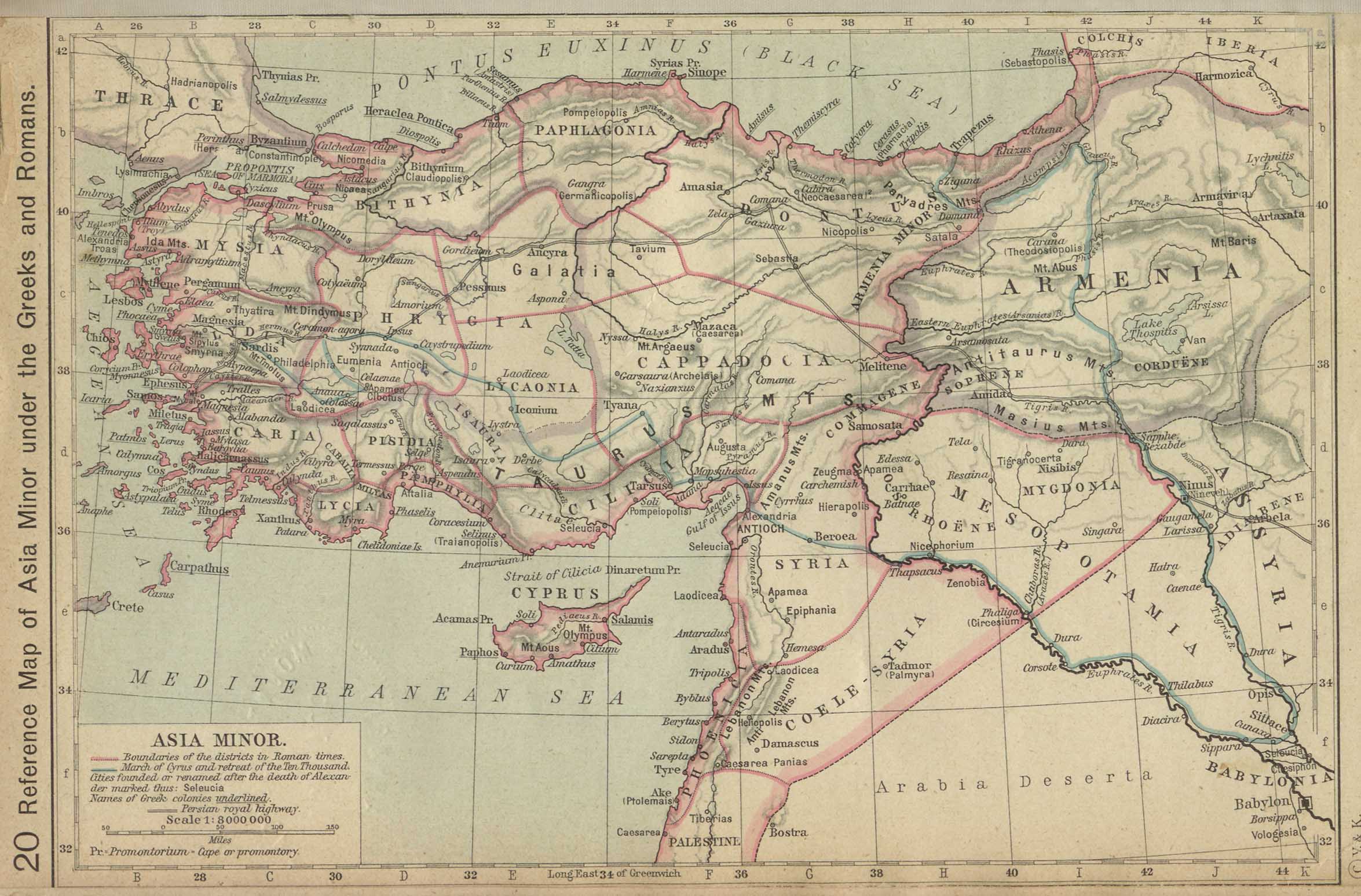
Reference Map of Asia Minor under the Greeks and Romans
Or this one, of Europe under Rome (I’m finally reading Gibbon’s Decline and Fall of the Roman Empire):

Reference Map of the European Provinces of the Roman Empire
Click to make ’em see-able & zoom-able.
These are gorgeous, and a bit of a mess, but isn’t that exactly what an historical atlas should be?
Happily, the Strand had an 8th edition (1956, with maps added to Shepherd’s final 1929 edition), so I won’t have to go online to see, say, The Growth of Russia in Europe, 1300-1796 or The Ottoman Empire, 1481-1683 or or the Growth of Frankish Power 481-814 or or or. . . .
(Of course, the zoom feature is pretty handy: lifting my glasses and sticking my nose an inch or two from the page isn’t always enough.)
Oh, I am going toss away so many hours leafing through and peering at these maps, and to no discernible productive end whatsoever.
Ain’t knowledge grand?
Comments : 2 Comments »
Tags: Europe, Historical Atlas, history, knowledge, maps, Perry-Castañeda Library Map Collection, William Shepherd
Categories : Uncategorized
Talking ’bout what everybody’s talkin ’bout
27 01 2015There’s an awful lot of shit about which I have opinions (informed and otherwise) that I think about writing about but end up not writing about because I am lazy and I’d rather not write uninformed thoughts which others who are informed have said better but mostly, mostly, because blogging is not my job.
It’s too bad, in some ways, because I’d really like (but not enough to do much about: lazy) to write for a rent check or two, but in other ways, saves me—mainly, from having to have an opinion about what everyone else is opining about. I get to say ehhhhh. . . in response to GamerGate or the NYPD or what that one guy said that time about a thing.
Again, I have opinions oozin’ out me pores, but most I get to save for an enjoyable session of barstool bullshitting rather than having to labor to turn them into something coherent enough for a blog.
No, that may not be a high standard, but it’s one I try (most days) to reach.
Anyway, all of this is a prelude to/apology for commenting on the the Jonathan Chait anti-p.c. piece. It’s not very good, but it is long, so. . . there’s that. Jia Tolentino, Amanda Marcotte, Angus Johnston, and Lee Papa all have good responses, so in the spirit of laziness non-repetition, I, uh, won’t repeat their arguments.
But, in the spirit of value-added, I will, uh, add this: JESUSHCHRISTTHISISSOOLD STOP STOP STOP!
Not enough value? How about: this whole p.c. thing has been around for so long—not the twenty years Chait complains about, but at least thirty—and that’s just using the term “politically correct”: as Erik Loomis pointed out on another LG&M thread, “such circular firing squads have existed for the entire history of the left.”
And yeah, the p.c. of my experience was indeed a lefty phenom—a term used by some leftists (who needed to work or sleep or go to class and thus couldn’t turn out for every fucking rally) to mock those who’d condescend to those who needed to work or sleep or go to class and thus couldn’t turn out for every fucking rally as insufficiently committed to The Cause (it doesn’t matter which one), and who (the condescenders, not the rent-payers) didn’t shower, to boot, and. . . where was I?
(Can you tell this is a post written under the influence of Wonkette?)
Oh, yes: it was a term of mockery of the left-pure by the impure-left.
Guess which side I was on?
At some point, apparently, “p.c.” became a sincere rather than a snarky tag on the left, which was unfortunate, as it allowed those on the right to pick up those snarky remains, rearrange them, and turn what had been a dart into an axe. Good for them, I guess.
In any case, I don’t want to criticize the sincerity of those who worry about microagressions or trigger warnings or whatnot, but, like Papa, I don’t have much use for those worries, either. I also don’t see the problem with having some folks worry about microagressions and trigger warnings and whatnot, because sometimes the folks who worry about things which are often dismissed are right to say, “hey, wait a minute!”
And, yes, sometimes they’re wrong, and when they’re wrong, one has the option of ignoring them or refuting them or mocking them—just as the worriers have the option of ignoring or refuting or mocking the dismissers.
This is what the bloggers, above, note—so, yes, I guess I did repeat what they have to say. But I also want to extend this, to note two more things:
1. A lot of this is coming out of campuses and college-age students, which is unsurprising.
College is the time of boundary-setting and boundary-trespass in terms of ideas and identities, and often in quite extreme ways. This is the age and the setting in which someone can be utterly and completely given over to a cause (of whatever sort) and, importantly, find that cause in common with others.
You can be passionate and not alone, and for a fair number of students, this is the first time in their lives that they don’t have to choose between the two.
That’s an astonishing moment, a kind of coming-into-oneself during which one is finally free to see where and how far she can go. After a time, some of us go through this moment, some go too far into or beyond it, and some, having found themselves in that moment, decide to remain right there.
Most, I think, pass through in some way or another—grow up, sell out, burn out, whatever—so freaking out about twenty-year-olds freaking out about boundaries—their own and others’—is pretty much akin to Grandpa Simpson yelling at clouds.
2. To extend something which Tolentino, et. al. point toward: a lot of those bitching about the p.c. boundary patrol are often powerful in the ways that the patrollers themselves are not.
Chait worked for The New Republic and now works for New York Magazine. Hanna Rosin writes for The Atlantic and Slate, and Sullivan, well, is Sullivan. They get to be irked by others taking issue with their words—who isn’t?—but to say there’s a right way and a wrong way to criticize is its own form of boundary patrol, and one most often deployed by those with more power against those with less power.
This is something which staunch free speech advocates (and it’s always “staunch”, isn’t it? never “rigid” or “unbending”)—and, sure, I’ll count myself among them—too often overlook in their defense of words: that words matter.
Of course, they get that “words matter”—hence the defense of words—but words can have more or less juice to them, depending upon who’s speaking or writing them. Pointing out microagressions or tone policing might be annoying as all get out, but they’re also ways to poke holes in those juiced-up words, to drain them of a bit of their power.
Or, more to the point, to poke holes in those who supply the juice, to drain them of a bit of their power—over others.
Again, annoying (especially if you don’t recognize yourself as having power over others) but not illegitimate on its face. It is, in fact, a fight about the rules of the fight, which those who are used to setting the rules would rather not have—and certainly not with such ardent critics.
And, again, as a tits-forward kinda gal and a rigid free-speecher, I think there are all kinds of criticisms to be made of p.c. policing, and all kinds of arguments to be made in favor of loose words.
But you can’t just bitch about having to make those arguments—you gotta actually make ’em.
~~~
*h/t Scott Lemieux and TBogg
Comments : 2 Comments »
Tags: college, Jonathan Chait, leftism, political correctness, power, sincerity, snark, speech, students
Categories : Uncategorized
Take a chance
11 01 2015Have I mentioned I’m lazy? I think I’ve mentioned I’m lazy.
Not in every aspect of my life, but certainly in too many. One of the more benign, yet highly irritating, forms is my middle-aged-onset laziness with regard to t.v. and movies: I don’t want to watch something in which I don’t know what happens.
This goes beyond not minding spoiler alerts into not wanting to endure uncertainty. I know something’s going to happen, and it about kills me not knowing the what and the when and the how.
I think that’s why I like procedurals: there’s such an established pattern with the plot that any anxiety over what-next is smoothed into mere waiting by the predictability of the genre: in Criminal Minds, for example, there’s the initial crime, then a second crime, then either the nabbing of a third victim (during which clock-ticking the team discovers something from the past) or a failed attempt that gives the team crucial information to identify the guy. Then they find the victim.
Bones had (has) its own pattern, as did Numbers, but they all had/have a pattern. I might roll my eyes at the predictability, but you betcha I rely on it.
That bothers me. Not that I like procedurals—who am I hurting?—but that I’m unwilling to try something else that I might like, might miss a movie which could move me, all because I get so wrapped up in not knowing the what-next that I can’t sit still for the what-is. And even when I am willing to try a new show—Flashpoint, Bletchley Circle, Lie to Me—what are they?
Prcedurals.
Pitiful. I used to watch so many different types of movies, read so many different types of novels, and while I might still read fiction, it’s not as much as I’d like. I used to enjoy, if not not-knowing, then at least, the getting-to-know or the finding-out. Not knowing was a chance, not a threat.
A little predictability isn’t the worst thing, but so much, too much, makes me feel small. I don’t always need to be big, but I miss the chance.
Comments : 2 Comments »
Tags: anxiety, big, laziness, life, movies, police procedurals, predictability, small, televisioin, uncertainty
Categories : Uncategorized
I’m only human, of flesh and blood I’m made
15 10 2014I haven’t read the book, but do you really think that would stop me from commenting on it?
I have a PhD, y’know, which means I am more-than-well-qualified to talk about an argument on which I have not laid eyes. After all, who but PhDs would have come up with the whole I haven’t read it, but I’ve read of it gambit?
Anyway, Katha Pollitt has a new book out—Pro—in she argues that those of us in favor of abortion rights should stop apologizing about our support and “reclaim the lives and the rights of women and mothers.”
As you would expect from someone who has written on this issue ad nauseam, I can only respond Right on! Right the fuck on!
The other day I noted that stories are unlikely to work the same kind of magic in swaying people toward a pro-choice position that they did in gay marriage; perhaps the, or at least a, solution, then, is simply to drop the stories, assert the right, and not budge.
I like how Hanna Rosin handled this in her review of Pro:
I had an abortion. I was not in a libertine college-girl phase, although frankly it’s none of your business. [. . .]
I start the story this way because Katha Pollitt, author of Pro: Reclaiming Abortion Rights, would want it this way. In fact any woman who’s reading this piece and has had an abortion, or any man who has supported one, should go in the comments section and do the same thing, until there are so many accounts that the statement loses its shock value. Because frankly, in 2014, it should be no big deal that in a movie a young woman has an abortion and it’s no big deal. We shouldn’t need a book explaining why abortion rights are important. We should be over that by now.
Yes: simply state, Yeah, I had an abortion, what of it?
I haven’t, by the way, had an abortion (although frankly it’s none of your business. . . ) and likely never will: I’ve never been pregnant, and, given my age, never will be. But had I gotten knocked up, I almost-certainly would have been clinic-bound.
In any case, being nice, being sorry, being afraid to make the political case of the necessity of abortion for women’s liberation has gotten us bupkes—no, worse, has gotten us fewer clinics, longer waiting times, and, unfuckingbelievably, a pushback against contraception.
Contraception! The “responsible” choice (as opposed to the irresponsible abortion) has now been hectored into the status of “controversial” among corporate owners and politicians alike.
Well, fuck that.
Ta-Nahisi Coates has been arguing of late that attempts to be “responsible Negroes” have black people little more than jail time, beat-downs, and death. He’s not arguing against responsibility per se, but against the double-bind that black people must be responsible in ways over-and-above the ways any [white] human beings must be responsible and that, too often, such Negro-respectability offers no protection whatsoever.
Trying to be “respectable” or “responsible” on sex and birth control and abortion hasn’t done much to secure women’s rights, so maybe now it’s past time to try something new: the assertion—without apology, without permission—of our full humanity.
That’s no guarantee of success, of course, but it will make damn clear what the stakes are.
~~~
h/t Scott Lemieux, Lawyers, Guns & Money (click link for more reviews by people who actually read the book!)
Comments : 1 Comment »
Tags: abortion, Hanna Rosin, humanness, Katha Pollitt, liberation, Politics, responsible, Ta-Nehisi Coates, women
Categories : Uncategorized

 AbsurdBeats