Geraldine Doyle, model for this image, died Sunday. She was 86.

Rest in peace.
h/t New York Times
Okay, so that whole unable-to-post-grades-on-Webgrade problem?
My fault: I haven’t checked my official e-mail in, oh, awhile, and, apparently, 10 days ago a message was sent to my account informing me of the expeditious expiration of my password. Which I didn’t see, because, well, I haven’t checked my official e-mail in, oh, awhile.
So completely totally obviously my fault.
I hate that.
An honest-to-goddess snow storm—whoo hoo!
Last year, if you recall, New York shut itself down preemptively, announcing on Tuesday before a single damned flake fell that the entire world would be closed on Wednesday. Hmpf.
Well, there were a few reports on maybe Saturday or Sunday of a possible blizzard, but it didn’t seem like that big of a deal. Maybe because it was over the Christmas weekend, maybe because kids wouldn’t be in school anyway, maybe I just wasn’t paying attention, but there was little hysteria.
There was, however, snow, blowing, blowing snow.
Trickster was either fascinated or flipped out by the initial sputterings from the sky:
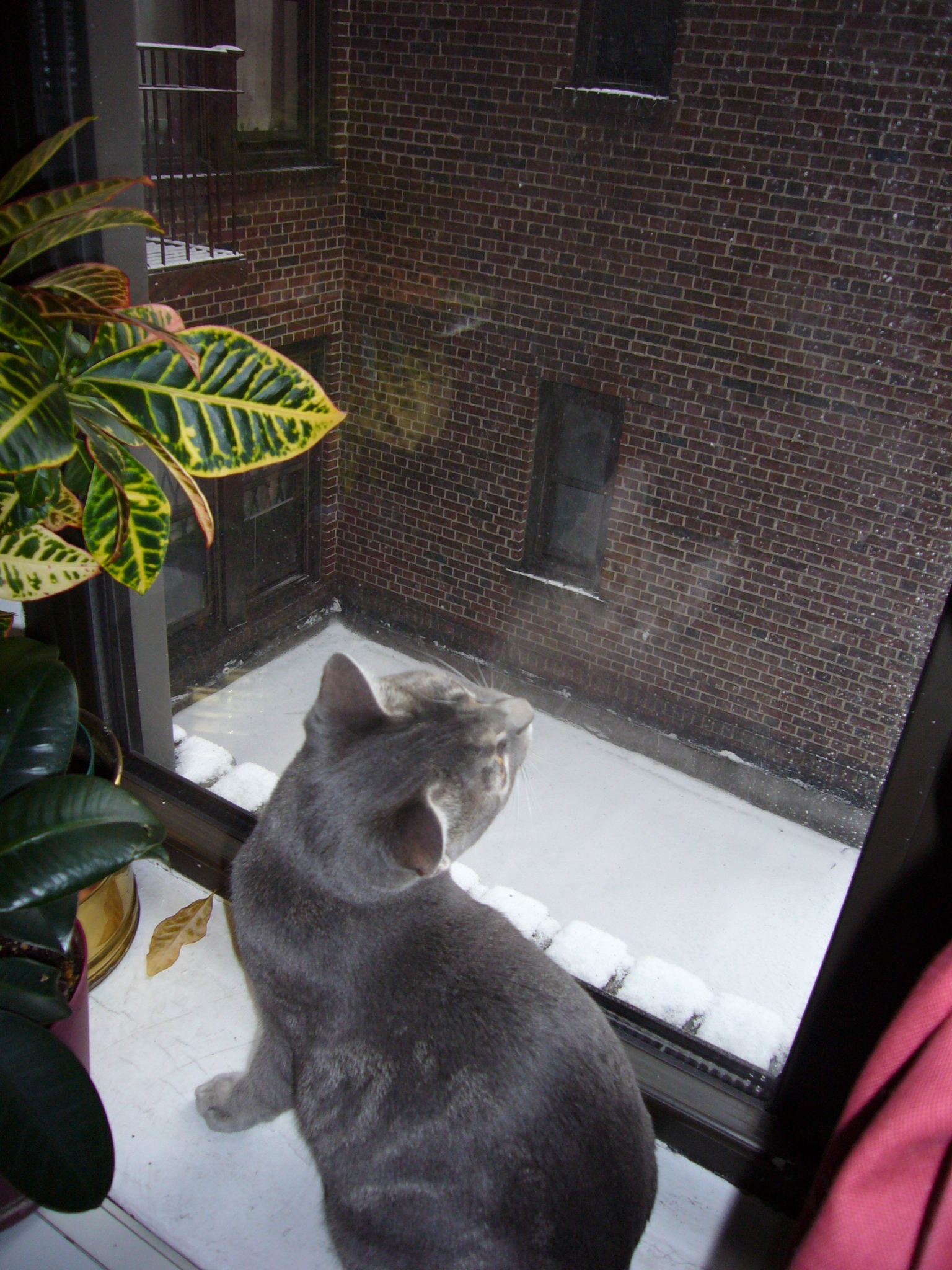
After awhile, however, she got bored, and did what she usually does: sleep.
Jasper yelped in response to the howling wind, and stretched out his body full-length trying to whap at the snow (by the time I got the camera out he was, of course, nowhere in sight). He did, however, helpfully interfere in my attempt to get a shot of the wind-sculpted drift in the corner:

Thanks, kitty-boy.
The wind was quite the artist, turning what would have been gently heaps of snow into mini-alpine ridges:

I generally try to get out after a big storm—not too many chances to wear my snow boots!—but a hangover from the flu made it unwise for me to attempt anything more physical than, mm, blogging.
(Oh, I did also try to enter my grades, due today, on Webgrade, but either something was wrong with my username and password or something was wrong with the system, and so I failed. The appropriate response, regardless? Fuck me.)
Anyway, I have heat and hot water and am not stuck in an airport or at Penn Station or on a train—apparently a couple of Queens lines, complete with passengers, were bollixed for hours—so despite the flu-crud, I was content to remain in my wee apartment and look at the big ol’ windy and wintry world through my windows.
It’s a trifecta—no, a hat trick!—of blog thefts, this time, from the NYTimes.
*A Harrah’s Casino coffee mug full of quarters given to me by my grandparents. The mug read, “Life begins at 21!” I was 9.
*One year my elderly great-aunt game me a box of straws and my sister received a tube of mustard. This remains a longstanding family joke nearly 60 years later.
*We received a can of haggis (yes, I guess haggis comes in a can) and a copy of the book “The Road.” It was quite the depressing Christmas.
*The worst as in destructive: My brothers sometime in the 1950s received an air gun and shot the ornaments off the revolving aluminum Christmas tree.
*When my sister was newly divorced for the second time and completely miserable, our mother gave her a cookbook called “Cooking for One” and some sort of individual crockpot to go with it.
*Dawn dish soap. I was 14. I guess somebody forgot to get me a gift, so they raided the cupboards. It was in a Happy Birthday bag.
*When I was 12, my mother gave me a wastebasket.
My Christmases tended to be pretty good, actually. There was always a little disappointment (where’s my pony?!), but my folks did what they could. One Christmas they bought my brother, sister, and I a combined gift: a t.v.!
We damned near hyperventilated as we unwrapped that gift.
And my mom’s side of the family has gotten into the habit of trading intentionally-crappy gifts with one another at their annual round-robin. Given this group’s wicked humor and delight in drink, well, it tends to be a very merry party.
So. Happy merry peaceful, to all and everyone.
. . . that the parents among you will not find this amusing:
I, however, snorted with laughter at the end.
Then again, I grew up with jarts, lay in the middle of the street popping tar bubbles, hung on to a car door and skied in my penny-loafers, and thought drinking eleven shots and countless beers and mixed drinks for my 18th birthday was a good idea.
h/t Kelly O at Slog
This is pure theft from TNC, but this man deserves every last bit of attention he can get:
Robert [Smalls] was sent to Charleston in 1851 to work for his master (now Henry McKee) where he held several jobs. He started out in a hotel, then became a lamplighter on the streets of Charleston. His love of the water, evidenced in his childhood at Beaufort, led him to work down on the docks and wharfs of Charleston in his teen years. He became a stevedore (a dockworker), a rigger, a sail maker, and eventually worked his way up to a wheelman (essentially a pilot, though blacks were not called pilots). He became very knowledgeable of the Charleston harbor.In the fall of 1861, Smalls steered the CSS Planter, an armed Confederate military transport. On May 12, 1862, the Planter’s three white officers were spending the night ashore. In the early morning hours of the 13th, Smalls and several other black crewmen decided to make a run for the Union vessels that formed the blockade, in accordance with a plan Smalls previously had discussed with them.Robert was dressed in the captain’s uniform and even had a hat similar to the white captain’s. The Planter backed out of what was then known as Southern Wharf around 3 a.m. The Planter stopped at a nearby wharf to pick up Smalls’ family and other crewmen’s relatives, who had been concealed there for some time. Now with his wife and children and a small group of other African Americans aboard, Smalls made his daring escape.
The Planter not only had the blacks on board but it also had four valuable artillery pieces aboard, besides its own two guns. Perhaps most valuable was the code book in Robert’s possession that would reveal the Confederate’s secret signals and placement of mines and torpedoes in and around Charleston harbor. Smalls piloted the ship past the five Confederate forts that guarded the harbor, including Fort Sumter.The renegade ship passed by Sumter approximately 4:30 a.m. He then headed straight for the Federal fleet, which was part of the Union blockade of Confederate ports, making sure to hoist a white flag. The first ship he encountered was USS Onward, which prepared to fire until a sailor noticed the white flag. When the Onward’s captain boarded the Planter, Smalls requested to raise the US flag immediately. Smalls turned the Planter over to the United States Navy, along with its onboard cargo of artillery and explosives intended for a Confederate fort.Because of his extensive knowledge of the shipyards and Confederate defenses, Smalls was able to provide valuable assistance to the Union Navy. He gave detailed information about the harbor’s defenses to Admiral Samuel Dupont, commander of the blockading fleet. Smalls became famous throughout the North. Numerous newspapers ran articles describing his actions. Congress passed a bill, signed by President Abraham Lincoln, rewarding Smalls and his crewmen with the prize money for the captured Planter.Smalls’ own share was $1,500 ($34,000 adjusted for inflation in 2007 dollars), a huge sum for the time. Robert personally met Abraham Lincoln in late May 1862 (two weeks later) upon which he heralded his personal account to the President. Lincoln was quite impressed with Smalls’ intelligence. His deeds became a major argument for allowing African Americans to serve in the Union Army. Smalls served under the Navy until March 1863, when he was transferred to the Army.In December 1863, Smalls became the first black captain of a vessel in the service of the United States. On December 1, 1863, the Planter had been caught in a crossfire between Union and Confederate forces. The ship’s commander, Captain Nickerson, decided to surrender. Smalls refused, fearing that the black crewmen would not be treated as prisoners of war and might even be shot. Smalls took command and piloted the ship out of range of the Confederate guns. For his bravery, Smalls was named to replace Nickerson as the Planter’s captain.[2] Robert returned with the Planter to Charleston harbor in April 1865 for the re-raising of the American flag upon Ft. Sumter.
Read the whole thing, and read the thread for even more on this great and good man.
Forget the Lost Cause: This is the history we should be celebrating.
Remember that nun in Arizona who was excommunicated for sanctioning life-saving surgery for a pregnant woman, surgery which resulted in the termination of her 11-week pregnancy?
Well, now the entire hospital has been disciplined, losing its official Catholic affiliation.
Bishop Thomas Olmsted called the 2009 procedure an abortion and said St. Joseph’s Hospital and Medical Center – recognized internationally for its neurology and neurosurgery practices – violated ethical and religious directives of the national Conference of Catholic Bishops.
“In the decision to abort, the equal dignity of mother and her baby were not both upheld,” Olmsted said at a news conference announcing the decision. “The mother had a disease that needed to be treated. But instead of treating the disease, St. Joseph’s medical staff and ethics committee decided that the healthy, 11-week-old baby should be directly killed.”
St. Joseph’s president Linda Hunt took the outrageous position that
“If we are presented with a situation in which a pregnancy threatens a woman’s life, our first priority is to save both patients. If that is not possible, we will always save the life we can save, and that is what we did in this case,” Hunt said. “Morally, ethically, and legally, we simply cannot stand by and let someone die whose life we might be able to save.”
It was precisely this attitude, as well as the unwillingness of administrators and doctors to promise never ever ever again attempt to save a pregnant woman’s life when that procedure might end the life of the fetus that led the diocese to strip its affiliation from St. Joseph’s.
Now that’s life.
h/t: Huffington Post
How may I be irritated? Let me count the ways:
*Irritation due to disagreement: This may be further divided into partisan (of any sort), preference-based, and personal disagreement, but it is just as likely that all three motivations may be at play (albeit at different levels of intensity). In any case, such irritation is usually merely irritating, i.e., uninteresting and unproductive—you say potayto, I say potahto—but can be dispelled if turned into a game.
*Irritation due to stupid arguments: The person making the argument either isn’t trying or doesn’t understand or is so riven with emotion that she is un-able/-willing to put together a coherent argument. Non-sequiturs, ad hominem attacks, and utter illogic abound in stupid arguments, which is what makes them simultaneously irritating and difficult to counter. Irritation may be expiated either by pounding the argument into oblivion or dissipated by walking away; while the former is more immediately satisfying, sometimes the latter is the only recourse.
*Irritation due to bad arguments: Similar to that caused by stupid arguments, this is a case in which there is at least a semblance of logic structuring the argument, but said structure is riddled with inconsistencies and bad evidence. The best antidote is continued conversation, which is possible if interlocutor is a reasonable person who is willing to repair his argument; at other times, one may have to find satisfaction in mending the argument yourself.
*Irritation due to bad-faith arguments: Again, similar to both stupid and bad arguments, but with the important proviso that the person knows her argument is shit and/or that she is fucking with the data, and doesn’t care. This is bad form in purely intellectual debates and deserves to be called out, but to be expected in political debates, where the point is to win. In the latter case especially it is important to keep one’s irritation in check (so as not to lose one’s head and thus the argument), but in the former case, one can channel the irritation into a kind of bemusement, and counter with one’s own ‘whimsical’ bad-faith argument (possible only if one hasn’t drunk too much).
*Irritation due to inconsistency/hypocrisy: Easy to spot in others, less easy to admit to in oneself, and damned well impossible to avoid if you spend any time at all thinking or doing. A fun charge with which to whack an opponent over the head, but rarely should too much be hung upon this, especially if it occurs on its own or as part of a stupid argument; point it out (or not), laugh if off, and let it go. On the other hand, if coupled with a bad or bad-faith argument, inconsistency and hypocrisy can heighten your overall irritation, and will likely have to be dealt with as one would deal with that caused by those bad[-faith] arguments.
*Irritation due to tone: The tone is usually either snide or condescending, or some variation thereof, and indicative of a sense of either inferiority or superiority. The best counter to this is absolute (even if feigned) sincerity in response, although the more likely response is either to adopt a similar tone or to escalate the snottiness. Such encounters rarely end well.
*Irritation due to crabbiness: This is self-generated, such that one is either looking for or finds trouble just because; can amplify other forms of irritation.
*Irritation due to material reality: Actually, just irritation due to physical discomfort, but this sounds so much more elevated, doesn’t it? Anyway, this may (but does not always) account for crabbiness, and can be countered by band-aids, medicinal cremes, relevant medications, a lie-down, sleep, ice, a heating pad, and/or food.
*Update: Oh, and I forgot: Irritation due to peeve. Similar to crabbiness, but more durable, this re-/occurs when confronted with whatever niggle happens to set you off, e.g., “irregardless”, stuck zippers, indestructible plastic packaging, bad parking, etc. Little can be done about this, beyond chanting “breathe” to oneself and trying to let it go.
~~~
All of this was prompted by my irritation with both Andrew Sullivan and Dave Weigel. Both of these men are conservatives (each in his own way), so I wondered if my irritation was due simply to disagreement, i.e., because they’re conservative and I’m not, or due to something more substantive.
I think it’s mainly down to disagreement. I may not like how the argument is shaped or think that the conclusion is foregone due to Sullivan’s or Weigel’s predispositions, but the arguments themselves may be legit. Yeah, sometimes I think the tone (Sullivan!) is off or the evidence (Weigel!) thin, but these guys (well, Sully more than Weigel) offer thoughts worth considering.
On the other hand, I’ve pretty much stopped reading Will Saletan because, while I may agree with at least some of what he writes, I think he’s often condescending, and too often musters incomplete or shitty evidence and deploys rhetorical tricks in place of reason. I couldn’t read him without getting irritated—so I stopped reading him.
I try not to stop reading people/arguments/magazines/web sites solely because I disagree—that seems weasely. I hold the views I do because they comport with my principles, but, epistemological nihilist that I am, I can claim neither that the principles themselves are grounded in absolute truth nor that they lead necessarily and ineluctably to my views. As such, if I truly do want to understand a phenomenon, then I have to approach it from all sides.
However irritating that may be.
No, not the actor, the head of the Family Research Council, re:
“Today is a tragic day for our armed forces. The American military exists for only one purpose – to fight and win wars. Yet it has now been hijacked and turned into a tool for imposing on the country a radical social agenda. This may advance the cause of reshaping social attitudes regarding human sexuality, but it will only do harm to the military’s ability to fulfill its mission.”
Go fuck yourself!
h/t: Joe.My.God
No no no no no no NO! No. No no no. NO!
In terms of public safety and national security, the sooner the world moves to a digital cashless economy, the better.
So says Professor Jonathan Lipow. To which I respond, well, you read my first line.
Consider the opening graf:
THE 500-euro note is sometimes called the “Bin Laden” — after all, Europeans may never see the 500 euro, but they know it is out there somewhere. Unfortunately, Al Qaeda’s leader and the 500-euro bill are connected in another way: high-denomination bills make it a lot easier for terrorists to operate.
Got it? A joke about a name actually reveals a deeper reality!
Although, exactly how high-denomination currencies make it easier for terrorists isn’t really explained so much as it is “analogized”:
Organized crime has always been a cash industry. In 1969, the Treasury stopped issuing $500, $1,000, $5,000 and $10,000 bills specifically to impede crime syndicates — the only entities that were still using such large bills after the introduction of electronic money transfers.
It is up to the reader to suss out the reason for big bills: My guess is that it’s a lot easier to store a load of cash if that load is a pallet-full rather than a room-full.
In any case, while it is clear that terrorists and other assorted bad guys [and presumably a few bad broads] prefer cash to credit because, as Lipow helpfully points out, one can collect and dispense cash without showing any ID whatsoever(!!!!) it is not at all clear that bin Laden and his henchmen [what a great word, by the way, henchmen: it even sounds sinister] are actually using those 500-euro notes.
But no matter: the point about the mob was just to reinforce that bad guys and dolls use cash, and that the government can make it harder for those bad guys (and dolls) to use lots and lots of cash.
(Did such actions lead to a lessening of organized crime? Well, no, since Lipow himself notes that drug traffickers pile up the cash, only now in $100 denominations. But that’s another column, right?)
(And for another aside: We should be grateful that after distribution about $19 billion in cash in Iraq and Afghanistan,
the military has gradually realized that the anonymity of cash makes it easy for terrorists and insurgents to smuggle in money and make purchases without a trace.
So the Treasure figured out in 1969 that cash was king among the kingpins, but it took the military 40 years to figure this out? Or is that, too, another column?)
Anyway. Lipow then tells us the solution to all these terroristic and trafficking woes is to move from actual to virtual cash, not just cell-phone based but, preferably, “smart cards with biometric security features.” He offers the charming example of the Universal Electronic Payments System:
In South Africa, the technology company Net1 now distributes social welfare grants to almost four million people. It’s simple: with a battery-operated, point-of-sale device akin to a credit-card terminal, money is transferred from one person’s card to another; during the process, the cards download and record each other’s transaction records.
Every few days, employees from the payments system head out to the villages and make their own money transfers, downloading the transaction histories of the cards they come into contact with, which contain the histories of the cards they interacted with, and so on. That data is then downloaded into the company’s mainframe, as a way of monitoring the flow of funds across the cards.
Best of all, the system can function offline and off the power grid, providing a secure means of payment under all conditions and without any geographic limitations. And the incremental cost of executing a transaction via this system is essentially zero. It is a promising model for the global economy.
It’ll be cheap, easy, and fun!
No, what’s important about this system is not any benefit provided to consumers, but that the crooks, absent the ability to accumulate funds off the books, would find their transactions open to audits:
In a cashless economy, insurgents’ and terrorists’ electronic payments would generate audit trails that could be screened by data mining software; every payment and transfer would yield a treasure trove of information about their agents, their locations and their intentions. This would pose similar challenges for criminals.
Because in a cashless economy, there’s no way—no way—these criminals could dodge a (gasp!) audit, amirite? And since electronic systems are by definition impenetrable, there’s also no way that these same criminals could smash their way through or tunnel their way under these virtual walls to hide, steal, or otherwise mess with these currency bytes, right? Right?
I’m snarking on Lipow, perhaps undeservedly—after all, I’m hardly a fan of either Al Qaeda or organized crime—but he hijacks the wheels (and grease) of the economy in service to the omnipresent national security state without a consideration for all of the other licit purposes of real-world currency, or any inconveniences (or worse) to people of that same world without cold, hard, cash.
Following Lipow’s example, I won’t bother actually to spell out all those inconveniences (Matthew Yglesias provides some possibilities in the link, above), but let’s consider some of those “or worse” scenarios.
The thread running through these possibilities? The loss of access, which can inhibit not just your purchases, but your purchase on the economy, your mobility, and your ability to engage in disfavored political activity.
Admittedly, the last three examples could be used against me just as I used the only-partial-effectiveness of Treasury Dept. actions to halt crime against Lipow, to wit: these things are already happening in the cash-ready world. Unlike, Lipow, however, I don’t argue that this means we should get rid of all e-money and rely solely on cash.
The virtual economy is useful, which is one of the reason that so many of us have moved happily into it, i.e., we were neither suckered nor coerced into doing so. Common currency was developed, as Adam Smith pointed out, as a convenience to both buyer and seller (as well as a way for sovereigns to accrue and maintain creditable wealth), and while some might have grumbled at the loss of commodity-barter, it is likely that most others liked the fungibility and—wait for it—accessibility of currency.
In other words, currency gave its holder options.
This mix of actual and virtual money seems to me to offer money-holders a reasonable array of options. Don’t like holding cash? Go with the debit or credit card. Prefer shopping online? Ditto. Like being able to fish a buck or two out of your pocket to buy a slice of pizza or to toss into a busker’s guitar lid? Cash. Don’t want a store (or another household member) to track your spending—or know it was you who bought something embarrassing? Ditto. Want the convenience of the card as well as the ability to buy and sell anonymously? Duh, both.
You can do variously nefarious things with cash, of course, as well as have variously nefarious things done to you, but so, too, with electronic monies. And I wouldn’t be surprised if it were more likely for you to be victimized electronically than, um, cash-ically—but I won’t push it.
So we make our choices—sometimes after much thought, sometimes with no thought at all—and do what we can.
I disdain the glib security-versus-liberty equations, not least because they are not necessarily opposites, and don’t necessarily have anything to do with one another; this particular “versus” implies a death-match which doesn’t necessarily exist.
“Necessarily” is the key term: Sometimes they are in relation to one another, and sometimes one does have to choose more risk in exchange for more freedom, and less freedom in exchange for less risk (although, even here, I question whether trading away one’s freedom will result in greater security—but I’ll leave that for another day).
Lipow, however, commits the opposite error: he doesn’t even consider that his quest for security could have any effect on liberty, large or small; in his eagerness to close off the options of criminals, he doesn’t much consider the effects on the options of the rest of us.
“Money’s destiny is to become digital,” he quotes an OECD report. But he and the report’s authors forget that money doesn’t have a destiny.
It has a use.
Which means we should, theoretically, have some say in how it is used.


 AbsurdBeats