The only—and I mean only—good thing about one-and-a-quarter inch cockroaches is that when you encounter a roach which is less than half an inch, your response is:
Pfft, whatever.
(And a quick kill, of course.)
The only—and I mean only—good thing about one-and-a-quarter inch cockroaches is that when you encounter a roach which is less than half an inch, your response is:
Pfft, whatever.
(And a quick kill, of course.)
Oh my god, is that who I think it is?
That stutter of chords, fanning out across the guitar strings, repeated, then a side-step into another flutter of chords. And now, that high reed of a voice. . . no.
A cover.
Strangely, I was disappointed. I didn’t particularly want to hear the song, but if Planet Fitness radio is going to play it, then play the real goddamned thing.
Faux Supertramp is unacceptable.
Not that I can listen to the real Supertramp, but at least with Roger and the boys, I know what I’m getting.
(I have no idea about the images, but this is the only actual Supertramp version I could find in my, uh, 3 minutes of searching YouTube.)
I sometimes listen to vids after I post them—I watched the Lena Horne interview a couple of times—but I won’t listen to this.
Takes me back. . . to where I don’t particularly care to go.
My older sister brought home Even in the Quietest Moments some time before I was in junior high, and by eighth grade I almost certainly listened to that album more than she did. ‘Give a Little Bit’ opened up side 1, and side 2 ended with the long mashup that is ‘Fool’s Overture’.
I loved it, beginning to end, unreservedly and unashamedly. When Breakfast in America and the double-live Paris came out I scooped those up, then went back and sussed out Crisis? What Crisis?, Crime of the Century, Indelibly Stamped, and their eponymous debut. (The latter two didn’t get much time on my turntable, and Stamped, which featured a naked woman’s tattooed torso embarrassed my teenaged self.) I stayed with them through Famous Last Words—Roger Hodgson’s last gig with the band, but didn’t let up until I was in college, and knew that Brother Where You Bound was the last Supertramp album I would ever buy.
Six years of intense devotion; it wasn’t a bad run.
I almost certainly still listened to them in college, but I don’t really remember that. And when I sold or gave away my albums prior to my 1993 desert sojourn, I knew that I would never own Supertramp in cd form.
I’m no longer embarrassed by women’s breasts (which, given my ownership of a pair, is probably a good thing), and even all these years later, when I don’t want to listen to one Supertramp song and two is out of the question, I can’t quite be embarrassed by my former ardor, either.
I was just about to write something snarky about the band, but, honestly, I can’t. You can, if you like—there is much eye-rolling to be done when it comes to Supertramp—but given how much I loved them, how they carried me out of my childhood and angsted right along with me in my teenaged years, it seems like bad faith for me to slag on them now.
I don’t love them now, but I did, once, and even if—or, perhaps, because—I no longer love any band (or any thing) the way I loved Supertramp, it seems a kind of betrayal both to my young self and to that love to repudiate them.
They weren’t the only band I listened to, of course, and when MTV hit SmallTown in the early 80s, a whole genre of music which the album-oriented rock of the Milwaukee stations never played suddenly chipped its way into my consciousness: the Police, the B-52’s (back when they still had the apostrophe), the Eurythmics, the Call, the Fall, the Clash, the Jam and on and on. I didn’t like them all, but to have the world open beyond Kansas or Boston—well, MTV in the early days performed a public service to us SmallTown kids who didn’t live close enough to catch the college radio stations.
By the summer after my sophomore year I was slam-dancing to the Violent Femmes at the Peaches stage at Summerfest, and when the LP played their 3 song ‘alternative’ rotation of the B-52’s (Rock Lobster), the Femmes (Gone Daddy Gone) and Surf Punks (Shark Attack), I was out whipping my skinny little body around that almost-empty dance floor.
A slightly-older co-worker at the local health club introduced me to Pat Metheny, and my theatre buddies to Manhattan Transfer, Frank Sinatra, and anything else that wasn’t, well, album-oriented rock played out of the Milwaukee stations.
So while I took Supertramp with me to college, I was already heading away from the songs which cocooned me and toward those that smacked me in the face, upside the head, and out into the headwinds.
I haven’t missed them in the fifteen or twenty years since I stopped listening, and I don’t think I ever will.
But they were a part of me, and they’re at the heart of one of the best things anyone has ever done for me:
Supertramp’s final tour with Roger Hodgson stopped at Alpine Valley, a mass-seating concert venue somewhere west of Milwaukee. I couldn’t afford one of the few hundred reserved spots, but I damned sure made sure that we got as close in as general seating allowed.
(General seating: the stage at Alpine Valley was situated near the bottom of a hill; the reserved seats were covered, and rising behind them, a vast slope of green. You’d get to Alpine Valley early in the day, set out your blanket and cooler in line if wanted to be first-ish in, or just in the gravel parking lot if you wanted to, I don’t know, hang out near your car. At some point they’d announce they would shortly open the gates, at which point you grabbed your shit and scrambled up into the crowd—which would, inevitably, start mooing—and pressed and pressed until they opened the spigot and you popped through the turnstiles and ran as fast as you dared down the hill to claim a spot.)
We did pretty good getting far down the hill at the Supertramp show, but as I was as short then as I am now, when the crowd stood up for the first song, I couldn’t see a damned thing.
That’s when the best-thing happened: JK, who didn’t come with us and wasn’t a part of my regular crowd, came over to me. Get on my shoulders, she said.
What?
I know you love Supertramp. Get on my shoulders.
JK was not a big girl, but she was strong, and she hoisted me up and bounced with me through that whole opening song.
What a magnificent thing to offer someone who’s not, really, even your friend.
I don’t remember what the opener was, and I haven’t seen JK since high school graduation, but as long as I can remember her I will.
So, you see, to turn my back on Supertramp is to turn my back on that passion and is to turn my back on this great, good deed that JK did for me.
She deserves better. And, what the hell, so do I.
In a discussion of death, a bit of editing; strikeouts old, italics new:
‘M&Ms?’
‘No thanks.’ Cate pulled out a chair. ‘I just don’t know what happens.’
‘Well, that’s the difficulty, corker, isn’t it? there’s the rub that’s the bitch of it, isn’t it?’ Veronica considered. ‘You don’t know until it happens. Don’t know if it’s better, or worse, or anything at all.’ She separated out the blue candies. ‘For what it’s worth, I don’t think people who kill themselves go to hell.’ Cate’s face was pointed toward her shoes. ‘I know the Catholics used to believe that, but now,’ Veronica let out a breath, ‘now even they offer a Mass for suicides.’
Cate’s spoke to her shoes. ‘For sure real?’
‘Yeah. For sure real.’ Veronica popped some chocolates into her mouth, then pushed the bag toward Cate. ‘I don’t think, hm, I don’t think any God worth believing in punishes people after death who’ve suffered so much in life.’ ‘I don’t see the point in a God who punishes people who’ve already suffered more than enough.’ for suffering.’
‘Even people who deserve it?’
Veronica smacked her hand down on the table. ‘Deserve it? Deserve what, Cate? Suffering?’ Her tone was harsh voice rose. ‘Everybody suffers. Everybody, . And not because they did something bad so they have to pay for it.’ just for being alive.’ Veronica was out of her chair now. ‘Goddammit, I hate this kind of talk. this shit. Like there’s some kind of hidden meaning in suffering: ‘You’re good, you’re bad’.’ People do bad shit all the time and nothing happens, and other people are just living their lives, and BAM! they get hit with the worst shit imaginable.’ She didn’t notice that Cate had drawn drew her feet up onto her chair, and had wrapped herself into a cube. her arms around her shins. ‘No, suffering is just there, because we’re just here, and it’s got nothing to do with how good or bad we are. Goddammit! If suffering were about who deserved it, all these goddamned dictators and killers and drug dealers and all the rest of them would be writhing on the ground in pain. Wri-thing. On. The. Ground. But they’re not, are they.’ Winning and losing ‘Good shit and bad shit happens, and that’s that.’ Veronica was stomping stomped around the kitchen.
‘No goddamned morality about that. And these goddamned These f Fucking televangelists, these goddamned hunters looking for trophies, treating us like prey. Goddamned predators! goddamned predators, just lookin’ to get their hooks into us. bottom feeders. No, goddammit, if there is a god, I don’t think she’d set these people up to represent her!’ Like they give a shit about any of us.’ She paused in her rant, and happened to glance at glared out the back door window, then turned to see Cate, cubed. She wiped her hand over her face, and sighed. ‘I’m sorry, Ah, shit, Cate, I’m sorry. I can get going, sometimes.’ She huffed out a breath. ‘Not helping.’
Not that this is the final version, but you see what happens.
The editing is surprisingly easy.
‘Surprisingly’ because I had avoided it for so long: Once I decided that if this was to be proper novel, and not just a novelty of the imagination, my inner surgeon emerged.
Again, this wasn’t at all an issue with the second novel. That one wasn’t a surprise, and so I treated it as I treated any serious bit of my writing: as something to be worked and reworked and ground down and down until until I could run my hand over the grain without it catching on a notch or splinter.
But this first one, mmm, this one was a gift, and I treated it as something that wasn’t quite mine.
Now it is, or at least, it’s becoming mine, something I claim as my own work. The affection remains, but it is no longer precious.
That’s as it should be.
Yes, this is a kill-your-darling situation.
I re-read (for the nth time) Unexpected People, and, well, nothing like a serious consideration that I’d put this out there for me to detach myself from the piece.
If it’s going to live, it can’t be my darling anymore.
I think the basic set-up is okay, but jeez louise the dialog is too much. So slice and dice and chop and sand and I think it could be okay.
It’s funny that only now can I see a way to edit this. When I made initial inquiries to agents back in 2007, I knew it was flawed but thought that an editor could help me figure out how to fix it; I hung back, I think, because of this, not engaging my customary editorial ruthlessness. But now, now that this will all be on me, I’ve snapped out of it, and I’ve begun sharpening my knives.
It won’t be a masterpiece, regardless, but it could be better.
And so it will be.
Once again, stay tuned.
Publish or perish?
What ought to be the fate of a first, flawed (fatally?) novel?
My second novel is pretty good, with no obvious structural flaws—although there are, of course, still flaws—and perhaps worth the effort to find an agent and, with luck, a publisher.
But the first, mm, the first is most definitely a first novel. Too much of this, not enough of that: the motivation for one if not two of the main characters remains murky, and however human the characters are (I am pretty good with character), they are a bit, tsssss, how do I put this, too wise?
Still, even with the over-knowingness, the characters are appealing, and I’d like to give them a chance. Hence the dilemma.
E-publishing removes almost all of the obstacles to publication, which is both a good and a bad thing. If an author thinks a novel is engaging enough, she can bypass all of the gatekeepers to print publication and go direct to the cybersphere. But gatekeepers are not always bad, and can keep an author from putting out something for which she feels affection, but which is also perhaps not ready for prime time.
Kill your darlings, said Faulkner, and I agree, wholeheartedly. I’ve struck beautiful sentences, etched out lyrical paragraphs, and consigned lovely metaphors to the trash bin, all because they didn’t advance the tale or the argument. The play’s the thing, said another well-known author (albeit in a different context), and it is because I ardently believe that the overall purpose matters more than any part that I am willing to kill my darlings.
But what if the entire play—or novel, in this case—is your darling?
I never, er, well, not since I was a kid, did I expect to write a novel, and then whooosh, this one (tentatively named Unexpected People) poured out of me. I wrote it in three months, after getting home from the late shift at work, and it came out clean. There was editing and trimming, of course, but I wrote and I wrote and then as I neared the end I wondered how it would end and then it did.
I wrote, and then I was done. What an amazing feeling!
The second novel was more complicated, which in turn required more discipline, more editing, more time; it is, on the whole, a more involved novel. But it also wouldn’t have happened without that first one, with what I learned in the writing of the first one, with what I learned I could do.
So do I chalk up Unexpected People as a kind of exercise, the practice before the performance?
That seems wrong, not least because it wasn’t an exercise, but a thing in itself: the stories, the characters, matter in themselves.
There is another way to deal with this, of course: try to fix those flaws. When I’d considered this previously, I thought, Oh, no, any surgery would kill the patient. But now I’m not so sure: I just sent a copy to C. (she’s helping me with a possible cover for a Smashwords version) and, just for kicks, decided to re-read it. The problems are evident—so much so I’m worried about what C. will say—but I still like the people in the story, still want to find out (even though I already know) what happens.
(Yes, I’m more hesitant to have a friend read this than strangers. That’s how it is.)
So I’ll finish reading it, then consider ways to shrink the flaws, perhaps by cutting back on the knowingness (i.e., the talkiness) of the characters, and hear what C. has to say.
I both do and do not want to publish this on Smashwords. There’s the whole matter of trying to get readers for it and marketing and shit would I have to Tweet and. . . tchaaaaarrgh maybe open a fucking. . . Facebook! account and all of the other issues of self-publishing.
But those are all technicalities, and secondary to the main question: Do I kill this darling, or let it find its way?
Stay tuned.
Sucks.
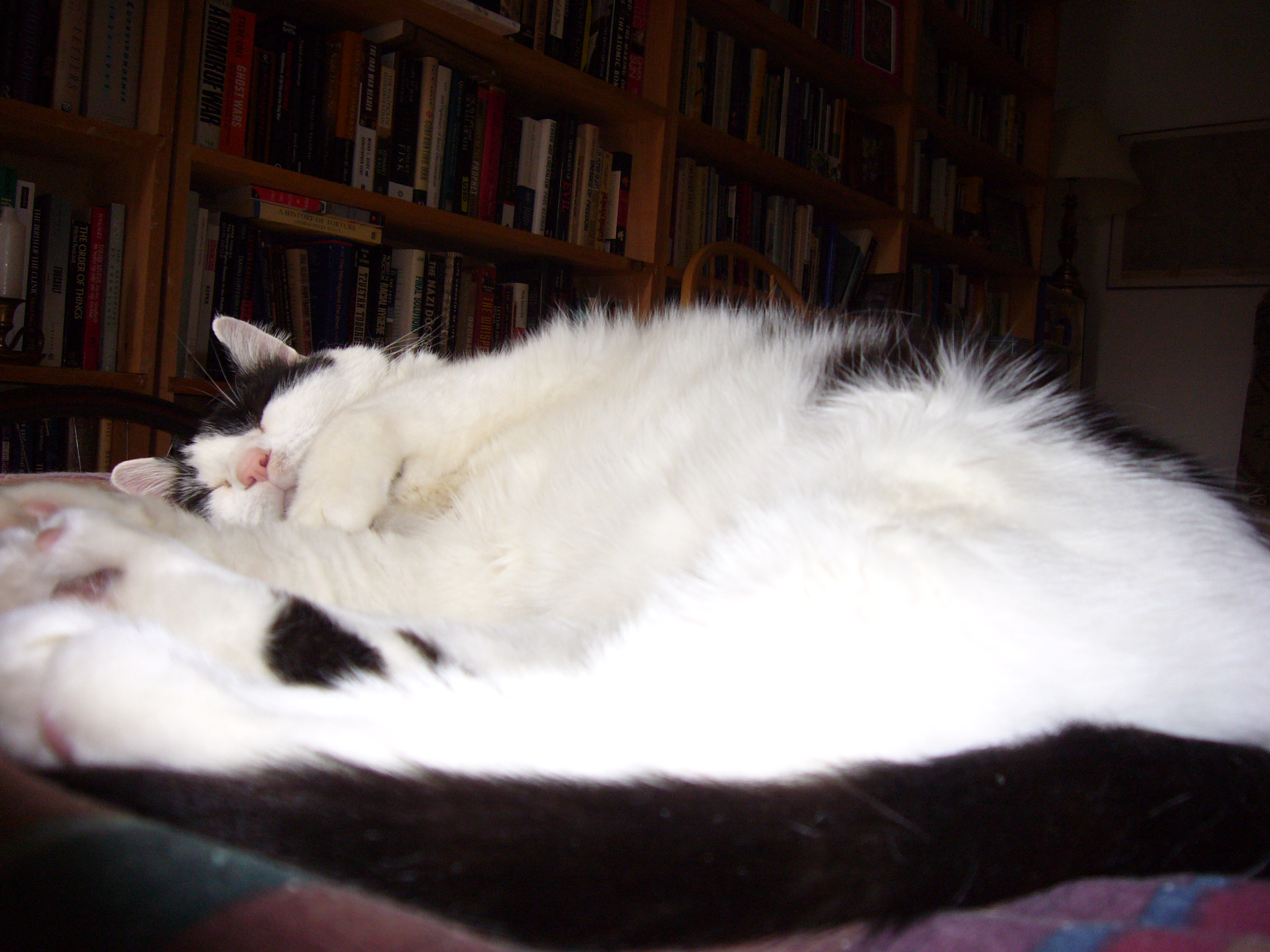
It’s almost time.
She’s been fading, fading, for months; I wasn’t sure she’d make it this long. But we are nearing the end.
I see her hunched-up walk and my breath catches in my throat. I scoop her up and hold her against my chest and tuck my chin into her fur and whisper No, not yet! I’m not ready.
And I set her back down and she walks fine and it’s clear that she’s not ready yet, either.
But it’s coming, and when she’s ready I’ll have to be, too.
Even if I’m not.
My beautiful Bean. . . !
I thought I’d be more sore.
Yeah, a bit of tightness across the shoulders, down my triceps, and I can now feel muscles just above my ass that I forgot I had, but, overall, I’m unexpectedly able to move.
The first day at the gym was a success.
It’s silly, that I need a gym, but I do. Having Prospect Park a less-than-10-minute run/from my house was not enough. Clear weather, open-enough sidewalks, not enough. Unhappiness with my body, not enough.
Remember when I said that I’d start walking 4 or 5 days a week as a way to ease myself into a running schedule? Yeah, didn’t work.
I do walk a fair amount, but not enough to counteract the tremendous amount of sitting I do. And while my diet is pretty good, I like cheese—I really like cheese—and I’d rather think about what I eat in terms of taste and balance rather than calories—what I want instead of what I avoid.
I’m not fat, probably not, by most accounts, terribly out of shape. We Americans are apparently packin’ on the pounds in record numbers, and all to the detriment of our hearts and knees and insulin levels, so perhaps I should feel comparatively good.
But that’s not how it works. While I do agree that health and fitness matter, I hate the moralizing that accompanies so many conversations on diet and well-being, as if to be fat is to be bad. I think to be fat is to be fat, and that’s all. There are unhappy consequences to carrying around extra weight, but those consequences accrue to the person carrying such weight, not me, so it’s not for me to pile moral pounds on top of the rest.
After all, I have plenty of my own excess baggage to lug around; it’s just not as obvious as fat.
I’m not without judgment, of course, but I have learned to ask what the point of it is before I let my criticisms loose. And there is no point to thinking that body size is in any way related to moral worth.
That’s how I try to view others, at least; for myself, well, I can come up with plenty of reasons for judgment.
I don’t want to be skinny, I don’t want to look like a 14-year-old boy, but I also don’t want to look—or more accurately, to feel—how I do now. I have a sense of myself as someone who is fit and able to take care of herself, and right now, I don’t feel fit and can’t count on my body to do what I want it to do. I like to be active, and to think of myself as active, and since I’m not the former I’m can’t do the latter.
And that makes me unhappy.
Perhaps I should ease up, be more accepting of this fortimpth body and the limits those fortimpth years impose. There is wisdom in the notion of letting things be.
But there is also wisdom in recognizing unconditional self-acceptance is not one of my strong points. I should perhaps be less harsh in how I view my body, and worry less about what others, especially possible intimate-others, might think about my body.
Yet telling myself to ease up on myself rarely works. No, I’m the kind of person who has to do, first, and only then can I say, This is enough.
And so, the gym. I won’t have to haunt the place 7 days a week, or freak out if I miss a day or two; three or 4 days a week should suffice, allow me to get my bod into a shape which makes sense to me, allow me to say, This is enough.

 AbsurdBeats
(Almost) No comment
30 06 2010Pediatrician Maria New, in a 2001 presentation to the CARES Foundation, a ‘nonprofit organization committed to improving the lives of families and individuals affected by Congenital Adrenal Hyperplasia.’ Girls affected by CAH have been prenatally exposed to higher-than-normal levels of androgens, and can lead to ambiguous genitalia; there may—emphasize may—also be a link to bi- and homosexuality.
New has been experimenting—without any institutional review board approval or the usual experimental controls—on pregnant women, dosing them with the steroid dexamethasone. Notes Alice Dreger, Ellen Feder, and Anne Tamar-Mattis in a recent Hastings Center Bioethics Forum post quote another paper by New & her colleague Saroj Nimkarn:
Dreger et. al. note that ‘It seems more than a little ironic to have New, one of the first women pediatric endocrinologists and a member of the National Academy of Sciences, constructing women who go into “men’s” fields as “abnormal.”’
(h/ts: Andrew Sullivan, Dan Savage, the Bioethics Forum)
Comments : Leave a Comment »
Tags: bioethics, nature, normality, sexuality
Categories : No comment