This was not helpful

21 05 2009

From the New York Times Lede Blog:

May 21, 2009, 7:38 am

Updated: 7:38 am

Catholic Archbishop Explains Remarks on ‘Courage’ of Abusers

The new head of the Catholic Church in England and Wales, Archbishop Vincent Nichols — who said on Wednesday that it “takes courage” for members of the clergy in Ireland who abused children “to face these facts from their past, which instinctively and quite naturally they’d rather not look at” — tried to clarify his comments on Thursday.

Archbishop Nichols, who officially takes over the post of Archbishop of Westminster at a ceremony on Thursday, told British television on Wednesday, after the release of a 2,600-page report detailing the abuse of Irish children at Church-run state institutions:

It’s very distressing and very disturbing. And my heart goes out today, first of all to those people who will find that their stories are now told in public…. Secondly, I think of those in religious orders and some of the clergy in Dublin who have to face these facts from their past, which instinctively and quite naturally they’d rather not look at. That takes courage. And also we shouldn’t forget that this account today will also overshadow all of the good that they also did.

On Thursday, Archbishop Nichols told BBC Radio that his remarks were “perfectly sensible” and stressed that he also said that anyone guilty of abuse should be prosecuted. The BBC reported that Archbishop Nichols said, of members of the clergy who had committed abuse:

It is a tough road to take, to face up to our own weaknesses. That is certainly true of anyone who’s deceived themselves that all they’ve been doing is taking a bit of comfort from children.

The Irish Times reports that Archbishop Nichols was also asked if members of the clergy should be subject to prosection and that he replied: “Yes, absolutely. If the offenses are such that demand that.”

——

Oh, at least he wants them prosecuted. So what is doing to make sure that happens?


Won’t get fooled again

20 05 2009

I was going to post something light, whimsical, even.

Then I read the paper.

The report on abuse in Irish schools was released earlier today, and offers up yet more horrifying stories of beatings, rape, humiliation, and all-around violence. Unfortunately, the Christian Brothers successfully sued the Commission to Inquire into Child Abuse to keep the names of the violent criminals its members out of the report, so justice, so long in coming, will be delayed even more.

From the Executive Summary:

More than 90% of all witnesses who gave evidence to the Confidential Committee reported being physically abused while in schools or out-of-home care. Physical abuse was a component of the vast majority of abuse reported in all decades and institutions and witnesses described pervasive abuse as part of their daily lives. They frequently described casual, random physical abuse but many wished to report only the times when the frequency and severity were such that they were injured or in fear for their lives. In addition to being hit and beaten, witnesses described other forms of abuse such as being flogged, kicked and otherwise physically assaulted, scalded, burned and held under water. Witnesses reported being beaten in front of other staff, residents, patients and pupils as well as in private. Physical abuse was reported to have been perpetrated by religious and lay staff, older residents and others who were associated with the schools and institutions. There were many reports of injuries as a result of physical abuse, including broken bones, lacerations and bruising.

And, of course, these children were rarely believed, or blamed for the torment visited upon them by both clerical and lay authorities. Again, from the ES:

Contemporary complaints were made to the School authorities, the Gardaí, the Department of Education, Health Boards, priests of the parish and others by witnesses, their parents and relatives. Witnesses reported that at times protective action was taken following complaints being made. In other instances complaints were ignored, witnesses were punished, or pressure was brought to bear on the child and family to deny the complaint and/or to remain silent. Witnesses reported that their sense of shame, the power of the abuser, the culture of secrecy and isolation and the fear of physical punishment inhibited them in disclosing abuse.

I saw a clip on the BBC of a man who had survived his years in the schools. He looked to be in his fifties or sixties, but the anguish was fresh.

According to the BBC, ‘The leader of the Roman Catholic Church in England and Wales, the Most Reverend Vincent Nichols, said those who perpetrated violence and abuse should be held to account, “no matter how long ago it happened”.’

So tell the good Brothers to release the damned names themselves. Don’t abandon that anguished man again.

I’ve been reading a number of different reactions to the release of the Commission report, including, dishearteningly, those few who argue that the abuse ‘wasn’t that bad’. Many more commentators blame the Catholic Church, with the blame running from the hierarchy to celibacy to gay priests to the heresy of Jansenism.

I’m not particularly interested in defending the Church—goddess knows it has more than enough lawyers to defend itself. But I don’t think the problem is with Catholicism per se, not least when inquiries into abuses in Australia and Canada revealed similar problems in Anglican-run institutions.

It’s not even a problem with Christianity or religion. There was recently an article in the St. Petersburg Times about the abuse, even death, of inmates at the Florida School for Boys. (Go here for the multi-media report.) The state knew there were problems, knew for decades there were problems, but little was done.

No one was charged for the torture and death of these boys.

Should I mention Guantanamo? Abu Ghraib? The prison outside of Bagram Air Force Base in Afghanistan? Hell, what about prisons within the US?

The dynamics of abuse in these various places is not all the same, but they do share one very important element in common: Unchecked authority.

Both parts of that phrase are important: Many of those [edit to add: who] abused were authority figures themselves, or granted authority to so abuse by those in positions superior to them. And those who didn’t condone the abuse itself nonetheless shielded these men (and in the case of the Irish Sisters of Mercy, women) from the civil and criminal consequences of their actions.

Oh, sure, Lindy England and Charles Grainor and Fathers Geoghan and Shanley were tried and sent to prison, but the problems of unchecked authority go far beyond these few so-called bad apples.

No, the abuse in borne of the righteousness of such authority, be it clerical or civic righteousness. These kids were delinquents or whores or incorrigible; prisoners are the lowest of the low, animals, threats to society; terrorists are, well, terrorists. In all cases ‘harsh treatment’ is acceptable, encouraged, even. How else are they to learn? How else are they to know who’s in charge? How else are they to know what’s good for them?

And it is such righteousness which allows abuse to continue, unchecked. Those in charge are holding the line, keeping us safe, willing to do the dirty work we all want done but don’t want to know about. They are good men and women; heroes, even.

Well, fuck that. I’m not an anarchist—I believe in authority, properly exercised—but if those in authority cannot, in fact, exercise it properly, then why bother? If those in authority escape prosecution (almost everyone), retain their licenses to practice law (Gonzalez, Yoo), remain on the bench (Bybee), get booted upward to a position in the Vatican (Cardinal Law), or get a school named after them (Arthur G. Dozier, head of the Florida School for Boys during the worst of the abuses), why the fuck should any of us respect this so-called authority?

And walking away or getting past all this or not looking backward or playing the blame game? No. Open it up, open it all up, and let those who authorized this abuse justify themselves in public, before the public, and, perhaps, before a jury.

Otherwise we’re just stuck with Meet the new boss, same as the old boss—be that boss a priest, a cardinal, a superintendent, a CIA official, or a president.

Open it up, open it all up.


Why, the little lady can think!

18 05 2009

Enough with the constant bitching about male pronunciamentos on abortion. Not that they can’t have their say, but, really, enough with their privilege.

So can I bitch about a woman’s pronunciamentos on abortion. . . ?

Let me rephrase that: I take issue with Amy Welborn’s take on abortion, specifically, with her quick dismissal of the question of the status of the [pregnant] woman. In her commentary on President Obama’s speech at Notre Dame, she notes

And a subissue – if this is not even an issue for you, if you do not see the unborn as a group in need of legal protection, and if you resonate with Obama’s call for reduced numbers of abortion…why? If Obama goes too far with this, he will run up against what Hilary Clinton ran up against a couple of years ago when she attempted to allude to a moral dimension to abortion. Boy, she had to backtrack, and fast.  The fundamental issue, you see, is trusting women as moral agents.

Why yes, that is the fundamental issue: trusting women as moral agents. Are we able to make decisions about our lives, or not?

I noted in a previous post that I didn’t think that rights language was sufficient to address the moral difficulties and passions of abortion. I still don’t. As much as rights are necessary to procure legal protections, without a sufficient moral and political argument behind those rights the reason for those protections are obscured, and the protections themselves at risk of a hollowing out.

The moral argument may begin at its basic level: survival. If I am to exist as a full human being in this world, then I cannot allow anyone else literal control over my life—whether that anyone else is a member of Congress, a judge, a boyfriend, or the fetus itself.

This is not as simple as it sounds, not least because we do live interdependently, and, in so doing, cede some measure of control to others. Yet even in society we are allowed to defend ourselves—our lives—even at the cost of another’s life.

There is nothing easy or automatic about that allowance, that decision to, perhaps, kill, and some of us are unable or unwilling to choose our own lives over those who threaten us. It is a fraught circumstance, difficult to determine in advance how one would react. My life or yours? I can guess, but I can’t know what I would choose.

But is abortion self-defense? I think it is, albeit of a different sort than that against a ‘outside’ attacker. First, it is an assertion against authority who might seek to prevent me from defending myself—the assertion of a right. Second, it is a self-recognition of a woman’s own worth as a human being, as being morally capable of determining whether to continue or end a pregnancy. It is an assertion of her own life.

But what of the good question Welborn does ask: If I don’t think fetuses as a class are in need of protection, then why bother with reducing the number of abortions?

The immediate response is that, as in other cases of self-defense, it is a fraught circumstance.

To recognize this is to recognize that the fetus, especially as it develops, is itself developing into a being deserving of its own recognition. To end the pregnancy is to end its development, its potential. And while I tend to accord personhood rather late in the pregnancy, the accordance itself is rather ad hoc; I’m not at all certain about fetal status.

Which means that I support abortion even if it could be killing another person.

This is not a politically happy conclusion. But if I am to assert the primacy of a woman’s moral capacity to choose her life over another’s, then I also have to allow that she is, in fact, choosing her life over another’s. It is entirely possible that terminating a pregnancy means killing a person—and if I defend the right to terminate, then I ought at least recognize this possibility. To make a moral decision is not to shirk consequences.

Pro-life advocates often argue that the status of the fetus as a person trumps all other claims, a position which I, obviously, reject. But what of the subsidiary claim of the innocence of the fetus? The Catholic Church, for example, argues that however grievous sexual assault, aborting a pregnancy resulting from rape is nonetheless forbidden, insofar as the fetus is itself innocent of any crime.

True, the fetus may lack malevolent intent, or any intent, for that matter. Yet however innocent the fetus, it still threatens; it is not about intent, but the effect itself. That said, I can still recognize the fetus is simply doing what fetuses do, capturing resources from a woman’s body so that it may develop. Whether this is innocence or simply the fetal condition, there is nothing personal in the fetus’s slow takeover of its immediate environment.

The problem, of course, that its immediate environment is, in fact, a(nother) person’s body.

This, finally, is where one may locate the core of the response to Welborn: When a woman does not want to continue a pregnancy, she sees herself at odds with the fetus, views it as an intruder, even; she aborts it to save herself. She kills to save.

Thus, the fraught circumstance, the one I believe most of us would rather avoid. I would prefer to reduce the number of abortions because even the morally defensible position to abort allows for the possibility of killing a person, and I would prefer less rather than more killing.

This hardly comprises a comprehensive defense of abortion, reproductive rights, and sexual expression; indeed, there are any number of pro-life advocates who consider pregnancy a just punishment for sex. But the position of those who seek to defend the life of the fetus is a morally serious one in a way that misogynistic screeds against women’s sexual personality is not, and, as such, deserves a similarly serious response.

It is not a nice response, and, I imagine, it’s bluntness might offend even some on the pro-choice side. But it is necessary to admit to what one defends, however unpleasant that defense may be.

Nobody ever said moral agency was easy.


Ghost in the machine

17 05 2009

She’s been gone two weeks and I don’t feel her anywhere.

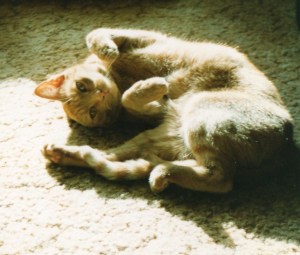
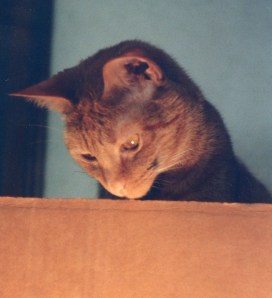
I choked up as this photo loaded on to the page, but it’s been been awhile since tears could be prompted by the thought of her.

She’s slipped right through and away from me.

Grief may be about the recognition of absence, as I mentioned previously, but what of the absence of the absence?

I can tell people I mercy-killed my cat and move on. I pull FatCat close to me and wonder how she is as an only cat. I think about getting a kitten in July or August.

I don’t think about Chelsea.

There’s a photo of her propped on top of her empty food dish (a small pot I threw and glazed in her tiger-striped coloring; FatCat has a similar black-and-white dish), but I rarely slide my eyes over the shelf on which the dish sits, so I don’t see her. Out of sight, out of mind?

It’s a relief not always to be verging on tears, but I’m discomfitted by my relatively smooth transition to post-Chelsea life. I was worried about the grief taking me over, but now I wonder about the easy sequestration of that grief.

I thought she’d be here. Yeah, I know, I’m an agnostic about all things supernatural, but I liked the idea of her, somehow, hanging around. Ms. Blithe comforted me with the words ‘Travel well, Skinny Cat,’ and I like the image of her continuing on, somehow.

Somehow. I was worried that my own disenchanted naturalism would dissipate into a cheap spiritualism, that I would be unable to deal forthrightly with Chelsea’s death and thus retreat into a moony ‘when-I-see-her-again’ wistfulness.

This is not a slam against belief. My friend and colleague J. is both ‘an orthodox Marxist and an orthodox Catholic’ (she pronounces this with her finger raised) says that ‘unlike those goddamned Protestants’ Catholics believe that animals have souls and I’ll see Chelsea in heaven. (Which is sweet, really, that she thinks I’ll make it to heaven.) I demurred and noted that some Protestants allow for this possibility, but, as with Ms. Blithe’s comment, I didn’t really take it in. It’s a nice idea that I don’t quite believe in.

I ought to be relieved: my agnosticism is not as blithe as I worried it might be! My beloved cat is gone and I don’t experience her as anything other than gone. She’s dead, as FatCat will one day be, as any other cats I take in will one day be, as my friends and family and I will someday be. Dead is dead.

Curiously, however, I am not eased by the fact that I am not eased by any post-death possibilities. I ought to be pleased with myself, insofar as I sometimes suspect that my agnosticism is little more than cover for lack of commitment. I am committed to doubt! I say, even as I think I am merely keeping all of my options open. Don’t want to be caught out a fool, doncha know.

So the unbelief side of my agnosticism holds. Whoopee.

Another stage of grief? Bargaining or whatever? ‘I want my cat back. I want her here, with me.’ And that she’s not, in any way, is a kind of small desolation which confirms the possibility of universal desolation. Is this the movement out of bargaining into acceptance? That death really does mean separation?

And then wrap this whole situation in the that whole over/underreaction dynamic I have going on, and it would make sense that I lurch from constant sorrow to a certain stoniness regarding her absence, and from there to a cosmic absence for everyone everywhere, forever.

I want to be clear-eyed. I want to remember. I want to keep open possibility. I want to commit. I want to make sense.

So Chelsea’s gone and I know that. I know that too well. I just want her here, as well.

I want something more.


No one is alone. . .

13 05 2009

. . . Oh yes, we are. Or is that ‘Oh yes, one is’?

Anyway.

Many of us to choose to live alone, and we cultivate our solitude even as we cultivate friends. Some of us would like to marry or attach ourselves to a intimate companion, but we’re not necessarily distraught over the lack of such a companion.

We’re alone, and we’re all right.

And yet, even if we’re—oh hell, lemme switch to the (duh) singular—even if I’m okay with my solitary existence, I’m okay because it is not only solitary. Among the main reasons I left Bummerville was the difficulty in finding friends—true friends, people with whom I’d share ideas and embarassments and beers and tears, not just folks with whom sharing went no further than ‘What’s new?’ There were a few people, here and there, but I lacked that gathering of intimates, the jumble of personalities who, collectively, form a kind of thick weave of comfort around oneself.

I can’t say I’ve fully cultivated those rich layers of friendships in New York City, but I have discovered some people who I hope to spend the rest of my life getting to know, and some of whom I already consider good friends. This is a tough old broad of a place, and as much affection as I might have for tough old broads, I also need trusted allies in dealing with her. Hence, the friends.

That works for regular life. What, however, of the ruptures of illness or trauma or disability of whatever sort? On her NYTimes blog, The Well, Tara Parker-Pope highlighted a report from the Human Rights Campaign Foundation on the difficulties same-sex couples may encounter in trying to care for their partners in hospitals. She notes that

While heterosexual couples typically don’t have to provide marriage licenses to hospitals in order to prove they are husband and wife, same sex couples often must document their relationship to hospital officials before being allowed to take part in a partner’s care.

In some cases partners and their children were barred from the bedside, and their beloved died alone. Even when they had documentation of their relationship, including legal papers in which they were designated as health proxies or given durable power of attorney, the partner often had to fight to be able to care for his or her companion.

I’m not going to go into the idiocy and brutality of exclusionary policies—commentors on the blog do that quite nicely—but instead will simply note that same-sex couples and single people are in many ways in the same unseaworthy boat: We’re screwed when we need help and institutions won’t recognize those whom we would like to help us.

Even when I was straighter than I currently am, I believed that single (straight) women should unhesitatingly support gay rights. Control over one’s body? Check. Control over one’s sexuality? Check. To live outside of normal sex roles? Check. To choose to have kids or not, and in what circumstances? Check. To live one’s life in a way that makes sense to her? Check.

Attacks on LGBT folk for their (our) allegedy degenerative effects on the rest of the healthy, wholesome, heterosexual social body can, without much imagination, morph into attacks on single folks themselves. Marriage is sacred, marriage is the foundation of society, heterosexual commitment is required for stable communities, sex outside of the bonds of matrimony is empty and selfish and dangerous, blah blah. There is One Right Way To Be, and to Not-Be that way is to be, well, ‘that way’.

Fine, so I’m ‘that way’ in more than one way. But this is how and who I am, and I’d like some security in my lonely and alienated unpredictable and gratifyingly cobbled-together life. And as much as I support same-sex marriage, I want to make sure that those of us who choose not marry don’t get left behind in that leaky boat.

Queer folk have (along with feminists) questioned the boundaries of matrimony and family and rightfully demanded reconsiderations of those boundaries to include a panoply of orientations and identities. This is good. But if the efforts to broaden the definition of marriage serve only to reinforce its privileges, well, that’s not so good.

So what do we single folk do? Do we follow the route taken by domestic partners and file paperwork designating friends as health care proxies? Do we give a list of approved visitors to any hospitals we use, so administrators don’t have to worry about violating HIPAA [privacy] regs?

If I’m in an accident or get sick, I want my friends to know. (Well, honestly, part of me wants to tough it out alone, the same part which is berating me for saying I want my friends to know. But hospitals suck and they suck even more when you’re in one alone. So Shut up, me.) I want them asking about my care and in my room and, if necessary, kicking someone’s ass on my behalf.

I want them to do what my family, a thousand miles away, couldn’t do. I want my people, here, to be with me.

Maybe this starts in conversations with friends. We talk to one another, find out what kind of support we have and don’t have, want and don’t want. Tell each other what we want from each other, what we’re willing and able to provide to one another.

I’m still assembling my life, and while it’s possible that at some point I could meet someone who could be a lifelong companion, I’m not waiting for him or her.

This is it. I am alone in this city—except for my friends. That’s a damned significant exception, and I’d like these folks to be able to act as my Significant Others.


That was the river/This is the sea

11 05 2009

Why bother with openness and honesty? Really, what’s the problem with a little subterfuge?

This, from a woman who blogs pseudonymously, who refers to FelineCity and Bummerville rather than the real places—and who’s trying to come to terms with life in general and her life in particular.

I intiated this blog with the notion of playing with ideas, of being able to turn things over in my hand without having to worry about referees and journals and publications. I took myself off the tenure track on purpose (another post, perhaps), but didn’t want to take myself out of the realm of political theory.

And it was to be about the ideas, not about me. But it’s become about me. I’ve set up another blog for my students, and some of my ideas about politics have migrated or will migrate to that site. It’s not that I’ve given up on politics and theory on this site, but my, ah, considerations of existence have become more prominent than expected, which means the considerations of my existence have also become more prominent.

This is not a problem. But there is the matter of my pseudonymity, and of the people in my life. I am protective of both my and their privacy, but the dynamics behind that protectiveness vary. While I don’t reveal my name, I’m more than willing to scrutinize my own actions—camouflage in service to revelation.

But I don’t want to hurt anyone else, and don’t particular want to reveal aspects of others’ lives that they may not want revealed. It’s one thing to relate a story in person to a friend; it’s quite another to send it out into the wild west of cyberspace, uncontrolled and uncontrollable. An empathic conversation in an intimate setting could simply devolve into bloggy fodder for someone else’s machine.

Yet what if your story is intertwined with someone else’s? Lori Gottlieb wrote an essay in this past week’s NYTimes about the complications of writing about one’s mother. If you write about your childhood, she notes, it’s inevitable that parents will make an appearance—and that they may not like it. She quotes Susan Cheever, who edited out a particular anecdote about her mother at her mother’s request: ‘Now I’d probably say, ‘It’s your life, but it’s my book.’ ‘

Does one’s book trump another’s life? Perhaps it would be more straightforward to say It’s your life, but it’s my life, too—and we don’t get to edit each other’s lives.

In Losing Mum and Pup, Christopher Buckley writes about his famous parents, Pat and William F., in ways both affectionate and morbid. Given what I had read on Crunchy Con, I had expected a scathing account of their parenting, but the revelations of their, ah, quirks as Mum and Pup seemed to conceal even more. Still, should Christo (as WFB referred to him) have written so expansively of his father’s drug habits, or his habit of unzipping and peeing out the car?

On the other hand, C. wrote a beautiful essay about one of her few memories of her mother, a beloved woman who died when C. was very young. There’s a context to this tale which is not explicitly mentioned (namely, the rest of C.’s life), but the story stands on its own, with a thin and sharp sorrow slicing through the poignancy of the tale. I’d heard it before, amidst a long conversation, but written on its own it’s taken on a resonance I didn’t hear amidst the crowd of spoken words.

I’m so glad she wrote it. It is a story which deserves its flight.

Still. I don’t write about my parents, with the exception of the posts on my dad’s stroke. We’ve had our difficulties, and I have made my own kind of peace with my folks—a peace which would not be served by debriding old wounds. They’ve healed enough; let them be.

Do I betray my writing in my silence? This is something memoirists often cop to: We’re writers, we betray, it’s what we do. I can’t speak to anyone’s sincerity in so copping, but it seems glib, a kind of cheap badge of courage: Look at all I’m willing to destroy in order to create!

I am not at all willing to destroy my parents. I’m not famous, they’re not famous, and the chances of them ever coming across anything I’ve written is very small, but I’m not willing to pick at them publicly. (Privately? Well, that’s what therapy was for. . . .) They’re decent people, and they don’t deserve that.

Would I write about them after they die? And would that be better or worse? After all, it is precisely because they’d be beyond my words that they’d be unable to respond to them. I don’t know what I’ll do, not least because I don’t know who I’ll be when they do die, and what I’ll need and want when they are gone. It is entirely possible, however, that I’ll never write much about them.

Is that protectiveness? Cowardice? Exhaustion? Yes.

But what of my own life? Why not reveal myself? Here, again, I refer to a post C. wrote, on self-stories which include ‘too much information’, in this case about an incident at a museum in Amsterdam. It’s funny. But it’s more than funny; it’s also a light she shines in her own face:

The reason I used my real name on that story is because I wanted to commit myself to being who I am, no matter what that means. Now I look back at myself 10 plus years ago with affection and exasperation. Can I really follow through? Can I really be that brave?

I don’t know that I can be that brave (even if no one is reading me). Oh, I could dismiss it all as ‘rash’, but I think C. is right on the need to commit oneself, no matter what.

This, after all, is the ancient understanding of courage: Not the exposure itself, but the willingness to stand fast, to hold to the courage of one’s convictions.

Eh, maybe I’ll half-ass it, no longer patrolling the perimeter for security breaches, allowing for the possibility that my identity will sneak across the border.

Not brave, not courageous, but a start.


And the sun would glint/On a time well spent/On a time that ain’t no more

10 05 2009

The tears no longer fall, but they do hover, expectant.

I’m trying to rush through my grief, away from the bewilderment of loss and the abashedness I feel at the grief itself.

It’s not that she was ‘just a cat’, nor do I try to compare her death to that of a human being. It doesn’t matter. The loss of a cat or a dog matters, on its own, just as the cat or the dog or whatever animal mattered, on its own, when he or she lived.

That’s what I tell myself, at least. But there’s still a part of me that says, Pssshh, don’t make too much of this. Don’t make this more than it is.

That’s what I do: I make too much of things, then tamp it all down, way down.

Perhaps this explains my reverence for balance: I have never learned, truly, how to balance, other than by going too far one way, then too far the other, then wondering just what the hell I’m supposed to do with the detritus of such a whipsaw.

Ignore it, forget it, walk away. Mention it to no one, until, perhaps, some point in the future when time has successfully exhausted the emotion.

A revision, perhaps: That’s what I used to do, what I still sometimes do. I’m trying to learn, at the fulcrum of my life, how to find a balance for the second half of my life which was absent in the first half.

So I am trying to come to terms with what it means to grieve a pet. It is both a small matter and a large one: Chelsea was a cat, and she was with me for almost all of my adult life.

And she let me know it: Chelsea was loud. She brayed at me when she was hungry, made pigeon sounds when startled, chattered away as I walked down hallways or got dressed, yipped when surveilling squirrels, hissed when FatCat batted her tail, yowled at thunder, groaned as she settled into my lap, and purred like a geiger counter gone nuclear.

(I had named her Chelsea because, while I was a big Janis Joplin fan, I didn’t want to be so gauche as to actually name her either Janis or Joplin. Instead, I name her for one of my favorite shots of Janis, decked out in her feathers in front of the Chelsea Hotel. Had I known she would end up sounding like her. . . .)

Part of the reason I got FatCat was due to Chelsea’s incessant noise: she was driving my then-roommate P. and me crazy with her constant talk. Of course, that backfired on me when she taught FatCat to talk, and I ended up with two cats yelling at me.

FatCat still talks, but she’s not the pundit Chelsea was—a kitty who comments on every move every member of the household makes.

So, this week, I miss the sound of her. If grieving is recognizing absence, then perhaps the resolution of such grief is in remembering the presence. Perhaps this is the only balance to be found in loss.

I am trying to let the balance come, but all that answers the summons are the tears.

But maybe balance cannot be summoned, that I can only let it come, that I can only recognize it when it does come. And even then, it might still come with tears.


You’ve got to. . .cry without weeping

4 05 2009

I hate crying.

I don’t do it very often, which means that when I do cry, I don’t do it well.

It doesn’t make me feel better, I don’t feel cleansed, released, relieved, or in any way unburdened.

When I’m crying, there’s always a part of me saying, Well, shit, I’m crying, and I hate crying.

I have cried more the past 6 days than I have the past 6 years, maybe the past 16 years. I cried on the bus, on the train, walking down the street, at my desk, on my bed, in the shower, at the stove, while washing dishes, making coffee, and retrieving milk from the refrigerator.

Have I mentioned how I feel about crying?

I don’t know what to do with tears, not least because I don’t know what to do with what causes tears. I’m no good with sadness.

Depression, despair, anxiety, numbness, unhappiness, disgruntlement, dissatisfaction—got all those down. But sadness? A specific reaction to a specific event which cannot in any way be fixed? Nope.

In many ways, I’ve been lucky. My parents and siblings and their kids are all alive and well, as are all close friends, past and present. Yes, I’ve had pets who were taken away or who’ve died, but it’s been a very long time since I’ve had to deal with something other than a self-inflicted loss.

I’ve certainly inflicted loss, on myself and others. I’ve left jobs and friends and cities, and am number one with the romantic-relationship-ending bullet. One former friend, who a couple of years ago decided to punish me for my alleged misbehavior (a misunderstanding) told me not to contact him, not even to try to clear up the misunderstanding, that he would contact me when he was good and ready. Fine. The letter he eventually sent still hasn’t been opened, the e-mail, unread.

Shut it down and walk away. Bloodless.

It’s not that I don’t recognize the downsides of being a cold bitch, and most of the time, I’m just a regular bitch. But I’m comfortable with the distances of bitchiness, even as I sometimes think that distance itself is not always the most comforting. This is what I’ve chosen. Consequences.

But now this, the mercy-killing of a cat who’s been with me almost all of my adult life. She leapt over my boundaries and into my lap even when I protested that I was reading or typing or just not in the mood. She didn’t care about my moods. She wanted to be scratched and held and at the center of my attention.

On cold nights she’d step over the blankets to sit on the sheet to the side of the pillow, and wait for me to lift the covers and let her in. And when I didn’t immediately do so, she’d paw at the covers, and if I still didn’t respond, she’d put her paw with her claws ever-so-slightly extended on my nose and remind me that if I knew what was good for me, I’d lift the fucking covers RIGHT NOW and let her in. Which I always did.

I’d bitch, but I’d always let her in.

And now she’s gone and I look at the box for the multi-cat litter and tear up, thinking, I only have one cat now. I open the fridge and look down at the floor, next to the heating pipe where she used to lay, and she’s not there. I lay in bed with Fat Cat on one side of me and the other side empty.

I used to wake up and pull both cats close and whisper ‘It’s good to wake up with two kitties next to me.’

No more.

So this is loss and it makes me sad and there’s nothing I can do about it except live with it.


The lion sleeps tonight

2 05 2009

Skinny Cat is gone.

1991-2009

1991-2009

She—Chelsea, a.k.a. Sweet Pea—was a good cat.

I will miss her; I already miss her.


While I was watching/you did a slow dissolve

30 04 2009

Skinny Cat is dying. Kidney disease.

She’s home, now. I had to bring her home.

She’s not in any pain, the vet said. She’s not suffering.

Still, he said

I know. This is not unexpected. But I was not prepared, not today.

I wanted her home, for a little while longer.

Just a little while longer.