Down-gazing

2 11 2008

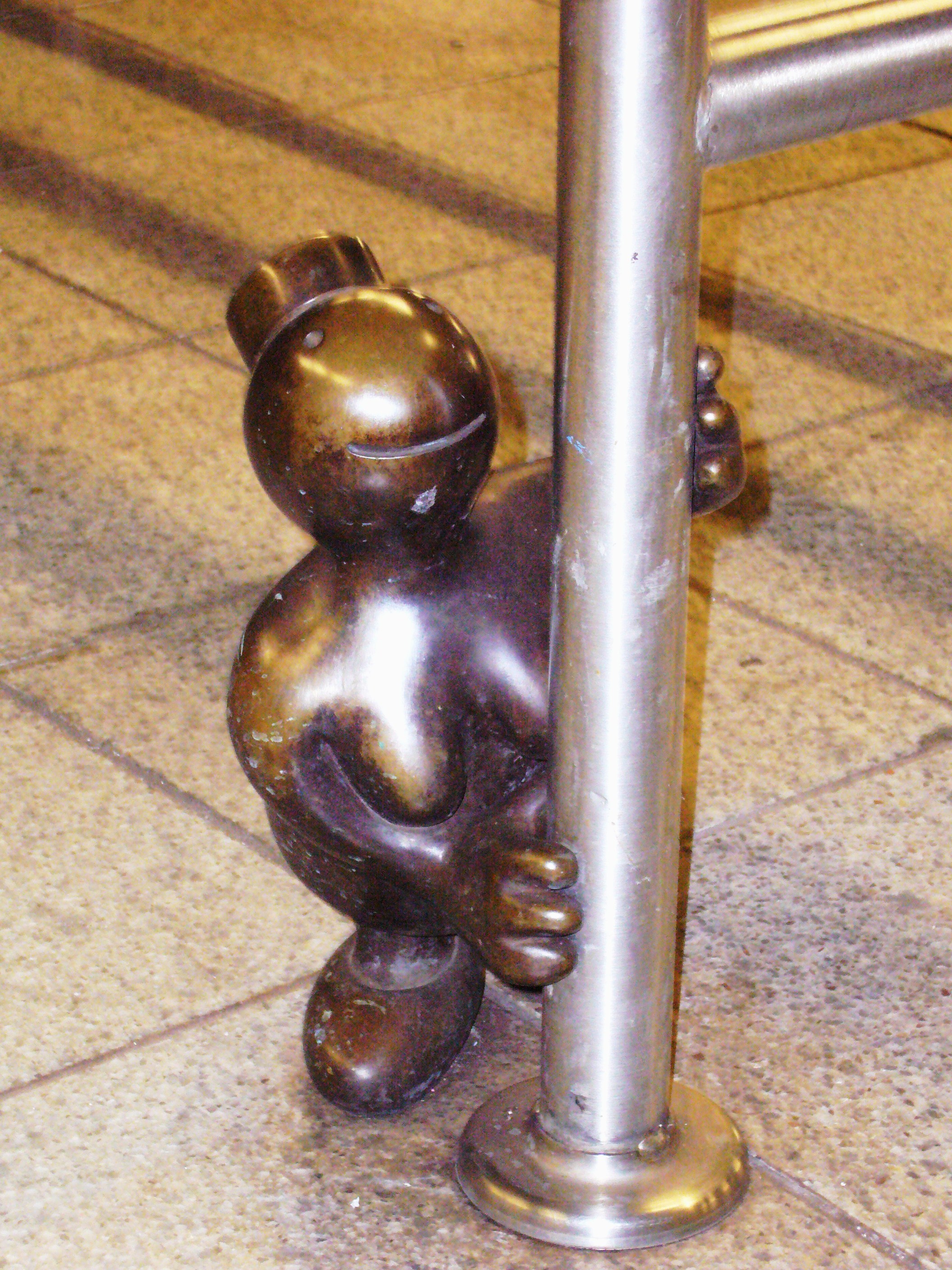
Little people live in the A train station, specifically, at the 14th St/8th Ave location. I only took photos of one figure, but I think I’d like to get them all.

They’re everywhere.

I like her smile.

I’m thinking of changing my avatar to one of these photos.

While my politics are pink(o), red isn’t really my color. Still, I like the whole hole-in-the-cube thing.

We’ll see.


Dead can dance

1 11 2008

Dead dead dead. Death with a scythe. Angel of death. The big sleep. The worm crawls in, the worm crawls out.

‘Tis the season of death!

I am not a spiritual person, but the time of Halloween/Samhain/All Hallow’s Eve/All Soul’s Day brings the contemplation of death into the public realm. Usually, we Americans deal with death privately—no Day of the Dead for us! No, to be an American is to be all about life. Forward! Forward! Into the future! Death rather interrupts that ride.

Death used to structure my life—well, no, it didn’t. It’s true that I was determinedly self-destructive for over twenty years, and was firm in my sense that I had to cut out my life from under me, but this sense was more about my distaste for life than it was any appreciation for death. I wanted an end, nothing more.

It was terrifically important that I not think beyond my end. I didn’t want to ‘taint’ my suicide, didn’t want it to be a gesture or a kind of weakness, thinking that somehow it would all be better after I died. Certainly, when you’re thirteen years old and trying to kill yourself, you tend to desire surcease, if only because a permanent separation from life is unimaginable. Let me die, I thought, and it will be better.

But as I aged, and more importantly, as I considered my self-destruction as a moral issue, I determined that any notion of ‘better’, any notion of ‘after’ would muddled my understanding of what I would do. I was to kill myself because that was the correct action, the only corrective to a badly disordered existence.

The argument behind this conclusion would take me too far away from where I want to go with this post; suffice it to say that the experience of failing to kill myself (and the reaction of those around me to such failures) sharpened my sense of the necessity of a morally clean (i.e., shorn of any emotional encumbrances such as a desire for comfort) exit. In any case, the issue was the break with life, not the entrance into death.

Now that I have walked away from the artifice of self-destruction, however, I need a new relationship with death. I don’t know what an ‘ordinary’ relationship would look like, not least because it is not a part of everyday conversation, but I’d like at least to begin to think about a life that will end in the same expected/unexpected way as those around me. I never, truly, had to think before about what it means to be a mortal being.

Thomas Lynch, in an essay in today’s NY Times, notes

We humans are bound to and identified with the earth, the dirt, the humus out of which our histories and architectures rise — our monuments and memorials, cairns and catacombs, our shelters and cityscapes. This “ground sense,” to borrow William Carlos Williams’s idiom, is at the core of our humanity.

To be human is to be mortal. there’s nothing particularly original in this observation; in fact, it is such a central part of our being that artists and writers—to say nothing of religion—regularly turn this upside down and inside out and stretch this notion in order to make some sense of this fundamental boundary. What does it mean to die? What would it mean if we were to live forever? While believers may be ecstatic at the thought of eternal life in the presence of a loving God, those who consider the notion of immortality on this earth tend to take a dimmer view of things.

In Jose Saramago’s latest book, Death with Interruptions, death takes a holiday. I haven’t yet read it, but from the reviews, it’s clear that, for the inhabitants of this novel, life without death lacks sense. Hannah Arendt, in The Human Condition, noted that natality is the founding condition of humanity; implicit is that for natality—birth—to have any meaning, the new life must eventually come to an end. For humanity to be renewed, humans must die.

While taking the larger view, Lynch also offers a more prosaic perspective:

[T]here remains something deeply human in the way we process mortality by processing mortals in the journey between life as we know it and life as we imagine it, in whatever space the dead inhabit. Wherever the dead go or don’t, it is the duty of the living to get them to the edge of that oblivion.

Since the first cave-dwelling Neanderthal awakened next to a dead kinsman and knew something would have to be done about it, we humans have looked into the tomb or grave or fire and asked ourselves the signature questions of our species: Is that all there is? Can it happen to me? What comes next? Only the dead know the answers. And the living are well and truly haunted by them.

Considering death, we are thrown back on to ourselves. How often do we take up such considerations, take up ourselves?

We prefer, as a people, to keep such hauntings limited to a day or two a year, paint it up in costumes or guide it down the hallway of a fright house. We can tame it, master it, keep it on a leash long enough to thrill us, but leashed, nonetheless. Then we scrub ourselves clean and begin our anticipations of Christmas. Lights! Presents! And, oh yes, new birth.

Enough with the cultural gloss. What does it mean not for a people, but for a person? Marjorie Williams, trying to see past her own death, felt keenly her prospective absence from her children’s lives. ‘Who will talk to my darling girl when she gets her period? Will my son sustain that sweet enthusiasm he seems to beam most often at me?’ As she witnesses, for the last time, her nine-year-old daughter’s preparations for Halloween, she dreams forward, writing that ‘I’d just seen Alice leave for her prom, or her first real date. I’d cheated time, flipping the calendar five or six years into the future. The character I’d played was the fifty-two-year-old mother I will probably never be.’ Her children will live, without her.

But in the meantime, she lived. For awhile she comforted herself with the fact that ‘I’ll never have to pay taxes, I thought, or go to the Department of Motor Vehicles.’ None of the irritations! But, as she recognized, in not having to deal ‘with all the error and loss and love and inadequacy’ of living, ‘I won’t have to be human.’

As her life lasted beyond its expected expiration date, she, too, moved beyond this sentiment. ‘The passage of time has brought me the unlikely ability to work, simultaneously, at facing my death and loving my life.’ It was often ‘lonely’ work, she noted, but it did not take her out of her life. Death, unwanted as it was, had to be taken into account if she was to have a human life, her life.

Jon Katz makes brings together the observations of both Lynch and Williams in writing about his hospice work. He writes repeatedly of people ‘on the edge of life’, knowing they are heading into death while trying to make sense of their lives. Hospice can offer them a way to a gentle reckoning, an easing through a process which is often un-easy. On their way to death, these people become alive to him, through the stories they tell him, the presence they bring to his life. To attend to someone in their final months or weeks or days is an honor, he says, and one which deepens his appreciation for their lives and his own.

And then there are the moments after death. Lynch, as an undertaker, has written quite a lot about this (go read his book, The Undertaking), but what stays with me is a story Anne Lamott told, about the death of a friend’s mother. I can’t find the exact story (so apologies for any misremembrance), but she writes how she and the friend cared for the mother in her home, how they touched her and held her and lay next to her while she lived, and then continued caring for her after she died. They washed her entire body and, although I’m sure my imagination has added this to the story, wrapped her in a clean shroud. It was a final act of love, for her and for them.

Perhaps this stays with me because I wonder who would wash and wrap me, after my death. Who will care for me? For whom will I care? I have a complicated relationship to my own solitariness, alternately protective of and resigned to it, and although I know (or think I know) that we enter death alone, I don’t know that I want to end my life alone.

Yes, Lynch had it right. To think about death is to think about life. Thrown back on to myself, I am uncertain of whether I can catch my self, by myself.




Is there anybody out there?

31 10 2008

No money. I don’t want this to be about money. If it’s about money then it’s about money, and not about life or philosophy or lifting yr. skinny fists like antennas to heaven. Readers, yes; money, no.

I am not opposed to making money; in fact, I’d like to make more of it. It’s handy to have, especially when you want something like your own apartment or Doc Martens or a plane ticket to somewhere else. But as useful as money is, that’s all that it is, and I don’t want to have to think about it beyond its utility. In other words, enough to live a stable lower-mid-middle class life is enough for me, and enough for me not to think about it.

So when Jtt. at Job2 asked if I were trying to make money off my blog, I might have (accidentally) spit on her in my emphatic denuciations of monetization. No no no no no no no! If I try to make money off of blogging, I told her, then that’s what I’ll be thinking about, worrying about. I’ll become a saleswoman, with just another product to hustle.

Okay, she said (backing her chair away from me a little), I get it. But what about your novels? Don’t you want to make money from those?

Yes.

‘Splain, please. I don’t write novels to make money, but once it’s written, once it’s done, I’d like to get it into the hands of readers. There are a couple of ways of doing that, including self-publishing, publishing it bit by bit online, or doing the whole agent-publishing house route. It’s the last option which is most likely to lead to a paycheck, as well as readers. I’d take readers without the paycheck, but if I could have both, then why not?

Still, how is monetizing (awful, awful word!) a novel different from monetizing a blog? Hm. I sense that it is, but haven’t bothered to shape that sense into thought. So, on the fly, here goes:

1. The novel is done; the blog is ongoing. When I’m novel-writing, I’m thinking only of the novel, of the characters, the plot, does this make sense, is that awkward, etc. I’m writing and editing and thinking about writing and editing, and that’s it. Once it’s done, then I might think, Oh, here’s who might like this. In other words, the pitch for the work is separate from the work itself. And, if I’d actually get off my ass and find an agent, then I wouldn’t have to worry much about the pitch at all—she would. Yes, I know that writers today are expected to help promote their own work, fine. But if/when I get published, I’ll simply be stuck into the maw of someone else’s machine and told what to do, i.e., I wouldn’t have to think much about it.

I know this sounds nuts, but it makes a kind of sense to me. The writing and the dancing-monkey functions are sufficiently separate that the latter won’t ruin the former.

Blogging, however, doesn’t have an conclusive end, and as such, couldn’t be temporally segregated from pitch. Sure, it’s possible that one could keep the two functions separate, but I don’t know that I could.

2. Novel writing requires a discipline that blogging does not. It’s work that I recognize as work, whereas blogging is, for me, an outlet rather than a discipline. Yes, I try to write at least every other day, and I (try to) take care in blogging, but, compared to the attentiveness I bring to story- or essay-writing, I’m pretty much just tossing out the words and hitting ‘publish’.

I like that I can do that. There are times when I wish I had spent more time on a thought before sending it into Cyberland, but given the kind of conversation I am trying to have with this blog’s readers (and occasional commenters), less rather than more editing seems appropriate. I am looser with words in conversation than I am in blogging, and looser in blogging than I am in writing. It’s an in-between space, and I’d like to linger here, to poke around and see what surfaces.

I don’t want to lose the linger. Were I to try to make money off of this, I fear my looseness would degrade into sloppiness, and I’d become so focussed on hits that I wouldn’t be able to see much else.

(This is already an issue for me. I want that conversation—I want readers—but I don’t want to write solely or primarily to increase my readership. I want it just to happen. And it probably won’t. You see the problem.)

3. I am full of shit. To wit: I have written for newspapers, written for money, and hold it against academic journals that they don’t pay contributors to those journals. Writing is work, goddammit, and if you want access to my work, you can pay for it. I cut out a clip from a Village Voice review awhile ago, of an author (whose name I stupidly did not include in the cutting) whose motto was ‘Fuck you, pay me’.  Yeah. Yeah!

The pinko, the writer, and the blogger in me exist in some tension, which leads to incoherent posts such as this one. Perhaps it’s a good thing that I am in no immediate danger of selling out to The Man.

Still, I think that this blather helps to clarify what might really be my problem with monetization: the pitch. I do not want to have to think about selling myself. At all. So if someone were to say Hey, blog or write for me, and I’ll take care of the pitching, I might go for it. Someone else can be the salesperson, and I can be the writer or blogger.

Not that simple, I know, not least because that someone else is going to want a product which s/he can sell. Hell, newspapers have long had to deal with the relationship between the editorial and advertising sides (does the advertising exist to support the content or does the content exist to carry the advertising), and the editorial side does not always win. And editors who shrug off advertising concerns may still assign stories based on presumed reader interest rather than the public interest.

So nothing’s pure. I know, and mostly like, that. But I’d still like to keep some parts of my life free, and allow my mind a chance to wander.


Bomp beep bomp bmml

30 10 2008

Tricked into creating a blog and coerced into NaNoWriMo. Curse you, C.! (No Facebook, tho’, no way no how.)

I have been much less successful tricking or coercing anyone else into creating a blog (J.: a movie blog—really!), but I have at least passed along the NaNoWriMo virus. I mentioned something to Jss. at Job3 and she just about leapt off the sidewalk in excitement. She writes (wants to write, starts writing, . . .), but hasn’t brought any long pieces to completion; NNWM is just the kick in the pants she’s lookin’ for.

Oh, Jss. also said that she’d blog if she had a horse. Why not pretend you have one, I said, and blog about that? You could call it ‘IfIHadAPony’ (after that dopey Lyle Lovett song), and go from there. I think she thought I was joking.

I’m not.

Or a bunch of us could put together a community blog called ‘IfIHadA’ and invite anyone to contribute their own ifs. Could be fun.

And you could run it, C. Serve you right.


Waiting for the great leap forward

29 10 2008

So I heard there’s going to be an election next week. Something about the presidency. . . ?

Yeah, I’ve been markedly blase this election season, and not just because ‘election season’ started shortly after the dinosaurs were killed off. I don’t like Bush, have little respect for the Democratic Party (tho’ much respect for individual Dems—go Russ Feingold!), and tend to think that the machinations in the nation’s Capitol are more likely to grind up citizens than ennoble them.

(Ennoble. I know, too much to ask for, but not too much to demand.)

Anyway, long before the major parties settled on their candidates, I knew I’d vote Dem. I’m not a Democrat—it’s a capitalist party, and I’m not a capitalist—but I often move to the right to vote for them. I don’t expect much (anymore), but thought Hey, if the Dem would close Guantanamo and stop torture, the vote would be worth it. That ought not be too much to ask for, and if I get more (sane HHS policies regarding women’s health and contraception, say, or an understanding that diplomacy is required in dealing with one’s adversaries, not friends), all the better.

So I registered with the nice woman in a Bed-Stuy park and asked for time off from Job1 to make sure I’d have time to get to the polls and listened to the conventions and speeches and urged my students to register and vote and listen to the conventions and speeches and listened to political coverage on WNYC  and read and read and read and. . . thought, Whatever.

It’s not that I’m blase about a McCain presidency. Given his apparent lack of interest in domestic policy, I feared that he would appoint ideologues to key positions in HHS, Education, and Justice as a bone to the rightists in his party (this was before the selection of Palin as his running mate). And while I agree with some conservatives that political questions ought to be dealt with politically and not juridically, I’m not looking forward to the judges a President McCain would appoint. Oh, and that whole Iraq thing. . . .

Still, as a pinko in the US, I’m used to the political despair of life under running capitalist dogs! in opposition. It’s not that hard, really. Try not to be OUTRAGED! every time someone says or does something with which you disagree—too exhausting. Don’t think that every person on the other side of you is fatally compromised as a human being—you will end up drinking alone. Oh, and have a drink every now and then, with friends to bitch, and with friends to spar. Yell, if you need to, then eat pie.

This is the one saving grace of the remoteness of federal politics from the ordinary lives of citizens: losing isn’t that much different from winning. Things may be slightly better or slightly worse, but you’ll get to bitch about it, regardless.

More to the point, you’ll get to bitch about it and forget it. That matters, more than any unhappy words (traitor! hater!) that some fool hurls at you. It used to. . . well, it still does irritate me when people foam that a Bush (or Obama) presidency means the end of life, liberty, and the pursuit of happiness. Whatever the flaws of the US, this ain’t Russia or Saudi Arabia or Myanmar: when you levee vos skinny fists comme antennae to heaven!, you will most likely be ignored, not imprisoned, disappeared, or murdered.

This is not to say that as long as we’re not being terrorized by our government all is well. Even as beaten-down a politics as exists in the US gives us some space in which to think and to act. Although I’ve moved from wide-eyed activist to squint-eyed theorist, I’m not willing to write off the possibility of something. . . good coming out of elections.

And thus my reconsideration of the coming election. I retain my squint, but I have to admit there is a humming within me at the prospect of an Obama presidency: Maybe we will get something more! Finally, an African-American president! Oh, the possibilities. . . !

It is a faint hum, but it’s there. Oh, the possibilities.


I fall to pieces

25 10 2008

All that there is to write, and all that I don’t write. Bits and pieces, effluvia from the day, surfacing only after the computer is turned off, or things worthy only of quick hits.

So, some of the jottings:

NaNoWriMo: It’s a week from National November Writing Month, and I’m starting to get a bit freaked. Fifty-thousand words! In a month! Jesus Christ!

There is no possible way that I can do this. I have one day off a week. And while I write fast. . . I have one day off a week.

Ah, fuck it. Try and fail. That’s life, ain’t it?

—-

Blogging extras: I see RSS and CSS and Twitter and Deli.cio.us (or whatever) and all this other crap and I go, Huh? Should I be doing something with these?

Nah. Or at least, not now. I don’t have to know everything before I start—do I?

—-

Crushes, cont.: I neglected to mention the anti-crushes, the horrifying obsessions with ideas and worldviews so on the other side of you. Pat Robertson. Jerry Falwell. The 700 Club. Trinity Broadcasting Network. Rod Parsley. John Hagee. All crack for the lefty brain: you know it’s bad for you, but you can’t. stop. watching.

And then, of course, there’s Ayn Rand, the Objectivist wonder drug, turning readers into zombies. Best not to engage them at all.

Like my crushes, I carry the obverse inside me, too, but not willingly. Nope, viruses lodged in my brain,  waiting, waiting, to be reactivated with just one           more            hit.

Brrrr. Scary.

—-

Settling in: Two and a-half years in New York and I’m still not settled. I would like to settle.

When I moved to Bummertown, I thought it would be my last city. Before that, I lived in Feline City, which I loved, but which was also located in another country. In fact, I moved to Bummertown because a number of people had said, Oh, you like Feline City? Well, then, you’ll love Bummertown!

No.

So when I heaved out of there to NYC, I did so with the idea that I would stay—but knowing it could all go bad.

It is not bad. I would like to stay. But for this to be real, for this to be my last(ish?) city, I gotta sink my feet into the concrete.

Hasn’t happened yet. Soon, please, soon.

—-

Procrastination: Sixty papers. Not long, not difficult to grade.

And yet I don’t grade.

Baaaaaad professor. Can I blame my status as an adjunct?

—-

God and alienation: Still working my way through the Bedlam Farm archives, and reading about Jon’s conversations with the Hound of Heaven (Pastor Steve from a local church).

Jon often quotes from Thomas Merton, and he writes often about his struggles with his own spirituality and doubts. This past winter he started blogging about his regular conversations with Pastor Steve, and his uncertain steps toward God.

I, too, for awhile engaged with a local priest (variant: Episcopal) about God and doubt, but after awhile felt like I was simply wasting her and my time. I am not uninterested in God—duh—but I don’t feel any great need to move out of my doubt. I wonder why other people believe, and what God and their relationship to God means to them, but I’m fine with my role as observer rather than participant.

And I admit to some bewilderment at the notion that one can get closer to others by getting closer to God. How does that work? Isn’t that simply a kind of alienation? Running away from the world rather than opening oneself to it?

Not that simple, I know, and it’s entirely possible that opening oneself to God helps one to open herself to the world (cf. Caputo and Vattimo and the concept of weak theology).

Still, as someone who struggles with openness, I see God more as an escape than an entry.

—–

S&P.A, who I knew in Bummertown, have just had a baby. S. was in labor for 25 hours (!), but in the photo of her and her son O., she looks terrific. Really beautiful.

And my roommate’s sister also just had a son. Cute, she said. Round head, round face, and loooong fingers. (Roommate and I are getting along better, these days. All for the good.)

Welcome to the world, boys. We’ll try to keep to keep the lights on for you.


The fire thief

25 10 2008

I have a crush on a dead woman. It’s not the first time I’ve crushed out on the dead.

I just finished reading Marjorie Williams’s The Woman at the Washington Zoo (and just started reading her new book, Reputation). Worth a gander.

There is a pang in reading her, however, given that she died a few years ago from liver cancer. In fact, I first became interested in her work after reading an obit in Slate about her, written by her (and her husband, Timothy Noah’s) colleague, Jack Shafer. It was a lovely tribute to her, as both a writer and a friend. I was reminded of that latent interest when I saw the new book at Job1, and decided to pick up a paperback copy of Zoo.

She’s a fine writer, and that she writes about politics and political actors piques my interest. She starts with a dual profile of Selwa and Archie Roosevelt (TR’s grandson). Pffft, I thought, who cares? But she opens with the line ‘The U.S. chief of protocol begins by threatening to cry.’ Okay, you got me: I’ll continue. Later she writes

‘May I call you Barbara?’ the question, an hour into the interview, is delivered in her low, nearly husky tones, with standard Southern ebullience. It seems peculiar only because it is addressed to someone named Marjorie, and asked by someone who is paid $77,500 a year to be the best-mannered person in America.

Nice.

She’s all over her profiles, although not in an intrusive manner: the stray ‘I’ pops up, but really she’s directing the reader to consider her subject as she does. That sounds bad—coercive—but it’s more along the lines of ‘I want you to see what I can see’, that is, as an invitation rather than manipulation.

The piece on Richard Darman (remember him? former boy wonder of Republican politics?) is killer, revealing how much he does not want to be revealed, and her piece on Barbara Bush may have started (or at least greatly helped along) the revised narrative of Bush not as friendly grandma, but suppressed-rage personified.

The longer pieces are better. They give her a chance to circle around the subject, air it out, whereas in the shorter (usually opinion) pieces she makes a beeline right to her point, avoiding the nuance which makes the profiles and extended essays such a pleasure.

And the piece on her cancer diagnosis (Hit by Lightning) as well as that on her last Halloween with her daughter pierced me. They are not only sad—in Lightning, she notes that ‘As seriously fucked cancer patients go, I am an astonishingly healthy person’—but it may be that it is the combination of dry wit, understatement (‘Turns out that when he stamped me A-1 healthy he was, in fact, reading the blood test results of someone else entirely. Oops.’) and blunt emotion (‘I was dying. Soon I would be dead. No one else would be in it with me. . . . I lay under those wonderful sheets and felt cold to the bone. I began to cry, loud, then louder. I shouted my terror. I sobbed with my entire rib cage. Tim held me while I heaved it out. . . .’) which calls up a complex of thought and emotion in me. Here was a real person, no more.

Okay, so she can write. So can a lot of people. Why the crush, the pang? I don’t know, exactly. I do know that I get these odd crushes on occasion, latching on to a writer or singer or thinker and then having to gulp up everything about them. Even at a young age I tended toward ardency: if I had one book by an author, I had to have them all; similarly with albums. I am still afflicted with this totalizing sensibility—I have to know everything!—but, as with all such afflictions, recognition (a.k.a. self-skepticism) helps me to control it.

Still, I tumble. Lou Reed. Nick Cave. Nina Simone. Laurie Anderson. Maxine Kumin. Billie Holiday. Godspeed You! Black Emperor. Ann Patchett. I’m able to hide it a bit with some authors—Foucault, Arendt, Caputo, Vattimo—because, hey, I’m a political theorist, I should know these people, but that is simply a less-than-artful dodge. I want to dive in, immerse myself in their words or songs or thoughts, pull them all around me, know them. And then, in that secret, way-down-below-the-level-of-comfort way, I want them to know me. I let myself go with these faraway crushes in ways I never would with the actual people in my life.

And then I get over it. I don’t repudiate the crushes, and in fact retain a certain affection for all of them after the ardor has faded. So I’ll read, and perhaps re-read Williams, trying to pull something out of her words that I don’t quite understand, but nonetheless desire. I’ll go with it, let the fever run, then carry Williams and her words with me, tucked away with the others in that cubbyhole for strangers who’ve come near.

I don’t like falling, for anyone or anything. But I am lucky, insofar as these crushes don’t crush me. I get both to move beyond them and to keep them with me. Let them keep me warm.


Talk, talk

24 10 2008

Enough with the talking.

Who’s good, who’s bad, who’s at fault, watch your back, blah blah: Things have been a bit jumbled at Job1 recently, leading to many this bored retail worker to engage in a fair amount of speculative analysis of workplace dynamics.

Hah. I’ve been gossipping. Pathetic.

Why pathetic? Well, what does it accomplish? I have no control over the behavior of my co-workers or managers (and, of late, little control over my own mouth). Adding my snippy little comments into the sullen air of the workplace does nothing to make the joint any more bearable.

I don’t like Job1, but it’s hardly a non-unionized coal mine. The work isn’t difficult, I’ve not had any run-ins with the managers, and I like most of my co-workers. It’s a fucking retail job and, as such, doesn’t matter much. But every time I snipe at this person or that, I’m acting as if I’m a judge in some grand morality play.

To repeat: It ain’t morality; it’s retail.

So it’s time for me to get back to my sense of how I ought to act. If I’ve got a problem with someone, then I should talk that person, to the face, not behind the back. And if I don’t like or trust someone, then I should simply withdraw as much as politely possible, and keep my mouth shut.

I’m not always certain who and how to be, but I do know that I don’t want to be the pursed-lip sniper.

That, at least, is something I can control.


Why I sing the blues

22 10 2008

No, not another disquisition on depression—although the real topic, presidential politics, is depressing enough.

Multiple posts on toleration, respect, religion, agnosticism, but only a few quick hits on politics.

What the hell? Aren’t I a political theorist, after all? Aren’t I the one who, in 2004, moved from a city I loved in another country back to the US in order to participate in politics? Who dragged her ass out of bed on Saturday mornings to ride a bus to another state for the privilege of knocking on doors and asking those granite folk who they were likely to vote for? Who had her dad drive her to NOW meetings (until she got her license)? Who remembers raising her first-grade fingers in a ‘peace’ sign every time the school bus driver/town mayor halted at the railroad tracks?

Jesus Christ, politics has been in my conscious life as long almost as long as I’ve been conscious of life. And yet my response to this campaign has been: Eh.

Yeah, yeah, I’ll vote, and I really am looking forward to an African-American family in the White House, but, honestly, I simply think Obama will do less damage (to this country, the rest of the world) than would McCain.

I’m not a moderate (I’m a ‘hard-core leftist: run for your lives!’), and my vote for Obama is not reluctant. I just doubt it’s going to matter all that much.

Sigh. It will matter, on some crucial issues: judges, executive power, Guantanamo, torture, access to contraception, the Lily Ledbetter pay act, diplomacy. These are not small things, so in saying I doubt how much the presidential race matters, I’m not saying it doesn’t matter at all. It does. That’s why I’m voting.

And Iraq? I truly don’t know how much leeway the next president will have to do anything momentous. From what I’ve been reading, the Iraqis want the US out sooner rather than later (tho’, preferably, not right this instant), and while the surge has brought a kind of peace to many areas of the country, it’s pretty clear that the force levels required for the surge are unsustainable. I’m guessin’ that whoever the next president is, the next stage of Operation Iraqi Freedom is ‘Iraqi-zation’.

Afghanistan? Unclear that either has a workable plan. That said, Obama seems far more practical (i.e., willing to adapt to exigencies) than does McCain.

So the vote matters: who do you want as captain of the ship?

And this is where I sigh and say, Eh, and sigh again, a bit more angrily, and say I don’t want a fucking captain and I’m not a goddamned ship’s passenger. I’m a citizen in a democratic republic who’d like there to be at least some connection between the peoples’ representatives and the people, who’d like to be addressed as something other than ‘constituent’ or ‘taxpayer’ or ‘prospective voter’. I don’t want to be wooed or massaged or have my pain felt up by some suck-up in a suit who’s going to tottle off to Washington or Albany (or City Hall) and do all that he or she can to cut the citizenry out of politics.

No, I’m not talking about enacting or blocking favored social programs (tho’ I would dearly love universal health care), but about legislators doing what they can to deepen democracy, to involve us further in our own governance. I’m thinkin’: New Deal. Or, more recently, efforts by people in the gulf region post-Katrina to rebuild their cities, physically and politically (and getting at best little help and at worst obstruction from govt officials). This isn’t just about self-help, but about acting in concert with one’s fellows and fully conscious of the political implications of such solidarity.

There’s so much more to say, and I think this really does matter, deeply and broadly, to us as citizens. To presidents, senators, representatives, governors, mayors, and city council members: we’re not you’re goddamned pets. Quit throwing us bones.

And to the rest of us: quit begging for those bones. Stand up already.

*Update*

Here’s the link to the lyrics to BB King’s ‘Why I sing the blues’

Or better yet, get Aretha Franklin’s ‘Spirit in the Dark’ cd and listen to her version. Fantastic.


Up-cross-grazing

20 10 2008

It really is too bad I lack talent.

I’d like to blame the light, the camera, but, really, it’s me.

I don’t know how to reveal the architectextuality of this city: that a part of my fascination lies in what is just beyond. The curves in the road which lead you to peer around, to see what else there is. The buildings behind and above and nestled next to.

Not exactly a palimpsest—buildings remain—but the constant jostling for space. A cause of despair and marvel.

So I lack talent. I try, nonetheless.

There is something here. I could spend the rest of my life not catching it.