You’re taking one down

17 11 2016

After an extended period of sparse posting, I spurted out a bunch of political posting because, well, it was going to be allllll right and then it allllll went very, very wrong.

But that ain’t the only reason.

My life has gone to shit, and writing about the country going to shit gave me something else to focus on. That there are concrete things that one can do to try to avoid being completely flushed away politically gave me a kind of steadiness.

My life, however, is still shit. I’ve love to blame this on Trump—I look forward every time I miss a train or stub my toe to screaming FUCK TRUMP!—but nope, even had Clinton taken the Electoral College, I’d still be navigating the doldrums.

This is not as bad as it gets, thank christ nowhere near as bad as it gets, but a shitty time is a shitty time. Yeah, I’m working, halfheartedly, on dragging myself up, but it’s tough to really get anything going on half a heart.

Still, I’ll do what I can.


We dress like students, we dress like housewives

16 11 2016

Two years, people, two years: 2018.

Yes, the presidential term is four years, but a) all of the House and a third of the Senate is up for a vote every two years; and b) there are state elections, including governorships, which are up for grabs in two years.

I live in a blue district in a blue city in a blue state, which has meant that in the past few years I haven’t paid much attention to off-year elections: I could do nothing, and my folks got (re-)elected.

Except, I don’t always know that these people were “my folks”. I mean, they were Democrats, but were they good at their jobs? Were they attentive to their constituents? Were they concerned with larger issues? Were they actually doing anything worthwhile, or just collecting a check.

So, what to do? Find out something about my city council member, state assemblyperson and state senator. Oh, and since I finally joined a party in this closed-primary state, I’ll have no excuse for not paying attention to the primaries as well.

And if there are no (good) primary challengers or if the candidates are alllllll right, then I can turn my attention to upstate candidates in need of help. The New York State Senate is controlled by Republicans, so if my own senate-candidate doesn’t need the help, then I’ll have to figure out some way to help someone who does.

That extends beyond just my state: if there are state or Congressional candidates in other states who could use a boost, then DO IT. For example, Louisiana Democrat Foster Campbell is in a run-off for a House seat against Republican John Kennedy. Yes, Louisiana is a red state, but here’s a man who’s got a shot as a blue. The Republicans are taking this seriously; so, too should Democrats and everyone who’s looking to advance any kind of non-insane/progressive/liberal/left agenda.

I’m broke, so, alas, I can’t do much. But if you can contribute: DO IT. Do what you can.

One more thing (for now): good people need to be recruited to run. I have no idea how to do this, but here’s the story of 26-year-old waitress and labor organizer Moira Walsh, who just won a seat in the Rhode Island General Assembly:

If you go to your boss and your legislator and ask for a raise and they say no, where do you go from there? That was the point at which I decided that if these people weren’t going to represent me, or even pretend to care that we were struggling, then they couldn’t really call themselves my representative, could they? That was when I started the process of running because I was tired of being told that they would tend to me later.

Walsh pretty much self-recruited, but note that she was prepared to do so via her participation in the labor movement, as well as the work itself:

I don’t consider myself a politician. I am just a waitress who happened to get pissed off enough to take a crack at it.

[…]

I felt like I had accidentally acquired all of these skills through waitressing that were setting me up for success in terms of the political world: being able to take some really awful comments with a smile on my face, remembering people’s names at the drop of a hat, walking six to 10 miles in a shift.

I spoke to a colleague earlier today about what to do with this terrible moment, and told her we had to grind it out: “Politics is the hard boring of small holes.” (That didn’t sound quite right to me, so I double-checked; the correct phrase, from Max Weber, is Politics is a strong and slow boring of hard boards.)

That’s what Moira Walsh, at age 26 did: she bored that hard board.

If you can be a Moira Walsh, do it. If you can’t support your local Moira: give money, knock on doors, call voters, register non-voters, design literature, drop literature, show up, do what you can.

One by one, bit by bit, we grind forward.


Transmit the message to the receiver

15 11 2016

After being knocked flat, then crouching, I’m back on my feet.

Still not listening to NPR, but I’ve managed WNYC and the BBC. It’ll come, it’ll come.

So, what are we to do?

My principles remain. I am committed to pluralism, committed to politics, and (I’ll try to be) committed to life beyond politics. I’m trying to be human. Politics won’t make us human, but it can make it easier or harder for us to become human. Let’s try to make it easier.

What does this mean? Since I’m a political theorist, I’ll be reading (natch) some political theory. I’ll also be reading some history, and anything else that can help me see what I do not see.

But not just that. If theories are to matter at all, they must be connected to actions. To that end, I sent the local offices of my representative and my two senators the following letter:

Given the recent election of a man manifestly unprepared to take over the presidency of this country, I understand that there is a great deal of discussion as to how much or how far the Democrats should go to aid or cooperate with President-elect Trump. This is indeed a difficult question, especially for those who value the institutions of government and who wish to mitigate any damage his administration will likely cause.

My suggestion to and to your Democratic colleagues: do nothing to help him.

He ran a hateful campaign predicated on harming large portions of the American citizenry, he could not be bothered to do the work to make the transition to the Oval Office, and he has selected a racist, sexist, anti-Semitic, anti-immigrant, anti-Muslim propagandist as his Chief Strategist. There is nothing in his actions to indicate he cares one whit about the people who voted for Secretary Clinton or anyone who did not enthusiastically cheer on his candidacy. He has done nothing to indicate he wants to be president for the entire United States.

In requesting that you do nothing to help the incoming administration, I do not also mean that you do nothing to help your constituents or this country. If he happens to put together a bill (e.g., the oft-mentioned infrastructure bill) which would injure no one and would do good, please do vote for it. Do what is necessary to fulfill your obligations to your constituents and to this country.

Those obligations, however, do not extend to aiding a man who would harm us. Yes, Mr. Trump will need a great deal of assistance if he is to rise even to the level of mediocrity. But let the Republicans, who selected this petty and careless man to represent their party, take responsibility for him.

Had Senator McCain or Governor Romney won the presidency in 2008 or 2012, I would have been distressed, but I would not have been moved to write a letter like this to you. Whatever my deep policy differences with these men, I doubted neither their experience nor their desire to do what they thought best for this country. I have no confidence whatsoever that the President-elect is concerned for anyone beyond himself or those within his inner circle.

(With all the necessary salutations and sign-offs and such.)

In doing this, I was following some of the advice of Emily Ellsworth,* a former Congressional staffer. Yes, she advises a phone call would be better, but late last night the letter seemed a good idea. As the weeks roll by, perhaps I’ll call. I’ll do what I can.

And that, dear readers, is what I suggest for those of you who are similarly distressed and looking for something to do: Do what you can.

There are all kinds of good ideas out there, some of which may make more sense to you than others. Do those. Don’t worry if someone is doing something else. Moving a country is a big damned deal and requires all different kinds of work. If you can’t stand to talk to someone who voted for Trump, don’t. If marching seems silly, don’t march. If you can’t stand to think about the national scene, look local. Wear a safety pin, don’t wear a safety pin—do what makes sense to you, and be kind to those on our side whose sense is different from yours.

I think the way through is by becoming large: big-hearted, broad-minded, and standing up and with one another whenever and wherever we can.

No, no compromise with racism and sexism, no compromise with hate. No compromise with the small and the mean. But we will have to invite to become large those who have taken refuge in the small.

I’m not ready to do this, not yet. If you voted for Trump, well, today I don’t want to talk to you. But some of us are going to have to, and maybe, down the line, I’ll be one of those who is able to.

But right now, I’m doing what I can.

~~~

What to do? Make contact:


In the sky a broken flag, children wave and raise their arms

13 11 2016

Not quite on my feet, but getting there; to steal from myself:

So let me, uncharacteristically, respond to anger with affection, even love:

This is my city; this is New York City.

It is big and  it is tough, but it isn’t mean, and it shouldn’t be small.

Let us be large, let us be mixed-up and loud and jostling and gesturing and Jewish and Muslim and Christian and Hindu and Sikh and Voudou and pagan and heretic and agnostic and atheist and conservative and liberal and radical and apathetic and hustling and napping and dancing and falling down and flirting and singing and praying and chanting and arguing and mourning and laughing and embracing and letting go and everything everything everything that we have always been and always became and always will be.

Let us be all of that and everything more.


Circus Maximus MMXVI: Hello darkness, my old friend

13 11 2016

So this is the end of the series—perhaps I should be using the Doors’s “This is the end” to mark the occasion.

The weekend after and I am still stunned. I still can’t listen to the news (WNYC & NPR), although I am reading plenty online. Reading is easier: as soon as I see something about THIS is the reason. . .  I know to move on. I laid out what I thought were the possible variables for Trump’s win and Clinton’s loss, accept that there might be still more; I don’t accept that anyone knows yet how to sort those variables.

I don’t. I have been knocked on my ass, and not have not managed to find my footing I don’t know much about the ground, either.

There were things I thought I knew. I thought I knew the extent of white supremacy in this country, thought most would, if faced with it, reject it. I didn’t think so many would just brush it aside, claim simultaneously that Trump was being both honest and that he didn’t really mean what he said, that the toxins he released weren’t that poisonous at all.

Maybe there’s something there, to be grasped: that those who embraced a racist didn’t want to be seen as racist. It is a slender reed.

So, what next? I don’t know.

What kind of president will he be? I don’t know.

Will he stick to his campaign promises? some of them? I don’t know.

Will he take the job seriously? I don’t know.

Will he turn over the day-to-day executive functions to his staff, to Pence? I don’t know.

Does he even want the job? I don’t know.

What kinds of judges will he appoint? I don’t know.

What kind of diplomacy will he conduct? I don’t know.

How will he react in crisis? I don’t know.

What will happen when he fails, as all presidents fail? I don’t know.

I don’t know the answer to any of these questions. The best possible answers are bad; the worst, are more than I can now bear to imagine.

But if one is to prepare, to resist, then all possibilities, the worst possibilities, must be imagined.


Leonard Cohen, 1934-2016

10 11 2016

And now this.

Goddammit, 2016.


Circus Maximus MMXVI: I break down in the middle and lose my thread

10 11 2016

I forced myself to listen to the radio yesterday morning, but last night I couldn’t do it, and today, still, radio silence.

Twitter, however, is still a go, with so, so many people saying THIS ONE THING is why Clinton lost/Trump won.

This gent, however, digs into the data to warn us “waitaminute”:

Read through the entire thread, as he really digs into and compares data across a number of states.

As he helpfully notes, there is no, one reason, and no reason that holds across all states. The “US electorate”, after all, is actually 50 states electorates, plus the D of C. What mattered a lot in one state may have mattered very little in another. Mistakes might either have tipped that electorate or were of no consequence whatsoever.

I don’t know that anyone has AN ANSWER to what happened on Tuesday, and if they do, I won’t believe ’em. I do think, however, that we can identify the possible pieces (or threads, if you will), that resulted in the overall electoral map, recognizing that the “thickness” of those threads varied across the states.

The parties: Republicans generally voted for Republicans and Democrats generally voted for Democrats, with some (varying) amount of crossover.  That’s been the general trend in American politics and there’s little evidence of deviation from it. The roles of the RNC and DNC were secondary to those of the campaigns.

The candidates: Each was flawed, each in his or her own way. Trump deviated a great deal from the standard Republican candidate, while Clinton was pretty much a standard Democratic one. What horrified Clinton supporters about Trump—his lack of political experience and unstable temperament—delighted his supporters: he was an outsider who spoke his mind. Similarly, his supporters derided her as a corrupt (emails! Clinton Foundation!) insider, with her experience a strike against her.

Some have argued that Sanders would have performed better than Clinton, but that’s awfully hard to conclude. He might have done better with some white voters, but not as well with black voters. That Feingold lost to the demonstrably terrible Johnson in Wisconsin leads me to doubt the “Sanders coulda. . !” advocates, but it’s also possible that Sanders at the top of the ticket might have helped Feingold. I doubt Sanders could have outperformed Clinton, but it is possible.

The campaigns: Given the candidates, did campaign strategies make sense? Arguably, Clinton erred in not spending time in Wisconsin, a decision driven in no small part by polling. Was there too much reliance on what turned out to be flawed state polls? What about ad strategy: too much on Trump’s flawed character and not enough on empathy for those attracted to him? Not enough reachout generally?

Turnout: This is of a piece with the campaigns itself. I had thought infrastructure and organization mattered a great deal in turning voters out, but Trump was able to do so with apparently relatively little staff. Does this mean that organization doesn’t matter generally, or that he was an outlier, able to pull people in via other means?

Racism/white nationalism: One of those possible other means, of course, was the implicit and explicit appeal to white nationalist grievances.

On the one hand, this is obvious, insofar as his support was overwhelming white, while Clinton’s was more ethnically mixed. On the other hand, there are also certainly plenty of Trump supporters who while tolerating the racism also seek to distance themselves from it, as well as to downplay the racism of the candidate himself. Those who revel in racism and those who tolerate racism collaborated to elect Trump, which matters a whole lot; but that they are also distinct may (or may not) matter as well.

(Add: class) As for those who suggest (often while touting Sanders) Clinton should have paid more attention to the “white working class”, well, if the key motivator is “whiteness” as opposed to “class”, then what? Is it possible to peel away an attachment to whiteness such that white workers consider themselves as part of a larger, multi-ethnic working class? Finally, initial data (subject to change) that I’ve seen suggests that Trump pulled the bulk of his support from the solidly-middle and upper-middle classes.

Actually, class deserves more than a parenthetical aside, not just for this campaign but for those going forward. It’s just that disentangling it from race is damnably difficult.

Sexism: How  and how much did it matter, one way or the other, that Clinton is, yes indeedy, a woman? How did that affect campaign strategy and tactics? How did it effect how the press covered her? How did it affect willingness to vote for her?

Voter suppression: Some states (WI) had tough voter i.d. laws such that some citizens couldn’t register to vote; some states (WI, NC) reduced the number of polling places and polling hours or relocated polls to locations less convenient for Democrats. Did this effect turnout? If turnout was down, as it was across many locales, could this be tied to suppression or simply to lack of enthusiasm?

The press: There have been a number of analyses of the amount of media attention given to policy versus everything else (emails emails emails), as well as a sense that few took Trump seriously enough to consider what his administration would actually look like.

They complained about her lack of press conferences, but said little about his similar lack. They (media organizations, not necessarily individual reporters) consented to having their reporters penned up. And Trump rather easily slid away from demands for his tax returns. Was she covered too much, too unfairly? Was he not covered enough? How did the coverage affect voting behavior, if at all?

The role of the press is highly contentious and will likely see the greatest play, not least because one of the media’s favorite activities is to talk about itself.

James Comey’s letter: This might be a sub-variable of the press, given how the press shouted about SHADOW OVER CLINTON WON’T GO AWAY. Still, should be considered on its own terms, especially given apparent widespread agency animus to Clinton. And, again, don’t know if or how it mattered at all.

Wikileaks: Again, another sub- of the press. Did the press give adequate context to the emails, especially in terms of ordinary operating procedures to campaigns? What of any (alleged) connections between Wikileaks and Russia? And even if there is a connection, does it matter?

Polls: They got it wrong. Why?

Voters: This would seem to be an output rather than input variable, but insofar as candidates will configure their campaigns around what they think will appeal to those voters, how voters respond to those campaigns will in turn affect the campaigns. What motivates and de-motivates voters? What do voters know, and what do they know that just ain’t so? What is the mix of rationality and irrationality among the voting public? And what of those who’ve voted before, but didn’t this time?

None of these variables is independent, of course. Some of these pieces reinforce and magnify others, while some minimize; and the relative size and  position of those pieces vary from state to state.

And this is crucial: Clinton won the popular vote (final tally t.d. unknown) and lost the Electoral College vote, so any wholly national focus will be wrong. What worked for her in one state could have worked against her in another, but given that the majority of voters did, in fact, vote for her suggests that she didn’t do everything wrong.

Finally, I’m trying to see a way to put together a rational understanding of what happened, but, as Carl Schmitt reminded-warned us, there’s a great deal to politics which is decidedly irrational.

Which means, of course, that you could do everything “right” and still lose.
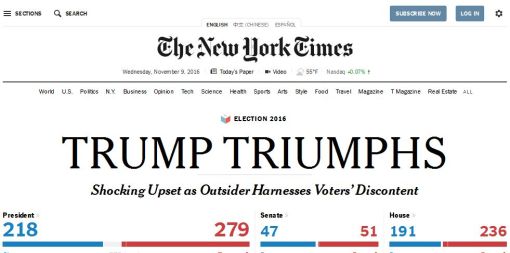


Circus Maximus MMXVI: It ended up in tears

9 11 2016

This is painful:

trumpwin

We’ll get through this, we will, through our tears, however hard it will be.


Circus Maximus MMXVI: Under pressure

8 11 2016

1:01: Time to go to bed and lie awake, stunned. Good night, all.

12:53: I’ve said before, for different events, that “I will no longer predict. . . .”

Adding presidential elections to that list.

I mean, I accepted the possibility that Trump, as the Republican nominee, had a shot, but I never believed it. I can say I was following the polls, which showed Clinton the likely winner, but, again, I didn’t believe he would end up the winner.

12:23: I’m sorry for Hillary Clinton, sorry for those modest gains I thought I could look forward to, and devastated with what we will lose with the Republicans in charge.

And devastated for all the people who have been targets, who will be targets, of the presumptive president.

12:16: All right, Republicans, this is on you. You’re in charge now, so let’s see if you can keep it together.

12:14: We’ll survive this, but not without pain, great pain and suffering.

12:07: President Donald Trump. Majority Leader Mitch McConnell. Speaker not-Ryan.

I was so, so goddamned wrong. Jesus christ. I ignored the polls showing Trump strength in the primaries, and paid attention to polls showing Clinton doing well. I thought I was being responsible.

But I also couldn’t believe that that many people wanted this intemperate incompetent to be president, that this many people hated Hillary Clinton.

I was so goddamned wrong.

11:36: Trump’s going to take Wisconsin. Goddammit.

11:34: They’re going to have all three branches of government. And an open Supreme Court seat.

11:27: I wrote a while ago that I didn’t think that most white people wanted to be racist, wouldn’t celebrate it.

I know, I know, #notallTrumpvotersareracist, but an awful lot of them don’t care that an awful lot of them are.

11:08: I’m ’bout ready to cry.

10:58: I’m going to be one of the wailers, aren’t I? One who’s going to have to recognize the legitimacy of a man who would be a terrible, terrible president.

10:43:Looking at that Times map, where Clinton needs 161 to get to 270:

  • CA-WA-OR will go Clinton, 74.
  • CO, leaning Clinton, 9 (83)
  • HI will go Clinton, 4 (87)
  • VA, leaning Clinton, 13 (100)
  • PA, leaning Clinton, 20 (120)
  • ME, leaning Clinton, 4 (124)
  • MN, leaning Clinton, 10 (134)

Possible pickups, too soon to tell:

  • MI (leaning Trump), 16
  • WI (leaning Trump), 10
  • IA (leaning Clinton), 4
  • NV (1% reporting), 6

She needs all of these to go for her. Jesus fucking christ.

10:37: I’m obsessing over the NYTimes live update map. Come on, Wisconsin and Michigan! COME ON!

10:24: I am freaking the fuck out.

~10:00: Jesus Christ, this thing is far too close.

Jesus Christ.


Circus Maximus MMXVI: We all look smaller down here on the ground

8 11 2016

XIII. Big crowds and wild cheering for one’s candidate are nice—intoxicating, even—but you don’t win just by drawing the enthusiastic.

You win by reeling in the reluctant and the resigned and getting them to the polls.

XIV. I’ve heard and read different pieces wondering about reconciliation and what Clinton should do to reach out to those who rejected her.

My first thought: Fuck them. FUCK THEM.

Second thought: What about what Clinton should do for those who supported her?

Third thought: Politics, goddammit, requires conciliation. Goddammit. Even if it’s fake, hypocritical, and wholly expedient, politics, per Crick, requires some basic ability for us to live with one another.

So those of who voted for Clinton can gloat for a bit and those who voted for Trump can glower for a bit, but then we need, however grumpily, to get over it

XV. Some folks, however, won’t get over it.

I expect Clinton to win, so it’ll be easier for us to say “Let’s get on with it” because there’s stuff we actually want her to do.

Some of the reluctant Trump voters will look down, kick the dirt, look up, sigh, and move on.

Some non-Clinton/non-Trump voters will shrug, go “Oh well,” and move on.

Some of the avid Trump supporters will wail, then sulk, then move on.

And then there are the dedicated Hillary Haters and MAGA folks, who will not accept the results, either by rejecting the vote totals out of hand (Fraud! Tampering!) or supporting every effort to impede a Clinton presidency through constant investigations and/or impeachment attempts.

I don’t know the best way to deal with this last group. I think any Congressmember who seeks to nullify the election results should be punished at every possible turn and continually denounced for their attempts to delegitimize the very political institutions in which they exercise their power. No mercy.

And the citizens who cheer on the nullifiers? That’s tricky. No coddling—even reconciliation doesn’t require coddling—but they’re a large enough chunk of the polity that they can’t simply be ignored, either. Yes, try to hive off some of the more uncertain members of this group, but how to do that? I don’t know.

Republicans presumably have the greater responsibility to deal with this dead-ender faction, but since the leadership alternates between appeasing and encouraging them, I don’t think they can be counted on to do the right thing. It shouldn’t be too much to ask—emphasize that Democrats are a legitimate party  and it’s not always unfair when they win—but it probably is.

MMXVI

What do I expect from a Clinton presidency?

More of the same, both good and bad, and probably a greater push on issues regarding child care and health. Congress, even if the Senate goes Dem, will likely continue their obstructionism, but Clinton might—might—be able to cobble together majorities to pass criminal justice reform.

Modest gains, at best.

I’ll take it.