Circus Maximus: If you act, as you think
8 11 2016Comments : Leave a Comment »
Tags: presidential campaign, The Police
Categories : Music, Politics
Circus Maximus MMXVI: Someone told me not to cry/I never thought I’d need so many people
8 11 2016Double bill, because it’s Arcade Fire and Bowie, Bowie and Arcade Fire:
1.
2.
Comments : Leave a Comment »
Tags: Arcade Fire, David Bowie, presidential campaign
Categories : Music, Politics
Circus Maximus MMXVI: See them on the beach or in New York City
8 11 2016
Comments : Leave a Comment »
Tags: B-52's, presidential campaign
Categories : Uncategorized
Circus Maximus MMXVI: This ain’t no fooling around
8 11 2016
Comments : Leave a Comment »
Tags: presidential campaign, Talking Heads
Categories : Music, Politics
Circus Maximus MMXVI: You know you’ll be hearing that sound
1 11 2016IV. It’s not bad that white working class folks are getting some (sympathetic) attention from the press.
It is bad that it is mainly white working class folks who are getting the attention.
V. However much race and class are fused in the US, they are nonetheless separable. Those in the WWC who embrace Trump do so more in the name of their whiteness than their class.
Have their been breakdowns of union member support for the candidates? Do white union members put class before whiteness? What are the conditions under which white workers choose one candidate over the other?
Unionism is no barrier to racism—not by a long shot—but union membership, to the extent that it raises consciousness of one’s class status, might therefore blunt the primacy of whiteness.
VI. It’s worth pointing out, of course, that, during the primary season, the median income of Trump supporters was $72,000 while that for Clinton (and Sanders) was about 61 grand—in all cases, above the national median income of $56,000. And a Pew poll of general election preferences showed that Clinton did better both among $100,000+ voters (51 to 43%) and those making less than 30 grand (62 to 33%); they more-or-less tied in the two middle income categories.
Given how the Pew survey numbers are presented, however, it is difficult to draw any conclusions about the percentage of white working class voters who support Clinton or Trump. That overwhelming percentages of black and Hispanic voters support Clinton suggests that she’s drawing from all classes. And while Pew didn’t offer any numbers on Asian-American voters, 538 highlights a National Asian American Survey showing a clear movement of most groups away from Republicans and toward Democrats.
On thing that can be concluded is that Democrats are ethnically diverse and Republicans, increasingly, are not.
And that’s going to matter—although how, at this point, I can’t say.
I fear the possibilities.
Comments : 3 Comments »
Tags: Donald Trump, Hillary Clinton, Politics, presidential campaign, white working class, whiteness
Categories : Politics
Circus Maximus MMXVI: Pick up the pieces and go home
19 10 2016Off all else, this is the takeaway:
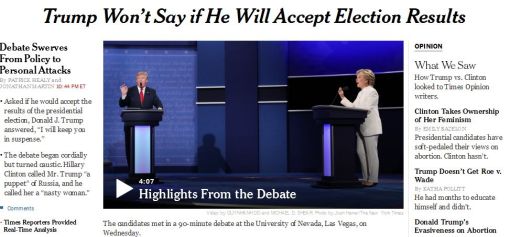
Three more weeks.
Comments : 3 Comments »
Tags: debates, Donald Trump, Hillary Clinton, presidential campaign
Categories : Politics
Circus Maximus MMXVI: Go on and put your ear to the ground
17 10 2016I. The reasons someone supports a candidate you hate may not be the reasons you hate the candidate.
I think Donald Trump a menace, an unstable, thin-skinned, ill-informed blowhard who built his candidacy on a nasty brew of resentment and bigotry. I consider his terrible temperament—the sulking, the whining, the needy bullying—and terrible policies (to the extent he has any) and think What a fucking disaster.
Some (half? most?) Trump fans look at those same things and think Fuck yeah! Where I see instability, they see authenticity; what seems to me ill-informed seems to them common sense; resentment is, yes, resentment, but a righteous one; and bigotry, well, that’s simply refreshing political-incorrectness.
Some (half? most?) of these fans like the shove-it attitude just because he’s saying Shove it.
And some (half? most?) see only a champion for a life they want to have, think they deserve.
II. Loss of privilege—unearned, unjust privilege—still registers as loss.
White supremacy is the founding injustice of this nation.
As a matter of justice in a plural nation, its destruction is of the greatest urgency.
As a matter of sociology in a plural nation, this destruction has led, does lead, to existential dislocation, to status disorientation on the part of those white folks who never had to deal with the costs of the construction of that whiteness.
As a matter of politics, both must be dealt with.
III. Everybody knows that the dice are loaded.
And nobody knows another game.
Is it worse to fix the fix, or to blow it all to hell, and start over?
The fix of the fix won’t hold; there’ll be new fixes. And blowing it all to hell is to blow it all away; there will be no restoration.
Pause: This is not to excuse—anything, or anyone.
I am trying to understand, to say what I see, to see what I see.
Comments : 2 Comments »
Tags: bigotry, Donald Trump, injustice, loaded dice, Politics, resentment, white supremacy
Categories : Musing, Politics
When Johnny comes marching home again
11 10 2016THE US IS NOT WEIMAR! I have shouted, hissed, flatlined, more than once.
And yet.
No, I’m not going back on that, but I wonder if a) the US was Weimar before Weimar was Weimar, and b) at least regarding the parties on the right, there isn’t something to the parallel.
B first: The Nationalist (DNVP, or German National People’s Party) was the main conservative party during the short-lived republic. It contained a mix of reactionaries and restorationists, militarists, aristocrats, and industrialists. It was anti-democratic, anti-Semitic, and rather constantly seeking to undermine whatever government (there were many) was seated at the moment.
The old man, Hindenburg, won the presidency as an independent (but with the support of the old-line conservatives) in 1925 (thumping his former colleague Ludendorff, running as a Nazi) and beat Hitler for the job in 1932. When the Nazis won the most votes in the last free parliamentary elections in November of ’32, thereby paving the path to the chancellorship in January of 1933, Hindenburg crony (and Vice Chancellor) Franz von Papen famously told those worried about Hitler that ‘You are wrong. We’ve engaged him for ourselves.’ To another he said, ‘Within two months we will have pushed Hitler so far into a corner that he’ll squeak.’
Well, that didn’t work so well, not least for Papen: he and his wife were murdered during the Night of Long Knives in 1934. (Nope, wrong: Papen was only put under house arrest, served as an ambassador for Nazi Germany, was acquitted at Nuremberg, and only died in 1969. It was General Kurt von Schleicher and his wife who were cut down.)
Anyway, there are some rough parallels to be drawn, I think, between the Nationalists and establishment (such as it is) Republicans, and between the Nazis and anti-GOP Trump supporters.
Again, these parallels are rough: I don’t think Trump is Hitler or his more, ah, avid supporters Nazis, although there are certain shared enthusiasms across both sets of followers. And the GOP establishment cannot fairly be compared too closely to the Nationalists: while they certainly want to restrict voting and are less than fully committed to civil rights for all citizens, they’re not actively plotting coups or looking to eliminate the Constitution.
Caveats deployed, the energy and anger of the anti-GOP Trumpeters, their bitterness toward any Republicans not waving his flag does echo the melodramatic intensity of Nazis, with the more lukewarm GOPpers standing in for the old Nationalists.
And the hatred for Democrats and Clinton, the cries to make America great again, the sense that the country has been corrupted and must be cleansed? Well, yeah, that too.
Back to a.
My knowledge of American history isn’t great, so treat this comparison even more gingerly than the previous one:
Was the US, or, more specifically, the former Confederacy, during Reconstruction akin to Weimar? That is, a fragile republic, all-too-soon overthrown by forces which never accepted the legitimacy of the rule?
I’m not going to go on about this, because I know neither the history of Reconstruction and its dismemberment nor that of the imposition of Jim Crow, I don’t know how well the anti-republican (and -Republican) forces and the political cultures match up, and there are clearly major differences.
Still.
Still, the lines are there, aren’t they?
Comments : 3 Comments »
Tags: GOP, history, Nationalists, Nazis, parallels, Trump, Weimar
Categories : Musing, Politics
Where no fear was
11 10 2016Comments : Leave a Comment »
Tags: Aramaic, God, Orthodox chant
Categories : Music

 AbsurdBeats