Do you feel real?

19 08 2016

I am not a successful academic.

I’m a pretty good teacher, but I’ve neither attended a conference nor submitted any papers for publication in over a decade. And yes, while I’m working on this ideologies project (which means I may end up submitting paper proposals to a conference or two), I’d have to say that I have not done the work of a good scholar.

I don’t like admitting it, but there it is.

Which is my way of wandering into this New Yorker profile of Martha Nussbaum. Nussbaum is, of course, a successful—a very successful—academic. She has, per that profile,

published twenty-four books and five hundred and nine papers and received fifty-seven honorary degrees. In 2014, she became the second woman to give the John Locke Lectures, at Oxford, the most eminent lecture series in philosophy. Last year, she received the Inamori Ethics Prize, an award for ethical leaders who improve the condition of mankind. A few weeks ago, she won five hundred thousand dollars as the recipient of the Kyoto Prize, the most prestigious award offered in fields not eligible for a Nobel, joining a small group of philosophers that includes Karl Popper and Jürgen Habermas.

Very, very successful.

Now, it’s true that I don’t like all of her books, but I have a number of them on my bookshelf and have used her work in my classroom. I’d guess that not only does she work harder than me, but that she’s also smarter than me and that if I ever got into an argument with her I’d almost certainly lose.

So, I’m not competing with her because I can’t compete with her: she’s way out of my league.

That said (you knew there’d be a “that said”, or maybe a “but still”), reading that profile made me uneasy: Is she for real?

~~~

“To be a good human being,” she has said, “is to have a kind of openness to the world, the ability to trust uncertain things beyond your own control that can lead you to be shattered.”

This makes a great deal of sense, and Nussbaum certainly does seem open to the world.

Her work includes lovely descriptions of the physical realities of being a person, of having a body “soft and porous, receptive of fluid and sticky, womanlike in its oozy sliminess.” She believes that dread of these phenomena creates a threat to civic life. “What I am calling for,” she writes, is “a society of citizens who admit that they are needy and vulnerable.”

But, as Rachel Aviv observes,

In Nussbaum’s case, I wondered if she approaches her theme of vulnerability with such success because she peers at it from afar, as if it were unfamiliar and exotic. [. . .]

. . . when I first proposed the idea of a Profile . .  [s]he responded skeptically, writing in an e-mail that she’d had a long, varied career, adding, “I’d really like to feel that you had considered various aspects of it and that we had a plan that had a focus.” She typically responded within an hour of my sending an e-mail. “Do you feel that you have such a plan?” she asked me. “I’d like to hear the pros and cons in your view of different emphases.” She wasn’t sure how I could encompass her œuvre, since it covered so many subjects: . . . “The challenge for you would be to give readers a road map through the work that would be illuminating rather than confusing,” she wrote, adding, “It will all fall to bits without a plan.”

I understand that one may seek to control as much as possible about one’s own life in recognition that there’s so much that can’t be controlled, but there’s appears to be little that Nussbaum accepts as out of one’s control.

That philosophers write one prescription and follow another is so common as to be axiomatic. But I find it jarring that a scholar of humanity who, remarking on operatic role she’s rehearsing, says “I feel that this character is basically saying, ‘Life is treating me badly, so I’m going to give up,’ ” she told me. “And I find that totally unintelligible.”

Oh my Hera, Martha, so many of us give up so often, how can you talk of a “society of citizens who admit” being shattered, needy, and vulnerable when you can’t see that humans who are shattered sometimes give up?

As Aviv notes, Nussbaum does give emotions pride of place in her philosophy, as a kind of ur-cognition. And there’s something to that, to the breakdown of the affect-vs-intellect duality. But in assigning emotions a cognitive role, she overlooks that emotions have their own role, as emotions.

This is tough for me, not least because I once aspired to the kind of Stoicism that Nussbaum seems to have achieved (and which may be yet another reason I respond so strongly to her). Yet I’ve spent too many years twisting and then untwisting myself not to see that feelings are more than just thoughts untamed, always to be subordinated to reason. I have difficulty with this still, but I can at least acknowledge that sometimes, sometimes, it is not the worst thing to feel, first.

Nussbaum allows the feeling, but only properly tamed. She feels through her thoughts, which is an accomplishment. And a loss.

~~~

There’s a great deal more in the profile—the discussion of her colonoscopy, her willingness to strip in front of others, her use of Botox and plastic surgery, and more—which, as someone who’d rather not appear in my skivvies in front of colleagues, older or younger (and would prefer they keep their clothes on, as well), only heightened my unease.

But then, on submitting that feeling to reason, I admit that it doesn’t make sense to feel embarrassed on behalf of someone who is matter-of-fact in dealing with her facts of life. And it allowed me to see Nussbaum, in all her determined discipline, as, well, a bit odd.

And thus, all the more real for her oddness.



Is there anybody out there?

17 08 2016

Hello! Long time, no see!

I’ve been away for a bit, and not for anything urgent or tragic or earth-shattering or delightful or infuriating or, really, anything other than ordinary life.

I was unemployed in June, which causes my rib cage to tighten and thoughts to shrink, but both taught and worked my second job in July and into this month; next week, fall classes begin.

So, yeah, ordinary life.

Which hasn’t been working for me.

I mean, unemployment obviously didn’t work (no puns, please), and not just because not having money is no good: I don’t do well with nothingness. But even with something, even with teaching (and regular paychecks), my life was—is—just. . . floating by.

I don’t mind a good float, but this wasn’t that. No, this was a haze, out of phase, a time-loop of the year before (and the year before that).

There might be a bit of depression.

So I’m trying something new, a something old which I’d tried half-heartedly before. Can’t say my whole heart is in it now, but, goddammit, there’s really no reason not to do this, it’s so simple.

I’m a night person, have been for as long as I’ve been aware that one could be a night person. I wrote college papers at night, then grad papers, then my dissertation, then my first novel, then my second. I want to write; I write at night.

But I haven’t been keeping a night schedule, and I haven’t been writing, and for all my scribbling in various notebooks, I haven’t been thinking through anything.

That’s not just about the lack of night, of course. I am undisciplined without a deadline, without a commitment to someone or something else; lacking that outside pressure, it’s too easy to shrug away the day.

But at night, late night, everything seems clearer, and what I couldn’t be arsed with during the day emerges, unbidden, from the dark.

Sounds weird, I guess: why should the time of day matter? I don’t know, but it does.

And that’s been the problem. Most people aren’t on a night schedule, so even when my work schedule has allowed me the night, I’ve been mimicking the ordinary schedule One Ought To Keep.

Which is ridiculous, because no one, not one damned person, has been tossing any Oughts at me about when and how I work. No one cares if I’m up until 2 or in bed until 10. It doesn’t matter if I’m regular or not to anyone but me.

And, goddammit, I’m more than halfway through my life so you’d think I’d have learned by now that when I get to make choices then I get to make the choices that actually suit me.

So, I’m staying up late and getting up late, and seeing if that will help me sync back up with my own life again.


What are words for?

19 07 2016

Sorry, little but little bits:

*I don’t care about Pokémon Go, and don’t care that others care about Pokémon Go.

*Melania Trump’s plagiarism was a) not that big a deal in and of itself, but because it was b) an easily avoidable error, it c) plays into an already-existing narrative that the Trump campaign is a mess. While this might not matter to his supporters, he can’t win the election unless he picks up new supporters, who might side-eye such chaos; thus, d) Melania Trumps plagiarism matters.

*That said, political scientists (yes, the same folks who argued that Trump wouldn’t win the nom, but, moving on. . .) aren’t sure how much campaigns matters.

*I like gin sours more than gin sours like me.

*PSCUNY has finally managed to wrest a contract from the state. Some are opposed, but, man, I don’t know that we can do better than this. It actually more of the past than the future—it deals with 2010-17—so whatever the weaknesses, well, the union’ll be back at the table for the next round soon enough. I’m voting yes.

*Unlike last year, I did stuff my air conditioner into the window and am using it—tho’ not enough to please my cats.

*I have no idea who Hillary Clinton will pick as VP. I’d like to see a pol (not a general), but I’m sure s/he’ll be fine.

*This will haunt me to the end of my days:


None but ourselves can free our minds

10 07 2016

What a shit week.

Some people have been posting photos of cute critters—of which, as a general tactic, I approve—to try to blot out the blood, but I prefer something steelier:

A demonstrator protesting the shooting death of Alton Sterling is detained by law enforcement near the headquarters of the Baton Rouge Police Department in Baton Rouge, Louisiana, U.S. July 9, 2016. REUTERS/Jonathan Bachman TPX IMAGES OF THE DAY - RTSH3XR

Jonathan Bachman / Reuters

Ebon @tyriquex has identified her as LIeshia Evans, mother of a 5-year-old son; according to ebon, she was released Sunday afternoon.


Baby, take a walk outside

4 07 2016

It’s time:

Camus’s take on the US, via John Doe and Exene’s uncertain harmony.


It ain’t me, babe

29 06 2016

Oh, to be innocent.

Innocence excuses every excess, every error, justifies every act, however unjust.

Think: He started it!

This is bad enough when dealing with small children, and one for which the correct response is usually I don’t care who started it—knock it off!, but in adults, arguing over politics?

Uhhhhhhhhhhhhnnnnnn.

It will surprise exactly none of you that I am skeptical of the notion of innocence in politics; in fact, it has no place. There is no political action without complicity: to make demands is to take responsibility, to legislate is to compromise, and to lead is to maneuver.

You can be good, in politics, but you cannot be innocent.

Which is why I’m not much moved by yelps from the likes of Rod Dreher that (almost) anything Christian conservatives do to resist anything queer is justified because, wait for it, the queer folk started it.

This is all over his blog: Well, okay, maybe in the past one or two people were mean, but now, the social justice warriors are all hellbent on attacking us poore wee Christian folk.

I want you to notice something. The Left always accuses the Right of advancing the culture war, even though it is usually the Right playing defense. The pharmacists’ situation is a classic example. Nobody in Washington state had the slightest problem finding RU-486 Plan B. If they couldn’t get it at the Stormans’ pharmacy, there were plenty pharmacies nearby where they could. Conscience exemptions are standard nationwide, and state and national pharmacy professional associations filed amicus briefs supporting the Stormans. Nobody wanted this regulation, except the Jacobins of the Sexual Revolution.

Now, I get that, on many sexual issues, the Right may feel under siege: same-sex marriage is now a constitutional right, trans issues are on the rise, and the death of Scalia (with a likely replacement by a Democratic nominee) means the wide latitude often afforded to mainstream Christianities is likely to be trimmed back.

These are losses.

But that one has lost does not mean that one is innocent—losing hurts, but it neither purifies nor sanctifies—or that playing defense somehow makes you more righteous than those on offense.  The mere fact that one is fighting to advance or fighting to defend is morally meaningless.

What is meaningful is the cause you seek to advance or defend.

Now, Dreher, in advancing his Benedict Option (as a defense against degeneracy), clearly believes his cause is just—boy, does he believe it

You may not be interested in the Jacobins, but the Jacobins are interested in you — and your children. We must fight them every opportunity we get, but we have to know what we’re fighting for, and we have to know how to continue the fight underground if we are ultimately defeated.

Leaving aside the infinitely more important cause of the eternal fate of souls, there is the matter of making sure that there are people alive in the generations to come who can properly bear witness to the past — not just the particularly Christian past, but to Western civilization, the civilization that — I speak symbolically, of course — came from Athens, Rome, and Jerusalem. We fight for Christian civilization itself, which includes what emerged from Moscow too. And therefore we must fight against the nihilistic successor civilization of New York, Los Angeles, Washington, and Brussels. We fight for the Paris of St. Genevieve, not the Paris of Robespierre. Modern civilization has no past, only a future. If our civilization is to have a future, it must be rooted in our past. We must remember our sacred Story.

I believe we will have a future, and I will fight for that future by fighting to keep alive the memory of the past. I won’t stake my life on defending New York, Los Angeles, Washington, and Brussels, but I will stake my life on defending Athens, Rome, Jerusalem, and Moscow. That’s where the battle is. It’s a battle taking place in every city, town, and village in America. Which side are you on?

—but that it is a defense grants it no more moral urgency than, well, the Jacobin advance.

Dreher, like every other partisan, believes his cause urgent and just, but being knocked off one’s pins doesn’t make the cause more just.

If that were so, then no political victory could be just, and every political loss, a tragedy.

A slaughter of the innocents, indeed.


A man looks up on a yellow sky

24 06 2016

As I watched the ticker on the BBC website tilt “Leave” I kept murmuring You stupid bastards.

Not that my opinion matters, of course. David Cameron gave the peoples of the United Kingdom The Clash’s choice, and choose they did.

I have no idea what this means, for the UK, for Europe, or for the US. There are smart people who can game out possible scenarios, but, at this point, the pieces are all still jumbled.

The leftist and partisan in me was, for reasons of pessimism, the murmurer; the political scientist was, in considering the jumble, more Well, isn’t this interesting.

Both, however, agree that voting to go while wanting to stay is a bad, bad tactic:

But many voters have since spoken out saying they are shocked at the poll’s outcome and did not believe their Leave votes would actually count.

One voter, named only as Adam from Manchester, told the BBC: “I didn’t think that was going to happen.

“My vote – I didn’t think was going to matter too much because I thought we were just going to remain.

More:

Another voter, Mandy, said: “I was very disappointed about the result, even though I voted to leave, this morning I woke up and the reality did actually hit me.

“But if I had the opportunity to vote again, it would be to stay.”

This person, however, really takes the tea-cake:

One said: “I personally voted leave believing these lies and I regret it more than anything, I feel genuinely robbed of my vote.”

I feel genuinely robbed of my vote. You stupid bastard.


Like a bird on a wire

24 06 2016

So, I’ve been on Twitter for a minute and my impression thus far is: huh.

I thought the problem would be that I’d be constantly chattering away, constantly trying to get both the first and last words, and constantly hung up in this spat or that.

Not what’s happened.

Oh, I’ve jumped in here and there, but, mostly, I’m just listening in. I have almost no followers (which is a) not a surprise, given my relative silence; b) yeah, an ego dent; and c) probably for the best), but am slowly building a roster of people who I want to follow.

And that’s where the “huh” comes in: While most (not all) of the people I follow are on the left, they’re not all left in the same way. In particular, I follow a number of bloggers who are black, which means I’m not only able easily to eavesdrop on conversations of which I otherwise might not even be aware, I’m also able to see how those conversations play out.

That’s key: I’m certainly used to reading and hearing black (and Latino and Asian) voices in the media, but, for the most part, these are media saturated in whiteness. I don’t mean white supremacy—The Atlantic, whatever its faults, is not a vehicle for supremacism—but that the story choices and the readership are largely white.

Black Twitter writes for itself. It’s not that the conversation is confined to black people, but that the microphone is located firmly within black America, and passed around to other black people. I can listen in, but whether or not I do so is rather besides the point.

This is not a surprise. I mean, any white person who’s ever heard a Chris Rock performance knows that how black people talk amongst themselves is not how they talk with white people. But even as someone who is not completely clueless about the existence of black culture, it can still be a smack upside my head to see, in real time, it’s not all about me.

And that’s bracing, in the best possible way.


We don’t need no thought control

16 06 2016

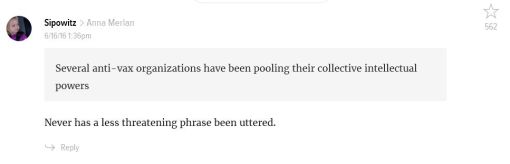
Just because this amused me:

Sipowitz vax

I’m not great at deadpan, so appreciate a good droll-take when I see it.


Another day draws away

16 06 2016

So I’m currently unemployed—which sucks—so one might think I’d be gettin’ all kinds of work done.

One has not met me, I see.

No, I’m one of those folks that if I have 5 things to do, I get 5 things done; 10, and maybe 8, maybe all ten.

But one thing? Two? Nope. Or 5 things, or ten, with no particular deadline? That’d be a no.

I’ve had posts in mind, but, clearly, haven’t written them. I have notes and files from this past semester that need to be sorted before the fall; they remain unsorted. Notes to prepare for my July class? Ha ha ha.

Okay, I did manage (today, finally), to enter books I purchased this past semester into my Filemaker database, and, finally, to figure out how to export it all to an Excel file (very easy). And I began sorting through those entries, highlighting those which lacked info (ISBN, say, or publisher) or which, because I may no longer own them or were duplicates, should be deleted.

(Which, shees, some of those books I clearly got rid of either before I left Minneapolis or before I left Somerville, but I still felt a pang seeing those titles. Did I really get rid of the Wonnacott & Wonnacott stats books, or are they in my folks’ attic? Whyyyy didn’t I keep the Shively? Honestly, I haven’t needed or even thought about those books for years, but here I am, panging after them. Pitiful.)

So, yeah. That I managed to pull my nose out of my naval long enough to do ONE THING today could mean I’m on an upswing. . . or that I’ll say, Okey-dokey, that was enough for this week.

TUNE IN, then, for another exciting episode of Will she or won’t she?

Or not.