Wide awake

6 04 2016

Tuesdays wipe me out.

I teach 3 courses on Tuesday (for about 5 1/2h, total), which you’d think wouldn’t be that bad, and it’s not as if I’m up at the crack of dawn, but man, by the end of the day (~8:40), I have had it. Yeah, I manage to hustle to the train, but even if I have supremely good train mojo and make it home by 10, I am done.

I’m still tired today, and I’m not sure why: I went to bed slightly earlier than usual and got a decent night’s sleep, but man, I feel shriveled.

You’d think if I just went to bed early tonight, all would be well, right? Nope. In fact, as the evening stretches out, I’m actually perking up.

I’m not–or not, any longer—a severe night owl, but if I could get away with a 11am-2/3am wake schedule, yeah, I would.

Except, I could, and I don’t: I don’t teach until 2, so I could get up around 10:30, be on the train by 11:30, and get to campus in time to argue with Jtte for awhile before heading to class.

So why don’t I?

I mean, I’m not currently working my second job, so it’s not as if I need to be on a 9-5 schedule. And Athena knows I’m not getting much accomplished in the morning as it is.

No, I think the issue is that I think I should be on a normal (-ish) schedule and even though precisely no one would care that I’m not, it would seem like I’m slacking off if I a switched to a 2nd-and-a-half shift.

I also think I’m worried that I might have to return to a normal schedule at some point, and then, Oh no! WhatdoIdo?!

I’m not making any sense with myself. I do need to pick up some freelance work, but it’s not as if I couldn’t write—I’d rather write—at night instead of during the day.

And that’s just it: I’ve got me some writin’ to do, and writing requires night time.

Maybe that’s the excuse I need to break away from all of the non-judgement my friends and colleagues are not shoving my way and just, y’know, do what I can.

Because I’m a grown-ass woman, and this is something I actually can do.


Everybody knows the captain lied, 22

4 04 2016

Does wealth make people shitty, or does one have to be a  shitty person to become wealthy?

Because why, if you have a bajillion dollars, can you not afford to pay your fucking taxes?

I’m broke, and I pay my fucking taxes. No, I don’t like it, but I don’t like it in a way that civilized person who recognizes that one has to pay to live in a civilized society doesn’t like it, which is to say, I bitch, and I pay.

But you, rich person, you apparently have so much money that you can’t afford to pay taxes or child support, you can only afford to pay some shitheel middlemen to hide your money for you.

How “entirely typical”.


All things weird and wonderful, 54

28 03 2016

Well, this is just lovely:

h/t Melissa McEwan


Oodly oodly oodly oo

27 03 2016

Hecate, I’ve been lazy.

I’m mean, I’m taking care of business teaching-wise, but when not prepping or not in class? Bupkis.

Oh, well I have been spending some time with my new phone (a Moto G, in case you’re interested) trying to figure out how it works. It’s quite seductive, really: shiny and new, and with far more power than my first three computers—nice, really.

But also, really: still a phone. My parents called earlier today and it took me about ten seconds to figure out how to answer the damn thing (don’t just hit the icon, but slide it over to the other icon); I also experimented while on the phone with my friend J., figuring out if the earbuds I’d bought for my other phone (which didn’t work because the phone was so, so old) would work (yes), how to look things up while on the phone (gotcha), and how to put it on speaker (failed at this, but I think I know how to do it now).

Oh, and I downloaded the only apps I’ll probably ever need: weather and MTA, and one which might be useful: Twitter. Hell, I might even start tweeting on the regular.

Anyway, it’s a phone, and it’s nice, and it works. As a phone.

~~~

Netflix put up the latest season of Crossing Lines, and I wasn’t sure if I wanted to watch it. I’d more or less enjoyed the first two seasons, but it got increasingly, ecchhh, baroque? operatic? ridiculous? as it went on, and the last episode of the second season was, frankly, dumb.

Still, I was bored and thought, What the hell, let’s see how they get themselves out of that last episode jam. Whaddya know: not bad.

Only three of the original cast members returned, and the plotting is much cleaner. It’s still only okay, but now it’s okay+, as opposed to okay- and falling.

And it has Goran Višnjić who is, well, who is someone I always enjoy.

~~~

Code Black, alas, fell off from it’s strong start. It’s still pretty good, but what was wrenching early on became sentimental later. And instead of letting the complications of the cases lead into the characters, now the characters are being wrung through unnecessary wringers to supply the drama.

Too bad.

Still, not too, too bad. It still had (the season ended in Feb) Marcia Gay Harding, Luis Guzmán, and Raza Jaffrey, after all, so if they bring it back later this year, yeah, I’ll check ‘er out.

~~~

Oh, and I don’t know that I’ll ever take a selfie. I was fiddlin’ around with the camera function on my phone, wondering, Hm, how does one take a selfie with this thing, when I noticed the little rotate-camera icon on the bottom and tapped it.

Ook, bad idea: Sunday morning, just out of bed, pre-fully-coffeed, laying on the loveseat with my neck and face all sorta scrunched and. . . yikes, it’s good I live alone.

Yeah, yeah, accept yourself and all that, but y’all know that my hippie streak only extends so far, right?


Hanging on the telephone

18 03 2016

So I’ve finally got a smartphone—budget, natch.

There will be much swearing in the Absurd household this weekend as I attempt to figure out how the damnable thing works.


From California to the New York island, 3

16 03 2016

I’ve half-joked before that political scientists don’t do either love or humor.

Plenty of political scientists are lovely and funny, but in our intellectual approaches to politics, we forget about passion and about the weirdness of political activity itself. Politics is about ‘interests’ and ‘resources’ and ‘distribution’, ‘policy’ and ‘governance’ and, oh yes, ‘power’. Some of us might speak of the ‘common good’ or talk about Aristotle vs. Plato, but in our rush to impose a rational structure across the sprawl of politics, we all seem to forget Hume’s admonishment that reason follows passion.

Yes, we attempt to come to terms with political ardor in terms of cognitive biases or philosophical error—which is fine!—but passion is not merely something to be explained away, but something in and of itself, which may in turn help to explain something (like politics) else—both explananandum and explanans, as it were.

This is a long way round to the point that those of us who study politics should not be surprised by passion, that people pick sides, and that they will defend—with words, with fists, with guns—what their (our) sides.

This isn’t an excuse for violence—for Hera’s sake, does that really need to be said?—but it is a defense of passion itself as a legitimate driver in politics. Unlike Hume, I do think reason may also be a driver, and just as passion may inform reason, so too may reason discipline—if only the expression of—passion.

But reason does not, should not, erase passion. Especially in politics.

cont.


This land is my land, 2

13 03 2016

If both order and freedom are necessary for politics, then how to reconcile them?

Hobbes said, in effect: you choose order, and whatever freedom may exist without disrupting order may, but not must, do so. Rousseau tried to bring the two together by denying that in a democratic society there is any conflict between them—one may speak unironically of being ‘forced to be free’. Locke sought a kind of middle way: you agree to the founding (representative) order which in turn allows for a wide, although not absolute, set of liberties.

These snippets do not, of course, do justice to these men’s thoughts, but do indicate the various ways early modern thinkers thought about how to build and maintain a truly civil society, that is, a society in which men may interact without violence.

Civility in politics, then, is less about manners than about the manner of our engagement with one another.

Now, that manner may also be a political matter: What kind of protest is acceptable? What are the appropriate venues of protest? How does one comport oneself while protesting? Are there forms of protest which are out of bounds? What if the protest overwhelms the phenomenon one is protesting? What if political speech intimidates protesters? What if protesters of political speech intimidate advocates?

Who is in the right and who is in the wrong?

And that question is where we go off the rails, thinking that the answer can be determined outside of politics itself. It can’t.

I tend to go far along with Arendt in positioning violence opposite of politics, but, Hobbesian that I am, I can’t completely deny its role in politics itself. If might makes right (and it does), then violence, as one form of might, can make right.

In the US political system there are supposed to be limits on violence in politics—that is a mythical part of our foundational order—but its use has often succeeded in containing insurgent (and non-violent) political acts. Almost every liberation movement in our country has been met with violence, both official and not, and has had to justify itself as worthy of its freedom to be political, that is, to be included in the political order itself.

That, by the way, is the radical promise of politics: that order can be challenged, upended, re-ordered, without bloodshed. That blood is so often shed demonstrates the practical limits of that promise.

cont.


This land is your land, 1

13 03 2016

Man, are we Americans bad at politics.

I don’t know if we’re uniquely bad, but we do seem to have some difficulty with the notion that disagreement (and expressions thereof) is normal.

I’m not just talking about the violence at Trump rallies, but also to violence at protests generally as well as meltdowns about campus politics. Disagreement over whether the best way to accomplish x is achieved by y or z is still acceptable, but disagreement over the fundamental means by which we prioritize x over p or decide that only y or z are worthy options is considered uncivil.

The very heart of politics—uncivil!

Granted, there are many plausible ways of understanding politics, and not everyone would go along with my Arendtian/Crickian view which places distinctiveness and pluralism at the center of political life. But if one accepts that a complex society will necessitate substantive differences amongst the members of that society, then the management of those differences will in turn be required to maintain both its complexity and functioning.

There are, as Crick notes, any number of ways for societies to deal with complexity, among them attempts to bring its various pieces into line and/or to suppress expressions of difference. It is only in politics, Crick argues, that the freedom which arises from and allows further complexity may be found and strengthened.

Or, as Madison somewhat more pessimistically put it,

Liberty is to faction what air is to fire, an aliment without which it instantly expires. But it could not be less folly to abolish liberty, which is essential to political life, because it nourishes faction, than it would be to wish the annihilation of air, which is essential to animal life, because it imparts to fire its destructive agency. …

The latent causes of faction are thus sown in the nature of man; and we see them everywhere brought into different degrees of activity, according to the different circumstances of civil society.

So, what Madison is resigned to and what Arendt and Crick celebrate is the endurance of difference and disagreement—and of politics to allow and make use of its expression.

Some leftists have argued that an open politics (of the sort often found in democracies) is merely reformist or bourgeois (as did the Communists in the Weimar republic), and thus fail to take seriously the radical possibilities contained within politics. Madison may indeed have been a conservative of a sort in wanting to limit what politics could accomplish in the new American system, but it was precisely because he saw that politics could be transformative that he sought to limit it.

And there is something to his conservatism, as well. As Crick noted, the first requirement of any system, political or otherwise, is to maintain order and thus provide security to its citizens or subjects. This is Hobbes’s basic insight: absent a leviathan, life is but a ‘war of all against all’, ‘solitary, poore, nasty, brutish, and short’. Fear matters, as does security.

But even as they matter, they are not all that matters, and the promise of politics is, pace Arendt, the promise of something more.

cont.


So what happens now?

11 03 2016

I’ve followed and enjoyed Jonathan Bernstein‘s disquisitions on American politics. I don’t always agree (his preference for the Madisonian presidential system, his views about money in politics), but he’s practical and open and good at linking to other political scientists.

He’s also been one of the leading proponents of The Party Decides thesis, which, to simplify matters immensely, argues that party insiders force discipline on the nominating process. I first reported on, then came to agree with, this notion, largely because what Bernstein wrote about it made sense.

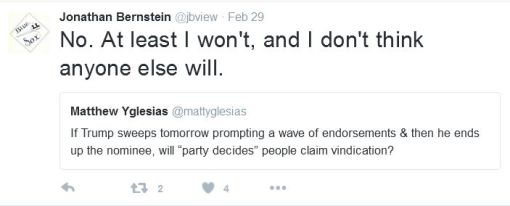
Of course, “making sense” doesn’t equal “correct”, as we’re all seeing in the current contest, and which Bernstein admits:

bernstein tweet

So, this is a not-at-all-direct prelude to the question: why didn’t Bernstein or other political scientists (or I) see Trump coming?

Another piece: Bernstein has been arguing, for years, that the Republicans at the federal level have become dysfunctional and (institutionally) irresponsible. He’s noted their disinclination to negotiate on bills which relate to their priorities, their unwillingness to vote on nominees which they themselves support to bureaucratic positions, and their indulgence of fantastical rhetoric.

And ‘the party’ has either a) been fine with all of this or b) unable to do anything about it.

Given that, why would Trump be a surprise?

Bernstein has been hitting Trump hard on his ignorance of how government works (see, for example, here and here, as well as on Twitter), but given that Republicans in Congress don’t seem to care much about governance, is it really a shock that Republican voters would support a guy who doesn’t care either?

So, given that Republicans have been acting like/unable/unwilling to discipline the nutters for awhile, and that Donald Trump is not that much of an outlier in the party, is Trump’s rise indicative of a breakdown of the-party-decides model—because the party itself has broken down in some significant way—or, perhaps, that the party has decided he’ll do just fine?


Circus Maximus MMXVI: Do ya like it like that?

9 03 2016

Five and a-half years ago I worried about the color of the sky in Sarah Palin’s world; half a year ago I suggested that Trump would only triumph* were he to keep on keepin’ on banging his own weird can.

So, two things: One, Ezra Klein is among the latest commentators to note that “he lies constantly and fluently about what his policies actually are.” Klein thinks this is a problem, and it is—just not for Trump.

It doesn’t matter that he lies or that he lies about his lies.

And. . . I don’t really know how one counters that.

*Well, okay, not really: I did say that he’d ultimately lose.

~~~

Of course, one reason that lies don’t matter, is that all too often truth = agreement and lies = disagreement.

May I give you New Hampshire State Rep. Susan DeLemus (R):

“I believe Donald. I am telling you, he says what I am thinking,” DeLemus said during a CNN focus group of Trump supporters that aired Thursday morning.

“We’ve got people in positions of power who I know for a fact are liars, liars,” she continued. “My president comes on the TV and he lies to me. I know he is lying. He lies all the time.”

Now, the Honorable Representative DeLemus is inarguably a nutter, but she’s saying plainly what others will only politely (or not so politely) suggest.

~~~

What this (not so politely) suggests, then, is that attacking a liar for lying will do little to peel support away from him.

So he has to be attacked from another angle. Senators Cruz and Rubio have done a bit of this, going after Trump for his business failures, which does seem to get to His Greatness. I’d guess dismissing him or openly mocking him would also rattle his bones.

The real question, however, is whether a rattled Donald is a Donald who loses support or, as some tiny bit of me still believes might happen, flips the table and flounces away.