What good’s permitting some prophet of doom

15 12 2015

Ahem:

It’s a sort of Weimar Republic problem. The liberal left have the upper hand, and use it so carelessly and arrogantly, so totally despising those who disagree with them,  that they risk losing not just their own superficial gains, but the whole of free society. I believe this to be true, and have tried arguing it with members of the new elite, quite often. They haven’t been interested.

Excuse me Mr. Peter Hitchens but did YOU NOT READ MY LAST POST wherein I noted that THE LIBERAL PARTIES IN WEIMAR NEVER HELD A MAJORITY IN PARLIAMENT PAST 1920?!

No, no, you clearly did NOT.

~~~

h/t Rod Dreher

(And yes, I’ll continue my long-form diatribe tomorrow.)


We leave the door of Destiny ajar

14 12 2015

Superficially, one might see the resemblances between Weimar and the US:

  • the concern, even hysteria, over supposedly inhuman enemies
  • polarization in society
  • economic insecurity
  • sense of wounded nationalism
  • dizzying movements within the culture
  • distrust of government
  • violence

But even more apparent is the crucial difference between the two:

  • the acceptance of Constitution itself

This is crucial because, in Weimar, large portions of the polity never accepted the constitution, never accepted the republic.

Part of this was due to, as I mentioned, the post-abdication government’s acceptance of the Armistice, and of the signing of the hated Treaty of Versailles: the German public couldn’t believe it had lost, and considered the harsh terms of the Treaty unjust. That the loss of territory, control over industrial regions, and, of course, reparations, made economic recovery difficult only heightened the skepticism toward a government which had apparently allowed all of this to happen.

Not everyone felt this way, of course. While liberal parties never managed to hold a majority in the Reichstag after 1920, the Social Democrats, the German Democratic Party, and the Catholic Center Party did hold significant chunks of parliament throughout this period, with various liberals holding the chancellorship as well.

But even had the Constitution been configured differently—the chancellor was appointed by an elected president, he was not simply the leader of the majority party or majority coalition in the Reichstag—it’s difficult to see how the republic could have overcome the irreconcilable differences in the polity itself.

Germany was divided between the reactionaries (those who wanted to restore the monarchy), the conservatives (ranging from nationalist-bourgeoisie to militarists), and liberals (social democrats, liberal-bourgeoisie); tucked in amongst these were Catholic interests, which tended toward conservatism (fear and loathing of the left) but which also appreciated the chance to participate in governance; the Communists, which by the 1920s subordinated themselves to Moscow; and various fascist groups, which had almost no role in government but which fought and killed in the streets throughout the decade.

Finally, after 1925 and with the election of Hindenburg, the republic’s president was a man who loathed the republic.

But it wasn’t just the politicians and the parties (many of which had paramilitary arms which regularly engaged in violence), but the institutions of the state itself were cool to the republic. The civil service was thoroughly conservative, as was the judiciary as well as the army. Bureaucrats, judges, and military officials rarely attacked the republic directly, but they never accepted it as legitimate; in the case of the judiciary, they would often sympathize with rightists who were brought before the bench, and raising a “patriotic” defense was often the ticket to either acquittal or a lenient sentence.

So, for example, none of the surviving conspirators in the assassination of Foreign Minister Walther Rathenau served more than five years, and only one of the conspirators involved in the Kapp putsch served any time at all.

And, most famously, the man at the head of the beer-hall putsch in Munich, one Austrian corporal named Adolph Hitler (he didn’t become a German citizen until 1932), not only wasn’t deported, he was given free rein to speechify in court, and given only a five-year sentence in ‘fortress incarceration’—of which he served only a year.

The US polity is at least somewhat polarized (there is some controversy as to how much), but one touchstone for pretty much everyone is the Constitution: everybody who is anybody says they love it.

We don’t all love it the same way, of course, but does anyone think that the assassination of the Secretary State would lead to a sentence of less than 10 years? That the attempted armed overthrow of a state government (with the announced intention to overthrow the federal government) by a non-citizen would lead to prison term of merely 5 years? and that he’d be out after a year? and not deported?

In fact, for as violent a society as the US is, our violence is, largely, non-political. This hardly makes it benign (especially when perpetrated by officials of the state, i.e., the police), but neither the Democrats nor the Republicans have paramilitary wings and their members tend not to participate in assassination attempts of political figures.

Furthermore, when someone is killed for political reasons—say, a doctor who performs abortions—most political leaders will distance themselves from the act itself (even if they do express sympathy for the motive). Just as if not more importantly, prosecutors, juries, and judges tend not to wave away such murders.

In other words, whatever the problems with our republic, most citizens, most elected officials, and most of the members filling the institutions of government, nonetheless accept the structure of the government.

I am very critical of elected officials (say, some Republicans) who suggest that other elected officials (say, some Democrats) are illegitimate, in no small part because attacks on the existence of the opposition in government is an attack on the legitimacy of the government itself—a dangerous proposition for any member of government to take. But even with Joe Wilson’s “You lie!” and the birther conspiracies and Mike Huckabee’s intimations that the president is some kind of traitor  (Jesus FUCK, Huckabee!), I have no doubt that any attempt on the life of the president, members of his Cabinet, or of anyone running for president would be met by near-universal condemnation.

(Yeah, near-universal: there will always be those who celebrate assassination, and some of the public condemners might be private celebrators, but it would be understood by all that public glee at the murder of a public official punches one’s ticket to the fringe.)

Which is to say, as much as folks may dislike the government, it’s probably not going too far to say they’d dislike the violent overthrow of that government even more.

To be continued.


Willkommen!

14 12 2015

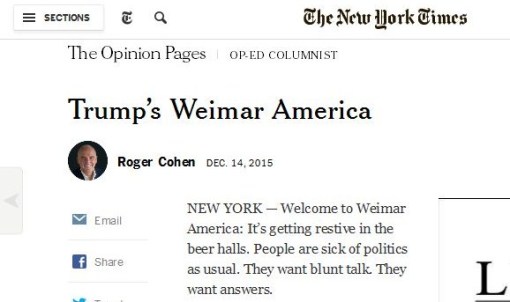
Fucking hell, ONE DAY after I make the absolutely authoritative and IRREFUTABLE argument assertion that the US is not Weimar, and Jeffrey Goldberg’s Twitter stream puts me on to this:

FireShot Screen Capture #035 - 'Trump’s Weimar America

No. No no no no no no no. Annnnnnnnnnd: No.

Question: Does Cohen state in any way how the US is like Weimar? He does not.

Oh, he goes on about anger and antipathy and xenophobia and bombast—as if these were new things in US politics—but says next-to-nothing about what Weimar was about.

The one thing he does mention, hyperinflation, he (correctly) dismisses: hyperinflation hit Germany in January 1923 (really, the inflation was bad even in the latter half of 1922), but by the following year was under control.

(Which is to say: those who think hyperinflation in 1923 => Hitler in 1933 are incorrect.)

So let’s look at Weimar, if only briefly.

The first thing to know is that the republic was formed out of the corpse of an authoritarian empire, an empire which lasted less than 50 years. Some conservatives had hated Bismarck’s Reich, believing the realpolitik behind its inception too cold, too practical; they wanted an expansive Empire, one which would compete with the UK and France, and which would dominated Europe.

At the onset of war in 1914, Germany failed in the former task, but it certainly was the strongman of the continent: it was the most populous state, and had the largest economy. The Kaiser’s government vacillated in its attempts to restrain the Hapsburgs, but when war came, the population was ecstatic: they were certain they would win, and that the glory, and riches, of victory would be theirs.

The government and the General Staff of the Army encouraged such thinking and then, as Germany’s fortunes turned in 1918, discouraged any counter-message through suppression and censorship; the Kaiser himself was only told of the need for surrender in September.

Oh, and can I pause here to note what shits were Generals Paul von Hindenburg and Erich Ludendorff? They’d set up what was basically a ‘silent’ military dictatorship in 1916, and when their tactics failed, they disclaimed any responsibility for those failures. Hindenburg went on to testify, twisting the words of an English writer, that the German army had been ‘stabbed in the back’ and Ludendorff—such a shit—set up any following government for failure. According to Detlev Peukert,

he pressed for the formation of a new government, which would have to concede Germany’s defeat and accept the likely peace terms that would follow, from the majority parties in Parliament: the Social Democrats, the liberals, and the [Catholic] Centre. The eventual effect of this cynical manoeuvre, which absolved the ruling conservative and military leadership of responsibility for the consequences of its own failed war policy, was to inflict on the democratic parties the odium of the notorious Dolchstoß [stab-in-the-back], directed by stay-at-home-politicians against the fighting soldiers in the trenches. (The Weimar Republic, p. 27)

(Ludendorff, you will not be at all surprised to learn, was also involved in the 1923 beer-hall-putsch, although the court acquitted him. He was sidelined after an unsuccessful run for the presidency in 1925 (Hindenburg won), but remained involved in far-right politics until his death in 1937.)

Now, I’m spending a lot of time on this, and we haven’t even gotten to the republic itself, but the point is, that republic was targeted by its enemies even before it was born—and those enemies came not from outside of Germany,* but from its very center.

To be continued.

~~~

*Okay, not entirely true: German Communists, inspired and later directed by the Bolsheviks, were also opposed to the republic—they did, after all, attempt a revolutionary coup in early 1919—and they created no small amount of trouble for the republicans once the new government was established. Still, whatever power they had in the cities and in industrial areas, they had little power in the apparatus of the state itself.

n.b.: I updated what had been “1924 =>. . .” to “1923”.


Circus Maximus MMXVI: If you believed they put a man on the moon

13 12 2015

Trump is not a fascist and the US is not Weimar, 1930 or 1932.

Ah, fuck it. I was going to write a big, long post on what is fascism and what was Weimar, but, shit, I don’t think Trump will get the GOP nomination and while the US is a too-violent society, including too much political violence, the parties don’t have paramilitaries which members regularly assault and assassinate one another.

I mean, I might at some point post on Weimar—keee-RIST what a fascinating period!—but the thought of tying that fascination to an explication of the not-fascism of someone who will not be the GOP nominee just makes me tired.

I will say the main reason I don’t think Trump is a fascist is the main reason I don’t think he’ll win: the lack of organization.

Italian fascists: organized.

Nazis: organized.

Trump? Well, he has staff, some of them quite interesting, and apparently a great many paid organizers in Iowa, but how many of those staff and organizers actually know what they’re doing? Even Molly Ball, in a piece generally credulous about Trump’s organization, notes that

To be sure, Trump’s campaign isn’t totally standard: Few of his hires have presidential campaign experience; his Iowa chairwoman is a former contestant on his reality show, The Apprentice. He doesn’t have a pollster or a super PAC. Though his press secretary, Hope Hicks, occasionally tangles with the media, he frequently gets on the phone with reporters to speak for himself in articles about him, rather than deploying a spokesperson.

(She thinks that latter bit is “refreshing”, and that “more candidates should do it”—which, Jesus, is wrong—and thinks that the fact that “Trump just found a bunch of people he liked and hired them, and it’s working out great” means that his organization is up to snuff. Ask me sometime what I think of Molly Ball’s analytical skills.)

He is doing well in the polls, sure, but can he translate that into primary votes? According to this Tim Fernholtz piece, as of October he hadn’t yet purchased data on voters:

“The voter file is a foundational piece for any grassroots campaign in Iowa and New Hampshire,” Patrick Ruffini, a veteran GOP operative who founded digital agency Engage, told Quartz. “If Trump’s campaign were not using any voter file, even after being offered it by the RNC, that would be a pretty shocking statement.”

He and his staffers can talk all they want about his “unconventional” approach, but primary (and general) election voting is a grind: You have to identify people who are likely to vote for your candidate, make sure they actually will vote for your candidate, and get them to the polls. If you lack a voter database, you can’t identify your likely voters, can’t reach out to them, and can’t make sure they actually show up to vote.

Trump staffers are, apparently, getting “bushels” of voters’ names, and they’ve apparently been grinding through them, but it’s not clear how well those names grabbed at rallies and restaurants match up with voter files, and thus, not clear how well his staffers will be able single out those who are willing to say “Go Trump!” to a pollster and those who are willing to spend several hours locked in a room on a Monday night in February.

And even if the rest of the primaries aren’t caucuses, that is, that they do only require a quick jaunt behind the curtain, there are 50 more of them; does he have infrastructure—and is he willing to pony up the money for the staff—to make it to through Super Tuesday, much less to June?

I do recognize that I could be wrong about all of this, that Trump may have figured out how to crack the delegate-gathering process the same way he’s figured out how to crack into the campaign itself. It’s entirely possible that I, in following Jonathan Bernstein, Nate Silver, and the rest on the durability of the old model of successful primary campaigns, am getting it wrong.

But I don’t think so.

~~~

And fucking hell, I just wrote an entire fucking post on this man, even after saying I wouldn’t bother.  Sucked y’all in with that ‘fascism bit’ and taking a turn at ‘organization’. Man. Sorry about that.


Pop goes the weasel

9 12 2015

I finally gave in and joined Twitter.

Initial response is not favorable.

It says I need to confirm my email address, but won’t send me the confirmation. The FAQ on this issue sends me in a circle. I can’t upload a profile photo; the FAQ doesn’t address the issue I’m having. This second issue may be related to the first, but I have no way of knowing this.

Now, I know I can be increddddddddibly tetchy beginning something new and unable to process even helpful help; that is, there may in fact be helpful help in the FAQ, but all I’m seeing are heaps of unhelpfulness.

Anyway, I’m sure I will, eventually, figure it all out, and my fears about Tweets-as-Pringles will in fact be realized.

Today, however, Twitter is as appetizing as a dead possum on hot asphalt.


Circus Maximus MMXVI: We are the sultans

7 12 2015

Now, I’m not one of those who thinks Trump is a fascist*, largely because I have a(n overly?) strict definition of fascism, though I do concede that he’s plucking those führer chords pretty hard.

Still, this is brilliant:

h/t Jeffrey Goldberg

*At the most basic level, I think fascists are highly ideological, which Trump is not: he’s merely opportunistic. This isn’t to say one can’t be a cynical fascist—Göring comes to mind—but he lacks any ideology beyond “winning” and himself.

I think the better descriptor for his politics is Juan Linz and Alfred Stepan’s concept of sultanism:

[A] sultanistic ruler characteristically has no elaborate or guiding ideology. There may be highly personalistic statements with pretensions of being an ideology, often named after the sultan, but this ideology is elaborated after the ruler has assumed power, is subject to extreme manipulation, and, most importantly, is not believed to be constraining on the ruler and is relevant only as long as he practices it.

Doesn’t that sound like Trump to you?

But like I said, still a brilliant photo crop.


Emancipate yourself from mental slavery

2 12 2015

So yet another clinic is attacked, yet more people murdered, and yet again cries are heard that the real murderers are Planned Parenthood or whichever organization or whoever clinician is performing the abortions.

Jamelle Bouie had a decent point: if you really do believe that abortion is worse than slavery, that every abortion clinic is the site of mass murder, then wouldn’t you think, even a little, that Robert Dear (or Scott Roeder or Eric Rudolph or. . . ) is a little bit John Brown, a little bit righteous?

It’s a serious question, and as someone who would hopefully act politically against any attempt to reimpose slavery in this country, I don’t know that I would rule against violence to prevent a massive, bleeding, injustice.

Which is to say, I might understand those who are committed to non-violent actions to end abortion who nonetheless think, Yeah, but. . . .

None of which is to say—surprise!—that I think abortion is a massive, bleeding, injustice. And I’ve long been irritated by those who compare Roe v. Wade to Dred Scott and thus, abortion to slavery.

I did used to struggle with this (oh, hey, maybe those prolifers are making a point about the fetus) until I decided just to dismiss the entire analogy: abortion slavery.

But now I’ll come up on that analogy from the other side: abortion isn’t slavery, the fetus isn’t a slave, but the legalization of abortion was, in fact, an emancipation for women, and any attempt to make abortion illegal takes away the freedom of the woman.

Now, I may have, in that second novel that I still haven’t managed to inquire about with an agent, had one of my characters argue with another that she wanted to “enslave women”, but speaking for myself, I don’t really like that language: as a great a loss to the dignity and liberty to women it would be to lose the right to end a pregnancy, it’s not the same as—not as horrifying as—chattel slavery.

It’s bad enough, though, as the loss of dignity and liberty is no small thing.

And thus to my final point: those who decry Planned Parenthood (et. al.) as mass murderers neglect (surprise!) the women who themselves get the abortion. Abortion clinics aren’t pulling women off the street and strapping them down so that the ‘abortionist’ can kill her third-trimester baby and sell its parts; no, women are choosing, one by one by one by one, to go to a clinic to end her own pregnancy.

Some women have one abortion, some have two abortions, some have more than two abortions; each time, it the woman herself who enters the clinic, who climbs on to the table herself, who asks that her pregnancy be ended. The abortion provider isn’t doing anything to her that she hasn’t asked to be done.

I understand that many intelligent and decent people do think that abortion is horrifying and  that 50,000,000+ babies have been killed in the U.S. since Roe, and are sincerely grieved by what they seen as the ‘abortion industry’ killing those babies en masse. They see abortion as a system that must be overturned as surely as the abolitionists saw slavery as a system to be overturned.

But what I see are the women, one by one by one by one, deciding, each for herself, what she can take, and what she can give, and what will be the course of her own life.

And that’s a liberty ardently to be defended.


Well, something’s lost, but something’s gained

26 11 2015

I went to the Neue Galerie yesterday to see the Berlin Metropolis 1918-1933 exhibit—but, alas, the exhibit was closed.

On a Wednesday! (I thought Mondays were when museums snoozed.)

Anyway, the upside to that downer was that it was early enough to stroll through the park.

I haven’t been through Central Park in, oh, a year, maybe? My favorite part is the very north, but angling down from East 85th to 72nd and Central Park West was still lovely.

015

017

020

024

Once I hit the street again I kept walking west until I hit the train station. There were a lot of people out, but I’ve learned how to look around while dodging oncoming pedestrians; all I could think, as I gazed at the sculpted ironwork and stately facades, the cheeky cornices and inscrutable reliefs, was Oh, this really is a beautiful city.

I bitch a lot about my life—I’m middle-aged and living like a graduate student, I’ve tanked my own career—but I’m living in a city that I’ve loved since I was young, and teaching students from around the world at a city university which is open to them all.

I really don’t know life at all—maybe I never will—but I’m all right. I’m all right.

May you live a beautiful life in a beautiful city, however strange it all may be.


Give a little bit

18 11 2015

There are days I’d like to get paid for writing, and days when I’m glad I don’t.

The past coupla’ days, I’m glad for the not-paid, because as someone who is not-paid for her writing, I’m under no obligation to give a HOTTAKE on the Yale, the University of Missouri, political correctness, illiberal liberals, Paris, Beirut, terrorism, or refugees.

Still, I’m willing to offer up a few warmed-over thoughts on the topics listen above:

*Yale: I could give a shit what’s happening at Yale, or any of the Ivies. It’s not that I think no one should care, but that I don’t.

*Mizzou, political correctness, illiberal liberals: I don’t know what it’s like to be a black student at a predominantly white university, but if I care about that experience—and I do—then I think I should listen to those who do know a li’l something about that topic.

This doesn’t mean I’ll agree a priori with the policy solutions suggested/demanded by those students, but that there’s nothing wrong with them either talking/shouting about those experiences or suggesting/demanding policy changes.

Which is to say, I view this as a political argument, and there’s nothing illegitimate with partisans taking their own side in that argument in such a way that challenges the preexisting norms of political argumentation (which are themselves the product of such argumentation).

Translated, this means that the liberal norms of how political discourse is to proceed are themselves shot through with political values. There’s nothing necessarily wrong or nefarious about value-laden rules, nor is there necessarily anything wrong or nefarious with challenging the values or the rules.

Such challenges can be irksome to those who think the rules sacrosanct or constitutive of the content of political discourse itself, just as it can be irksome to those making a particular argument to be told that their particular mode of argument-making is against the rules.

That’s politics, not the end of the world.

On a more personal note, I think there is some value to liberal norms of discourse, and that such norms can themselves accommodate apparently or even actually illiberal arguments, which is to say, partisans get to take their own sides.

There are all sorts of caveats, nuances, etc., to this interpretation, but my main sense that this is politics, and not a sign of the apocalypse, holds.

*Okay, I care a little about what happens at Yale, but that’s in spite of it happening at Yale.

*I have nothing new to say about the bombings in Paris, Beirut, and elsewhere, beyond an expression of horror, dismay, and sorrow.

As I’ve previously said, I doubt there’s one cool trick one can try to shed those unwanted terrorists, that terrorist networks might be comparable to organized crime networks, and that, like those organized crime networks, they will be difficult to root out—by whatever means.

*I think the U.S. should not only take the 10,000 Syrian refugees, I’d be fine with New York taking all 10,000.

I mean, the only downside is that we already have a housing crunch, but—and I am being serious here—if there were room in my apartment building, I’d say, Come on in!

Not to move into my apartment, I hasten to add. I do need my space.

But if I wouldn’t be your roomie, I’d gladly be your neighbor.


Don’t know much biology

11 11 2015

I know, I know, I shouldn’t be surprised by anything I read from Rod Dreher, but still: how could a guy who wrote this*. . .

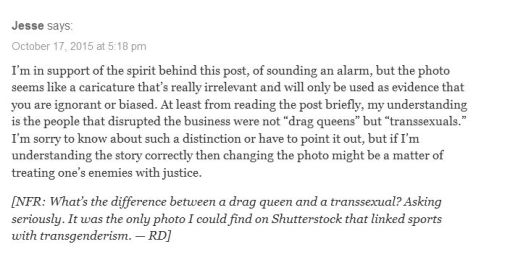
Dreher trans drag

. . . and this. . .

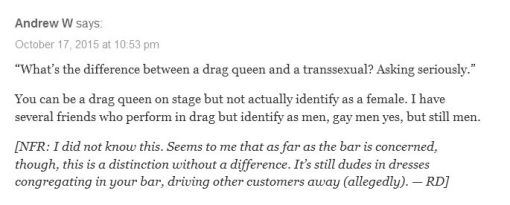
Dreher trans drag2

. . . be so confident in writing this:

Dreher race transSo he knows race and transgenderism are not in the same category, even though he doesn’t know what transgenderism is.

Amazing how that works.

*The post originally had a picture of a drag queen at the top.