Circus Maximus MMXVI: Talk talk

10 11 2015

Reading Gawker’s live blog makes it tempting, but. . .

. . . once again, I am neither listening to nor watching Republicans debate one another on who can heighten walls highest, lower taxest lowest, and shrink government down to the shrinkiest dink possible.

It’s magic!

Those kids could go far.

Of course, I also think this guy would fit it quite well: just substitute “government” or “immigrants” or, really, anybody, and there’s your campaign slogan!


Circus Maximus MMXVI: Don’t know much about history

9 11 2015

On the one hand, voters shouldn’t worry that Ben Carson doesn’t know much about policy because he’s like Solomon:

“There are a lot of policies that I lack knowledge on,” he told reporters during his book signing in Miami on Thursday. “I’m gaining knowledge. But I don’t by any stretch of the imagination confess to knowing everything. That’s the reason you have advisors.”

“Even Solomon, the wisest man who ever lived, said, ‘A multitude of counselors is safety.’ The real question [about candidates] is, after they’re informed and have an opportunity to digest and talk about it, can they make a wise decision? It’s a false narrative that you have to know everything.”

Yet on the other hand he know more than any stupid experts about the purpose of Egypt’s pyramids:

“My own personal theory is that Joseph built the pyramids to store grain. Now all the archeologists”—here, Carson waves his hand dismissively—“think that they were made for the pharaohs’ graves. But, you know, it would have to be something awfully big if you stop and think about it. And I don’t think it’d just disappear over the course of time, to store that much grain.” Carson had his own take on the engineering: “When you look at the way that the pyramids are made, with many chambers that are hermetically sealed, they’d have to be that way for a reason.” The King’s Chamber, as he saw it, was not an instrument panel or a power substation, but a big Tupperware container.

“It’s still my belief, yes,” Carson said, on Wednesday, when CBS News asked him if he still held to this theory. Then, with an almost pitying smile, Carson explained again, as if to a child, that “the pyramids were made in a way that they had hermetically sealed compartments. You wouldn’t need hermetically sealed compartments for a sepulchre. You would need that if you were trying to preserve grain for a long period of time.”

So, riddle me this: how does Carson know what he knows and know what he doesn’t know so that he’ll know when to go with what he knows and when to defer to those who know what he doesn’t know?


Paint it black

8 11 2015

Oh my Apollo, CSI: Cyber is so bad. So so so bad that I can’t even watch it.

I mean, I hated CSI: NY and I still watched it to its wretched, moralizing end, but Cyber‘s writing is so ridiculous that all I can think while watching it is why am I watching this?

So I stopped.

I do know exactly why I watch Code Black, however: because it’s good.

Again, a procedural, and, again, I started watching it because of Marcia Gay Harden and Luiz Guzmán—and they are terrific—but I keep watching it because I want to see what happens next.

Okay, so having Raza Jaffrey (a terrorist in Dirty Bomb, yet another sacrificial analyst in MI-5) doesn’t hurt,  and Kevin Dunn is amusing as the ER’s director—and Moesha‘s dad is there, too, with his son (on the show),  foxy character actor Cress Williams. And, slowly, I’m starting to warm to the various residents.

But I’m into procedurals because I like the cases, and Code Black does a great job with its cases. Okay, some aren’t great—the what-the-hell decision to unkink that woman’s ovary was a bit much—but they keep moving, moving, and in all of that movement you get to see the characters of the docs emerge.

It reminds me of early ER, where all of the action was focused on the work, and before it strayed from the fragile and weird in the ER and into the soapiness of life outside of it.

That the characters have lives outside is clear: Harden’s character, Lianne’s, family was wiped out by a drunk driver, the older resident’s son died of a glioblastoma, the asshole resident is a recovering addict, and you know there’s something going on with Jaffrey’s character to explain why he left surgery for emergency med.

Again, however, all of this is handled through the work, how their “outside” lives affect how they’re doctors. I like that.

But what I’m really impressed with is how they handle grief. It’s accepted that people will grieve in an ER, and the show let’s them do it. In one episode, a mother attacked her injured son for the drunk-driving accident which killed her other son. When one of the residents tried to intervene, Lianne said simply, This is what grief looks like.

Later in that same episode she tells the mother, who hasn’t left her dead son’s side, that she needed to be with her other son. He killed someone, Lianne said, and like any decent person who’s done that, he wants to kill himself. You need to help him want to live.

In another episode, a man comes into the ER to dry out, which he does, but by the end, he’s back, with Lianne stitching up his head. She’s gentle, matter-of-fact, when asked if she’s frustrated: No, a terrible thing happened; this is his grief ritual.

Sappy? I guess it could be, but I see it as a kind of rawness: a terrible thing has happened,  and sorrow follows.

And that’s it; the sorrow remains.

I hope the show, even amidst the predictabilities of the procedural, can keep that rawness, and that sorrow.


Beep beep and beep beep yeah

8 11 2015

So this is what happens when busyness and laziness combine: no postin’.

To compensate, do I do one long post, or a buncha little ones?

Buncha little ones, methinks. Let me start with a question—or two, actually:

  1. How much jail time do you think I would get for beating the shit out of a car which alarm has been going off every 20 minutes or so—sometimes more frequently—for the past two days?
  2. Do you think beating the shit out of the car will in fact stop the car alarm?

Your responses would be greatly appreciated.


Rolling in the deep

28 10 2015

There was a Republican debate tonight and plenty o’ grading for my Friday class. So what did I do?

Watched interviews with Adele on YouTube.

I’m not necessarily a huge fan of her music—I mean, I like her husky voice and retro-soul sound and all, but she doesn’t set my hair on fire—but I am quite a fan of her.

This video is part of the reason why. Start watching about the 9:10 mark:

She starts a bit low-key, but once she gets rollin’, well, who wouldn’t want to hang out with her?

Still got to get that grading done, tho’.


Lines are drawn upon the world

21 10 2015

Liberalism, conservatism, communism, fascism, feminism, environmentalism, libertarianism, anarchism.

Your basic soup of ideology.

I’ve taught an ideology class before, and yeah, I pretty much went through these (and their varieties): it’s bog-standard to compare these different bits to one another.

Yet I, of course, have come to disagree not only with myself but EVERYONE ELSE!!!

(Okay, I doubt very much I’m the only dissenter to this approach, but let’s pretend I’m being original, here.)

My crankiness with the standard approach stems from history, in particular, the combo of teaching the course of Weimar and my earlier musings on modernity. (I’m still musing, by the way, but to no particular end.) I wanted something which helped me to make sense of these histories, and for which history would help make sense of the ideologies.

Blah, blah, what I came up with was something centered on modernity (as historical epoch), which in turn lead to various ontologies (or Weltanschauung—hey, I’m doing Germany, so why not a little German?), which in turn give rise to various ideologies.

Here’s the basic idea: historical epoch

MODERNITY (historical epoch)
Liberalism (Weltanschauung)
…liberalism (ideology)
…conservatism
…socialism
…anarchism
Reaction
…monarchism
…aristocracy
Totalitarianism
…fascism
…varieties of communism
…varieties of theocracy

This is drafty—very drafty—but I’m trying to get at the notion that all of these ideologies in fact come out of world-views which are themselves formed in reponse to Modernity. In particular, I’m trying to get at the importance of the concept of time: of the past, and the future.

So, for example, while the ideologies of Liberalism hold to a more-or-less open future, those of Totalitarianism hold to closed future, some final, perfectible, end. Those of Reaction, on the other hand, reject Modernity’s social-linear notion of time and seek a return of past glories.

What I don’t include here, obviously, is any explication of what Modernity or the various ontologies or ideologies mean. I’m also not so sure about the ideologies themselves: I don’t think anarchism (or libertarianism, which I don’t include) are sufficient as governing ideologies themselves; it might make more sense to fold anarchism into socialism (as I implicitly do with libertarianism and liberalism).

There’s also the matter that these Weltanschauungen are ideal-types, and while the ideologies themselves are closer to the ground, the organization and experience of politics itself tends to slosh over any neatly drawn lines.

Finally, this schema may not travel well to other parts of the world. The experiences of China, India, and Japan (to name a few) are arguably not anchored in a response to Modernity: they’ve got their own things goin’ on. I wouldn’t be surprised to see some sort of overlap in ideologies, but I’d guess the underlying dynamics would be distinct.

I don’t think that’s a knock against this genealogy, however, to say that’s it’s limited: that tends to be feature of genealogies generally.

Anyway, this will take more work (I’ve already modified this from my original presentation in class last week), but I think there’s something there.

And ja ja, Hegel or someone probably already beat me to this. Guess I’ll have to get my own owl.


Listen to the music: And when I’m dead

19 10 2015

Listen to the music is dead; long live Listen to the music.

Okay, so I had this idea to listen to all of my alt-blues-jazz-pop-punk (i.e., whatever wasn’t classical) cds from A to Z. I hadn’t really been listening to enough music, and thought this project would get me back to garden.

It worked, for a bit. And then it didn’t. And then it kinda did, and then it really didn’t.

If I wasn’t in the mood to listen to the next cd in rotation, I didn’t listen to anything at all. I’d occasionally pop in a rogue disc, but mostly, my player went unplayed.

For awhile I thought I’d lost my music mojo: All that had moved me no longer did. I mean, that was kinda the point of starting the project, to reconnect to something which had for all of my life mattered to me.

But it wasn’t true. Music did still move me. I’d occasionally listen to my Mp3 player on the train and BAM, I was right back in it. Or I’d hear a stray song and maybe bounce around, maybe mouth the words, maybe sit as still as still can be.

In other words, I have no earthly idea why I stopped listening to the music in the first place, and whatever my previous sense of Needing-to-see-this-through, well, sometimes persistence is its own obstacle.

I am trying to listen to more of my own music. It’s a connection for me—tho’ to what, I couldn’t tell you—and helps to quiet my distractions.

Maybe I’ll get more writing done; maybe I won’t get anything more done than I would, otherwise. Regardless, I’ll  bounce around, maybe mouth the words, maybe sit as still as still can be.

~~~

Some of what I’ve listened to recently: Hem, Jayhawks, Rickie Lee Jones, Katell Keineg.

I’ll never get married, but if I get married, I’ll dance to this at my wedding:

And this one, well, I like the undertone of menace:


Black coffee

13 10 2015

Have I mentioned how I like my coffee?

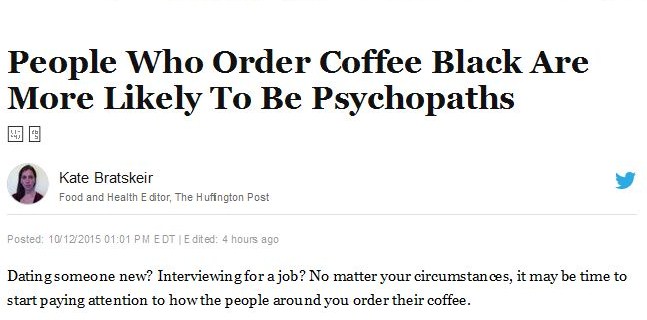
'People Who Order Coffee Black Are More Likely To Be Psychopaths'

I learned the hard way that, in New York, if you want a black coffee, you have to specify ‘black coffee, no sugar’.

‘No cream’ is implied in black coffee, but, unlike elsewhere, ‘no sugar’ is not. You must be clear.

(‘Light and sweet’, by the way, means hop that hot caffeine up on cream—and it will often/always be real cream—and multiple scoopfuls of sugar.)

If the coffee slinger doesn’t know you, s/he’ll repeat this back you, skeptical: ‘Black coffee, no sugar?’

Again, this must be confirmed: ‘No sugar.’

If you buy coffee often enough at the same place, your java dealer will remember you by saying ‘black coffee, right? no sugar?”, then grin when you confirm this is so.

I very occasionally drink coffee and cream—a shot of Bailey’s in a mug of joe is a lovely winter drink—but sugar makes it unpalatable.  I once threw out a large cuppa because I had simply ordered a black coffee, and the server helpfully included the sugar.

That was a sad day.

It was also instructive, as I never made that mistake again.

~~~

I think I’ve mentioned this story before, but it’s good enough to repeat: A former editor of mine at The Daily Cardinal once said ‘I hate coffee, but when I drink it, I drink it black, because real women drink it black.’

Now that’s a role model.


Circus Maximus MMXVI: We don’t need another hero

8 10 2015

“I have had a gun held on me when I was in a Popeye’s organization” in Baltimore, [Ben Carson] told Karen Hunter on Sirius XM Radio, referring to the fried chicken fast-food chain. “Guy comes in, put the gun in my ribs. And I just said, ‘I believe that you want the guy behind the counter.'”

Doubt the guy behind the counter is going to be voting for the good doctor.

Via


Circus Maximus MMXVI: Sincerely

7 10 2015

Hillary Clinton has come out against the Trans-Pacific Partnership, and I say ‘Great!’

I also say: don’t believe it for a minute.

If she becomes president and the deal has been ratified by Congress, she’ll do nothing to overturn it; if it were shot down, she’ll find a way to resurrect it.

So, too, would a Republican president.

Even money on whether President Bernie Sanders would throw in with the TPP.