Summersongs: Romeo Void

7 08 2014

Had enough of the angry money posts? How about biting sex posts?

Biting sex. . . hmmm, I see how that could be taken a couple of different ways. In any case, the “biting” refers to the attitude of Deborah Iyall toward sexy sexytimes and the occasional aftermath.

I first thought “A Girl in Trouble (Is a Temporary Thing)” would be the summersong, but after a night out with C & K, thought that maybe “Never Say Never”

Whatever. It’s Romeo Void, and even tho’ Iyall tells the girl that old man would “be warm in your coat”, why be literal about the coat-wearing and the presumably cold weather?

It’s about the beat and the attitude—and the backup boys singing temporary temporary in the chorus.

Do pop songs even use sax anymore? And, yeah, those Eighties video production values. . . .

I might like you better if we slept together

How can you not sing along to that?


Everybody knows that the Plague is coming, 4

6 08 2014

File under: why would anyone be surprised?

First up: Professor John Ashton, the president of the UK Faculty of Public Health, who writes:

“In both cases [Aids and Ebola], it seems that the involvement of powerless minority groups has contributed to a tardiness of response and a failure to mobilise an adequately resourced international medical response.”

and World Health Organization director general Dr Margaret Chan:

“We must respond to this emergency as if it was in Kensington, Chelsea and Westminster. We must also tackle the scandal of the unwillingness of the pharmaceutical industry to invest in research [on] treatments and vaccines, something they refuse to do because the numbers involved are, in their terms, so small and don’t justify the investment. This is the moral bankruptcy of capitalism acting in the absence of a moral and social framework.”

Second, Allan Sloan, who is surprised enough to be outraged that American companies would park their “incorporation” overseas so as to avoid taxes:

Inverters don’t hesitate to take advantage of the great things that make America America: our deep financial markets, our democracy and rule of law, our military might, our intellectual and physical infrastructure, our national research programs, all the terrific places our country offers for employees and their families to live. But inverters do hesitate — totally — when it’s time to ante up their fair share of financial support of our system.

Profit-seeking companies seeking to maximize their profits?! Who ever heard of such a thing?

And those who don’t invert?

Wall Street is delivering a thumbs down to Walgreens’ announcement of a $15.3 billion plan to complete its acquisition of Europe-based Alliance Boots and decision not to pursue potential major tax savings by shifting its headquarters overseas.

Bad capitalists!

Since all is not gloomy, allow for a bit of intellectual-property absurdity:

Wikimedia, the US-based organisation behind Wikipedia, has refused a photographer’s repeated requests to remove one of his images which is used online without his permission, claiming that because a monkey pressed the shutter button it should own the copyright.

Cheeky monkey*!

David Slater/Caters—and monkey!

*Actually, a crested black macaque

~~~

h/t to a coupla’ folks at The Stranger: Charles Mudede, and Ansel Herz  (twice!)


Everybody knows the deal is rotten, 3

5 08 2014

How wonderful that French and American cultural institutions are expanding into the United Arab Emirates. How wonderful for the Emiratis to visit the Louvre and the Guggenheim or enroll at NYU without needing a passport.

Ibrahim has the sort of intelligence that crackles around him in sly, sarcastic sparks. He is smart in a way so obvious that he tries to hide it from his bosses by speaking in broken English. He knows five languages, loves poetry, and dreams of getting a master’s degree.

Isn’t it marvelous that a man so obviously intelligent and cultured is laboring to bring such cultural riches to the boss who calls him a donkey?

I mean, how fantastic is it that Ibrahim had someplace to go after being chased out of his own country after the NGO for whom he translated couldn’t be bothered to protect him because he wasn’t a real employee? That he was able to pay someone over $700 in order to work in a place that does, in fact, treat him exactly as a laborer?

And shouldn’t we celebrate when

In 2007, up to 30,000 Arabtec workers went on strike in Dubai. Men building Burj Khalifa, the world’s tallest skyscraper, put down their tools. The strike had been coordinated with mobile phones to protest low wages and poor living conditions. Police arrested 4,000 strikers. At the end of ten days, Arabtec promised a pay raise. Managing Director Riad Kamal told Reuters that the impact on the company’s profits would be less than 1 percent.

Arabtec could pay more without any pain to themselves! Win win!

Of course, not everyone was so happy: After 3000 men went on strike for  pay raise from $176 to $217 a month,

The police arrested 70 men they claimed were ringleaders. “Their presence in the country is dangerous,” Colonel Mohammed al Murr, director of the Dubai Police’s General Department of Legal and Disciplinary Control, told the National, a state-owned newspaper.

After this, Bangladeshi workers, who were alleged to have helped organize the strikes, were banned for an indefinite period from seeking UAE visas.

I could go on and on and on and on, but you get the point. Conditions are so terrible in these men’s home countries that they pay to work under terrible conditions.

And the neoliberal sings Ain’t capitalism grand! Isn’t it wonderful that these surplus can be put to good use for 200 bucks a month! Isn’t it wonderful that the Louvre and the Gugg and NYU get to extend their brands and the Emiratis—the citizens, not the vast majority of migrant laborers—get to enjoy these brands!

Isn’t it wonderful that a man who speaks five languages and  loves poetry arrived to find only that he wanted to leave?

~~~

Okay, there is one truly wonderful thing: the workers are fighting back. They are, damn-near-literally, at the point where they have nothing to lose but their chains.

“Capital is global and derives its velocity from replicating the same model everywhere. Gulf Labor is arguing for a global, humane, and fair standard of labor and migration regulations to accompany, and slow down, global capital,” said Naeem Mohaiemen, a New York–based Bangladeshi artist who is a member of Gulf Labor. “The implications can be staggering. If Saadiyat implemented world-standard labor and migration rights, that could become a precedent for implementing the same standards in the entire region. Then people would ask, what about migrant labor in Malaysia? In Texas? And so on…”

Which is precisely why capital fights so hard against labor.

~~~

Extensive quotes from Molly Crapapple’s Slaves of Happiness Island, in Vice
h/t Jen Graves, The Stranger


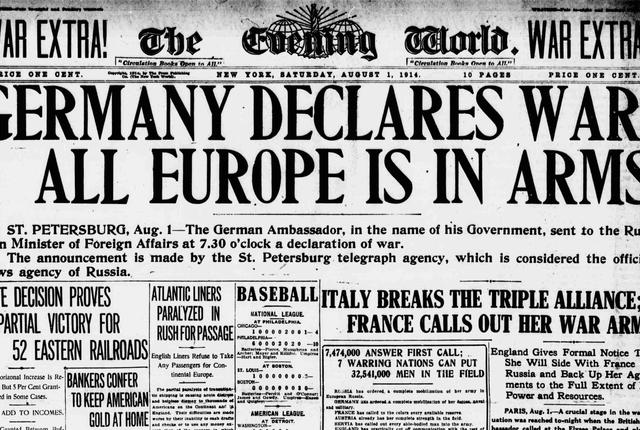
This is the end

4 08 2014
Image credit: Chronicling America

Image credit: Chronicling America

A war begins, and so begins the end of the European medieval period.

The medieval era had, of course, been ending for some time: Luther’s declaration, the wars of religion, the Thirty Years War and the Treaty of Westphalia, the scientific revolution—all of these tore the present away from the past and thrust its people into a new world, literally and figuratively.

Reactionaries bemoaned this newness and sought to wrench their world back; Enlightenment philosophes celebrated the demise of the old and considered the wrenching mere birth pangs for the unbounded future. Ordinary people went about their business, adjusting to spread of literacy and the advancement of capital, managing, as always, what the world presented to them.

Modernity arrived at different times in different throughout its 4-century advance: the Dutch and the Scots were the vanguard, France thrashed violently between the old and the new, Spaniards retreated, and the German-speaking peoples went in all directions in their various lands.

It is the long holdout of those German-speaking peoples and the empires they proclaimed which carried the medieval into the modern era; the Kaiser and the Emperor were the last holdouts.

And thus the war, begun by these medieval powers, brought them to their end.


While my guitar gently weeps

3 08 2014

I need to play my guitar every day.

I do not play my guitar every day.

To be clear: “need” is not about need or desire in an of itself, but in terms of getting better; if I want to get better, I need to play every day.

Which I don’t. Play, I mean. The desire is there; the follow-thru, not so much.

I do play every other day, and if I miss my every or other day, I do get a bit anxious and feel that I’m missing something (i.e., experience a “need” more akin to the first definition); it would help if that anxiety kicked in a bit earlier.

Anyway, if I want to get better, why don’t I play more?

For starters, I suck. I don’t hold down the strings hard enough, my chords fuzz out, and too damn often I nick the A or G string when I’m aiming for D. And because I don’t look at either my right or left hand while playing—that discipline at least has held from those yay-old lessons—I too often reach for the wrong fret.

It’s a mess.

Now, when I do practice, and especially when I practice every day, all of those problems are lessened (tho’, alas, not eliminated)—which brings me back to the question: why don’t I play more?

And here’s the thing: I think too much when I play.

I hate HATE when anyone tells me I think too much: NO SUCH THING! But there is something about letting one’s mind drift which may work better than focusing. When I read, I focus, and when I learn something new, I focus, but I don’t focus when I write, my best runs happen when my mind wanders, and I only got over the hump in pot-throwing when I stopped trying so hard.

I think I have to stop trying so hard with the guitar.

The pot-throwing is instructive: I took a class at Minnesota, and went in periodically during the course to work on my pots (small, uneven, terrible), and I can’t say I enjoyed it all that much. I was continually frustrated—the more I wedged the clay the more air bubbles appeared, the more careful I was in centering the chunk on the wheel the more off-center it became, and raising the sides? Pfft, forget it. I don’t think I’m misremembering when I state that one lesson-night resulted in tears.

And then I got it. I was never great or even truly good, but I got enough that I thought, Hey, I can do this, and so I was more willing to put more time in at the studio. I was also, crucially, more willing to roll with the vagaries of clay and pot-throwing: some days every pot I threw turned out, some days none did, and I was okay with that.

I’m not zen, but I got pretty zen about throwing pots.

I can’t figure out what exactly led to that switch. Something allowed me to hang back from my own throwing, and thus to go more deeply into it; detachment allowed for enjoyment, which led me back into the studio.

I’m not sufficiently detached from the guitar-playing, it seems. I have noticed that when I’m thinking of something other than the notes, I tend to play them much better, that when I bore into the bars I clench up trying to avoid mistakes with these notes and worrying about the notes to come. And I don’t enjoy that.

So: I need to find some reliable way to zone out and let my fingers do their walking. Were that to happen, I might find myself wanting more to hear what they play.


Blames it on fate

29 07 2014

1. Victims are bad political actors.

To act politically is to act power-fully, that is, to wield power. To wield power well, you have to recognize that you are, in fact, capable and in a position to wield power; to wield power wisely, you have to be willing to act beyond the wound suffered, to see that others suffer, and to try to create conditions in which suffering is not the main driver of you and your people.

This, needless to say, is tremendously difficult: Nelson Mandela is lauded as one of the great political actors because he tried to move beyond suffering and to point South Africa toward a future in which all of its peoples took part.

He is lauded because what he did was so rare.

2. This doesn’t mean that victims can’t ever become political actors, or that the circumstances of one’s victimization cannot justly for the basis of one’s political activities.

There is a history of victims demanding recognition as having been victimized, demanding that victimization cease, and in some cases demanding recompense for their victimization. These causes—poor relief, civil rights, indigenous rights, Chicano rights, women’s liberation, gay liberation, disability rights—are just, and justly fought for in the political realm.

I am not arguing that the issue of victimization is off-limits to politics—quite the opposite.

The promise of politics is that one is able to act on one’s own behalf, to act in concert with others on shared concerns, and to act in service to larger principles and ideals. Politics offers the possibility of acting both for oneself and beyond oneself.

Politics offers the possibility of power.

A good way to avoid victimization is to gain power.* It is not unreasonable for those who first gain power seek to use it primarily in defense of oneself and one’s group, and then to try to advance that group’s interests based on more-or-less-narrowly self-interested grounds.

Note that this is the history of politics in New York City.

Note as well that New York City is not known for its pantheon of wise political leaders.

3. To state this baldly: in order to act well, to govern well, one has to leave behind one’s primary identity as a victim and embrace a wider role.

One’s past victimhood may, perhaps even should, continue to inform one’s political actions, but broadly, rather than narrowly, and based on generally applicable principles rather than solely on one’s own, particular, experiences.

Again, those experiences matter—politics ought not be shrunk to mere procedure—but if one’s own experiences matter, then one ought to be able to recognize that others’ experiences matter as well.

If you think it is wrong that you suffer, then you ought to be able to see that it is wrong that others suffer, such that when acting to relieve one’s own and to prevent future suffering, one ought to seek a wide relief, a broad prevention.

You don’t have to do that, of course—see the history of all politics, everywhere—but if you stick only to your own kind, insist that yours is the only victimization that matters, that even to suggest that others may be victimized, much less that you may victimize others, is to victimize you all over again, then you are a bad political actor.

If you cannot see that others may be victimized, that others suffer, then you cannot see others.

If you cannot see others, then, politically, you can act neither wisely nor well.

~~~

n.b. Recent events in and commentary about Israel and Gaza obviously informed this somewhat-fragmentary post.

~~~

*Arendtian tho’ I am, I nonetheless recognize that power may be gained thru non-political means as well. For the purposes of this post, however, I confine myself to political power.



All things weird and wonderful, 42

28 07 2014

Well, this is a no-brainer:

h/t Cute Overload


Gotta keep bars on all our windows

27 07 2014

Israel is us or, shall I say, US, as told by Jon Snow:

I feel guilty in leaving, and for the first time in my reporting life, scarred, deeply scarred by what I have seen, some of it too terrible to put on the screen.

It is accentuated by suddenly being within sumptuously appointed Israel. Accentuated by the absolute absence of anything that indicates that this bloody war rages a few miles away. A war that the UN stated yesterday has reduced 55 per cent of  Gaza’s diminutive land to a no-go area.

Go tell that to the children playing in the dusty streets or the families forced out of  shelters like the UN school compound, to forage for food beneath shells and missiles.

In and out of an Israeli transit hotel for a few hours in Ashkelon, an hour from the steel crossing-point from Gaza, there were three half-hearted air raid warnings. Some people run, but most just get on with what they are doing.

They are relatively safe today because  Israel is the most heavily fortified country on earth. The brilliant Israeli-invented, American-financed shield is all but fool-proof; the border fortifications, the intelligence, beyond anything else anywhere.

This brilliant people is devoting itself to a permanent and ever-intensifying expenditure to secure a circumstance in which there will never be a deal with the Palestinians. That’s what it looks like, that is what you see. It may not be true.

The pressure not to go on this way is both internationally and domestically a minority pursuit.

He notes the security demands and commands from behind windows and walls, disembodied voices demonstrating control over voiceless bodies:

“Feet apart!” they said. “Turn! No, not that way – the other!” Then, in the next of five steel security rooms I passed through – each with a red or green light to tell me to stop or go – a male security guard up in the same complex above me shouted “Take your shirt off – right off. Now throw it on the floor… Pick it up, now ring it like it was wet” (it was wet, soaked in sweat).

From entering the steel complex until I reach the final steel clearing room where I held the baby, I was never spoken to face to face, nor did I see another human beyond those who barked the commands through the bullet-proof windows high above me.

Is this not how we in the US approach the rest of the world? We send drones over deserts and bombs into buildings and we sit in our sumptuously appointed country pointedly ignoring what we do and how we are.


Summersongs: XTC

23 07 2014

Moar music!

Yes, I’ll continue with my Listen to the music series, but I’m feeling a bit. . . limited by the one-way trek through my cd collection. So why loosen things up a bit, and gambol thru some songs of the season.

XTC’s Skylarking is, to me, a summer album. The first single was released in 1986, smack dab in the middle of my college years, and tho’ the album didn’t come out until the fall, my (mis?) memories are of listening to this in the green months of Madison.

The most well-known song may be “Dear God”, because in 1986 in the United States it was controversial to put out a single mildly criticizing/questioning the Big Kahuna. It wasn’t until I brought home my own copy of Skylarking that I realized that I got an alternate version: “Dear God” wasn’t included.

On the one hand, I was pissed, because even though the song wasn’t that great, I liked it well enough, and I didn’t like that it had been removed. On the other hand, I probably laid out 8 bucks for the new vinyl and wasn’t about to shell out even more money just for one song.

Singles? No.

Anyway, the songs that tie me most closely to that time are “Summer’s Cauldron/Grass” and “That’s Really Super, Supergirl”. I could never figure out Andy Partridge’s attitude toward the Supergirl—was he being nasty or pouty?—but I thought, get over it. In fact, I might have liked the song just for the attitude it inspired in me.

Listen to the lovely:

And enjoy the smirk:

Bonus fun fact: I recall Andy Partridge saying in an interview that all Englishmen had two of the following three characteristics: had bad teeth, were bald, were gay. He noted that he was bald and had bad teeth.

Don’t know why I remember that, but I do.


Everybody knows the dice are loaded, 2

22 07 2014

Ariella Cohen, on “poor doors”:

Extell, on Manhattan’s Upper West Side asked the city to approve a plan for a 33-story luxury condo with a separate entry for the tenants residing in the publicly subsidized rent-stabilized units, which will be segregated from the rest of the building into a section facing the street while the luxury units will face the Hudson River.

This address isn’t the only one with citizen-subsidized egress segregation, but the overall numbers remain low, if only because, as Cohen notes, it’s hard to retrofit old buildings with separate-because-unequal entrances.

Still, one gets the sense that if it were possible, it would be more popular among the penthouse set. David Von Spreckelsen, a poor-door developer, defends the tender sensibilities of the wealthy living in tax-subsidized mixed-income housing:

I think it’s unfair to expect very high-income homeowners who paid a fortune to live in their building to have to be in the same boat as low-income renters, who are very fortunate to live in a new building in a great neighborhood.

Take it away, Jean-Jacques:

[I]f one sees a handful of powerful and rich men at the height of greatness and fortune while the mob grovels in obscurity and misery, it is because the former prize the things they enjoy only to the extent that the others are deprived of them, and because, without changing their position, they would cease to be happy, if the people ceased to be miserable.

~~~

It’s tempting to end on Rousseau, but Cohen makes an important point in her ending: such segregation is not inevitable. It was enabled by policy, and can be undone by policy.