And all the little fishes come a-swimmin’ to me

23 09 2009

This was going to be a post about God.

Or mebbe not so much about God, but about the unease I feel at the sight of those who interpose God between themselves and the world, themselves and other people.

But, criminy, on this humid Wednesday night, how ’bout some photos instead?

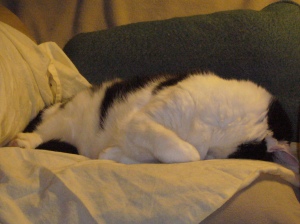
A feline representation of my state of mind

A feline representation of my state of mind

Heading uptown. . . .

One of the things I love about the Cathedral Church of St John the Divine’s is that it is so understated. It is the space itself which impresses, not gilt and glitz.

That said, the sculpture at the entrance to the Close is soooo over-the-top, and so not like the rest of the place, that I can’t help but dig it:

The archangel Michael after slaying Satan, cuddling a giraffe (!)

The archangel Michael after slaying Satan, cuddling a giraffe (!)

You really do have to see the whole thing to appreciate it—

More giraffes!

More giraffes!

—but here are some of the, ah, elaborations around the sculpture:

If I had a better camera, I could give you a glimpse of the magnificence of the interior. As it is, I can offer only this, the rosette above the re-installed organ pipes:

And this, from the chapel of St Martin of Tours:

Sculpture of Joan of Arc, above a stone removed from her cell

Sculpture of Joan of Arc, above a stone removed from her cell

Ah, well, if I’m not hauled off to debtor’s prison and manage to get my fiscal unbalance balanced, I’ll splurge on a camera worthy of this place.

And now for a completely misleading shot:

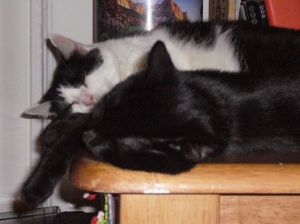
Side by side in perfect harmony. . . ?

Side by side in perfect harmony. . . ?

Actually, not:

Tolerance

Tolerance

This is as close to peace as we get in this household.

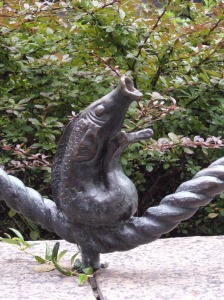
Oh, hell, one last shot of the menagerie surrounding the archangel:

I got a weakness for lizards; what can I say?

(inspired by Ms. Blithe’s photos of sandstorms in Queensland)


God: Gotta love ‘im!

6 08 2009

Just finished GK Chesterton’s Orthodoxy.

Summary: I believe what I believe. Christianity is true because Christianity is true. Non-Christian perspectives do not make sense from a Christian perspective.

Uh-huh.

Orthodoxy is one of those books oft urged on non-believers as a way of allowing us to make sense of, and perhaps, bring us to, faith. It’s not quite an exercise in apologetics, not least because its argument, such as it is, is less about proclaiming and defending the doctrines of the church than in ridiculing alternative beliefs: His critiques of contemporary thinkers are scattershot, mixing and mashing them up so as to be better able to dismiss them all as incomprehensible, and his discussion of doctrine is almost non-existent.

No, the book seems more a matter of Chesterton explaining himself to himself, a turn-of-the-century version of the Talking Heads lyric Well, how did I get here? As such, it’s a kind of brief theological psychology, with reason dragooned into the role of the therapist.

Read this book if you’re interested in Chesterton, or if you particularly enjoy the alleged wit of reversal, along the lines of ‘you think A is B, but B is A.’ O ho ho! Imagine an entire book of such bon mots:

Descartes said, ‘I think; therefore I am.’ The philosophic evolutionist reverse and negatives the epigram. He says, ‘I am not; therefore I cannot think.’

If the apple hit Newton’s nose, Newton’s nose hit the apple.

If Nietzsche had not ended in imbecility, Nietzscheism would end in imbecility.

And on and on, epigram substituting for argument.

Allow me my own: I came looking for the argument from the man, but found the man in the argument. Alas, biography is not philosophy.

See, that’s not so hard now, is it?

Perhaps I should give the last word to the long-departed Mr. Chesterton (substitute ‘book’ for ‘novel’):

A good novel tells us the truth about its hero; but a bad novel tells us the truth about its author.


Ghost in the machine

17 05 2009

She’s been gone two weeks and I don’t feel her anywhere.

I choked up as this photo loaded on to the page, but it’s been been awhile since tears could be prompted by the thought of her.

She’s slipped right through and away from me.

Grief may be about the recognition of absence, as I mentioned previously, but what of the absence of the absence?

I can tell people I mercy-killed my cat and move on. I pull FatCat close to me and wonder how she is as an only cat. I think about getting a kitten in July or August.

I don’t think about Chelsea.

There’s a photo of her propped on top of her empty food dish (a small pot I threw and glazed in her tiger-striped coloring; FatCat has a similar black-and-white dish), but I rarely slide my eyes over the shelf on which the dish sits, so I don’t see her. Out of sight, out of mind?

It’s a relief not always to be verging on tears, but I’m discomfitted by my relatively smooth transition to post-Chelsea life. I was worried about the grief taking me over, but now I wonder about the easy sequestration of that grief.

I thought she’d be here. Yeah, I know, I’m an agnostic about all things supernatural, but I liked the idea of her, somehow, hanging around. Ms. Blithe comforted me with the words ‘Travel well, Skinny Cat,’ and I like the image of her continuing on, somehow.

Somehow. I was worried that my own disenchanted naturalism would dissipate into a cheap spiritualism, that I would be unable to deal forthrightly with Chelsea’s death and thus retreat into a moony ‘when-I-see-her-again’ wistfulness.

This is not a slam against belief. My friend and colleague J. is both ‘an orthodox Marxist and an orthodox Catholic’ (she pronounces this with her finger raised) says that ‘unlike those goddamned Protestants’ Catholics believe that animals have souls and I’ll see Chelsea in heaven. (Which is sweet, really, that she thinks I’ll make it to heaven.) I demurred and noted that some Protestants allow for this possibility, but, as with Ms. Blithe’s comment, I didn’t really take it in. It’s a nice idea that I don’t quite believe in.

I ought to be relieved: my agnosticism is not as blithe as I worried it might be! My beloved cat is gone and I don’t experience her as anything other than gone. She’s dead, as FatCat will one day be, as any other cats I take in will one day be, as my friends and family and I will someday be. Dead is dead.

Curiously, however, I am not eased by the fact that I am not eased by any post-death possibilities. I ought to be pleased with myself, insofar as I sometimes suspect that my agnosticism is little more than cover for lack of commitment. I am committed to doubt! I say, even as I think I am merely keeping all of my options open. Don’t want to be caught out a fool, doncha know.

So the unbelief side of my agnosticism holds. Whoopee.

Another stage of grief? Bargaining or whatever? ‘I want my cat back. I want her here, with me.’ And that she’s not, in any way, is a kind of small desolation which confirms the possibility of universal desolation. Is this the movement out of bargaining into acceptance? That death really does mean separation?

And then wrap this whole situation in the that whole over/underreaction dynamic I have going on, and it would make sense that I lurch from constant sorrow to a certain stoniness regarding her absence, and from there to a cosmic absence for everyone everywhere, forever.

I want to be clear-eyed. I want to remember. I want to keep open possibility. I want to commit. I want to make sense.

So Chelsea’s gone and I know that. I know that too well. I just want her here, as well.

I want something more.


What next Big Sky?

19 04 2009

I don’t Believe much, although I believe all kinds of things. And I don’t Dismiss much, although I dismiss all kinds of things.

Yes, the caps signify one of the Big Issues: Is there anybody out there? Or in here, or laying about. . . somewhere? Anybody?

I mostly don’t believe, although it’s a congenial, changeable kind of unbelief, one which ambles in no particular direction and avoids no particular consequences. There’s a god? Okay. No god? Okay.

Either way. It’s not as if I have much to do with the existence of God or gods, or that gods have much to do with me. Maybe they look in on us every once in awhile, beer in hand, munching nachos and commenting on those crazy Grabowskis or McFees or Olapundes. And then they go back to doing whatever godlike things they do over beer and nachos.

Okay, so that’s a bit cute. And I’m also fudging on the notion that any god(s)’ existence is separate from us: What if they only exist because we believe they exist?

That’s the conceit which underlies Neil Gaiman’s American Gods, a thoroughly enjoyable shamble through the back alleys of American beliefs and folkways. Some—many—of the old deities are nasty, and require a ritual of violence which, for the most part, has been smoothed away from contemporary religion. They’re not nice, and the people who invoke them aren’t always nice, but you nonetheless feel, along with the main character, Shadow, that the loss of these gods would, in fact, constitute a real loss. To forget the tricksters and warriors and shape-shifters would be to forget ways of being in this world, to lose mysteries and secrets and fortuna herself. And, in Gaiman’s world, the gods themselves are bereft, abandoned and small, trying not to disappear.

Even though I’m a big fan of reason, I’m not particularly surprised by my tender reaction to American Gods. As a child with an, mm, active imagination, my default position was that everything—and I mean everything—could think and feel. It wasn’t that I felt this way at all times, but that, when I wanted to, I could conjure up a sympathy with my favorite tree (an elm behind the garage, with a low branch for easy access) or cows in a field or the old cannon standing guard over the lagoon.

In fact, I don’t know that this was so much about my imagination as it was about childhood in general. Kids believe all kinds of nonsense—this is one of the delights and terrors of childhood—and readily share their stories with one another. And they learn not to share too much with adults, who at best indulge them and at worst tear their stories away and shred them. Grow up, they’re told.

As a child who experience the full range of delight and terror, I don’t particularly care to romanticize childhood. I like reason and explanation and science and the whole notion of demonstrable cause-and-effect. And I’m quite taken with the notion of chance and physics combining to form canyons, camels, and the cosmos.

But chance isn’t the same as fortuna, and the indifferent universe can disappoint as well as exhilarate. Most of the time I think, Well, we’re here for 70 or 80 years, and that’s it. If your life is to have any meaning, it’s up to you to make it, and even then, you might fail. Don’t count on anything beyond this world to bail you out of your sorrows, or let anything beyond this world to get in the way of your joys. Anything you have, anything you feel, anything you become is all here, is all you have.

And yet. And yet I think What if? I close my eyes and summon that child-sense of Isn’t there something more? You can see that in my writings today, that semi-constant questionof Is there something more? Wasn’t there something more?

I can’t put that there into words beyond the more; it is in fact beyond me, around me, running ahead and pulling up behind me. I walk under ladders and step on cracks and wish that there were ghosts and spirits and hope that not everything can be explained.


I fall to pieces

25 10 2008

All that there is to write, and all that I don’t write. Bits and pieces, effluvia from the day, surfacing only after the computer is turned off, or things worthy only of quick hits.

So, some of the jottings:

NaNoWriMo: It’s a week from National November Writing Month, and I’m starting to get a bit freaked. Fifty-thousand words! In a month! Jesus Christ!

There is no possible way that I can do this. I have one day off a week. And while I write fast. . . I have one day off a week.

Ah, fuck it. Try and fail. That’s life, ain’t it?

—-

Blogging extras: I see RSS and CSS and Twitter and Deli.cio.us (or whatever) and all this other crap and I go, Huh? Should I be doing something with these?

Nah. Or at least, not now. I don’t have to know everything before I start—do I?

—-

Crushes, cont.: I neglected to mention the anti-crushes, the horrifying obsessions with ideas and worldviews so on the other side of you. Pat Robertson. Jerry Falwell. The 700 Club. Trinity Broadcasting Network. Rod Parsley. John Hagee. All crack for the lefty brain: you know it’s bad for you, but you can’t. stop. watching.

And then, of course, there’s Ayn Rand, the Objectivist wonder drug, turning readers into zombies. Best not to engage them at all.

Like my crushes, I carry the obverse inside me, too, but not willingly. Nope, viruses lodged in my brain,  waiting, waiting, to be reactivated with just one           more            hit.

Brrrr. Scary.

—-

Settling in: Two and a-half years in New York and I’m still not settled. I would like to settle.

When I moved to Bummertown, I thought it would be my last city. Before that, I lived in Feline City, which I loved, but which was also located in another country. In fact, I moved to Bummertown because a number of people had said, Oh, you like Feline City? Well, then, you’ll love Bummertown!

No.

So when I heaved out of there to NYC, I did so with the idea that I would stay—but knowing it could all go bad.

It is not bad. I would like to stay. But for this to be real, for this to be my last(ish?) city, I gotta sink my feet into the concrete.

Hasn’t happened yet. Soon, please, soon.

—-

Procrastination: Sixty papers. Not long, not difficult to grade.

And yet I don’t grade.

Baaaaaad professor. Can I blame my status as an adjunct?

—-

God and alienation: Still working my way through the Bedlam Farm archives, and reading about Jon’s conversations with the Hound of Heaven (Pastor Steve from a local church).

Jon often quotes from Thomas Merton, and he writes often about his struggles with his own spirituality and doubts. This past winter he started blogging about his regular conversations with Pastor Steve, and his uncertain steps toward God.

I, too, for awhile engaged with a local priest (variant: Episcopal) about God and doubt, but after awhile felt like I was simply wasting her and my time. I am not uninterested in God—duh—but I don’t feel any great need to move out of my doubt. I wonder why other people believe, and what God and their relationship to God means to them, but I’m fine with my role as observer rather than participant.

And I admit to some bewilderment at the notion that one can get closer to others by getting closer to God. How does that work? Isn’t that simply a kind of alienation? Running away from the world rather than opening oneself to it?

Not that simple, I know, and it’s entirely possible that opening oneself to God helps one to open herself to the world (cf. Caputo and Vattimo and the concept of weak theology).

Still, as someone who struggles with openness, I see God more as an escape than an entry.

—–

S&P.A, who I knew in Bummertown, have just had a baby. S. was in labor for 25 hours (!), but in the photo of her and her son O., she looks terrific. Really beautiful.

And my roommate’s sister also just had a son. Cute, she said. Round head, round face, and loooong fingers. (Roommate and I are getting along better, these days. All for the good.)

Welcome to the world, boys. We’ll try to keep to keep the lights on for you.