A girl in trouble is a temporary thing

4 06 2009

One more question, and I swear to god that I’m done with this topic (for awhile).

This is directed [out into the ether] to those who would enact a legal ban against abortion:

What will you do to the women?

It’s a simple question, but I’ll be damned if I’ve been able to come up with an answer. I’ve checked pro-life web sites, asked this question in comments sections of blogs, listened to those who want abortion made illegal, and no one will say what would happen to women who want abortions and act to obtain them.

Most declare they have no intention of charging women—we’re all just victims of the big, bad abortion industry—unless those women happen to be the ones providing the abortion. No, those on the receiving end, well, we’re to be pitied for being dragged into the maw of the baby-killing machine.

Erin Manning, who comments on and occasionally subs for Rod Dreher at Crunchy Con, accused me of scaring up a Handmaid’s Tale-style scenario when, some time ago, I asked this question to the Crunchy commentariat. (And, honestly, all I did was ask the question, nothing else.) She then went on to outline a future in which life is valued and women and children protected and supported and valued and families supported and, um, valued and. . . it’s all good!

With those nasty abortionists out of the way, girls and women will apparently be liberated from the degredation of sexual autonomy and boys and men will cherish us as the sanctified vessels we are.

I’m only exaggerating a little bit. Really, she wrote in rose- and golden-prose of this spectacular, life-affirming, future. And she absolutely refused to engage the question of law, order, and punishment.

So, to repeat: If abortion is outlawed, what happens to the women who seek abortions?

Anyone?


Indict! Indict! Indict!

11 03 2009

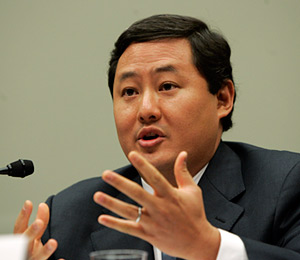
Tenured radical, indeed: former Office of Legal Council/current professor of law John Yoo.

Ap photo/Susan Walsh (via Salon)

Ap photo/Susan Walsh (via Salon)

Here’s a link to Yoo’s infamous torture memo; a key argument regarding the lawfulness of various forms of ‘aggressive interrogation’ can be found on pp. 26-31. The most famous excerpt can be found at the bottom of p. 27:

In defining substantial bodily injury, for example, the statute speaks in terms of disfigurement, or loss of function of some bodily member or organ. In case of serious bodily injury, the statute reaches more serious injuries to include those injuries that bear a substantial risk of death, result in extreme pain, as well as protacted  disfigurement or the impairment of a bodily member or organ.

Here’s the DOJ site which lists the nine recently released Bush-era memos on presidential power; these were apparently written by Yoo and now federal judge (!) Jay Bybee.

Photo via Slate

Photo via Slate

Impeach, then indict, this moral and political cretin, as well.

And all the rest of those who enabled this evisceration of the Constitution and the brutalization of human beings: Indict! Indict! Indict!


Some of my best friends are. . .

21 12 2008

Rick Warren loves gay people.  Most people know I have many gay friends. I’ve eaten dinner in gay homes. No church has probably done more for people with AIDS than Saddleback Church. Kay and I have given millions of dollars out of Purpose Driven Life helping people who got AIDS through gay relationships. So they can’t accuse me of homophobia.

(A gay home? What the hell is that? Is everything all, you know, queer inside?)

And Rod Dreher of CrunchyCon lets it be known, just before he starts screeching about Nazi/Stalinist/intolerant/militant gay activists, that a former roommate of his is gay, that by golly he has friends who are gay.

No, Pastor Warren and Mr. Dreher are absolutely tolerant of the gays. No, it’s those nasty militant gays who are the intolerant ones, the ones who throw around terms like ‘bigot’ and ‘homophobe’ and yell at those who seek to keep the sodomites in their rightful place.

And the whole marriage thing? Let’s let the good pastor explain his opposition to gay marriage: I’m opposed to redefinition of a 5,000 year definition of marriage. I’m opposed to having a brother and sister being together and calling that marriage. I’m opposed to an older guy marrying a child and calling that marriage. I’m opposed to one guy having multiple wives and calling that marriage.

Now that’s tolerance! Comparing same-sex marriage to incest, pedophilia, and polygamy! But hey, he at least said he wasn’t so much opposed to California’s domestic partnership laws which grant hospital visitation rights or allow anyone to name anyone else an insurance beneficiary. Although I don’t know that he’s said anything about advancing a domestic partnership agenda in other states. . . .

The problem, Mr. Warren believes, is that gays don’t seek, um, equality (can’t quite say that word, can ya, Pastor?), but ‘approval’: Much of this debate is not really about civil rights, but a desire for approval. The fact that 70% of blacks supported Prop 8 shows they don’t believe it is a civil rights issue. Gays in California already have their rights. What they desire is approval and validation from those who disagree with them, and they are willing to force it by law if necessary. Any disapproval is quickly labeled “hate speech. Imagine if we held that standard in every other disagreement Americans have? There would be no free speech. That’s why, on the traditional marriage side, many saw Prop 8 as a free speech issue: Don’t force me to validate a lifestyle I disagree with. It is not the same as marriage.” And many saw the Teacher’s Union contribution of $3 million against Prop 8, as a effort to insure that children would be taught to approve what most parents disapprove of.

Ooookaaaaay. ‘Force by law’? Damned, um, straight. Disapprove of me all you like, just as you can disapprove of divorce; just leave me my laws on equal marriage and divorce.

And if you can’t handle having someone label your speech hateful, tough shit. You want to be able to rip on your preferred opponents without anyone calling you out on that ripping—who doesn’t? But someone calling your speech hateful hardly impedes your rights to such speech. Yeah, I know, too many people think ‘hate speech’ should be outlawed (a terrible, terrible idea), but has it been? Have you been arrested crossing the state lines into Massachusetts or Connecticut, Mr. Warren?

Somehow I’ve managed to put up with terms like femi-nazi and traitor, and I’m nobody. I’d rather not be compared to the Gestapo, but I hardly think my rights have been lessened by the moron who’d called me that.You, you big, powerful man, you, you shouldn’t have a problem dealing with a few sissies, should you? (I mean, without hiding behind those African-American voters who supported Prop 8. Because majorities are never wrong about rights for minorities, especially if some of those majority members are minorities in other contexts—right?) If not, well, don’t worry: hurt feelings do not equal fewer rights.

So can the talk about the scary, child-indoctrinating queers. Oh, wait, did I as a citizen just shred your rights as a citizen to blather about incestuous, pedophiliac, polygamous gays?

And how intolerant is it of me to call you intolerant? Am I threatening your rights by stating that if tolerance is to mean anything beyond ‘I won’t kill you,’ then those who profess to tolerate Others deserve to be smacked verbally for unloading such nonsense as ‘I care about gay people’ or ‘love the sinner, hate the sin’ while in the next breath explaining why queers shouldn’t marry or adopt kids, or why the demand for equal treatment under the law is somehow out of line or, gasp, militant.

Militant gay activists. Jeez, that sounds familiar. Militant unionists. Militant black activists. Militant feminists. The gall of us, refusing to accept our inferior status!

I don’t have a gun. I don’t want to shoot you or blow you up. I’m just not willing to go to the back of the line because of the discomfort I cause to your delicate moral sensibilities.

[All quotes courtesy of a transcript of a recent interview, as well as updates, posted on BeliefNet; emphases in the original.]

A coda: I’m not crazy about the term bisexual. It’s not that it’s inaccurate, any more than homosexual or heterosexual is, but that it sticks too close—hell, it is—the technical definition of a form of sexual orientation. Hets get ‘straight’, and homos get ‘gay’ and ‘lesbian’ (along with a bunch of other happy and not-so-happy designations), but bis? We get. . . bi. Blech.

I prefer ‘ambi-sexual’, as in ‘both, around’ (thanks Webster’s!). Ya still got the ‘bi’, but it’s rounded out, more lyrical. Plus, fretful person that I am, I like the proximity to other ambis, as in ‘ambiguous’ or ‘ambivalent’.

Bi? No, ‘ambi’. Works for me.


Coda to: This woman’s work

15 09 2008

I noted in the previous post my, mm, strong opinions on the legality of abortion. But I didn’t say anything about the morality of abortion.

Is abortion moral? Yeah, I think it is. But I also have a lot more sympathy for the position that it is not moral than I do for the position that it shouldn’t be legal.

I think it’s moral because of the status of the woman. When unexpectedly pregnant, a woman has to decide whether to end or to continue the pregnancy (and if she continues with it, to keep the baby or give her up for adoption). It is a real dilemma, one which requires some hard thinking about her own life, her relationship to the man involved, her relationships to other people in her life, and her understanding of the fetus. Is it a baby? A person? Or just a conceptus, a potential person, but not one yet? It requires moral work to make one’s way through these questions, and to consider how to act amidst uncertainty.

Yeah, I know, there are girls and women who act unthinkingly in terminating their pregnancies, but arguably just as many act unthinkingly in continuing them. That some women (and the people around them) don’t do the moral work doesn’t mean it’s not there to be done.

But what of the fetus? Absent a miscarriage or abortion, it will someday push itself out of the woman to enter the world as a baby. Even in its embryonic stage it is arguably human—if only human tissue rather than human being. What about its. . . rights isn’t the right word. . . what about its status? What of the possibility that it is already a human being?

Judith Thompson had one reply to this question, in her famous example of the violinist whose life would end were he not attached to another person. (It’s been a long time since I read the piece—sorry I can’t remember the particulars. And I’ll see if I can find a link to the piece online.) She concluded that even if the violinist would die if you detached him from you, you still had the right to do so.

It’s an interesting piece, but I don’t know that it gets at all the complexities of abortion. Hm. What I mean is, I don’t think that all those who talk about a ‘right to life’ are really into rights talk. I think it’s about something deeper, or at least other, than rights. I think, for many, it is about a protectiveness toward the fetus/baby, and about a belief that one ought to sacrifice oneself on behalf of another vulnerable being.

These are not unworthy sentiments (and I’ll skip for the moment any legislative ramifications—we’re talking about morality, not politics—as well as those worms who are afraid of and want to control or punish women’s sexuality), and ought not be dismissed without deeper consideration.

Abortion is a moral issue. Those of us who believe such a choice ought to be left to the woman need to do a better job of articulating that morality.


This woman’s work

15 09 2008

A 23-year-old woman has been blogging about her decision to get an abortion at myabortion.tumblr.com. Her site, titled ‘What to Expect When You’re Aborting’, includes a line near the top that says ‘I’m 23. I’m knocked up. And I don’t want to keep it. You can fuck yourself, Judd Apatow.’

She notes in her first posting, from August 20,

I’m trying to get some advice and info that isn’t off a bulletin board style fact sheet. When I google “abortion blog” —because we all know blogs are a great repository for facts and rationality— i get these terrifying pro-life, abortion regret websites. One is called ” silent rain”. UGHHHHH.

WHERE IS THE JUNO OF THE ABORTION WORLD?!?

Precious, silver-tongued, knocked up 16 year olds where are you??

I found this site through either Broadsheet or Feministing, and have been reading it for the past few weeks or so. Like the commentators and the blogger herself has noted, it seems really odd that there isn’t more out there in the cyberworld about the experience.

What do I think about the blog? First, the requisite disclaimer: I am totally-utterly-completely-militantly pro-choice. I don’t like parental notification laws, I don’t like waiting periods, I don’t like legislatively-mandated ‘informational lectures’ (that’s you, South Dakota)—I don’t like any more legislative or regulatory conditions attached to abortion than would be attached to any other medical procedure. This is nobody else’s damned business, legally speaking.

And I really do believe all that. I’ve been pro-choice for as long as I’ve been menstruating, have argued on behalf of a woman’s right since I was a teenaged feminist, and have heard the stories of more than one friend who’s undergone the procedure.

I, however, have never had an abortion, never been pregnant. And while I think that I probably would have terminated the pregnancy had I ever gotten knocked up, I don’t know, for sure. I think it’s one thing to have an opinion about an issue, and quite another to have lived through it.

So I’m surprised by my ambivalence toward this blog. I truly don’t know what it’s like to be 23 and unhappily pregnant, and am glad that she’s willing to talk about the issue. (How many women have had abortions? How many talk about their abortions? Not nearly as many as have had them.) But, I don’t know, the tone seems off. Glib. Narcissistic?

AAARRRGH! What the hell’s up with that reaction? She’s 23! Her body is being taken over by an unwanted intruder and she wants it out! But the process of evacuating her uterus is not an easy one. She considered taking RU-486 before deciding on a surgical abortion, but even though this is a generally safe procedure, it’s still surgery. It’s still a big deal.

So maybe this is less about glibness than bravado. When you’re in the middle of the rapids, you just try to paddle yourself out of them; you don’t have time to wonder about the beauty of the canyon or profundity of a waterway which has been carving its way through the earth for millenia. Nope, you’re just trying not to drown.

And I’m on the bank. Who am I to critique her on her technique or disapprove of her brand of kayak? If I don’t like what I’m seeing/reading, I can leave. This is what she’s going through, and how she’s going through it. It’s not about some PR campaign about the Perfect Candidate for the Perfect Abortion Experience. Because what woman could live up to that?

And why should we have to? We shouldn’t have to be perfect (or, shudder, the Perfect Victim) to ‘deserve’ to make decisions about our bodies. It ought to be enough that we live these bodies.


Oh, Martha (part II)

22 08 2008

Martha Nussbaum, Liberty of Conscience, cont.

The beer has been poured. Okay, back to the two main lines of critique: her treatment of issues in chapter 8, and her silence on politics.

I’ll start with chapter 8: Contemporary Controversies. As mentioned in the previous post, Nussbaum picks out the Pledge of Allegiance, evolution, imagination, gay marriage, and fear of Muslims. It’s not clear to me that the Pledge deserves its place on this list (abortion? contraception? sexuality generally?), and in the section on fear of Muslims, she focuses on Europe, but the problem is less with the list itself than in how she approaches these issues.

First, the Pledge. Yes, it has its place in the annals of American jurisprudence, which may be why she includes it here, but this seems an historical rather than contemporary matter. The recent case brought by Michael Newdow, against the recitation of [‘under God’ in] the Pledge, excited a lot of commentators, but as he was denied standing by the Supreme Court, nothing happened. Nussbaum makes a plausible case that it may, at some point, ripen, but not now. As she herself notes, ‘Given public feeling on the issue, it would cause a national crisis were the Supreme Court to say that the words “under God” are unconstitutional. [. . .] If there is uncertainty about the correct way of proceeding in such a momentous case, it is probably wise for the Court to avoid the issue as long as possible—hoping that, in the meanwhile, greater public understanding of Hinduism, Buddhism, and other related religions, as well as a greater appreciation for conscientious moral atheism and agnosticism, will undermine the perception that the opponents of the pledge are all dangerous subversives.’ [314] I won’t be holding my breath for this greater appreciation, but I take her larger practical point.

The teaching evolution in the public schools, on the other hand, clearly is an ongoing controversy. She slips into hermeneutical mode at the outset of the section, pointing out that the Christian fundamentalist understanding of Genesis is unique to a subset of Bible-believers. ‘Practices of allegorical reading of scripture are nothing new, not in the least connected with skepticism or agnosticism.’ [316] Nussbaum takes the reader through Jewish traditions and into mainstream Protestant interpretations of Genesis, noting that ‘Teaching Darwin’s theory does not deny the biblical story (although it does suggest that one would need to read it nonliterally), . . .’ From this she concludes, citing approvingly Judge Jones’s decision in the Dover case, that teaching so-called creation science or intelligent design in the science classroom impermissably imposes a sectarian doctrine in the public schools.

This is all fine, but she’s doing something in the evolution section which evolves (sorry) even further in the section on imagination and difference in the classroom. This is the most intriguing case in this section, and I’m glad Nussbaum brings it up; I’m just not sure that she realizes the profundity of the issues she raises. ‘I have said that the public schools can and must teach values that lie at the heart of our political principles. [. . .] The classroom strongly encourages the use of imagination to come to grips with the variety of people who live together in our country.’ [327] (Leaving aside the fanciful notion that imagination is encouraged in the classroom, it is nonetheless a lovely sentiment.) Unfortunately, ‘For some believing Christians in our nation, this exercise of imagination is sinful. It is a kind of magical thinking, and magic is bad. What is good is strict obedience to the literal word of the Bible.’ [329] She takes up the 1987 case Mozert v Hawkins, in which parents Bob Mozert and Vicky Frost objected to various books on the schools reading lists. They didn’t like how gender roles were portrayed, or the use of the word ‘comrade’, alleged hidden messages promoting satanism, and the purported Hindu influence of the texts. Mainly, however, they objected to ‘exposing ther children “to other forms of religion and to the feelings, attitudes and values of other students that contradict the plaintiffs’ religious views without a statement that the other views are incorrect and that the plaintiffs’ views are the correct ones”.’ [330] Attempts at accommodation failed. The Sixth Circuit Court of Appeals Court ruled against Mozert and Frost; the Supreme Court declined to hear the case.

Why is this such a fascinating case? After all, it seems a no-brainer: As Chief Justice Lively points out (and Nussbaum quotes): ‘The “tolerance of divergent. . . religious views” referred to by the Supreme Court is a civil tolerance, not a religious one.’ [332] The parents and children aren’t required to believe anything about these other religions, and their allergy to mere exposure to them does not rise to the level of religious oppression. They may continue to believe and practice as they see fit.

The civil/religious tolerance (Nussbaum prefers ‘respect’ to tolerance) distinction is a useful one, and does real social and political work: You are a citizen in a plural society, and such citizenship requires a practical recognition of that plurality. You may not like it, you may even try to change it, but as long as such plurality exists, you may not claim legal exemption from it. This seems a straightforwardly democratically-republican understanding of the obligations of citizenship: Democratic insofar as it recognizes difference, and republican in the insistence on a similar public treatment of one’s fellow citizens.

But what if one’s religious views truly do not allow for a recognition of difference? What if it truly is onerous to one’s religious practices and beliefs to act respectfully (or tolerantly) toward the Other? Nussbaum argues in favor of a generous interpretation of polygamy as it related to 19th century Mormons, namely because it was central to their beliefs. What if the shunning of the Other is central to belief? Nussbaum could make the ‘compelling state interest’ argument, but she sticks to the civil tolerance theme. It’s a reasonable tactic, but in doing so she ducks an unavoidable consequence of the judgment: that tolerance of the intolerable can itself be oppressive. Had she used the state interest argument, she would have had to confront head-on the coercive nature of the state’s action. Coercion may be inevitable in these cases; the least we (I concur with the court’s decision) can do is grant the Mozerts and Frosts (as well as those opposed to the teaching of evolution) the recognition of that coercion.

This also raises the question of how to deal with the children in such cases. Nussbaum writes movingly of the role of imagination in Women and Human Development, and I’m inclined to agree that a life is not fully human without such imagination. But we Americans also grant wide latitude to parents to raise their children as they see fit, seeing these children (especially when young) as members of a family more than as fully rights-bearing individuals. (It’s been a long time since I’ve read Amy Guttmann’s Democratic Education, but I think she makes the argument that we might want to consider a bit less deference toward parental control.) What if parents raise their children in such a way that they are unable, when adults, to make their own way in the world? Nussbaum is surprisingly assertive of children’s rights as individuals in Women and Human Development; here, she sidesteps the issue.

I suspect the problem is her desire to accommodate all sides of the debate (as evidenced by her careful repetition of the list of not only monotheists but also Hindus, Buddhists, Taoists, Confucianists, pagans, atheists, and agnostics in her list of interested parties to the various debates). Consensus, when honestly reached, is terrific, but it is not always possible. In some matters, there are winners and losers, and that hard truth ought not be hidden.

Nussbaum at least puts together coherent arguments for the first three issues; not so for the fourth issue and fifth issues, gay marriage and fear of a Muslim planet. To take the latter issue first, she notes that while there have been isolated instances of anti-Muslim violence in the US, Muslims are, for the most part, free to practice their religion. (I think she downplays the significance of expressed anti-Islamic animus, and she ignores the post-September 11 roundups of Muslim males by FBI & immigration officials, but she’s right: there haven’t been any pogroms.) Thus, after a brief mention of the veils and drivers licenses (and some self-congratulatory words on Americans’ deep and entrenched respect for religious difference), she heads to Europe.

Europe is a problem for Nussbaum. Europeans value diversity less, have done a lousy job integrating immigrant populations into their societies, and in some cases (France!) are intolerant of public displays of religion. Nussbaum is not the first person to point out the difficulties some European nations are having with ethnic and religious minorities, but she does a terrible job—actually, no job—of putting such difficulties into context. She makes mention of the treatment of Jews in the eighteenth century, and that’s about it. Really: all of European history is dealt with in less than two paragraphs on p. 348. She thus concludes, from her voluminous historical research, that ‘The reasons for this difference between the European and the American traditions are many and complex. One reason was surely that the Americans had experienced the European way and didn’t like it.’ Uh huh. The other two reasons are lack of majority religion in the US (given the varieties of majority-Protestantism), and that ‘European nationalism has typically relied on ideas of blood, soil, and belonging to define nationhood, whereas America’s self-conception as a nation has, like India’s, been political: a set of democratic commitments, not a single ethnic style, is what holds us all together.’ [348]

Even I, who is embarrassingly ignorant of much European history, knows this is wrong. Blood and soil may matter to some versions of fascist thought across various countries, as well as to non-fascist sensibilities within some countries, but it was hardly across the continent. How would she explain republican France, with its emphasis on language and republican ideals? Or to British imperial history? Even if I agree with her that Jack Straw’s statements about niqab-covered women are appalling, I’m so damned bothered by her shallow understanding of these other cultures that I’m inclined to dismiss everything she has to say on this particular issue.

Finally, given her discussion in Women and Human Development of the distortions of adaptive preferences (i.e., one makes the only choices one can, however lousy, and may come to value them as good choices), how can she not even consider that some forms of religious dress might actually be oppressive? To continue that line of questioning would take me outside of the realm of this book review (and I go back and forth on this issue), but, shees, to state that the burqa is as unproblematic as ‘normal Chicago winter gear and surgical masks’ [350] is. . . idiotic. I don’t like using such a term for a thinker I (generally) respect, but the thoughtlessness of her narrative on this point is dismaying.

Which leaves me with the gay marriage section. If the Muslim section is a trifle, the piece on gay marriage is an offensive and incoherent mess. For much of the book she takes the side of the minority believer against majoritarian practices. This is a legitimate approach, but it breaks down when the issue is less of the freedom of religious expression than freedom from religion. Thus, she considers gay marriage from the perspective of belief, and questions whether any religious tradition requires gay marriage. Some prohibit, some allow, but none require. Given that Nussbaum wrote sympathetically of the centrality of polygamy to 19th century Mormon beliefs, one might suspect a concurrent sympathy for alternate forms of marriage, but the lack of centrality of gay marriage to religious belief means, for Nussbaum, that the First Amendment has little to say on this issue. ‘It seems difficult to imagine any Free Exercise claim in this area.’ [338] However,

The Establishment Clause might seem more promising, for many people see the current restrictions on same-sex marriage as a de facto establishment of a Christian or Judeo-Christian norm. But a case that claimed a right to marriage for gays and lesbians on Establishment Clause grounds would be extremely weak. As I’ve argued, these limitations on marriage are not particularly characteristic of Judaism and Christianity, at least in their present form; they are things with regard to which Judaism and Christianity are deeply divided, and non religious America is also deeply divided. Nor is there any religion that strongly promotes same-sex marriage, though many permit it.

Moreover, the state has always chosen definitions of marriage and family that favor some traditions and disfavor others, without any apparent constitutional problem under the religion clauses. . . .

But if the issue of sexual orientation is not really a religious issue, or, at any rate, not an issue to be handled under the religion clauses, is there some other way in which these clauses can help us think through our divisions over these issues? [339-40]

Oh. My. First, she offers NO EVIDENCE for the assertion (the second in this section; see also 338, top) that atheists and agnostics are divided on the issue of gay marriage. Maybe we are, maybe we aren’t, but given that it seems so terribly convenient for Nussbaum to make this assertion (so as to say this isn’t really a religious issue), I’m not taking her word on this.

In fact, it seems terrifically important that secularists are divided, precisely so she can avoid dealing with the religious component of the anti-gay-marriage argument. Because she is so focused on believers, she can’t come around to the other side to see that at times what is required, from the perspective of liberty, is a claim against religion. Dammit, it’s getting late and my thoughts are fraying, but let me try to hash out this last point before going to bed (I guess I’ll have to finish in a part III.) Nussbaum tosses out that states have always regulated marriage—so what? Nevermind that she considered prohibition of Mormon polygamy as inimical to freedom; as long as gay marriage isn’t anywhere required by religion, no problem. (Of course, there’s also the matter that some religious proponents of gay marriage are advocates precisely because they see the sanctification same-sex relationships as intrinsically involving core precepts of their beliefs. Nussbaum, however, rides right past these arguments.)

But, of course, there is a problem, akin to that facing Catholics in Protestant-influenced public schools: the state has taken on the prejudices of sect and, in imposing the requirements of that sect on all, violates its own neutrality and thus, the rights of those outside of that sect. For Nussbaum to state that because Reform Jews and some Christian denominations welcome gay marriage means there is no sectarian influence in the definition of marriage is to ignore large swaths of the political debate surrounding this issue, as well as common sense.

Shit, I’m breaking up, and I want to be very clear in the rest of my critique. I’ll pick this up later. Now: to bed.


Oh, Martha

22 08 2008

Martha Nussbaum has written a mediocre book. I am sorry to write this, insofar as she is a thoughtful writer working in the liberal tradition, but her new book, Liberty of Conscience, is not good. Worth reading—maybe—but by no means a vital contribution to the issue of religion in the public square.

Nussbaum is a philosopher and legal scholar; unsurprisingly, then, she approaches the question of religious liberty in the US less as a political matter than a Constitutional one. There is history, but of the history-of-ideas sort, emphasizing Roger Williams and James Madison rather than how indigenous people, colonists, and later, Americans, practice their religion on the ground. She covers various debates over establishment and free expression in the federal Constitutional Convention as well as some state debates. She also highlights particular 19th century events, such as the reaction to the newly-formed Church of Jesus Christ of Latter-Day Saints (aka Mormons) as well as to increased Catholic immigration. She then takes a tour of the usual 20th century Constitutional suspects, hitting on the role members of minority religions have played in expanding deference to non-majority (i.e., mainline Protestant) practices. Nussbaum makes clear her preference for the approach the Supreme Court used in Abington School District v. Schempp in general, and for the jurisprudence of Justice Sandra Day O’Connor in particular. She ends with a discussion of five current issues (the Pledge of Allegiance, gay marriage, evolution, imagination, and the fear of Muslims), and a professed optimism that liberty will out.

That is a very short summary of the book, and those with a particular interest in debates over Constitutional interpretation may be more (or perhaps, less) impressed than I with her argument. Such debates are not, however, a concern of mine. (Yes, I have opinions on this matter, but these are not bones on which I care to gnaw.) My unease with her narrative grew over the course of the book, culminating, upon entering chapter 8, in a kind of disbelief in her approach. But before I launch into full critical mode, I would like to mention a few irritations.

First, the book feels loose. I use her book Women and Human Development in one of my courses, and she mentions repeatedly that different portions were presented in various seminars, colloquia, and conferences; so, too, with Hiding from Humanity: she’s returning to and revising familiar material. She does mention in both her notes and in the acknowledgments section of Liberty various prior presentations of the material, but the chapters are noticeably drafty.

Which brings me to the second irritant: sloppy writing. Although I haven’t read all of her work, Martha Nussbaum does not strike me as either a sloppy thinker or writer. If this were your only exposure to her thinking, however, you might conclude otherwise. She rightly valorizes Roger Williams’s early advocacy of liberty of conscience and religion, and highlights excerpts of his 1644 Bloudy Tenent of Persecution which would earn a political candidate a media shellacking were she or he to repeat them today. Still, was Williams as influential as she proclaims? Yes, she mentions Locke, Kant, Smith, and Madison (though doesn’t have much good to say about Jefferson and not much about anyone else of that time), but Williams is given the primary credit for having influenced American sensibilities on religious liberty. Maybe. Yet Nussbaum is so effusive in her praise of him that I wonder who’s been downgraded to make room for all this promotion.

More trivially, she uses the term ‘reasonable’ more often than a reasonable person reasonably should; this is especially apparent in chapter 7. Now, this is problematic not only for aesthetic, um, reasons, but also because the constant invocations of what reasonable people may reasonably do elides the fact that reason is not always the overriding factor in peoples’ thoughts, feelings, or actions (something which she discusses, at length, in Hiding from Humanity). By the end of the chapter the references to reasonableness take on a skin of desperation, as if the repeated mentions themselves will pile up to bridge that gap between the unfortunate is and the promised land-of-reason ought.

(Most trivially? ‘In 1831, in another case very like that of Jonas Philips, another Jew, confusingly named Levi Philips. . . .’ [129] What?! Why the ‘confusingly named’? Lousy sentences are not unforgivable, but I bring this one up to highlight a certain slackness in editing. There are, alas, other examples.)

Third irritant: The presentation of history from the Northeast south and westward. This is a general bias in our national narrative, but for the love of pete, can’t SOMEone try to remember that some of the earliest Europeans to hit the continent were the Spanish? Yes, anti-Catholic sentiment was heightened in tandem with increased Catholic immigration, but is it just possible that, as (Protestant) settlers moved westward and encountered already-existing Spanish and mestizo—Catholic—populations, that hostility flared between these groups? I honestly don’t know, but could we at least expand our understanding of the history of American colonization to include Spanish (and French Catholic) settlers?

So much for the minor points. On to the truly problematic: her approach to secularists, and the discussions in chapter 8. But first, I need (okay: want) a beer. Part II follows.