If you choose not to decide, you still have made a choice

6 03 2013

Do you become more or less of a crank the more real your anxieties become?

I’ve joked that I’m a privacy crank (even as I realize the, ah, complexities of worrying over privacy on a public blog), but I’ve felt pretty confident that I’d be able to balance my antipathy to any kind of tracking with desire to participate in a full social life. I accept cookies in order to access certain websites, but periodically clear my cache and browser history; I have a cell phone which I can use to text and *gasp* talk, but which doesn’t have a GPS. I search on Google, but not while I’m signed in to my job-related Google account (which, outside of work, I never use).

And I live and work and ride the trains of and walk around New York City, which has CCTV mounted in train stations and on the sidewalk. I don’t like the surveillance cameras, but as a small and plain person, I doubt very much that I’m camera-candy.

At least, that’s what I tell myself.

But it seems as if the chances of being both social and private are dissolving in the corrosive effects of a culture which wants only to “share” and technologies which enable such sharing. As Mark Hurst points out, while one could try to minimize the omni-info maw of social media, a technology like Google glasses sucks you in—whether you want to be so sucked or not:

Remember when people were kind of creeped out by that car Google drove around to take pictures of your house? Most people got over it, because they got a nice StreetView feature in Google Maps as a result.

Google Glass is like one camera car for each of the thousands, possibly millions, of people who will wear the device – every single day, everywhere they go – on sidewalks, into restaurants, up elevators, around your office, into your home. From now on, starting today, anywhere you go within range of a Google Glass device, everything you do could be recorded and uploaded to Google’s cloud, and stored there for the rest of your life. You won’t know if you’re being recorded or not; and even if you do, you’ll have no way to stop it.

And that, my friends, is the experience that Google Glass creates. That is the experience we should be thinking about. The most important Google Glass experience is not the user experience – it’s the experience of everyone else. The experience of being a citizen, in public, is about to change. [emph in the original]

Y’know those illegal cell-signal blockers? Would they work on something like this? If not, someone is working on countering this, right? Right?

Because, at some point, if you can’t legally opt out of this surveillance without opting out of society, those of us who want to be around other people without being subject to their tracking techs might want to consider, mmm, other ways to remain free social beings.

. . . . Yeah, I really am a crank, aren’t I?


Come together

25 02 2013

This is as close as my critters get to cuddling:

012

Twenty minutes after I took this shot, Jasper leaned over and began licking Trickster. Which was, as ever, prelude to biting.

Oh well, they both seem to like me well enough.


No hippychick

17 02 2013

I have never been hip.

There have been times in which I might have approached cool, but, really, I doubt I’ve ever been cool, either.

No, I run too hot: I was too eager, too earnest, too political, too angry, too depressed, too neurotic, too in-my-head, too awkward, too dismissive, too dug-in, too restless, too. . . yeah, I dunno what exactly hip is, but I was too-much (and not-enough) ever to be it.

I’m not bashing the hip, however—at least, not in the this post. Yes, when I lived in the un-hip far-out-on-the-L section of Bushwick and had to deal with the polyester-bowling-shirt-surfer-shoe-straw-hat-wearing skinny folk of the near-L-stop Williamsburg and hip-Bushwick, I met my weekly quota of sneering-at-hipsters with ease. But now, away from the L train and a bit more ensconced in my life in New York, I shrug my shoulders and think, Eh, it’s a thing.

And, honestly, while I never could have been hip or cool (or punk or goth), there was always a part of me that was/is fascinated by the performers of hip. I was waaaaay too self-conscious to have treated my life as a kind of performance, to have shown myself off with such elaborate disdain for anyone who wasn’t me and mine.

Oh, I disdained, believe me, but I could never achieve that combination of commitment and detachment necessary to the extended pose of the hip. I didn’t have the knack.

All of which is a long way toward considering yet another NYTimes Style section piece on Brooklyn hipsterdom—only this time, the hipsters have moved upstate, to what author Alex Williams calls “hipsturbia”.

There’s much to criticize about the piece, as there always is with Style section essays—the exclusive focus on above-median-income white people, the writing off of large sections of Brooklyn, the constant need to say Brooklyn is over, etc.—but I don’t know how critical I can be of those profiled in the piece.

They want their comforts at an affordable price; who doesn’t?

Sure, it sounds obnoxious to decide to live in a place because when you did a Google Map street search you found more Subarus than SUVs, but who doesn’t look for signals that a particular neighborhood might work for someone?

I don’t have much money, but even with my limited funds I had (and have) my preferences. I like my general neighborhood and am glad for my train options, but would like to be closer to Prospect Park, and a few more coffee shops/bistros/pubs would be nice. I like trees.  I’d rather live with more apartment space in Brooklyn than less in Manhattan. And since I’ve never been hip, I don’t have to worry that as Brooklyn is, pace the Times, fading in hipness, it’s no longer the place for me.

Anyway, it seems as if the problem is less with the former Brooklynites than with the Times trying to stamp its own narrative on their exits. It’s not that hard: these folks are trying to find a way to live their lives in ways that make sense to them, and are trying to figure out how to blend what they like best about Brooklyn (or, really, any place they lived and loved before) with what they can find where they are now.

Trying to figure out how to make sense ain’t a trend; that’s life.


All things weird and wonderful, 30 & 31

31 01 2013

Two-fer weirdness!

Fred Clark at Slacktivist/Patheos tipped me off to both of these—okay, he didn’t email me personally and say, Hey, Absurdbeats, these might be candidates for your weird wonder series, but as I’m a reader and he presumably writes for his readers, why not say he wrote about these for me?—where was I? Oh, yes, while trying to decide which to use, it occurred to me that this is my blog, and I can both of these suckers if  I damned well please.

Which I do.

So the first:

It Takes Planning, Caution to Avoid Being ‘It’

Group of Men Have Played Game of Tag for 23 Years; Hiding in Bushes, Cars

Russell Adams, Wall Street Journal

[…]

One year early on when Mike Konesky was “It,” he got confirmation, after midnight, that people were home at the house where two other players lived. He pulled up to their place at around 2 a.m., sneaked into the garage and groped around in the dark for the house door. “It was open,” he says. “I’m like, ‘Oh, man, I could get arrested.’ ”

Mr. Konesky tiptoed toward Mr. Dennehy’s bedroom, burst through the door and flipped on the light. A bleary-eyed Mr. Dennehy looked up as his now-wife yelled “Run, Brian!” Mr. Konesky recalls. “There was nowhere for Brian to run.”

[…]

That’s right, ten men have been playing tag for 23 years.

That’s some fuckin’ dedication, man, and if it isn’t quite as weird as some stuff (or the next item), it’s still a damned fine enough to count as wondrous.

Now this, this is weird:

Source: scuba.com

The comment on this delightful specimen:

Come on, evolution, you cannot be serious with this sh—

Oh, wait. OH. Ha! I get it. Clearly the red-lipped batfish is a work of satire, not meant to be taken as a literal “animal,” which would of course be ridiculous. Sorry, I can be a bit slow sometimes. Nice one.

The site is WTF, Evolution?, and it’s only two weeks old, so go ahead, catch up, then follow it FROM THIS DAY FORWARD.

I was talking with one of my students today about how amazing biology is—I did manage to restrain myself and not use the phrase ‘weird wonder’—especially in comparison to non-quantum physics.

Nothing against non-quantum physics—gravity and the conservation of matter and the principle of inertia are all deeply practical things—but it’s not. . . ohmyfuckinggod mindblowing the way quantum physics and almost all of biology is.

Newtonian physics, I mused to the student, is efficient and predictable, but biology, emmm, not so much. Biology is all about survival, so anything that will get you there, well by gum, let’s do it! And if conditions change such that more adaptations help with survival and reproductive fitness, go ahead, just tack those adaptations on!

If physics is sleek and efficient, then biology is a Rube Goldberg contraption.

“I’m not sure we’re done with this fiddler crab yet.” “Don’t be such a perfectionist, evolution, it’s good enough.” “But the claws are totally different sizes, don’t you think people will notice?” “Dude, it’s fine, let’s go make some birds with funny butt feathers.”  (Thanks to @davelevitan for the suggestion.)

It’s true, I don’t always love life, but damn! I do loves me some Life!


Cry me a river

21 01 2013

So I awoke to a great wailing and gnashing of teeth. . . no, wait, that’s not right.

So I awoke to confused alarms of struggle and flight. . . no, no, that’s not it, either.

So I awoke to a sledgehammer pounding the plaster and tile in the apartment above. Ah, yes: that’s more like it.

This was a good thing.

Why? Because of this:

004

The cats noticed before I did (I always get nervous when they stare at the wall or ceiling, afraid of some fearsome bug), but before long the consequences of those odd, easily-ignored, noises became apparent.

Don’t judge me: When you live in an old building, there are always odd noises. If you don’t learn to ignore them, you will spend all of your time tracking down the whys and wherefores.

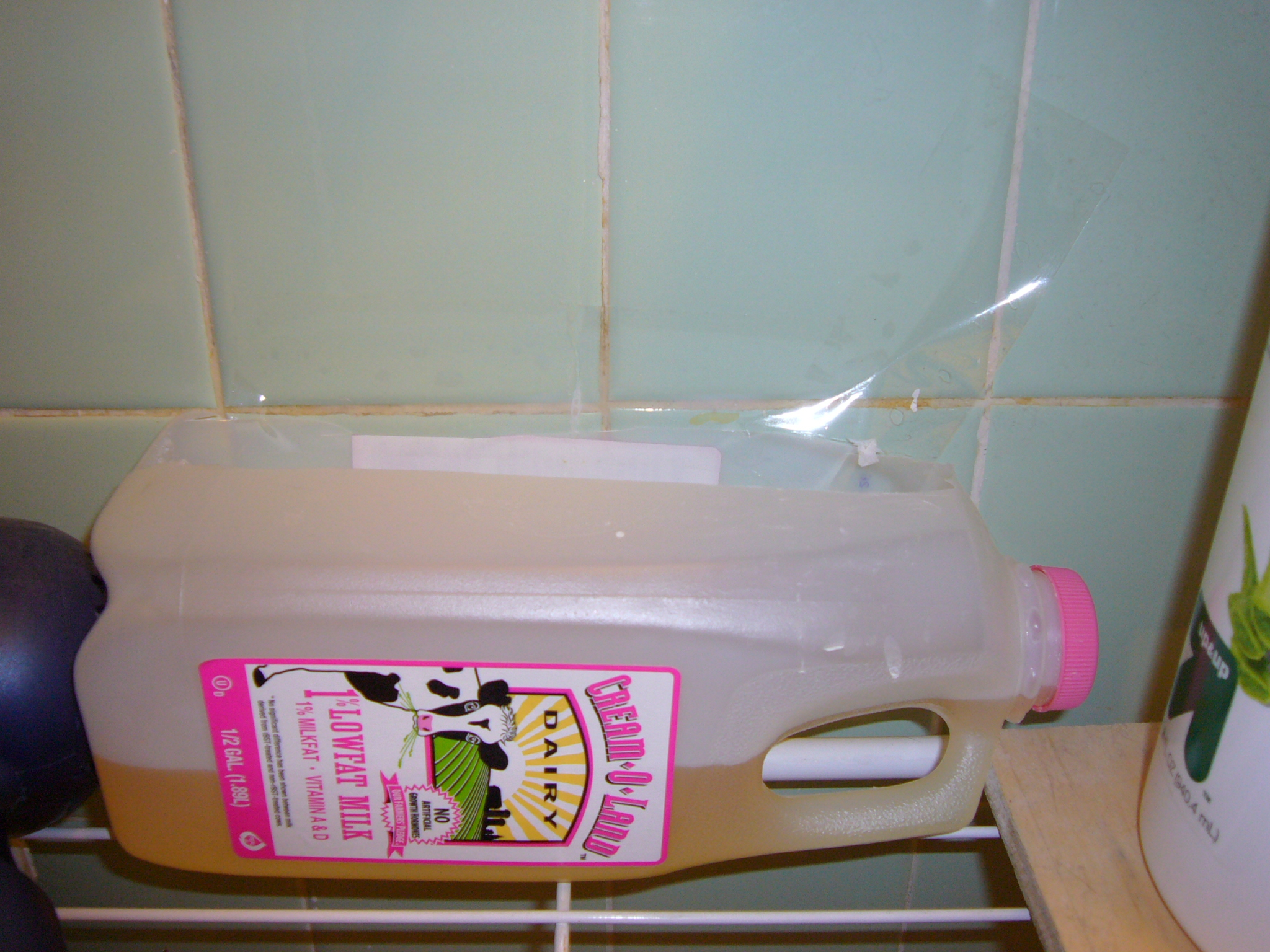
This, however, could not be ignored. Friday night it was just the living room wall, but by Saturday, the other side of the wall, in the bathroom, was pooching out. The living room wall looked bad, but there wasn’t too much water; the bathroom wall, however, was rather too weepy.

005

I’m not much for weeping, either by me or my walls, but daubing it with a towel wasn’t going to make it all better. So, in the spirit of what used to be called jerry-rigging, then MacGyvering, but has now been snazzed up to “life-hack” (which, by the way, did you see this list of 99 life-hacks? handy!), I rigged up a catch-basin for the wall’s tears:

006

Two keys to this, of course: One, the cap (which, unlike the recyclable jug, had to be dug out of the trash), and two, the tape. The water would just have dripped behind the plastic had it not been given a slide from the tile into the jug. Luckily, the drip path didn’t follow the grout line, so the tape held its own.

(And no, that’s not sewage in the jug; the water was colored by whatever is in the wall.

Anyway, the super was up bright and early smashing walls for the plumber, and they’re now up there stomping and clanging and scaring the hell out of my cats and, hopefully, putting an end to the source of the walls’ agonies.


All things weird and wonderful, 29

15 01 2013

The poetry of material things

What a lovely name for a Tumblr.

I am a materialist—tough to be Marxisch and not a materialist—but, honestly, I hadn’t really considered the poetry in the material, itself.

It was there, of course, in every Art Deco building or carved lintel, every curving bridge, strutting muscle car, and heavy-ceramic diner coffee cup. I noticed the beauty, but not the material, the sea, not the water.

I love this image. Ordinary and sublime and balanced without fussy symmetry. Just so.

How can this be real? It must be a poem. . . .

(h/t The Near-Sighted Monkey)


Devil was my angel

14 01 2013

Is it an aha moment if it drags you down and hollows you out?

Kurt Anderson at Studio 360 has been running an occasional series on “Aha Moments”—those encounters with books or movies or music which have changed one’s life.

Most of the stories are enlightening or funny or just sideways; I wonder if he’d want to hear about dark epiphanies?

I may have discussed this before, but what the hell: I was around 15 when I had mine. Two years earlier I had first started trying to kill myself, and after one brief ER visit and overnight psych ward stay at 14, I was trying to come to terms with my inability to end myself.

It was also around this time that I read The Thorn Birds, by Colleen McCullough. There’s a scene late in the book when the priest Dane, Maggie’s son (by the priest Richard Chamberlain Ralph) goes for a swim, saves two women from drowning, then feels his heart bunch up. He begins to struggle to get back to shore, then says, in effect, Isn’t this what I want? To be with God? He stops struggling, spreads his arms, and drowns.

(That’s how I and Ms. Wikipedia remember it, at any rate.)

Well. That made quite an impression: Is this what I really want? To die? I could only answer, Yes. Am I ready to open my arms and let go? Not yet. Ah. This means I should wait until I’m ready, and only then kill myself.

Now, you might think this is pretty fucked up because. . . it’s pretty fucked up. Why did I have to answer Yes to the want-to-die question? I had no other answer. I had so humiliated myself by my failure that it seemed to me the only way to overcome that humiliation was to succeed.

Oddly, then, the Dane-epiphany kept me alive. I couldn’t stand another failure, and I couldn’t stand to live: thinking that I could stay alive long enough to prepare myself for death gave me some breathing space (albeit of rather toxic quality). I’d think about it periodically, check if I were ready, say nope, then keep living.

Of course, the pressure built. I tried and failed again in college, then again my first year of grad school. At this point I just said Fuck it, and stopped dealing with anything having to do with depression and suicide. I avoided books and movies on the theme, and did my damnedest to shut it all down.

And that worked, for years, that worked. And then the cracks, the frays, the quake, the buckling—whatever metaphor you prefer—and there I was, much older, and still not dead.

Which was a problem.

I was at least able to figure out that if I still hadn’t killed myself, well, y’know, there was something I could do about it. Back into therapy, back into the fight should-I-stay-or-should-I-go, blah blah. I did the work, I excavated myself, exposed the structures of my fucked-up living-to-die being, and by the end,  could neither stay nor go.

And then I had another moment. This wasn’t an Aha Moment the way the Dane thing was, but was a recognition, nonetheless. I had been listening to a lot of Beth Orton, and there was one song, Devil Song, which stayed with me, stretched out and empty and barely there.

But looking back in retrospect
Did you ever really get what you’d expect?
Trying to rectify
Got lost a little further
You’ve been trying to justify
Find out how and where it came

Devil was your angel, but it’s not no more
The devil was your angel, when you weren’t sure

Yep, pretty much.  And then there’s this:

Gonna take you back down
I won’t feel no shame
Till my dreams
Are my own again
Gonna take you right down, and I’ll take the blame
Till my dreams are my own again

Here I am again

Those lyrics didn’t save me. In some ways, I didn’t even save me: as I’ve mentioned previously, there was no decision, just a leaf turning this way rather than that.

But I think there was something in this song that said, in effect, you can go with this. Just because you were that before doesn’t mean you have to stay that way.  It’s okay not to die. It’s okay to be alive.

It’s coming up on 12 years since that night, and I’ve remained here. And that’s all right.

Here I am again.

Not yet, but getting there, getting there.


Listen to the music: Keep on keepin’ on

8 01 2013

I lost my groove.

I mentioned in a previous post that I am no longer a completist, that is, I no longer need to own every cd by every singer or band that I like. Five U2 cds? Enough. Six REM? Plenty. It’s not that I won’t buy any more cds of those for whom I already own multiple discs, but, y’know, the urgency has faded.

Given my former completist sensibilities, however, I do own many cds by one band/singer which, frankly, has been a problem on my quest to listen to every cd I own: I burn out on a group.

My current (cheapo) stereo allows me to load 3 discs at a time, which is just right: Enough for a solid listening section, without me wanting to cut it short. But when you’re working through your collection alphabetically, that means the Beatles are followed by the Beatles followed by the Beatles.

I like the Beatles. But, unlike in the past where I would overdose on a single group, I no longer have the patience to listen to three or six hours of the Beatles or Beck or, really, anyone. Hell, the 72-minute long Mary J. Blige cd was too long for me.

Like I said, the groove was gone.

Once it became apparent that I was avoiding listening to my cds because I didn’t want multiple all-Beck nights, I decided to switch things up. I considered just plucking cds out randomly, but I figured that the pick wouldn’t really be random and that I’d just pick cds I often listen to. No, better to continue with the alpha-step, but tweak it.

Now, when I have more than one cd by the same performer(s), I choose the first one, then pick a cd from the following groups. So I chose Beck’s Mellow Gold, then Daniel Belanger, then Belle and Sebastien’s “Tigermilk”. The next night, Beck’s Sea Change, Belle & Sebastien’s Storytelling, and Belly’s star.

Works like a charm.

A few other things. One, I really do like Belly. I like Tanya Donelly’s wordplay (On every track/I fractured every back/Thinking the point was step on every crack), and how her voice cracks on “Super-Connected”—one of the things that distinguishes pop singing from, say, operatic singing is that the flaws are an integral part of the force of the song. (Think of Merry Clayton’s break in the Stones’s “Gimme Shelter”: she’s been hauling Jagger through that wail, and when she finally breaks near the end, you know what she’s been through and what she’s put you through.)

Two, I am a puddle in the face of a good leftist rallying song. Goddamn if I didn’t tear up listening to Black 47’s “James Connelly” (Oh Lily, I don’t want to die, we’ve got so much to live for/And I know we’re all goin’ out to get slaughtered, but I just can’t take any more). I am a pinko all the way through my bitter little heart.

Three, I think this whole quest is starting to take shape. Early on I was treating this as a kind of duty; even as I claimed I wanted to see if I could recapture my connection to the music, it felt more like a test—and who likes taking tests? But I’ve gotten off my ass enough times to shimmy around the wood floor, or paused just to take in the words and the sounds that now, now it feels more like a chance.

And that’s all right.

~~~
28. Be Good Tanyas, Chinatown
29. Be Good Tanyas, hello love
30. Beach Boys, Endless Summer
31. Beatles, Revolver
32. Beatles, Abbey Road
33. Beatles, Please Please Me
34. Beatles, White Album
35. Beatles, Sgt. Pepper’s Lonely Hearts Club Band
36. Beck, Odelay
37. Beck, Midnight Vultures
38. Beck, Mutations
39. Beck, Mellow Gold
40. Daniel Belange, Rever Mieux
41. Belle and Sebastien, “Tigermilk”
42. Beck, Sea Change
43. Belle and Sebastien, Storytelling
44. Beck, Guero
45. Belly, star
46. Belly, King
47. Benedictine Monks of Santo Domingo de Silos, Chant
48. Beta Band, Hot Shots II
49. Bettie Serveet, lamprey
50. Jordy Birch, Funmachine
51. Bjork, Post
52. Black 47 [eponymous ep-cd]
53. Mary J. Blige, No More Dramas


The sweetness follows

31 12 2012

Merry happy peaceful.

040

Still here, still on the way.

May where you are be as maddening and exhilarating as you desire.

May your desires confound and delight you and carry you away and bring you to where you need to be.

May we all be where and how and who we need to be.

With kisses.


I pick up the phone and go Execute

27 12 2012

Are we always already cyborgs?

Sorry for the Heideggerianism, but it’s tough to talk about ontology and technology without bringing in the Nazi Gasbag, specifically, his Question Concerning Technology and, for that matter, Letter on Humanism.

What’s set off this spasm of speculation? A bit in Crooked Timber on a piece by Noah Smith about cyborg techs. Chris Bertram was snarking on economists in his bit, but the, um, question concerning (cyber) technology is taken up with some vigor in the comments.

One question, of course, is the one ol’ Marty throws at us: what is it to be a cyber-human? Can one even be a cyber-human? He, the master of despair, would say No:

In truth. . . precisely nowhere does many today any longer encounter himself, i.e., his essence. Man stands so decisively in attendance on the challenging forth of enframing that he does not grasp the enframing as a a claim, that he fails to see himself as the one spoken to, and hence also fails in every way to hear in what respect he ek-sists, from out of his essence, in the realm of an exhortation or address, that he can never encounter only himself.

As I paraphrased this elsewhere (okay, my dissertation), “There can be no peaceful coexistence between technology and humans because the ways of technology, in the course of enframing humans, prevent them from being fully human.”

This drives Heidegger over the edge: “We have only purely technological conditions left. It is no longer an earth on which human beings live today.”

To which I responded, more or less, Bosh.

Heidegger’s concept of enframing helps us to see how caught up we are already in a techno-scientific world, that we are not separate from the technologies we create and use, and, as such, are shaped by the techs themselves. But as acute as Heidegger was in diagnosing technoscience, his prognostic skills for humans were warped by his own, ah, idiosyncratic understanding of history, and rather complete misunderstanding of actual humans.

And even the acuity of his diagnosis is marred by its partiality, that is, that he treats technological practices as somehow more forbidding and final than every other social practice that ever existed before.  In other words, he gets the transformational powers of technology, but in assigning the power to the techs rather than to the nexus of social practices which produce them (although he does go forward from the techs to the practices they produce) he misses the continuing human presence in the tech practices themselves.

This line of thinking leads rather easily to Foucault and his much-quoted bit—“My point is not that everything is bad, but that everything is dangerous, which is not exactly the same as bad. If everything is dangerous, then we already have something to do”—as well as to Donna Haraway’s admonition that “We cannot pretend we live on some other planet where the cyborg was never spat out of the womb-brain of its war-besotted parents. . . . Unlike the hopes of Frankenstein’s monster, the cyborg does not expect its father to save it through a restoration of the garden.”

In other words, this is how we are, and how we are today is as human as we want to be.

Two further points: One (and this was going to be the main point of this point until I sidetracked myself, and hm, maybe I really should make that a separate post), the real excitement about cyber-techs is about the dream of control—and it is the dream, not the tech, that is the worry.

A précis for that separate post:  A computer, its parts and software can all be patented and their use, to some extent, controlled, but what we think when we’re away from the computers remains with us, is beyond the control of any owners or managers. I don’t know if implants would make us more productive, but they would certainly make us more manageable.*

The concern, I’d argue, lies more with the management than the implant.

*Note: This is not necessarily an argument against all implants, and the speculative future post will dig around the nuances of cyber-techs and practices, but, y’know: précis.

Two, it’s not at all clear that we much care how human we are or could be.

Heidegger bemoaned the concealing power of techs—to do is not to think—but it’s doubtful than many people in the history of people have ever spent much time pondering being. Maybe cyber-techs will hide us irrevocably from ourselves, but it’s also just possible that in thinking about how we incorporate these techs into ourselves, we’ll wonder not just about the techs, but about us.

I doubt it, but what the hell: one can always hack the hack.