Don’t get your back up over this

1 06 2009

I don’t lose arguments.

Arrogant? Maybe. But also true.

I have lost arguments, many, many, arguments. But not anymore.

Why not? I’m not a genius, and I don’t know everything, so it’s not as if I couldn’t lose an argument. And I still get pissed off and lose my mind—which is not so good from the never-lose-argument perspective.

And I still drink.

Nonetheless, there are a number of very good reasons why I no longer lose arguments:

One—and this is the most important reason—I don’t engage in arguments I know I’ll lose.

It is so, so easy to avoid losing arguments if you keep yer yap shut when you don’t know what the hell you’re talking about. I don’t argue about baseball statistics, the appropriate strike formation for an attack on North Korea, or the best way to skin a rabbit. I don’t argue about the advantages of a V- versus inline-cylinder engine, the success rates of arthroscopic surgery, or what makes a souffle rise or fall.

In other words, I don’t argue about most things, because I don’t know most things.

Two, I always admit when I don’t know something. This is not only the honorable thing to do, but it’s also useful: I don’t hang an entire argument on a questionable piece of information.

So, for example, I might suggest that the reasons that women get abortions early in their pregancies are distinct from the reasons of women who procure later-term abortions. I don’t know this for sure, i.e., I haven’t conducted a survey or read through all the data on abortions, but I’ve done enough reading to render this a plausible argument.

But that’s as far as I’ll go. I won’t say This is a fact or Everybody knows when I don’t know if it’s a fact and it’s not something that everybody would know.

(And I never say Everybody knows. Good lord, talk about an easy way to lose an argument: All one’s interlocutor has to say is I don’t know that and game over.)

Three, I’m ruthless. I’ll nail the other person for trying surreptitiously to change the terms of the argument, using a phrase carelessly, or trying to back away from a statement which has since become problematic.

Four, I don’t cheat. This is the flip side to number three: I don’t put myself in a position where the other person can call me out.

Five, I don’t argue when I’m drunk. Anymore.

Six, I don’t argue when I’m really angry. Anymore.

You’ll note, then, that my overall posture is defensive. I don’t overextend myself and always seek the firm ground, and a large part of my strategy is simply waiting for or baiting the other person (in)to making a mistake.

This strategy, of course, does not necessarilly lead to winning. I do sometimes win arguments, especially when I have a command of the facts that the other person does not or I simply frustrate the other person into a blunder, but more often I simply don’t lose. Draw.

I learned the beauty of the draw in grad school, after losing many many arguments to my friend D. D. was smarter than me, more worldly, already had a master’s upon entering the Ph.D. program, and one of the most competitive people I’d ever met. We’d start a conversation, which would turn into an argument, which would turn into a wipeout.

Then, at some point, I got smarter. I paid attention to how D. argued, how he’d slice away the portions of an argument which were inconvenient to his point of view, change the terms of the debate, or assert matters of fact which were, in fact, contestable.

I say this in admiration. He was smart and competitive and knew that the rules only mattered if you got caught. And I started to catch him, and once I did, I stopped losing to him. I don’t think I ever won an argument, but I could draw him out until we would admit to a mutual, exhausted, halt.

THAT was victory.

This history helps to explain why I love to argue with people who are smarter than me: It makes me sharper and forces me to call on every last scrap of knowledge in order to keep up.

Similarly, the desire to stay sharp goes a long way toward explaining why I keep up with the arguments of whatever ‘other’ side there is to an issue I care about. If they have a good argument I want to know it, so I can learn how to counter it.

(No, it’s not all tactical. I also keep up with ‘other’ sides because ‘my’ side has its own blind spots, and if I truly want to know something, I have to be able to see what I can’t see.)

To state that I don’t lose arguments isn’t to say that I’m never wrong. I’m often wrong—I don’t know most things, after all—and, given that I don’t know most things, am far too free with my words. But these are fragments, shootin’-the-shit briefs with coworkers or friends meant to be toss-offs. Assertions, after all, are not arguments.

Finally, I should reiterate that I don’t, in fact, engage in many arguments. I argue with Jtt. because she’s always ready for a throw-down, and always willing to put her authoritarian views on the line. (Also, every conversation with Jtt. can seem like an argument, even when it’s not. It’s how she is.)

But it’s rare that an opportunity for a truly interesting argument presents itself, one in which all present are sober (enough) and engaged (enough) and informed (enough) to really go tits-out  into battle.

And that’s cool. Once I no longer worried about losing arguments, it was no longer so important to turn every discussion into an argument. Now I can have good, heated, involved, conversations with friends, conversations in which our passions lead us to question and into uncertainty and, perhaps, into discovery.

I like to compete, and to know that I can compete. I also like that there’s more to conversation than competition.


For she loves you for all that you are not

23 05 2009

I love a good ruin. They rarely disappoint.

Buildings, I mean. Edifices. Material constructs: walls, gates, jetties, fences. Anything built to last, which crumbles.

I was perusing a book today on abandoned places—factories, mostly, but a few schools—and all I could think was slowly flipping through the pages was Oh, I want to go there.

Not that I have anything against visiting functional places. Or living in one: I like having heat and hot water and plaster which stays on ceiling and walls rather than spitting down on my head. And if you buy me a ticket to the Tate or the Louvre or the Prado I will very happily mose my way through them (tho’ a ticket to the Hermitage? I’d take that one first of all).

But after making my way through what I could of the Hermitage, I might ask if it’d be possible to check out Chernobyl. Suit me up and lead me through the plant itself, then mose with me through the near-empty streets and in and out of abandoned buildings. Let me see the overturned desks and pictures on the walls of the schools, the dust on the windowsills and the paint peeling up in waves.

Let me see all that is no longer there.

Do I find ruins romantic? Not exactly. Haunting, perhaps. Thrilling. A little spooky. It’s as if by everything being laid bare, something even more is hidden. There is the evidence of stories, with the stories themselves—gone. The silence whispers.

I remember as a kid going to Disney World and wanting more than anything to explore the castle at the center of the Magic Kingdom. A castle! What could be better!

Castle—pfft. It was a big damned hallway. I still remember walking into the joint and looking around and looking around and looking around and thinking. . . this is it? This isn’t a castle, this is just. . . a big building. A big damned disappointing building.

More disappointments followed. I’d see a building with a magnificent edifice and enter and then. . . nothing. Or, worst of all, suspended-tile ceilings, florescent-tube lighting, and gray carpeting. (Ever been though the buildings on the quad at Duke University? Gothic exteriors, seventies interiors.)

FelineCity had a good mix of old, still functional buildings and places going to seed (sometimes they were the same places).  They also had a series of ports, some of which didn’t do enough business to justify more than a chain strung between two rusted poles and a vague intimation that trespassing was not allowed, which I freely explored on my bike and on foot. There were floating rustbins and dilapidated offices and crumbling walkways and not really anyone around to shoo me away.

GradCity was also on a river, and the industries which had clustered along the waterway had largely taken leave of the city, their factories left behind for the homeless, the punks, and restless students like me. City officials have since refurbished these areas, inviting the regular folk to enjoy the scenery. I can’t really complain, not least because I no longer live there, but I do miss the kind of furtive exploration these abandoned spaces allowed.

There are seedy and abandoned spaces all over New York City, but I haven’t done much poking around them. Security is tighter here, of course, and it is more likely than not that these derelict places are nonetheless inhabited. But still, if I could get a guide. . . .

And oh! That place on Long Island, the old mental hospital? Totally off limits. I want to go.

This city is built on ruins. Yes, history is constantly erased in this Land of the Developer, but just as often it is merely hidden, built over or around, odd nooks or old mosaics or peculiar stonework all that’s left to signal that there was once something else, here.

Perhaps this is why ruins exhilarate in ways that Main Attractions! rarely do: The magic castles are so often filled with nothing but the lure of the Magic™, where the excitement is in the anticipation, not the exploration. All pitch, no promise.

But ruins pitch nothing, and that they promise nothing other than ruin is what allows one to consider not what is to come, but what has been. They are literally throw-backs to another reality, and they tempt precisely because they are present markers of the absence of another present, and presence.

Something else, something other, something more.

Gone, but not quite.


Ghost in the machine

17 05 2009

She’s been gone two weeks and I don’t feel her anywhere.

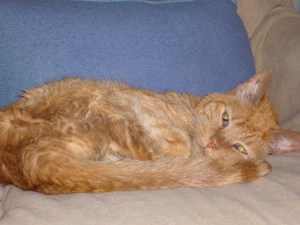
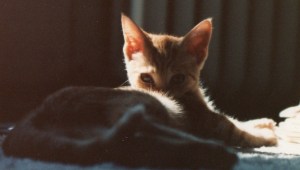
I choked up as this photo loaded on to the page, but it’s been been awhile since tears could be prompted by the thought of her.

She’s slipped right through and away from me.

Grief may be about the recognition of absence, as I mentioned previously, but what of the absence of the absence?

I can tell people I mercy-killed my cat and move on. I pull FatCat close to me and wonder how she is as an only cat. I think about getting a kitten in July or August.

I don’t think about Chelsea.

There’s a photo of her propped on top of her empty food dish (a small pot I threw and glazed in her tiger-striped coloring; FatCat has a similar black-and-white dish), but I rarely slide my eyes over the shelf on which the dish sits, so I don’t see her. Out of sight, out of mind?

It’s a relief not always to be verging on tears, but I’m discomfitted by my relatively smooth transition to post-Chelsea life. I was worried about the grief taking me over, but now I wonder about the easy sequestration of that grief.

I thought she’d be here. Yeah, I know, I’m an agnostic about all things supernatural, but I liked the idea of her, somehow, hanging around. Ms. Blithe comforted me with the words ‘Travel well, Skinny Cat,’ and I like the image of her continuing on, somehow.

Somehow. I was worried that my own disenchanted naturalism would dissipate into a cheap spiritualism, that I would be unable to deal forthrightly with Chelsea’s death and thus retreat into a moony ‘when-I-see-her-again’ wistfulness.

This is not a slam against belief. My friend and colleague J. is both ‘an orthodox Marxist and an orthodox Catholic’ (she pronounces this with her finger raised) says that ‘unlike those goddamned Protestants’ Catholics believe that animals have souls and I’ll see Chelsea in heaven. (Which is sweet, really, that she thinks I’ll make it to heaven.) I demurred and noted that some Protestants allow for this possibility, but, as with Ms. Blithe’s comment, I didn’t really take it in. It’s a nice idea that I don’t quite believe in.

I ought to be relieved: my agnosticism is not as blithe as I worried it might be! My beloved cat is gone and I don’t experience her as anything other than gone. She’s dead, as FatCat will one day be, as any other cats I take in will one day be, as my friends and family and I will someday be. Dead is dead.

Curiously, however, I am not eased by the fact that I am not eased by any post-death possibilities. I ought to be pleased with myself, insofar as I sometimes suspect that my agnosticism is little more than cover for lack of commitment. I am committed to doubt! I say, even as I think I am merely keeping all of my options open. Don’t want to be caught out a fool, doncha know.

So the unbelief side of my agnosticism holds. Whoopee.

Another stage of grief? Bargaining or whatever? ‘I want my cat back. I want her here, with me.’ And that she’s not, in any way, is a kind of small desolation which confirms the possibility of universal desolation. Is this the movement out of bargaining into acceptance? That death really does mean separation?

And then wrap this whole situation in the that whole over/underreaction dynamic I have going on, and it would make sense that I lurch from constant sorrow to a certain stoniness regarding her absence, and from there to a cosmic absence for everyone everywhere, forever.

I want to be clear-eyed. I want to remember. I want to keep open possibility. I want to commit. I want to make sense.

So Chelsea’s gone and I know that. I know that too well. I just want her here, as well.

I want something more.


No one is alone. . .

13 05 2009

. . . Oh yes, we are. Or is that ‘Oh yes, one is’?

Anyway.

Many of us to choose to live alone, and we cultivate our solitude even as we cultivate friends. Some of us would like to marry or attach ourselves to a intimate companion, but we’re not necessarily distraught over the lack of such a companion.

We’re alone, and we’re all right.

And yet, even if we’re—oh hell, lemme switch to the (duh) singular—even if I’m okay with my solitary existence, I’m okay because it is not only solitary. Among the main reasons I left Bummerville was the difficulty in finding friends—true friends, people with whom I’d share ideas and embarassments and beers and tears, not just folks with whom sharing went no further than ‘What’s new?’ There were a few people, here and there, but I lacked that gathering of intimates, the jumble of personalities who, collectively, form a kind of thick weave of comfort around oneself.

I can’t say I’ve fully cultivated those rich layers of friendships in New York City, but I have discovered some people who I hope to spend the rest of my life getting to know, and some of whom I already consider good friends. This is a tough old broad of a place, and as much affection as I might have for tough old broads, I also need trusted allies in dealing with her. Hence, the friends.

That works for regular life. What, however, of the ruptures of illness or trauma or disability of whatever sort? On her NYTimes blog, The Well, Tara Parker-Pope highlighted a report from the Human Rights Campaign Foundation on the difficulties same-sex couples may encounter in trying to care for their partners in hospitals. She notes that

While heterosexual couples typically don’t have to provide marriage licenses to hospitals in order to prove they are husband and wife, same sex couples often must document their relationship to hospital officials before being allowed to take part in a partner’s care.

In some cases partners and their children were barred from the bedside, and their beloved died alone. Even when they had documentation of their relationship, including legal papers in which they were designated as health proxies or given durable power of attorney, the partner often had to fight to be able to care for his or her companion.

I’m not going to go into the idiocy and brutality of exclusionary policies—commentors on the blog do that quite nicely—but instead will simply note that same-sex couples and single people are in many ways in the same unseaworthy boat: We’re screwed when we need help and institutions won’t recognize those whom we would like to help us.

Even when I was straighter than I currently am, I believed that single (straight) women should unhesitatingly support gay rights. Control over one’s body? Check. Control over one’s sexuality? Check. To live outside of normal sex roles? Check. To choose to have kids or not, and in what circumstances? Check. To live one’s life in a way that makes sense to her? Check.

Attacks on LGBT folk for their (our) allegedy degenerative effects on the rest of the healthy, wholesome, heterosexual social body can, without much imagination, morph into attacks on single folks themselves. Marriage is sacred, marriage is the foundation of society, heterosexual commitment is required for stable communities, sex outside of the bonds of matrimony is empty and selfish and dangerous, blah blah. There is One Right Way To Be, and to Not-Be that way is to be, well, ‘that way’.

Fine, so I’m ‘that way’ in more than one way. But this is how and who I am, and I’d like some security in my lonely and alienated unpredictable and gratifyingly cobbled-together life. And as much as I support same-sex marriage, I want to make sure that those of us who choose not marry don’t get left behind in that leaky boat.

Queer folk have (along with feminists) questioned the boundaries of matrimony and family and rightfully demanded reconsiderations of those boundaries to include a panoply of orientations and identities. This is good. But if the efforts to broaden the definition of marriage serve only to reinforce its privileges, well, that’s not so good.

So what do we single folk do? Do we follow the route taken by domestic partners and file paperwork designating friends as health care proxies? Do we give a list of approved visitors to any hospitals we use, so administrators don’t have to worry about violating HIPAA [privacy] regs?

If I’m in an accident or get sick, I want my friends to know. (Well, honestly, part of me wants to tough it out alone, the same part which is berating me for saying I want my friends to know. But hospitals suck and they suck even more when you’re in one alone. So Shut up, me.) I want them asking about my care and in my room and, if necessary, kicking someone’s ass on my behalf.

I want them to do what my family, a thousand miles away, couldn’t do. I want my people, here, to be with me.

Maybe this starts in conversations with friends. We talk to one another, find out what kind of support we have and don’t have, want and don’t want. Tell each other what we want from each other, what we’re willing and able to provide to one another.

I’m still assembling my life, and while it’s possible that at some point I could meet someone who could be a lifelong companion, I’m not waiting for him or her.

This is it. I am alone in this city—except for my friends. That’s a damned significant exception, and I’d like these folks to be able to act as my Significant Others.


That was the river/This is the sea

11 05 2009

Why bother with openness and honesty? Really, what’s the problem with a little subterfuge?

This, from a woman who blogs pseudonymously, who refers to FelineCity and Bummerville rather than the real places—and who’s trying to come to terms with life in general and her life in particular.

I intiated this blog with the notion of playing with ideas, of being able to turn things over in my hand without having to worry about referees and journals and publications. I took myself off the tenure track on purpose (another post, perhaps), but didn’t want to take myself out of the realm of political theory.

And it was to be about the ideas, not about me. But it’s become about me. I’ve set up another blog for my students, and some of my ideas about politics have migrated or will migrate to that site. It’s not that I’ve given up on politics and theory on this site, but my, ah, considerations of existence have become more prominent than expected, which means the considerations of my existence have also become more prominent.

This is not a problem. But there is the matter of my pseudonymity, and of the people in my life. I am protective of both my and their privacy, but the dynamics behind that protectiveness vary. While I don’t reveal my name, I’m more than willing to scrutinize my own actions—camouflage in service to revelation.

But I don’t want to hurt anyone else, and don’t particular want to reveal aspects of others’ lives that they may not want revealed. It’s one thing to relate a story in person to a friend; it’s quite another to send it out into the wild west of cyberspace, uncontrolled and uncontrollable. An empathic conversation in an intimate setting could simply devolve into bloggy fodder for someone else’s machine.

Yet what if your story is intertwined with someone else’s? Lori Gottlieb wrote an essay in this past week’s NYTimes about the complications of writing about one’s mother. If you write about your childhood, she notes, it’s inevitable that parents will make an appearance—and that they may not like it. She quotes Susan Cheever, who edited out a particular anecdote about her mother at her mother’s request: ‘Now I’d probably say, ‘It’s your life, but it’s my book.’ ‘

Does one’s book trump another’s life? Perhaps it would be more straightforward to say It’s your life, but it’s my life, too—and we don’t get to edit each other’s lives.

In Losing Mum and Pup, Christopher Buckley writes about his famous parents, Pat and William F., in ways both affectionate and morbid. Given what I had read on Crunchy Con, I had expected a scathing account of their parenting, but the revelations of their, ah, quirks as Mum and Pup seemed to conceal even more. Still, should Christo (as WFB referred to him) have written so expansively of his father’s drug habits, or his habit of unzipping and peeing out the car?

On the other hand, C. wrote a beautiful essay about one of her few memories of her mother, a beloved woman who died when C. was very young. There’s a context to this tale which is not explicitly mentioned (namely, the rest of C.’s life), but the story stands on its own, with a thin and sharp sorrow slicing through the poignancy of the tale. I’d heard it before, amidst a long conversation, but written on its own it’s taken on a resonance I didn’t hear amidst the crowd of spoken words.

I’m so glad she wrote it. It is a story which deserves its flight.

Still. I don’t write about my parents, with the exception of the posts on my dad’s stroke. We’ve had our difficulties, and I have made my own kind of peace with my folks—a peace which would not be served by debriding old wounds. They’ve healed enough; let them be.

Do I betray my writing in my silence? This is something memoirists often cop to: We’re writers, we betray, it’s what we do. I can’t speak to anyone’s sincerity in so copping, but it seems glib, a kind of cheap badge of courage: Look at all I’m willing to destroy in order to create!

I am not at all willing to destroy my parents. I’m not famous, they’re not famous, and the chances of them ever coming across anything I’ve written is very small, but I’m not willing to pick at them publicly. (Privately? Well, that’s what therapy was for. . . .) They’re decent people, and they don’t deserve that.

Would I write about them after they die? And would that be better or worse? After all, it is precisely because they’d be beyond my words that they’d be unable to respond to them. I don’t know what I’ll do, not least because I don’t know who I’ll be when they do die, and what I’ll need and want when they are gone. It is entirely possible, however, that I’ll never write much about them.

Is that protectiveness? Cowardice? Exhaustion? Yes.

But what of my own life? Why not reveal myself? Here, again, I refer to a post C. wrote, on self-stories which include ‘too much information’, in this case about an incident at a museum in Amsterdam. It’s funny. But it’s more than funny; it’s also a light she shines in her own face:

The reason I used my real name on that story is because I wanted to commit myself to being who I am, no matter what that means. Now I look back at myself 10 plus years ago with affection and exasperation. Can I really follow through? Can I really be that brave?

I don’t know that I can be that brave (even if no one is reading me). Oh, I could dismiss it all as ‘rash’, but I think C. is right on the need to commit oneself, no matter what.

This, after all, is the ancient understanding of courage: Not the exposure itself, but the willingness to stand fast, to hold to the courage of one’s convictions.

Eh, maybe I’ll half-ass it, no longer patrolling the perimeter for security breaches, allowing for the possibility that my identity will sneak across the border.

Not brave, not courageous, but a start.


And the sun would glint/On a time well spent/On a time that ain’t no more

10 05 2009

The tears no longer fall, but they do hover, expectant.

I’m trying to rush through my grief, away from the bewilderment of loss and the abashedness I feel at the grief itself.

It’s not that she was ‘just a cat’, nor do I try to compare her death to that of a human being. It doesn’t matter. The loss of a cat or a dog matters, on its own, just as the cat or the dog or whatever animal mattered, on its own, when he or she lived.

That’s what I tell myself, at least. But there’s still a part of me that says, Pssshh, don’t make too much of this. Don’t make this more than it is.

That’s what I do: I make too much of things, then tamp it all down, way down.

Perhaps this explains my reverence for balance: I have never learned, truly, how to balance, other than by going too far one way, then too far the other, then wondering just what the hell I’m supposed to do with the detritus of such a whipsaw.

Ignore it, forget it, walk away. Mention it to no one, until, perhaps, some point in the future when time has successfully exhausted the emotion.

A revision, perhaps: That’s what I used to do, what I still sometimes do. I’m trying to learn, at the fulcrum of my life, how to find a balance for the second half of my life which was absent in the first half.

So I am trying to come to terms with what it means to grieve a pet. It is both a small matter and a large one: Chelsea was a cat, and she was with me for almost all of my adult life.

And she let me know it: Chelsea was loud. She brayed at me when she was hungry, made pigeon sounds when startled, chattered away as I walked down hallways or got dressed, yipped when surveilling squirrels, hissed when FatCat batted her tail, yowled at thunder, groaned as she settled into my lap, and purred like a geiger counter gone nuclear.

(I had named her Chelsea because, while I was a big Janis Joplin fan, I didn’t want to be so gauche as to actually name her either Janis or Joplin. Instead, I name her for one of my favorite shots of Janis, decked out in her feathers in front of the Chelsea Hotel. Had I known she would end up sounding like her. . . .)

Part of the reason I got FatCat was due to Chelsea’s incessant noise: she was driving my then-roommate P. and me crazy with her constant talk. Of course, that backfired on me when she taught FatCat to talk, and I ended up with two cats yelling at me.

FatCat still talks, but she’s not the pundit Chelsea was—a kitty who comments on every move every member of the household makes.

So, this week, I miss the sound of her. If grieving is recognizing absence, then perhaps the resolution of such grief is in remembering the presence. Perhaps this is the only balance to be found in loss.

I am trying to let the balance come, but all that answers the summons are the tears.

But maybe balance cannot be summoned, that I can only let it come, that I can only recognize it when it does come. And even then, it might still come with tears.


You’ve got to. . .cry without weeping

4 05 2009

I hate crying.

I don’t do it very often, which means that when I do cry, I don’t do it well.

It doesn’t make me feel better, I don’t feel cleansed, released, relieved, or in any way unburdened.

When I’m crying, there’s always a part of me saying, Well, shit, I’m crying, and I hate crying.

I have cried more the past 6 days than I have the past 6 years, maybe the past 16 years. I cried on the bus, on the train, walking down the street, at my desk, on my bed, in the shower, at the stove, while washing dishes, making coffee, and retrieving milk from the refrigerator.

Have I mentioned how I feel about crying?

I don’t know what to do with tears, not least because I don’t know what to do with what causes tears. I’m no good with sadness.

Depression, despair, anxiety, numbness, unhappiness, disgruntlement, dissatisfaction—got all those down. But sadness? A specific reaction to a specific event which cannot in any way be fixed? Nope.

In many ways, I’ve been lucky. My parents and siblings and their kids are all alive and well, as are all close friends, past and present. Yes, I’ve had pets who were taken away or who’ve died, but it’s been a very long time since I’ve had to deal with something other than a self-inflicted loss.

I’ve certainly inflicted loss, on myself and others. I’ve left jobs and friends and cities, and am number one with the romantic-relationship-ending bullet. One former friend, who a couple of years ago decided to punish me for my alleged misbehavior (a misunderstanding) told me not to contact him, not even to try to clear up the misunderstanding, that he would contact me when he was good and ready. Fine. The letter he eventually sent still hasn’t been opened, the e-mail, unread.

Shut it down and walk away. Bloodless.

It’s not that I don’t recognize the downsides of being a cold bitch, and most of the time, I’m just a regular bitch. But I’m comfortable with the distances of bitchiness, even as I sometimes think that distance itself is not always the most comforting. This is what I’ve chosen. Consequences.

But now this, the mercy-killing of a cat who’s been with me almost all of my adult life. She leapt over my boundaries and into my lap even when I protested that I was reading or typing or just not in the mood. She didn’t care about my moods. She wanted to be scratched and held and at the center of my attention.

On cold nights she’d step over the blankets to sit on the sheet to the side of the pillow, and wait for me to lift the covers and let her in. And when I didn’t immediately do so, she’d paw at the covers, and if I still didn’t respond, she’d put her paw with her claws ever-so-slightly extended on my nose and remind me that if I knew what was good for me, I’d lift the fucking covers RIGHT NOW and let her in. Which I always did.

I’d bitch, but I’d always let her in.

And now she’s gone and I look at the box for the multi-cat litter and tear up, thinking, I only have one cat now. I open the fridge and look down at the floor, next to the heating pipe where she used to lay, and she’s not there. I lay in bed with Fat Cat on one side of me and the other side empty.

I used to wake up and pull both cats close and whisper ‘It’s good to wake up with two kitties next to me.’

No more.

So this is loss and it makes me sad and there’s nothing I can do about it except live with it.


The lion sleeps tonight

2 05 2009

Skinny Cat is gone.

1991-2009

1991-2009

She—Chelsea, a.k.a. Sweet Pea—was a good cat.

I will miss her; I already miss her.


While I was watching/you did a slow dissolve

30 04 2009

Skinny Cat is dying. Kidney disease.

She’s home, now. I had to bring her home.

She’s not in any pain, the vet said. She’s not suffering.

Still, he said

I know. This is not unexpected. But I was not prepared, not today.

I wanted her home, for a little while longer.

Just a little while longer.


Is time long or is it wide?

29 04 2009

Skinny Cat is in the hospital.

She’d been having weight problems, but seemed to be getting better, i.e., gaining weight. I was sure of it.

Over the past couple of days, however, her behavior changed: While she continued to eat, she basically stopped moving except to get to the food dish and the litter box. She stopped climbing on to the chairs, stopped climbing into bed, stopped coming into the bedroom in the morning yelling at me to get my ass in gear and feed her the canned food.

So I spent the morning looking up and calling around to vets, finally finding one I could get to by bus and who would see her today.

The first thing he said, upon examining her and finding out how old she is—18—was, ‘You have some decisions to make.’

I find out tomorrow what kind of decisions they will be.