Devil was my angel

7 07 2013

Twenty five years ago today I was vacationing in lovely Chez Bedlam, watching Wimbledon, enjoying the respite from the Madison heat.

Well, okay, it might be a stretch to call a just-barely-voluntary (as in: do it or else) stint in a locked psychiatric ward a “vacation”, but I did watch Wimbledon and the ward climate, like everything else, was controlled.

I’d first ended up in B6/5, as the unit was known, in June, and not voluntarily. I still have my “patient’s subject’s right” sheet for those detained against their wishes:

UW detained

I was first interviewed by the some/all of the staff (what fun!) the day after the cops deposited me in the ER. I don’t remember much about the interview—and, really, even in calling up the event I’m almost certainly altering it—but I do recall someone asking me (after I must have mentioned I’d been accepted to grad school in political science) if I thought I’d be or wanted to be president.

I’d snorted and said “No”. My therapist was the only one who laughed.

Everyone else was dead serious. I wonder if they were trying to figure out whether my distorted thoughts had extended all the way into delusion.

I did get the hearing, was represented by a competent attorney, and ended up staying, mmm, a week, maybe?

A coupla’ weeks later I was back, not in cuffs this time, but under the impression that had I not returned voluntarily the cops would know where to find me.

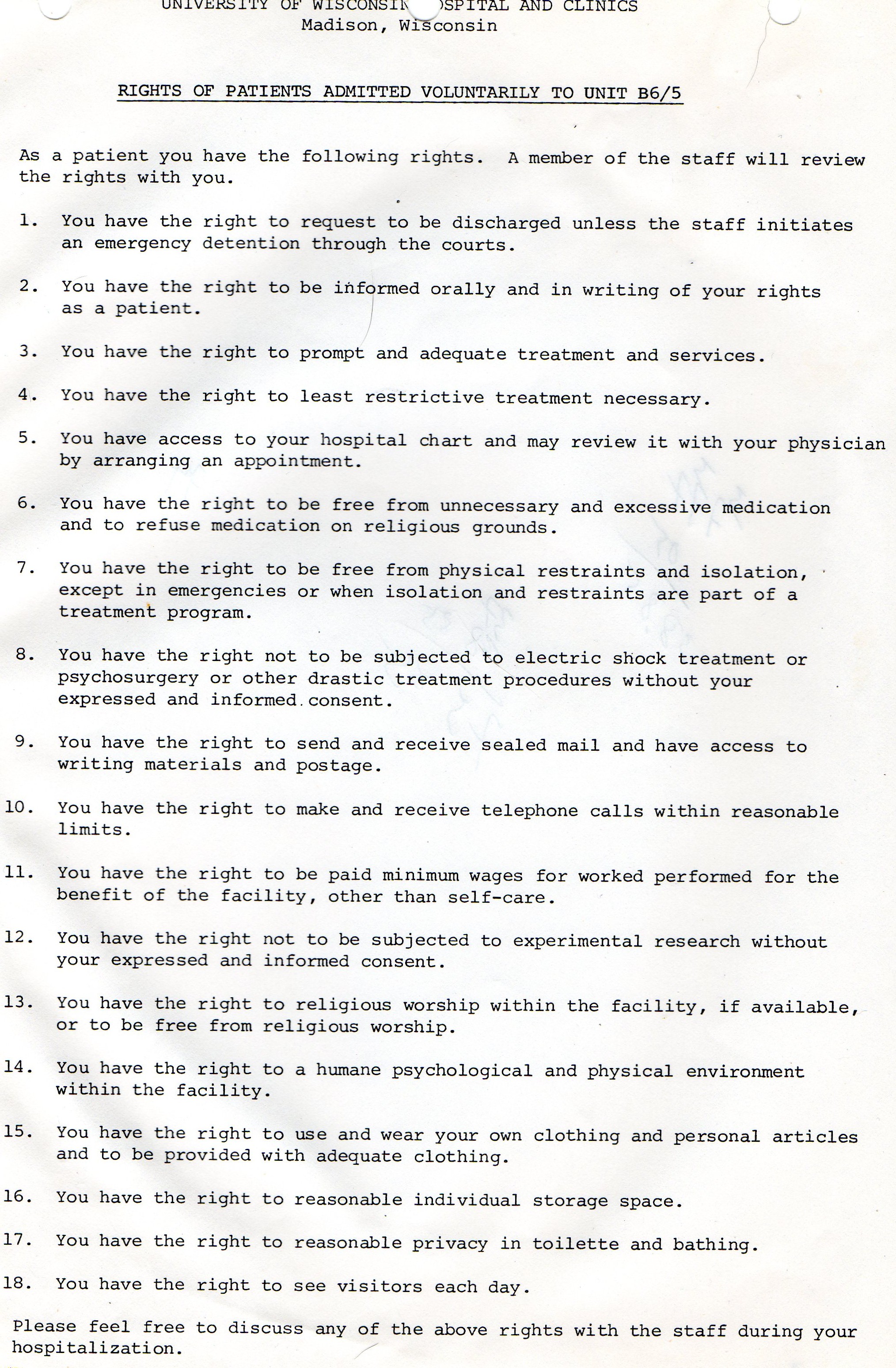
My rights as a voluntary admit were a bit more expansive:

UW voluntary

Friends did visit, bringing food and quite possibly a beer, and over the course of my two stays I made friends with J. who, unlike me, was not at all conflicted about wanting to get better. She wanted to be healthy more than anything, but it seemed like every time she managed to get a grip on the ledge, something would come smashing down on her fingers.

We stayed in touch for a few years afterward, but eventually fell away from one another. I have no idea if she’s still alive.

Anyway, no great scandal on the ward. ECT was suggested, but the suggestion was dropped at my vehement opposition. I was given an experimental drug, fluoxetine (brand: Prozac), but it made my legs shake and not much else, so that ended. I spent a few nights in the open containment rooms, got a few day passes, had a few good conversations with some of the nurses, and then I left.

And about a month or so after I left I was in Minneapolis, starting grad school.

Strange time, that.


Everything is all right

5 07 2013

Since I mentioned I’m grumpy about the electric bill (among other things), I guess I should look into this:

“Bitchy resting face is a definite phenomenon that plastic surgeons like myself have described, just never with that term,” he says. “Basically many of us have features that we inherit and/or develop with age that can make us look unpleasant, grumpy, or even, yes, bitchy.”

Youn says many plastic surgeons perform what he calls “expression surgeries,” procedures meant to improve resting facial expressions.

Yes, the Today show invited a surgeon on to discuss a “phenomenon” which was first discussed. . . in a comic video.

Thanks, Today, for making our world just a little more terrible.

~~~

h/t Anne Rose-Strasser, ThinkProgress


Ice ice baby

5 07 2013

Made it through June, but the beginning of July and it all ends.

The a/c-free livin’, that is.

I don’t have any strict rules for when I put the box in the window, but when I can’t sit in my apartment without thinking how hot I am and I can’t sleep at night without heat interruptions,  it’s time.

Pre-a/c I used to just sweat and swear it out, waiting for the thunderstorm or front shift to blow through and restore me to sanity [oh hush, you]. I hated the steam bath, but ohhhh, the blow-through was divine.

Anyway, the other night the mugg couldn’t be budged by the fan and yesterday as the temp and dew point crawled skyward I said ‘Self, it’s time.’

The cats appreciate the cool, but as I’m the one paying the electric bill, I’m a bit grumpy about the whole thing.

Still, better grumpy than homicidal.


So dry your tears and baby walk outside

4 07 2013

It’s the fourth of July!

I know some folks disdain later X as too poppy, but when your pop is as rough and jangly and heartfelt and angry and sad and what-the-hell as this, it should be sung to, not sneered at.

And, y’know, given Exene’s flexible relationship to pitch, it’s the kind of song everyone can sing to and get it right.


Whoo-oop, just a little bit

1 07 2013

dmf is right: I gotta lay off the blogs that are leading me to screw myself into the ground.

Y’know, Sullivan with his Baldwin-proves-liberals-suck rampage (and before that, Clinton, and Palin, . . .). I don’t disagree with him (that Baldwin’s an asshole, and his Tweet, hateful), but jeez, make the point, and move on.

I mean, Alec Baldwin is an actor. An actor. That’s it. So you don’t like the people who like him, which gives you a chance to get all tribal and everything. Fine. We all get tribal some times. Just. . . own the tribalism, man, and stifle the it’s-the-principle! nonsense.

And Dreher, oy, reading him of late (Paula Deen, Trayvon Martin, liberals always and everywhere) is plucking my last nerves. The meanness, the double-treble-quadruple standards, the pissiness at pushback. . . .

Oy doesn’t begin to cover it.

~~~

Oh, and then there’s this.

Makes me so proud I work for CUNY.

~~~

There’s a difference between motive and intention, isn’t there? It seems that there’s a difference.

Motive is where something starts, and intention is where it leads, right?

Yeah, I think that’s right.

~~~

So I’ve been turning over this thought in my head about the whiteness of the GOP and arguments (click here for a Crooked Timber post that has the various relevant links) that Republicans don’t have to worry about being the party of the pasty.

I think they do.

I don’t have this all worked out, but it seems that in order for the GOP to be the White Party they’re going to have to entice voters based on their whiteness, and I don’t know how many folks think of themselves primarily as white.

This is the crumbling underside of the default standard of white: regular [i.e., non-academic, non-race-politicized] white folks haven’t had to think about their whiteness. To bring them to you, you first have to bring them to their whiteness, convince them that their whiteness ought to be their primary concern, then further convince them that their candidates will do the most to preserve their white privilege.

Yes, whitey-first appeals have worked and will continue to work in a number of districts, but I don’t see how this appeal can be expanded, largely because I don’t know how much white folks who aren’t already racialists really want to be racialists. I think white-first appeals would turn them off, maybe make them less likely to vote Republican.

Most Americans don’t want to think of themselves as racists—even the racists don’t want to be seen as racists—and aren’t in a hurry to separate themselves (in their imaginations, at least, if not always in practice) from their fellow Americans. We’re not always large, but an awful lot of us aspire to be.

I don’t know, I’m probably talking out of my nose. It just seems like  focus-on-the-whites is a losing proposition with many of those very same whites.

~~~

Okay, back to Dreher—but to one of those posts that make me go Hmm rather than AAAAAAARGHHH! Namely,  on the problem with ‘the right side of history’ arguments.

Someone as non-whiggish as me casts a similarly skeptical eye on those claims, but skeptic that I am, I go even further: If there is no right side to history (which there isn’t), why the fealty to moralities anchored deep within that history, i.e., traditions?

I mean, isn’t the advocacy of tradition based on a notion of the judgment of history (properly threshed, of course)?

More talking out of my nose, I suppose, and maybe these are really two separate things.

But I kinda think not.


Move like that

30 06 2013

I get antsy.

I can go long stretches with a routine or an arrangement, and then. . . I get antsy. I toss things out, put some stuff into storage and pull other stuff out, and I move.

That used to be literal: Between college and the latter years of grad school, I moved on average of more than once a year.

There was that first year in grad school, with the screechy-horrid roommate who accused me of lying to her about. . . something, whereupon I decamped to a horrid, horrid apartment about 2 miles west on Franklin Avenue for a couple months. Then the woman who replaced me and the decent roommate kicked out the screechy-horror after she threw their kittens out of the apartment—they found tracks in the snow, but not the kitties—an invited me back in.

Oh, and there was Albuquerque, and that basement apartment that I had to leave after a week or two, into a room in the house of that nice, soft-spoken woman who turned out to be psycho when she wasn’t being nice and soft-spoken, then the duplex around the corner which my ABQ-cat Jomo broke out of with some regularity.

(Before I left Albuquerque, I found Jomo a home with a Los Alamos post-doc who wanted an indoor-outdoor cat. Figured he’d be happier on a ranch in the mountains than trapped in a Minneapolis apartment building.)

One place in Montreal, one in Somerville, then sublet in Prospect Heights,  room in Clinton Hill, apartment in Bushwick, room in Bed Stuy, and then, finally, my own place, in lovely Prospect- Lefferts Garden.

And this apartment is fine, it really is. I’d like a bigger place, but, for now, with my finances, this joint works out fine.

Still, I get antsy, and since I’m in no position to move, I move. . . my furniture.

It’s tough—small place, remember?—but I can shift around my desk and various wine-box shelves and swap out rugs. Can’t really do much with the bedroom: four bookshelves line the back wall, and while I have moved my bed NSE and W in the same position, it really only works where it is now (headboard south).

Anyway, I’m sitting in my living room watching Eureka (fourth season—new episodes for me) and thinking, Huh, I’d really like to change things up. But how? I’ve tried this and that and the other thing and, really, the way I had it was probably the best way.

Still. Antsy.

So I tried something else, that I hadn’t tried before. I don’t know if it’ll work, but, y’know, it’s the summer and I was antsy and I wanted to move and so I did.

My stuff, I mean.

And maybe, someday, my stuff, my cats, and me, into a larger place where I have many—or at least, some—different ways of how to arrange it all.


On the tv and the media

29 06 2013

I’m no good at personal confrontation.

I know, I know, y’all are thinking But absurdbeats, you can be such a bitch!  And it’s true! I can be! But as comfortable as I am tearing into an argument, I am no good at tearing into a person—so much so that I cringe at witnessing a person getting chewed out.

That said, my discomfort transformed into awe over the course of this video:

Maybe because this guy wasn’t some poor schmoe but a CEO, maybe because Congresswoman Duckworth was so righteous, maybe because he was so. goddamned. shameless, but I actually enjoyed this, uh, little exchange.

Commenters on other sites have pointed out that the problem may lie less with Mr. Owie-I-Turned-My-Ankle-Once than with a system that allows him to claim a veteran’s disability for an injury sustained in prep school, and I don’t disagree.

But: a shitty system does not excuse shitty behavior.

Systems matter. The ancients pointed out that the type of society in which one lives affects one’s behavior, and over the millenia thinkers have exhausted a lotta brain cells trying to figure out how, exactly, culture may shore up or degrade virtue. Aristotle wondered whether one could be good in a bad polis, Diogenes wandered about searching for that one honest man, and today those of very different political persuasions bewail the corruption of our culture and the doom which awaits us all.

So, okay, culture matters.

But so, too, does conscience. I don’t know the exact relationship between culture and conscience, what resources any one individual needs to reflect on this relationship, nor what one needs to choose conscience over an interest which culture may promote, but I doubt that conscience is always and everywhere collapsible into culture.

There’s something called ‘virtue ethics‘ which focuses on conscience and character. I am dubious of its efficacy on its own—it’s too easy to slide from virtue as a goal to virtue as an excuse—but as part of a comprehensive set of standards, it’s can help to check oneself. If you want to think of yourself as a good person, then you need to consider what are the actions of a good person, and how do my actions compare.

This is where the whole conscience-culture nexus gets tangled (as least for us epistemological nihilists): If culture decides what is ‘good’, and I want to be ‘good’, then how can I go against culture?

That’s a tough one, and in its abstract form I can only offer multiple, partial answers.

The case of Mr. Owie-Ankle, happily, is not so abstract, and thus more amenable to judgement.

Braulio Castillo clearly cares about goodness. He’s a man who contributes to charity and gives back to his community.  Given that he publicizes these good works, one can safely say that Castillo has at least thought about what is good.

As such, it is telling that he both highlights his “military service” and obscures the details by which he came to claim veteran’s disability based on that “service”. On his company’s website it is noted that he

attended the United States Military Academy (West Point) Preparatory School. Braulio was honorably discharged from the United States Army and received a service connected, disability rating from the Department of Veterans Affairs for his active duty service as an enlisted soldier in the US Army.

Did you catch that? He attended not West Point, but West Point Prep, doesn’t detail the injury (injured his foot in an exercise), and calls his time spent at that prep school “active duty service as an enlisted soldier in the US Army.”

It was not.

If he thought that he did nothing wrong in claiming a 30-percent disability for an injury sustained prior to an active college-football career, then why not publicize the details?

It’s entirely possible that he thinks that doing good here makes good whatever he does there (another skew in virtue ethics), so why bother with such petty matters as, um, fudging the facts?

It is also entirely possible that he may have been suffering from a malady Upton Sinclair identified long ago: “It is difficult to get a man to understand something, when his salary depends upon his not understanding it!”  And perhaps he could point to the particular business culture in which he operated—in which not understanding something is SOP—and say B-b-b-but everyone’s doing it! and claim that if his acts aren’t, y’know, good-good, they are at least par for the course.

(Of that last possibility, I would be unshocked.)

But that he called himself an “enlisted soldier in the US Navy Army” on “active duty service” when he was neither tells me he knew he was fucking with the facts, and was fucking with those facts for money.

That’s not good, Mr. Castillo, not good at all. You richly deserved that shredding.

And because of that, I richly enjoyed that dessert.


99.9 fahrenheit degrees

25 06 2013

Okay, it’s not quite that hot—just lower nineties.

Still, I have not yet put my air conditioner in the window, relying instead on a fan.

Why? One, I don’t like air conditioning.

Oh, I appreciate it when it’s sweltering enough to melt my face, but it is a brittle appreciation, one driven more by annoyance at the necessity of the a/c than a delight in the artificial cool it brings.

Two, I prefer fan-in-window cooling at night to that of the a/c. The fan, strategically aimed (well, okay, propped slant-wise in the window) at my bed, delivers an even cooling on a low hum throughout the night. The a/c, on the other hand, cycles on and off as the room warms then cools then warms then cools.

Not a nice even cool.

Three, I don’t like air conditioning.

What, have I mentioned that? Okay, um. . . yeah, so I don’t like a/c at night.

I’ve mentioned that, too? Well, the fan-in-window has worked the past couple of nights and has afforded me (or would have afforded me, had Jasper not been an asshole) delightful nights of sleep.

Four, I’m cheap. A fan costs less to run than a/c.

Five, it hasn’t, really, been that bad. I don’t like 90-degree weather, and while it’s been hot and humid, the weather has not devolved into the beastly, by which I mean: I can sit in my apartment with the fan and not constantly be thinking about how miserable I am.

Six, I’m teaching this month, so manage to be out of my apartment during the worst part of the day.

Seven, this heat wave is supposed to break tomorrow night. I can wait it out.

I’d really like to get through the summer without shoving the a/c unit into one of my few windows, but if the heat gets to the point where it immiserates rather than merely annoys me, then shove it I will.

The a/c into the window, I mean.

~~~

Warning: So begins the series of wailing-and-gnashing-of-teeth posts about summer. At some point there’ll be a post in which I announce I’ve cut off all my hair (probably titled ‘And then she cut off all my hair’)  and one, in August, in which I announce “I hate everything”. No, I’m not planning these things: I just know they’re gonna happen.


Brothers in arms

23 06 2013

It’s a modest little show, charming without being precious.

Eureka. I’m (re-)watching Eureka.

I’d happened upon the show at either Hulu or Netflix, watched it here and there, skipping around enough to keep loose track. I liked it, that’s all.

I don’t know if it would qualify as sci-fi. I guess so, insofar as it doesn’t really fit into any other genre—even with a sheriff at the center, it doesn’t really count as a police procedural—and with all the  future-tech, it is fictionalized science. Anyway, I like science fiction, I like clever writing, and I like odd characters.

And on second viewing, I’m latching on to the characters. This isn’t deep stuff by any means, but I’m enjoying how they relate to one another. There’s romance and friendship and antagonism and collegiality and over time it’s. . . nice to see how it all plays out.

The primary relationship is probably that between Sheriff Carter and Global Dynamics head Allison Blake, with a close second that between Carter and his daughter, Zoe, but for me, the central relationship is that between Carter and Henry.

It’s a real friendship between these two, and the actors, Colin Ferguson and Joe Morton, have good friend-chemistry. More than that, they acknowledge that they’re friends, and note on regular occasions how important that friendship is to both of them.

‘Buddies’ aren’t anything new to television, but these guys aren’t buds: they don’t drink beer and knock each other the shoulders and misdirect whatever affection they have toward one another toward, say, a basketball game or a car. They like each other, and that’s enough.

I think that’s one of the reasons I so like Numb3rs. At the center of that show is the relationship between the brothers, Don and Charlie. Don’s a bit of a hard-ass and the genius Charlie is annoyingly needy, but they check in with one another, as brothers. They look out for each other, get on each other’s nerves, and are still working through the weirdness of their childhood relationship.

It’s not a one-time thing, the working on the relationship, and I think that’s what sets apart Eureka and Numb3rs from buddy shows. It’s just there, from episode to episode, and sometimes it’s frayed and sometimes it needs work, but the friendships are demonstrated in their constancy, not in some grand epiphany.

It’s nice to see that, in men. And for them, too.


And so on and so on and scooby dooby dooby

21 06 2013

Un-able/-willing to think long thoughts, but still wanna say some things; thus:

*Sully’s been running a series on bisexuality (including a rather disingenuous vid of Dan Savage on how he loves the bis), to which I find myself mildly irritated.

Only mildly. I’m a mid-life bi who can’t be arsed to date anyone (or be arsed enough to do whateverthehell I’d have to do to entice someone to date me), male or female, and it’s just so obvious to me that this is a Real Thing that discussions of its existence are, well, irritating.

Most of what’s been said is about men, with the requisite oo-women-are-bendy disclaimers, and gay men who once said they were bi seem to be holding court in these posts, but, I dunno, more bi-straight men and bi-women ruminating on this might be nice.

Don’t know how much control Sullivan has on who writes in, however. (And no, I won’t be writing in, and not just because I don’t want to be another bendy-broad: I just don’t have much to say about my own experiences.)

*Another bit from Sullivan: He posted what what seemed to me two contradictory pieces In the same post) on drone warfare.

The first concerns the tedium of drone surveillance, as well as the clarity of the videos (“A nine-camera sensor nicknamed Gorgon Stare is capable of streaming full video with enough resolution to discern facial expressions.”). Through repeated viewings, drone operators become familiar with their subjects:

“It might be little things like a group of kids throwing rocks at goats, or at each other, or an old man startled by a barking dog,” says Mike. “You get a sense of daily life. I’ve been on the same shift for a month and you learn the patterns. Like, I’ll know at 5 a.m. this guy is gonna go outside and take a shit. I’ve seen a lot of dudes take shits.”

The second bit comes from Sascha-Dominik Bachmann

Keith Shurtleff, the US Army Chaplain and military ethics teacher, aptly summarized this concern “that as war becomes safer and easier, as soldiers are removed from the horrors of war and see the enemy not as humans but as blips on a screen, there is very real danger of losing the deterrent that such horrors provide.”

So my question is this: if the drone operator can see the people with whom he’s become so familiar, how removed is he, really, from the horrors of war? Is he not more aware of the humanity of possible targets than, say, pilots, for whom targets really are “blips on a screen”?

*No, Jordan Bloom, just because “The libertarian says the draft is slavery” doesn’t make it so.

I hold to my civic republican beliefs and consider shared civic obligation of particular importance to a pluralist (pluralistic?) society.

Yes, national service can be a problem, but, done right, it doesn’t have to be. I would favor a mandatory 2-yr paid stint in either military or civilian service beginning within some months of leaving/graduating from high school for all citizens and those who want to become citizens.

Yes, there’s an argument for/behind this, but did I mention the un-able-willing thing?

*George Packer has put together some great posts at the New Yorker on the financialization and Siliconization of our economy, and what it means for all of those folks who just don’t fit on Wall Street or in the Valley.

I borrowed a number of quotes from his “Change the World” piece on Silicon Valley for my summer pol sci class, highlighting the certainty of the tech-heads of their ability to lead [some of] us out of the swamp of politics and into the clean, well-lit techno-utopia beyond.

Can you guess my response to that certainty?

*This fucking guy:

Never, ever, ever, wait for a SIGN before you escalate! You will miss out on the vast majority of chances if you sit around waiting for SIGNS. Men are notoriously bad at reading women’s minds and body language. Don’t think that you’re any different. From now on you must ASSUME that she is attracted to you and wants to be ravished. It’s a difference in mindset that makes champs champs and chumps chumps.

. . .

Decide that you’re going to sit in a position where you can rub her leg and back. Physically pick her up and sit her on your lap. Don’t ask for permission. Be dominant. Force her to rebuff your advances.

Should I note for fairness’s sake that if a woman really really really makes super-crystal clear that she’s just not that into you then This Fucking Guy does allow that perhaps you should back off, if only to try again later, er, for safety’s sake?

Didn’t think so.

*Think vaginas are icky?

Fine, whatever. Just don’t be shocked that not everyone shares your belief  that vaginas are “objectively gross.”

(And not that you’ve asked, but I won’t be sleeping with you, either.)

*It’s a bad idea to arm the Syrian rebels. Bad bad bad.

I’m generally opposed to slippery slope analogies, but this is one case where it seems that if the US gives a guy a gun, we see little reason not to give him a cannon, then an RPG, and on and on until we get sucked in or distracted and everything goes to hell.

More to the point, as bad a butcher as Assad is—and he’s bad—the US has shown little-to-no-ability to make these situations better rather than worse.

I was agnostic-on-to-mildly supportive-of the Libyan intervention, but I can’t really tell you why I think this is such a bad idea.

But it is.

*Shall we end on a happy note?

My window-basil is growing like gangbusters. It apparently likes the rain as much as I do.