Prob’ly die in a small town

28 05 2010

What a nightmare.

I was in a room that was sunny and empty, inspecting an empty closet full of my stuff. The place had been packed up and I’d only just started packing. The movers were coming this morning only it was the night before and it was  4:00 in the afternoon and I hadn’t yet reserved a moving company.

I had to move by the next day and I probably wouldn’t get my deposit back because the lease ran through the summer.

It was like the back corner bedroom in my apartment on Madison that I shared with three friends and in which I lived alone.

I was moving back to SmallTown and in with my parents it was normal and I thought I could visit Madison and I sat down and said What am I doing?

. . . . And then the alarm went off.

Jesus.


Everything! Everything! Everything!

25 05 2010

Blows my mind how little I know. That is most excellent.

I’m not kidding: However much I wish I knew, mm, everything, that there is so much more out there to discover keeps me keepin’ on.

Consider my medieval Euro-history project: I recently finished Charles Freeman’s The Closing of the Western Mind (which is about the transition from the pagan to the Christian era), and man! what a jumble early Christian history is!

I did know that it took awhile for Christianity to gel as an institutional movement, but thought that after the Council of Nicaea in 325 everything was all sewn up until the Great Schism of 1054, and even then, it wasn’t until Luther and Calvin that the [western] Christian fabric was truly rent.

Only I didn’t know what the Council of Nicaea actually accomplished (something to do with the Trinity, maybe? And that Nicene Creed, right?), didn’t know that very little was settled at Nicaea, that the splits between the Eastern and Western churches were evident within a century of Christ’s death, and never knew, frankly, how the Copts fit into all this.

Well.

I still don’t know, frankly, but slowly, slowly, this is all seeping in.

This is how I learn something new.

My approach  is to read promiscuously, trusting that with enough exposure I’ll be able to piece together a particular phenomenon. And I don’t need to dive into deep scholarship at the outset either; solid popular books (like Freeman’s) give me the chance to train my sights, as well as offer a decent bib I can crib. I do prefer that what I read be, you know, good, but even the junk can sometimes be useful, if only as a kind of astringent for my thoughts.

Anyway, that’s how this political theorist began her work with genetics: Snatching every book with the word ‘gene’ in the title and gulping them down, then more slowly working my way toward what, for my purposes, were the most important (or delectable, to continue the metaphor) platters on the table.

I’m still in the gorge phase of my research, slurping up commentary on how orthodoxy was invented and how intertwined it all was with empire; how faith, political power, and obedience to god and man never quite fit together; how misogyny was built into early belief; how anti-Judaism became anti-semitism; and how time itself was changed.

And that’s just the beginning.

A colleague asked where I was going with all of this. I don’t know, I told him. I know there’s something there, but I don’t yet know what it is.

Now that, my friends, is one of the best feelings in the world.


There’s nothing you can’t do

23 05 2010

New York City is a pain in my ass.

For example, late last night AND earlier today, a local island combo was playing their version of ‘Dancing Queen.’ Great: take two irritants (steel drums and ABBA) and put them together and what do you get?

Closed windows on a warm day, that’s what you get.

Did I mention that the only other tune they seemed to know was ‘Amazing Grace’?

Ex-cel-lent.

But this is also my city, full stop. I was watching the Jay-Z/Alicia Keys (honey, what’s going on with that hair?)  vid ‘Empire State of Mind’ for the first time (!) last night, and even though the only really good thing about that song is the refrain, honest-to-god, I welled up.

I gave myself over to the song, to the city.

This is it.

Which is not to say that this is all there is. I read a piece in the Times today about a woman who opened a series of hotels in Austin, and the accompanying slide show offered glimpses of local shops and local characters and I thought, Oh, they don’t have that here. And I was wistful, because I knew that as much as I like those local shops and local characters and ways of life which are decidedly not available in New York, I wouldn’t leave New York to live in those other places.

I was wistful because for the first time in my life I knew I would stay.

SmallTown? Great place to be a kid, but once I hit double-digits I knew I was on my out. Madison—loved it. A quarter of a million people and it felt like a big city to me. My world opened up in ways I hadn’t even thought to expect, so what else was there for me to do but go through that opening?

Minneapolis, mm, not so much, but that was largely due to my displeasure with grad school. There actually are charming neighborhoods and funky shops and I still miss my troika of used book stores near Hennepin and Lake, but: No.

Albuquerque is charming in a charmless sort of way, a bit ramshackle and easy and full of the western wide open blue,  but too hot, too sunny, and not enough water. (Still, ABQ, like Madison, is one of the major settings of my second novel.)

Montreal was wonderful, and the only other city which gives, for me, New York a run for its money. If it weren’t for New York, in fact, I might have emigrated just to live in that city.

Somerville? Great apartment, great upstairs and downstairs neighbors. That’s it.

All of this is my belated response to a series of recent posts in the blogosphere about the the absolute and relative worth of New York. Eh, I think, it’s not for everyone—and that’s not a criticism of those not-fors, but a recognition that no place is the absolute Best Place: it’s all relative to who and how each of us is.

I didn’t know that New York would take when I moved here, and, frankly, my first year here sucked: money, work, money, apartment, money money money. I still worry about money, still don’t have enough of it in a city which feeds on it.

Do you need the litany of problems with this joint? The dirt and the crowds and the cutbacks and the roaches and rats and no charm, no quiet, no ease, no let up to the hustle. Nothing is as good as it was and nothing will change the ceaseless changes. This city does not care about me, does not need me, will not notice when I am gone.

But it allows me to be. I have been restless for over thirty years, and will be restless evermore, but in this city my restlessness can roam and I can remain


The lion sleeps tonight: one year later

2 05 2010

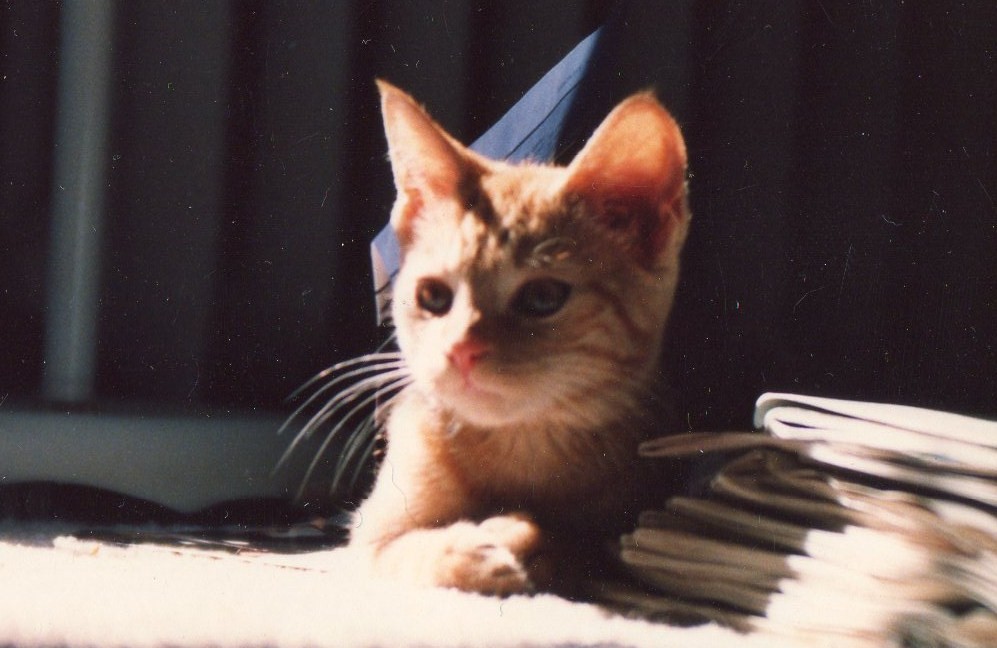
Chelsea. It’s a year to the day.

1991-2009

The mourning has not gone well. I’ve grieved, and not. I’ve handled it, and not.

I can think of her without tears, but only rarely; because of this, I only rarely think of her.

She does help me with Bean, in trying to do better in recognizing and responding to her needs. I’m patient with Bean in a way I was not always with Chelsea.

I couldn’t see that she was dying, couldn’t see her.

I still can’t, in so many ways.

My sweet Chelsea still has something more to teach me. Perhaps by next year, I can finally let her rest.


Taxman!

11 04 2010

Here’s a little tip: If the free e-tax provider that you used last year tells you that you OWE FOUR TIMES MORE than what you received last year as a refund, and it sends you around and around its e-form trying to figure out what went wrong, it’s probably worth your time to try a different e-filer.

And yeah, I know, don’t wait until April to do your fucking taxes, either!


Time is a bastard

5 04 2010

I can’t think big without thinking small.

Okay, so not strictly true—I can aggrandize with the best of ’em—but I do have to gather enough nails before I can be confident of a structure holding.

So in attempting to come to terms with medieval thought-modernity-post-modernity, I want to make sure I get the timelines right, even if, in the end, it’s really not about the dates at all.

It’s a litt. . . a lot embarrassing how poor is my knowledge of any pre-twentieth century history. I picked up bits here and there as a background to understanding certain contemporary conflicts, but I had no sense of how this tied into that—hell, I had only the thinnest sense of this and near-none of that, much less of any ties.

I am therefore now engaged in the process of infilling 500 or so years of European history, beginning around 1200 and heading into the 1700s.

Lotta shit happened; who knew?

I don’t want to go too far back into medieval times, because, again, I’m interested in the transition, but the 13th century seems a reasonable spot into which I can row my boat: It’s  in this century that the  papacy achieves its greatest power (only to see it begin to decline as kings begin to accrue and guard their increasing territorial power), as well as the century of the Inquisition.

Perhaps I could have begun with the First Crusade (Pope Urban II, 1095), or even further back with the split between the eastern and western Christianity (1054). Or I could have gone the other way, and begun with the first Black Death pandemic in 1347.

But the 13th century seems right: that monarchs began to assert themselves against the claims of the Vatican augured the beginnings of the nation-state (not to arrive fully until the dissolution of the Hapsburg and Ottoman empires in the early 1900s), which carries its own moral and political claims. It was also during the 1200s that the earlier re-discovery by Christians of classical texts became integrated into various university curricula; Thomas Aquinas’s Summa Theologica, published late in the century, is the apotheosis of Aristotelian Christianity.

Can I tell you that before I began this project I knew almost none of this?

I swore after I took my prelims, and then again after I finished my dissertation, that I was done learning.

Hah. And I thought I was so smart. . . .


It’s getting better all the time

4 04 2010

I blame Rod Dreher.

No, he didn’t start it—well, maybe he did—but he certainly propelled my thinking back a thousand years or so.

Mr. Dreher, you see, is an American old-school conservative: He’s skeptical of modernity even as he admittedly eats of its fruits; skeptical of government (that’s the American part) even as he decries a culture which, in his view, corrodes human dignity; and a believer in community and roots even as he’s repeatedly moved his family around the country.

I say this not to damn him, not least because he is honest about his contradictions, but to locate, if not the then at least a, source of my current trajectory.

You see, I became interested in one of his contradictions, and took off from there.

Dreher has written (not terribly thoughtfully, for the most part) on Islam and the violence currently associated with it. He then contrasts this to contemporary Christianity, and to the relative lack of similar violence. There are all kinds of commentary one could offer on his views and contrasts, but what squiggled into my brain was his unquestioning acceptance of a main tenet of modernity—why would this professed anti-modern base his critique on a pillar of modern thought?

Time: The notion that there is a forward and a back-ward, and that forward is better than back.

This notion of the forward movement of time, the accretion of knowledge, the betterment of the status of the world, has explicitly informed progressive thought within modernity, but it runs underneath almost all of modern Anglo-American and European thought.

(Disclaimer: I’m not talking about the whole world in my discussion of modernity, or of all forms of modernity—there are forms of modern art and architecture, for example, which are distinct from that of  political theory—but of the set of ideas which emerged out of Europe and which greatly informed European philosophy and political institutions. These ideas have of course also found a home across the globe (not least in the United States), but in attempting to trace the ideas back to there source, I’m confining myself to the United Kingdom and the continent. Finally, I make no claim that these ideas in and of themselves are unique to Europe, but that there particular shape and constellation is historically specific. That is all.)

Okay. So, what got to me about Dreher’s contentions regarding Islam was that Christianity today was ‘better’ in some objective (or at least, intersubjective) way than Islam, that is, that even those who are not Christian would see that Christianity is better for the world than Islam.

I’m neither Christian nor Muslim, so theoretically I could simply dismiss such claims about the relative merits of these religions as a kind of fan jockeying of a sport I don’t follow—except that, contrary to Franklin Foer, religion has been a far greater force in the world than soccer.

In any case, even if it is the case that currently there is less violence associated with Christianity than with Islam, it wasn’t always so: The history of Christian Europe was until very recently a history of warring Europe.

I’ll leave that for another day. What is key is the general formula:  that at time t x was strongly associated with y, and that if at time t+1 x is no longer strongly associated with y it is not to say that x will never again associate with y.

To put it more colloquially, just because it ain’t now doesn’t mean it won’t ever be. That Christianity is no longer warring doesn’t mean it won’t ever war.

To believe otherwise is to believe that the past, being the past, has been overcome, never to return; the future is all—a thoroughly modern notion.

Again, as I’m not a fan of either team, I’m not about to engage in Christian-Muslim chest-bumping. More to the point, shit’s too complex for that.

Besides, that’s not what I’m interested in. In thinking about time, I got to thinking about what else characterizes modernity, and thus what might be post-modern, and oh, are we really post-modern? no I don’t think so even though I once took it for granted (which goes to show the risks of taking things for granted) and maybe where we are is at the edges of modernity and who knows if there’s more modernity beyond this or whether these are the fraying edges and hm how would one know maybe it would make sense to look at that last transition into modernity and what came before that?  the Renaissance but was that the beginning of modernity or the end of what came before that? hmm oh yeah the medieval period and Aquinas and . . .  uh. . .  shit: I don’t know anything about the medieval period.

So that’s why I’m mucking about the past, trying to make sense of those currents within the old regime which led, eventually (although certainly not ineluctably) to the new.

It’s a tricky business, not least because I’m looking at the old through the lens of the new; even talking about ‘looking back’ is a modern sensibility.

So be it: Here is where I stand; I can do no other.

Well, okay, I can crouch, and turn around, and try not to take my stance for granted or to think that my peering into the past will in fact bring me into the past.

But I can still look.

~~~

My starter reading list, on either side and in the midst of.

  • A Splendid Exchange, William J. Bernstein
  • God’s Crucible, David Levering Lewis
  • Eunuchs for the Kingdom of Heaven, Uta Ranke-Heinemann
  • Aristotle’s Children, Richard E. Rubenstein,
  • A World Lit Only By Fire, William Manchester
  • Sea of Faith, Stephen O’Shea
  • The Science of Liberty, Timothy Ferris
  • Betraying Spinoza, Rebecca Newberger Goldstein
  • The Scientific Revolution, Stephen Shapin
  • Leviathan and the Air-Pump, Stephen Shapin and Simon Schaffer
  • Coming of Age in the Milky Way, Timothy Ferris

Suggestions welcome.


Friday poem (Sunday): The Nude Swim

14 03 2010

Odd how people become friends.

The first cause is proximity: We’re seated next to each other in a first grade class, have lockers across the hall in high school, settle in the same dorms, go out drinking after the first grad seminar.

And work. We meet at work.

But I didn’t become friends with everyone from school or in college or grad school, didn’t want to hang out with everyone I ever met at the paper or food service or the restaurant or co-op or bookstore. Only some people were interested in me; I was only interested in some of them.

I have good friends in New York, which is one of reasons I like New York.  That I lacked such friends was among the reasons I couldn’t take Boston, that I left good friends was among the reasons I so fiercely miss(ed) Montreal.

And among my friends, here, is Cte. She is a singular personality, who draws clear lines around people: in or out. I’m glad I’m in, because she’s smart and witty and always willing to argue (and as little likely to concede as I am), and who holds on to those inside as strongly as she pushes off those on the outs.

Need I say that she rejects sentimentality and that her heart, while large, does not easily warm? Or that she fends off any kind of direct affection—she will let you buy her a drink—especially the physical kind?

In that, she reminds me of me, or at least, how I used to be. I’m less likely to sprout spikes at the intrusion of a hand on my shoulder, but there was a time when I would literally spin away from any human contact.

No, I was never physically or sexually abused: this was not PTSD. Nope, it was something much simpler, a way to control what I couldn’t understand, and thus couldn’t let any one else access.

I was afraid all the time. Afraid of myself, my volatility, my desire and contempt for comfort, afraid of what others could do to and for me. I was drowning and refusing to be saved, hating myself for wanting to be saved.

I took it out on my body. I didn’t hate my body, but it was just one more thing I didn’t understand. I wanted to live in my head—my mind, I thought, was strong—because everything else about me was beyond me, and because beyond me, weak. I thought if I could just deny enough of myself, I could eventually bring it under control.

The key was control. I couldn’t control my emotions, so I sought to deny them. And because those emotions could be sparked—I still don’t understand why this happens—by the touch of another, I sought to deny myself all touch.

No one who knows me today would call me touchy-feely, but I am much more free with a hug, a kiss, an arm around the shoulder. To be honest, at some point I had to force myself not to flinch, because such obvious unease only drew attention to that unease, and question-mark looks I’d rather not answer; the point, still, was (and occasionally is) to manage myself, to manage how others see me.

Yet I have also become more comfortable with touch. I am conscious of it, always, and far more at ease giving than receiving, but it is a relief, truly, when with people I know and trust, when with my friends, to not have to police every goddamned move.

So I wonder about Cte. I don’t know enough about her—surprise! she’s not one to go on about her life before, well, now—to know why she behaves this way, or that it is in any way a problem for her. She could simply believe that, for her, such physical interactions are unnecessary. She might get enough from the people around her just by having us be around her.

I admire her strength. And I hope that’s what it is.

This is all a very long intro to a not terribly long poem.

Anne Sexton was, famously, the best friend of Maxine Kumin, but it is not for the theme of friendship that I chose her tonight. No, it is for her extravagance, her unwillingness to shut herself off from herself.

(Given her emotional instability and suicide, perhaps it could be argued that a bit more willingness to turn away would have kept her alive. Or perhaps it would have led her to kill herself much sooner than she did. I don’t know, and it doesn’t much matter now anyway.)

Sexton wrote songs to her breasts and her uterus and about masturbation, so if I really wanted to push myself beyond my own boundaries—if I am less stiff than I used to be, I am still easily mortified by myself—I’d print one of those.

But this is the one that moved me, a poem about nakedness and ease, about the unexpected ways others may see us, and about the unexpected ways such sight can still us.

The Nude Swim

On the southwest side of Capri
we found a little unknown grotto
where no people were and we
entered it completely
and let our bodies lose all
their loneliness.

All the fish in us
had escaped for a minute.
The real fish did not mind.
We did not disturb their personal life.
We calmly trailed over them
and under them, shedding
air bubbles, little white
balloons that drifted up
into the sun by the boat
where the Italian boatman slept
with his hat over his face.

Water so clear you could
read a book through it.
Water so buoyant you could
float on your elbow.
I lay on it as on a divan.
I lay on it just like
Matisse’s Red Odalisque.
Water was my strange flower.
One must picture a woman
without a toga or a scarf
on a couch as deep as a tomb.

The walls of that grotto
were everycolor blue and
you said, “Look! Your eyes
are skycolor. Look! Your eyes
are skycolor.” And my eyes
shut down as if they were
suddenly ashamed.


I watch you sleeping on the bed

9 03 2010

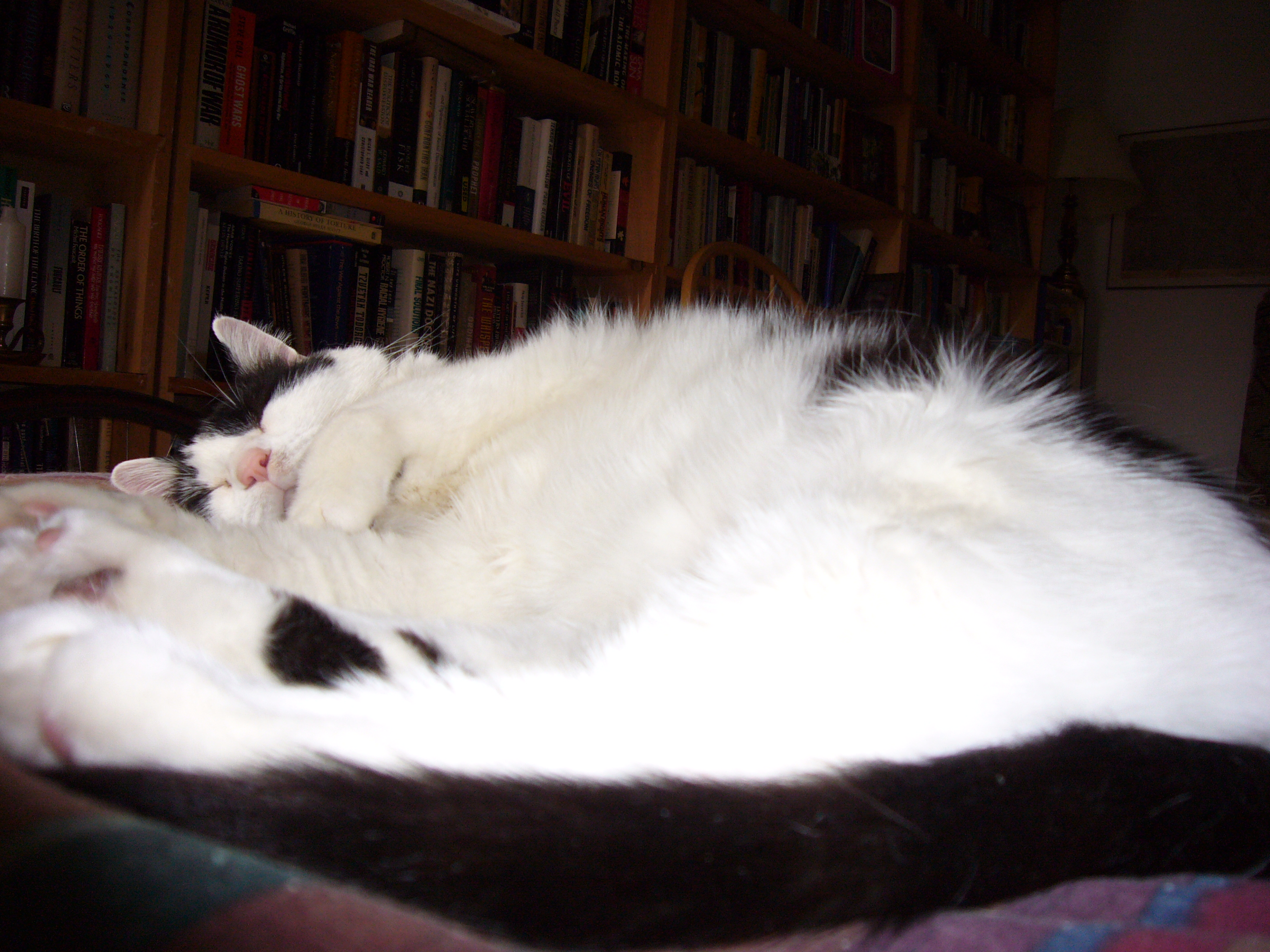
My beautiful Bean is sick.

Not desperately so, and perhaps not-imminently-fatally so, but she is ill, and it likely that this illness will at some point result in her death.

It pains me to say this, because I do not want my sweet old kitten to die, but I cannot ignore her decline.

Cannot. Will not.

I did ignore what was happening to Chelsea. It’s so clear, in retrospect, that she was sick for years, dying for months, and almost gone by the time I saw that gone was the best place for her. I spent money I didn’t have on a delusion that at 18 what little life she had in her was enough for a few more years.

It made the ending harder than it had to be for both of us.

So I won’t do that with Bean. I will see her, as she is, an old and sick cat. Oh, I’m doing what I can, within reason, to slow that decline, but at 15 1/2, ‘within reason’ amounts to home care and wishes.

Whether that decline is weeks or months or even a year, I have no idea.

But I’ll be ready, or readier, this time. Chelsea taught me that. Wishes or no, I have to see Bean clear.


I am iron man

17 02 2010

Or straw man—the same thing, really.

This post’s edition of hay*-covered solemnities concerns that which threatens to bring down/is significantly degrading/has already brought down Western Civilization, aka, all that is Good and Holy in the world: Relativism.

Mind you, the crusade against relativism isn’t confined to the autocratic right; Good Liberals are also apt to say, before observing that what’s okey-dokey in one society might not fly in another, that of course they’re not advocating relativism, but. . . .

I’m not a particularly Good Liberal, tho’ I don’t have anything against them. In fact, the imaginary Good Liberal brings forth exactly the point that needs to be made about relativism: that there is a difference between recognition and advocacy.

I am one of those who merely recognizes relativism (as well as its aliases-slash-cousins social constructivism, anti-foundationalism, and epistemological nihilism), as opposed to those who advocate on its behalf. (I don’t know many people outside of  first-year grad students who are advocates, but I’ll get to that in moment.)

First, recognition. I mean this plainly, which is to say, I relativism as a condition of our (post)modern existence. There is no singular rule, no singular god, no singular absolute standard against which to measure ourselves. There is no transcendent rule, no natural law, no universal order of human life.

There is no inherent meaning. There is no essential good and bad.

But this does not mean that no rule is possible, no standards may exist, and no judgments of good and bad are allowed. It simply means that any questions of judgment cannot be thrown back to an absolute or transcendent marker.

It simply means that questions of meaning have no necessary relationship to capital-T-Truth.

It simply means that capital-T-Truth may not much matter.

To recognize all of this is not to say this is good or bad. As the saying goes, It is what it is.

Those who think this is bad tend to mourn the loss in culture of an overarching purpose/underlying order; some try to figure out how to live with this, some blame those of us who point out the fractures for causing them, some deny any fractures exist, likening them to surface cracks distracting us from a deeper unity.

Perhaps they’re right, the denialists. I have no way of knowing.

And I’m fine with that.

Some might think this makes me an advocate of relativism, but it simply means that I refuse to take epistemological sides. I look through time and space and see so many ways of living, so many ways of being, and instead of choosing one over the other, shrug and note that outside of a way of being, I can’t say that one is absolutely or transcendentally better than the other.

Again, this doesn’t mean I can’t have my own preferences or that I can’t judge. It does mean that I have to lay out the terms of that judgment, terms which have no final grounding in any sort of metaphysic. Terms which can be rejected, in other words.

It’s not as if I’m completely at sea. I live in a particular time and place, and can call upon the values and concepts of this time and place—this way of being—in order to make my arguments and interrogations. But I have no ultimate trump card, nothing to throw on the table to say, absolutely and finally, Ha! I win. Instead, any wins are provisional, subject to override and undertow, and thus in need of constant defense and elaboration.

Nothing can be taken for granted.

That’s my starting point—nothing can be taken for granted—and while I understand that life might be easier if I could, epistemologically, take a few things for granted, that’s not something I choose. Instead, I choose the nothing.

But this doesn’t make me an advocate for nothing and, to be fair, I don’t think most advocates for relativism choose nothing, either. Even Nietzsche, who’s sometimes held up as the grandee of nothing, recognizes rather than advocates nothing. His great challenge is, Precisely what will we do with all this nothing? Now that God is dead, what?

What he did advocate, an embrace of the life of the Overman, repelled many, but the advocacy for the Uber-life is but one response to the condition of nothingness, not its apotheosis.

Anyway, I snarked earlier that only the eager young joyfully embrace relativism (and no, I’m not just talking about an earlier version of me), but this isn’t quite right, either. Rather, there are those who, in the name of its corporate-friendly version, diversity, admonish that it’s not acceptable to judge those from other cultures or with other ways.

If this is what people choose, well, it must be okay.

No.

Not that one might can’t say ‘Whatever’ to the choices of others, but that one must say this. In a sense, this type of advocate implicitly accepts the charge from the absolutists, et. al.: absent something eternal and outside of ourselves, we can make no judgments.

Again, the crucial point is not that no standards may exist, but that no standard must exist.

There is another dimension, of course, which adds some urgency to these issues, which is the consideration of power. It’s too late (cursed that 9-5 job!) for me even to finish the exegesis on relativism, much less sketch out the implications of power, so allow me the upshot when I say that such a consideration argues in favor of setting standards.

But that’s another post.

*I know hay isn’t the same thing as straw, but gimme a break: I’m not in Wisconsin anymore, and my audience is muuuuuch more sophisticated than those persnickety rural types who insist upon dunning us sophisticates with their petty knowledge of, oh, farming and plants and nature and everything. Honestly.