Wipeout, pt. III

4 11 2010

Do the Republicans care about ideas?

EmilyLHauser agrees that ideas are important but in a cri de coeur argues that Republicans don’t care about ideas, don’t care much about people, period:

If we, the Democrats, were fighting an ideology that was somehow bigger than “defeat the Democrats and support the rich,” I wouldn’t feel so ill. If today’s GOP were offering, you know, ideas, I wouldn’t feel so ill. If we were engaging on the merits of a case, the merits of a piece of legislation, the merits of this appointee or that bit of policy — I wouldn’t feel so ill.

But what the GOP is doing — what it has done since the Newt Gingrich House — is dragging us down to our lowest level of discourse, our basest fears, our most easily pushed buttons. They are playing us, and they are doing it magnificently. And the depth of the hypocrisy, not to mention the utter lack of concern for honest-to-God real human lives that are damaged or destroyed in the process is just mindboggling to me.

It is enough, she notes, to make me hang my head and weep.

I don’t disagree that the Repubs were nasty and mean, that they appealed to the lowest common denominator—even helped to lower that denominator—or that they impeded the progress of even noncontroversial legislation and executive appointments simply because they could, and because they thought it would hurt the President and the Democrats.

But I don’t know if that’s all they were. Yes, the notion bring-down-the-deficit-by-reducing-taxes is unsupported by the evidence and the show-solidarity-with-the-little-guy-by-helping-the-Big-Guy sensibility is incoherent at best, but that these themes are deployed to manipulate doesn’t mean they’re only manipulative.

There are people who honestly believe in supply-side economics, who think wealth actually does trickle down, so why wouldn’t they try to convince voters of the same? Why wouldn’t they try to bollix up any and all legislation or presidential maneuvers which counters their views?

In the past two years the Republicans have treated the entire executive, judicial, and legislative arenas as fields of action for Total War. Gentlemen’s agreements, practical accommodations for the sake of governance, across-the-aisle alliances for shared agendas—gone gone, gone daddy gone. Day-to-day tactics are now driven by partisan strategy and whether it is good or bad (I tend to think the latter), it is now the standard operating procedure.

The Democrats and President Obama (bless their hearts. . .) have been operating as if good-will still mattered, as if individual legislators would cross party lines in the name of a worthy cause, as if party didn’t override everything. And while they’ve been able to accomplish a great deal, much of what they have accomplished they won precisely because they, too, sought to beat back every bit of opposition to their preferences.

The key difference is that the Republicans have evolved to fight in every way, while the Dems have contented themselves to fighting bit-by-bit.

And here is the hard nut of my disagreement with Mizz Emily: The issue isn’t that the Republicans are devoid of ideology, but that they see all that they do in service to that which preserves that ideology. No, they’re not fighting idea-by-idea; they’ve gone global.

And if the Dems are going to advance their causes, they’re going either going to have to pull the GOPers back to the Dems preferred methods (unlikely, not least because it’s not clear that the Dems have a clear and effective notion of their preferred methods) or they’re  going to have to go global, too.

That doesn’t mean they have to deploy the same hatefulness as did some of the GOP campaigns, but it does mean that they will have to bring it to every.single.thing. they do. It may be ugly and awful, but it’s also necessary.

Ideas matter, but so does the strategy used to bring those ideas forth. Let’s hope the Dems figure that out before 2012.


Wipeout, pt. II

3 11 2010

I am an ideologue.

No, not particularly happy to write that, and as quickly as I might state that that’s not all that I am, I also have to admit that it is also that I am.

I bring this up to consider the interpretations of elections. After the Republicans suffered reverses in 2006 and 2008, a fair number of activists blamed those reversals on the lack of conservative steadfastness. Had the GOPers only stuck to their guns, these folks said, we’d a-won.

Yeah, right, I thought.

But that same thought skittered around my mind in the lead-up to this election. If only the Dems hadn’t been so pusillanimous, election night would have been a bleed rather than a hemorrhage.

In my defense, I was thinking more about tactics, whereas the conservatives were thinking more about policy. I’m not a moderate, but I think welcoming moderates (and even conservatives) into the Democratic party isn’t a bad thing: I am most decidedly not a purist on political matters.

But that interpretation rather too conveniently lets me off the hook. I want the Dems to push hard, to ignore squeals about the supposed unfairness of maneuvering to enact their agenda, and I want that agenda to reflect my leftist views.

When you win, goddammit, you act as if you’ve won.

And when you lose, you obstruct and resist and dissent and do what you can to limit the damage likely to flow from the other side’s win.

That’s how it is, for Dems and GOPers, liberals and conservatives. Shut up about the process—really, SHUT UP. It’s terrific when you win and terrible when you lose and all your whining about fairness or rudeness or partisanship is just so much rote rot. If you truly think it’s unfair, then change the process; otherwise, shut up.

So that’s how I know I’m an ideologue: However annoyed I may be when political adversaries obstruct what I want done, I don’t think they’re wrong to obstruct. In fact, if they think they can best achieve their aims through obstruction, then they’re fools if they don’t obstruct.

That’s not cynicism; that’s smart politics.

And finally, I know I’m an ideologue because however fatigued or Machiavellian I may be, I do believe ideas matter, so much so that I find it easier to deal with those who actually want to do something—even if I hate that something—than those who want to win just to win.

Even I’m not that cynical.


Wipeout!

3 11 2010

I am not a pundit.

And yet, as a political scientist (however mediocre), I am nonetheless required to say something about the first Tuesday in November in an even-numbered year.

Ahem.

[[[[[[[Loooooooooooooooooonnnnnnnnnnnnnnnnnngggggggggggggggggggggg pause]]]]]]]]]]

Aw, shit, you want punditisms, you know better than to check here. So how about some real political science?

There’s a rationality problem in voting. No, not in terms of does-my-vote-count sense—there are reasons beyond that of affecting in an absolute manner the outcome of an election—but in terms of the intransitivity of the vote.

To wit: Voters may prefer A to B and B to C. So far, so good. But it is often the case that voters may also prefer C to A.

Transitivity would lead one to expect that A > B > C, but the possibility (and in many cases, actuality) of A > B > C > A renders voter preferences irrational. There are any number of variations on intransitivity, but this is the basic set-up.*

This is hardly always the case, of course. A > B > C  (w/A > C) happens often enough; that we live in a (largely) two-party polity and that those parties hold primaries arguably erases the third option, such that one must choose either A or B.

But the argument could also go the other way: If your preferred candidate loses the primary, you might decide to vote for the opposition party’s candidate rather than your own. So you support Mike Castle in Delaware  who loses to Christine O’Donnell  in the Republican primary, and are so unhappy with O’Donnell that you end up voting for Chris Coons.

On the naked-individual level, this isn’t necessarily irrational: Castle > Coons > O’Donnell, such that the loss of Castle’s candidacy simply moves you to the next step.

But on the party-member level—and this is how the primary system can work against transitivity—it makes no sense. You vote in a primary because you support that party, but in the end vote against your party.

And as you move up levels, the transitivity problems increase, not least because you’re aggregating not only within districts, but aggregating across districts. Add in winner-take-all seats, and the interpretation of results is a muddle.

Oh, and add in people who don’t know what the hell they’re doing—don’t understand even the basics of policy and legislating—and good night, Irene.

Now, this is not just sour grapes. I’m not happy about yesterday’s results, but the muddle holds in almost every damned election.

Does this mean elections are useless? Nope. They do provide a kind of check on those in power, and marked preferences clearly do emerge at some levels. Whatever the problems with electoral representation, it is better than having no say in one’s representation.

Elections > no elections. Full stop.

Still, elections are simply the ticket to the show—terrifically important, insofar as one needs to get into the arena before one can play—but the play is the thing.

And here I think of George W. Bush’s first term. Here’s a man who clearly lost the popular vote and only won the electoral college after a lengthy (and still disputed) legal process, but who nonetheless sought to govern as if he had won overwhelmingly. (Which, come to think of it, he arguably did win ‘overwhelmingly’: he didn’t have to share the Oval Office.)

I like almost nothing about GWB’s administration, but I give him credit for the boldness of his moves in the years 2002-2006. He was the president and he governed as president—disastrously, from my perspective—but he was very effective in rolling past and over any opposition.

Was this because Bush was so strong or because the opposition so weak? Both, likely.

But both Bush’s presidency (the strong and the weak parts) and Obama’s first two years demonstrate that if you want to get something done—war in Iraq, health care reform—you have to keep moving, keep rolling past and over any opposition.

Stop moving—see Bush and Social Security reform—and you lose.

Of course, it’s all so much more complicated than all of this, and many more dimensions than can be captured in any regression or mathematical model; even Machiavelli recognized that boldness was not always enough to overcome Fortuna. Or a determined opposition.

So, Mr President, how determined will you and your party be?

(*See William Riker’s Liberalism Against Populism and his discussion of ‘the paradox of voting’ for a more elegant discussion of in/transitivity. And for real wonky quantitative pol sci discussions, check out The Monkey Cage.)


Today is Tuesday, today is Tuesday

2 11 2010

So, yep, it’s Tuesday. The first Tuesday in November. The first Tuesday in November in an even-numbered year.

Huh.

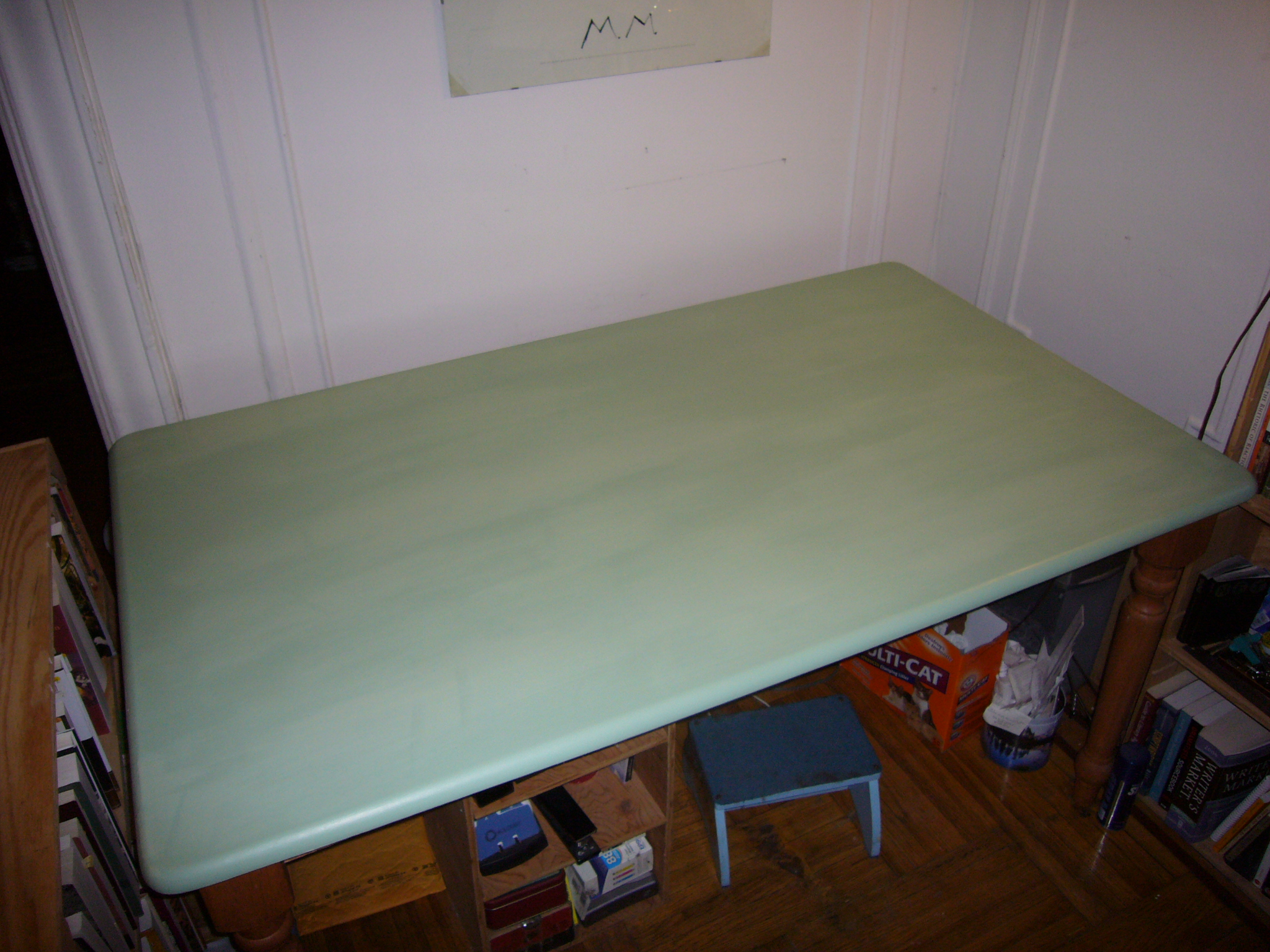
I’m celebrating the first Tuesday in November in an even-numbered year by painting my desk.

Actually, the desk was a table before I put a computer and a bunch of books on it. I bought it when I lived in Somerville and had a HUGE kitchen—and was still under the delusion that I might someday have lots and lots of friends in the Boston area and we’d all congregate regularly in my gorgeous apartment with its HUGE kitchen.

Anyway. It was sometimes stored and sometimes used as a table in New York, and after I failed to sell it, I figured I’d bring it with me to this apartment and use it as a desk.

It’s fine as a desk. The height’s a bit awkward vis-a-vis the arms on my chair, but that’s manageable. The truly great thing about it is that I can store a bunch of office-related stuff underneath it and out of site.

But the color, sigh, the color.

I had stained it lo those many years ago, and was never happy with the stain. I was going for something warm and not too dark; I ended up with. . . orange.  Well, not orange exactly, but definitely orange-ish.

I ougtta paint it, I thought.

And did nothing.

Then the thought would come around again: I oughtta paint it.

And nothing. It’s really dark in that corner; painting the desk would really lighten things up. Nothing.

Repeat repeat repeat.

But now! This first Tuesday of November in an even-numbered year and when I am only half-employed—now would be a fine time to paint it!

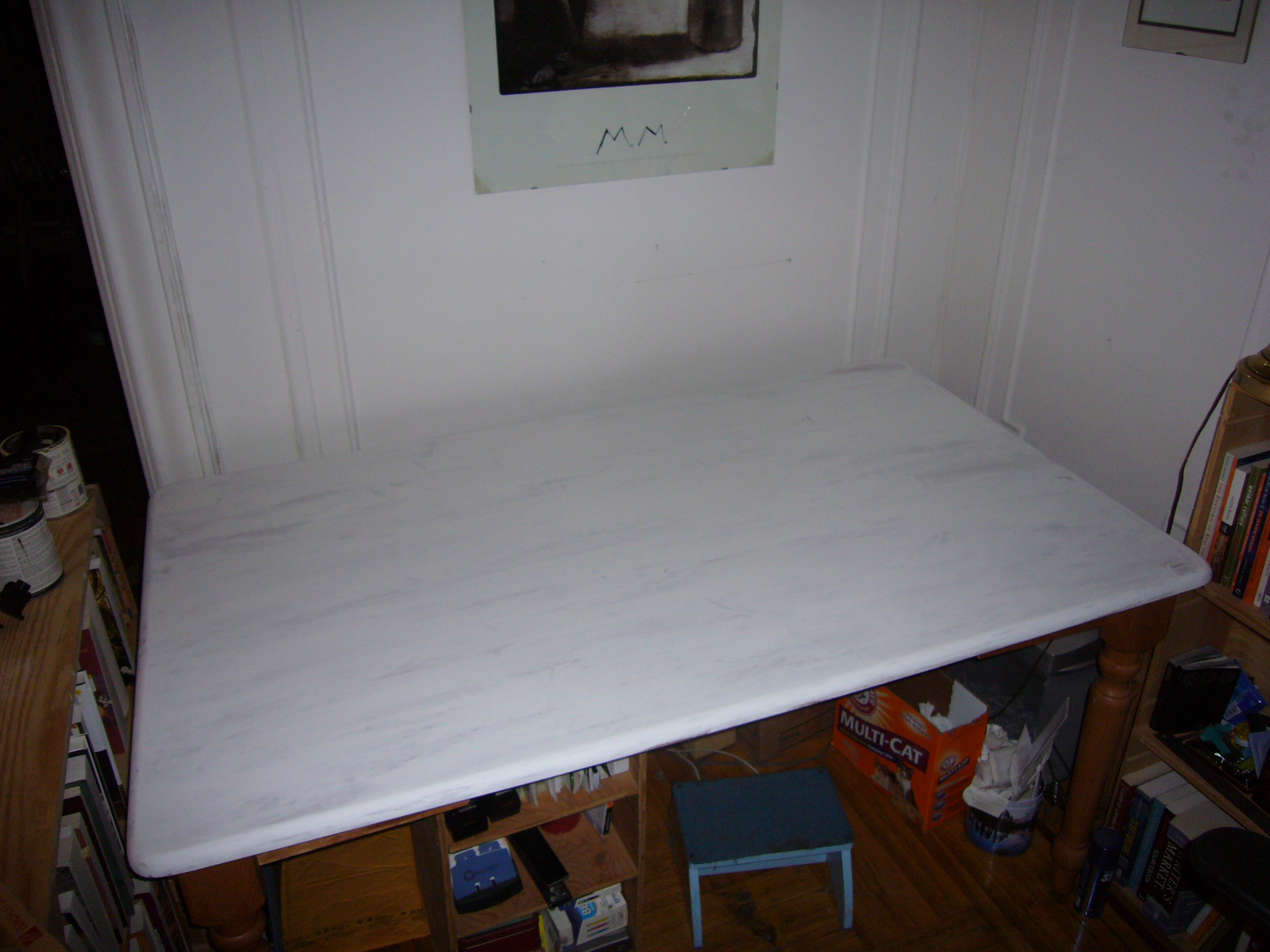
So when I got home from my very slow run through Prospect Park, I sanded down the top and primed it. Ta da!

Primed and ready!

Terribly exciting, I know. Almost as exciting as creating a large space of wetness with two kitties around.

(And no, I don’t keep the cat litter under the desk: I use the box as a makeshift garbage can. ‘Cause I’m cheap thrifty like that.)

I’m going for something very light green—not mint (flashback to bad bridesmaid dresses)—but more olive or apple-y. I’ll see what I can manage with the paint I have.

Yup. It's painted.

It’s not yet dry, and I intentionally didn’t mix it thoroughly, so it’s a bit streaky.

If I can keep the cats off it for the next half hour or so, it should be fine.

So that’s what I did on the night of the first Tuesday in November in an even-numbered year.

Watched paint dry.


Let’s call the whole thing off

31 10 2010

Oh god, another election.

I can’t listen to the radio—I was glad that last week was WNYC’s fall fund drive, which meant continual (and amusing) Alec Baldwin interruptions—and skim over any and all election forecasts, punditry, analyses, and general media wankery about What This Election Means.

What This Election Means? It’s a midterm election following an historical presidential race (which itself followed a terrible two-term presidency) and occurring amidst a recession.  Marginal seats picked up two years ago get lost, and high unemployment tends to leave voters with a throw-the-bums-out sensibility.

What It Means: Duck Duck Goose.

You would prefer A Referendum on The President? Maybe. Whatever. A meaningless conjecture, insofar as Obama is not up for reelection this time around, and because the man has two years in which to spiff himself up and make himself all attractive again to voters.

I know all this; so why am I particularly down on this round of elections?

Because my side is gonna lose big? Pfft, I’m used to losing, and these Dems are not so much ‘my side’ as they are actively not-against me. That’s nice, and valuable, but with the exception of Russ Feingold, that bitter little heart I mentioned two posts ago ain’t gonna break for the loss of any of ’em.

No, I’m just old. Or I started bingeing on politics at too young an age, and now I have, finally, had enough.

I remember Reagan’s election—oh, hell, I can remember Nixon’s election in ’72, but I don’t recall having any particular thoughts about it at the time—and remember thinking Oh, This Is Very Bad.

And his second election? Not a surprise, but a blow, nonetheless. That was the first campaign I worked on, the first one which I experienced close-up: I was part of the crew which helped prep a huge Mondale/Ferraro rally on the steps of the Capitol in Madison. Every moment not in class I was at campaign headquarters, and I worked hard enough and long enough and smart enough to earn a ‘backstage’ (actually, off-limits areas of the Capitol) badge.

SmallTown hick working Big Time politics. Exhilarating.

Then, the morning after the rally, I got on a bus to take part in an anti-nuke march in Chicago. Didn’t know a soul there, so I was able to sidle up by myself to the stage and listen to Jesse Jackson and Helen Caldicott (and my memory says Petra Kelly but I think my memory is imagining things) and take in the muted misty day.

Then, the day after that, I got on a bus to Milwaukee to hear Gloria Steinem speak.

Hell of a weekend.

And probably the high point of my political involvement. I have attended other rallies (including two tits-freezing anti-war marches in Montreal in 2003) and worked on other campaigns, but I was never so involved as that semester of college.

Okay, there was the time we marched down Bascom Hill and into the Capitol to protest the state’s investment in companies that did business in South Africa and ended up occupying the rotunda for two weeks, but even then, I didn’t sleep there the entire time (marble is cold and uncomfortable).

No, I started pulling back even in college, and with the exception of two (failed) union drives in grad school, even more so in grad school. I had been aghast when an undergrad pol sci prof mentioned that most political scientists aren’t that interest in politics; now, I was beginning to understand.

I did give it one more go, tho’: In the run-up to the 2004 election I felt like I had to do something, so although I loved Montreal and had the chance to extend my post-doc, I said, No, I can’t be on the sidelines for this election: I gotta go back to the States and campaign.

Which I did. And which I hated. And which, of course, came to naught.

(I sometimes wonder if part of my disdain for Boston is a cover for my own self-contempt for making the stupid decision to leave my beautiful Montreal labyrinth for the dull and crabby snarl of The Hub. Christ.)

So now? Now I vote, because, you know, I should vote. And I pay attention because, you know, I should pay attention.

I’m in my forties and I’ve been voting and paying attention for thirty years and I’ll keep voting and paying attention for the next forty or thirty years.

It’s just that that used to excite me; now it just wears me out.

(h/t to BenjaminTheAss, who hasn’t given up.)


Am I sitting in a tin can

27 10 2010

My sister is not a crier.

Okay, yes, she has a sentimental streak and will tear up at matters involving her daughters or family generally, and she is far more expressive with her [non-angry] emotions than I ever will be. She’s normal, in other words.

But when I say she’s not a crier, I mean: she’s not someone to fall apart if things don’t go well or if there’s any sort of crisis. Instead, she switches into hyper-practical let’s-fix-this-mode, and then gets on with it.

She was crying when she called me.

V. was planning to visit me this weekend, flying in tonight and out on Monday. She’s flown before, but she hates it—really, really, really hates it as only someone who is terrified can hate a thing—so it was a big deal when she decided to fly here alone.

She might have made it, too, had it not been for the 60-80 mph windstorms which streaked across the upper midwest last night, windstorms which, not coincidentally, led to widespread flight delays across the region.

The flight tonight probably would have been delayed, too, but the weather on the ground in NYC has simply been a fizzle of gray and rain. She would have been fine.

But if you’re terrified of flying under even the best of conditions, to hear 24 hours before your flight about how awful the wind is and how much turbulence it’s kicking up, to think all day long at work about that wind and turbulence and having not only to fly into to NYC but back out, well, then, whatever equilibrium you’ve managed to convince yourself you could maintain is likely to dissolve into tears at an exit off the highway.

I’m not thrilled with flying—don’t (surprise!) like the feeling of being trapped—but it doesn’t panic me. Had it been me flying today, I’d have gotten on the plane.

But it wasn’t me, it was my steady, normal, practical, terrorized sister.

I felt so bad for her. She said it was a good thing my number was preprogrammed into her cell phone, because she was shaking so bad she probably couldn’t have dialed it. She said she felt stupid—and my sister never ever shames herself—not least because one daughter flew to Australia for a semester abroad and another to Austria for a series of musical performances, and I can’t even do a two-hour flight.

It’s okay, I told her. I’m not going anywhere, so it’s not like you missed out on your only chance to visit me in NYC. And I wouldn’t want you to spend your entire weekend worried about the flight home.

Let’s chalk it up to the weather, we agreed. Had it not been for the freak tree-bending winds, she could have done it.

So I hope my steady, practical, cheerful sister doesn’t let the anxiety which detoured her from the airport derail a nice, long weekend at home with her husband.

Go out to dinner with D., I suggested. Get the New York Strip.

She laughed. It was a good sign.


James Fallows shows you how to do this

26 10 2010

Do not piss off James Fallows: he will take off your head, split your torso, slice out your knees, and sever your Achilles heels.

In other words, the man knows how to burn.

Mr Fallows, as I hope you know, is a peripatetic journalist with a wide-ranging curiosity and a rigorous approach to public knowledge—by which I mean he expects that citizens (and more particularly, his readers) have the capacity, and therefore the responsibility, to educate themselves about the world.

Thus, woe unto you if you snipe at him with a faulty rifle.

Consider this response to readers who complained that Fallows, in pointing out that Al Gore was not a signatory of the open letter composed by Nobel laureate Desmond Tutu and signed by 14 other laureates to the Chinese government requesting the release of 2010 Nobelist Liu Xiaobo, neglected to mention the 2009 winner, Barack Obama:

When I returned to my computer just now, after an hour away for lunch, I found several screens full of incoming emails all to the same effect. Here’s a sample:

“I don’t see the name of the 2009 Nobel peace prize winner either–namely Barak Obama.”And:

“The list seems to be missing someone else who might have an influence on the Chinese government, oh heay, where is our fearless leader’s John Hancock? Was President Obama too busy playing golf to bother? Didn’t Obama win one, too?”
I am sorely tempted to use the names of some of these senders, but… Many dozens of emails total, all with this same theme — the hypocrisy of Obama in not speaking up for his fellow laureate, and the hypocrisy of me for not pointing that out. Here is what’s interesting:

– Something must have happened to get a lot of people riled up about the same topic all at the same time. Was it mentioned on Fox? Did it get onto a right-wing site? I don’t know. I just see what’s in the inbox.

– Not one of these people could apparently be bothered to check and see that, within hours of the award, Obama had in fact urged the Chinese government to release Liu Xiaobo. The final words of the official White House “statement by the president” were, “We call on the Chinese government to release Mr. Liu as soon as possible.”

He then offers a copy of the headline ‘Barack Obama tells Chinese to release Liu Xiaobo, along with a photo and sub head.

It took me approximately two seconds on Google to find numerous references to Obama’s statement. For tips on how you can do this at home, see here. I’m not blaming anyone for wondering whether Obama had in fact issued a statement. I do blame people for not bothering to find out before issuing a blast.

The combination of ignorance, lack of curiosity, and certitude is a very difficult one to offset.*
____
*And lest this last sentence further inflame some people, I mean it very specifically: Ignorance = lack of knowledge, in this case about what Obama had done; lack of curiosity = not spending the two seconds it would take to check; certitude = “was he too busy playing golf?”

Ignorant incurious certitude: a modern curse.

** To spell out an issue that would take more than two seconds to look up: While the original letter was an appeal to China’s President Hu Jintao, it was officially addressed to all heads of state of the G-20 countries, plus the Secretary General of the UN and a few others. So Obama was one of the people on the “To:” part of the letter. That would have made it odd for him to sign it — apart from the more basic fact that serving heads of state do not sign open letters.  The real point is: why didn’t he speak up for Liu Xiaobo’s release? He did — right away. (links included; bold added)

Evidence in the face of ignorance, delivered with heat—that’s how you do it.


Blog flog: Subway Art

23 10 2010

Thoughts, oh so many thoughts, on: kyriarchy, patriarchy, enough-with-the-neologisms-already, structures of domination, confrontation, critical analysis, dissolve into understanding, alienation. . . .

Words words words blah blah blah.

So what that I’m text-oriented; luckily, others are more visual:

‘Nuff said

This pithy shot is from Subway Art Blog, which I read about in the NYTimes City Blog and, because I got a shitty night’s sleep and am too lazy to go to the gym or do much of anything, decided to visit.

Yay, laziness!

That shot is listed under ‘Stuff that Hates on Hipsters‘, but wait! There’s more!

‘You Know You Love It!’ (Aug 17)

Yes, even I, the arch feminist sophisticate (ha!) have a 14yo boy inside of her.

For those with who appreciate weirdness, check out the feature on Olek, a mad crocheter (sp?) who collaborated with the author by appearing in and around the subway wearing a crochet body suit.

Makes my bitter little heart beat just a bit faster about this New York underground life.

‘All Tracks Lead to Brooklyn’ (June 3)


No comment

19 10 2010

On the Personhood Amendment in Colorado

BONUS stunned-beyond-words: Virginia Thomas, wife of Clarence Thomas, left a voicemail for Anita Hill:

Good morning, Anita Hill, it’s Ginny Thomas. I just wanted to reach across the airwaves and the years and ask you to consider something. I would love you to consider an apology sometime and some full explanation of why you did what you did with my husband. So give it some thought and certainly pray about this and come to understand why you did what you did. Okay have a good day.

h/t Salon (War Room, Broadsheet), Digby’s Hullabaloo


When all else fails. . . kitties!

18 10 2010

I got nothin’.

Yes, all kinds of opinions about politics and football and freelancing and upcoming family visits but, honestly, why put you or me through that.

So, until the mojo returns. . . kitties!

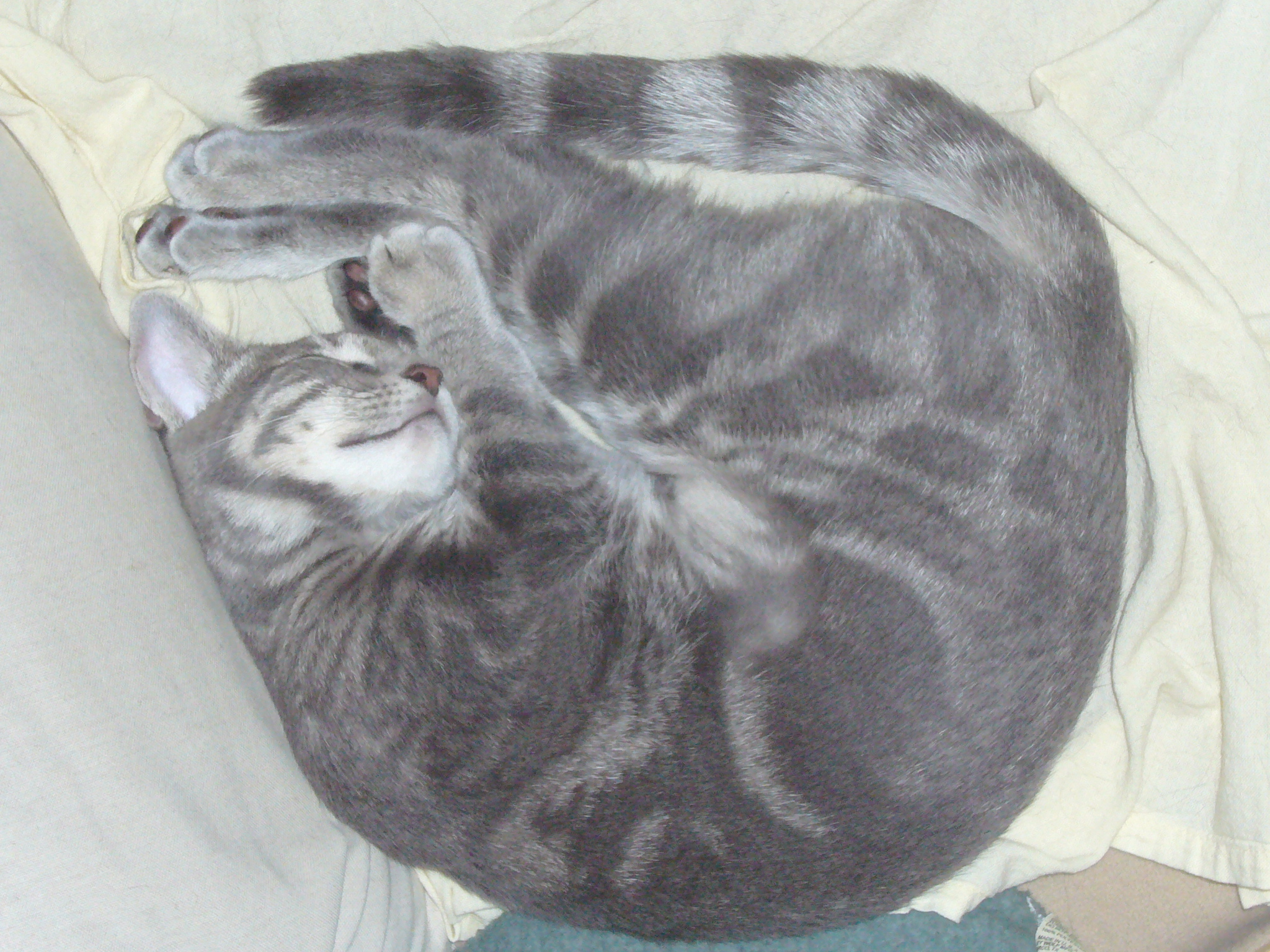
Kitty croissant, or nautilus shell---take yer pick

Here’s the kitty boy, decidedly ignoring both me and The Trickster:

Not paying atttention: la la la la la

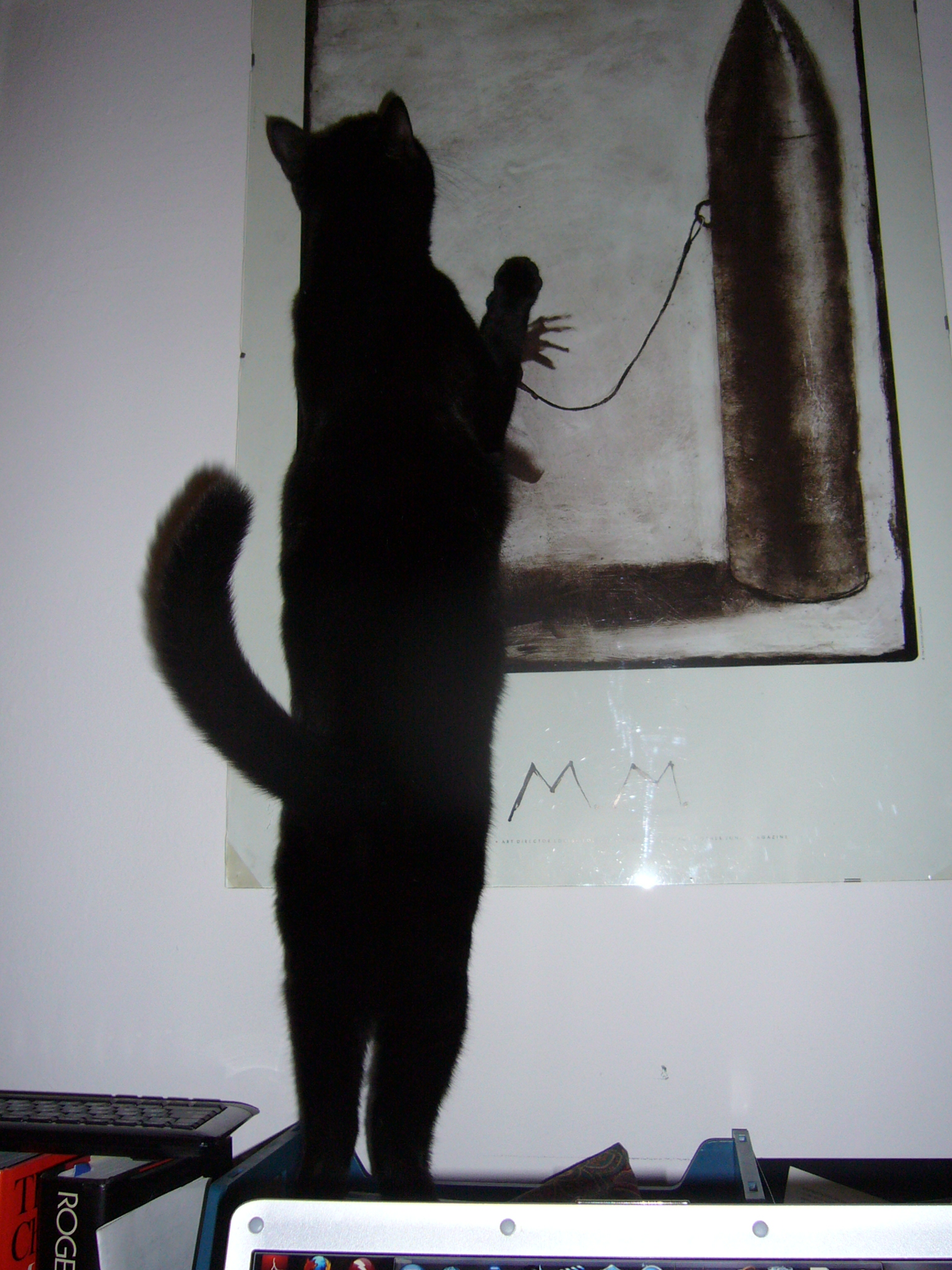
Here he is again, driving me up a fucking wall:

Oh, is this bothering you? Really?

He’s got this thing, where he climbs on to something inconvenient and proceeds to dig away at whatever is hanging on the wall. Not the wall itself, mind you, which might be amusing. No, he has to whack away at something which could fall and break or fall and break something else and in either case generally rip up the plaster.

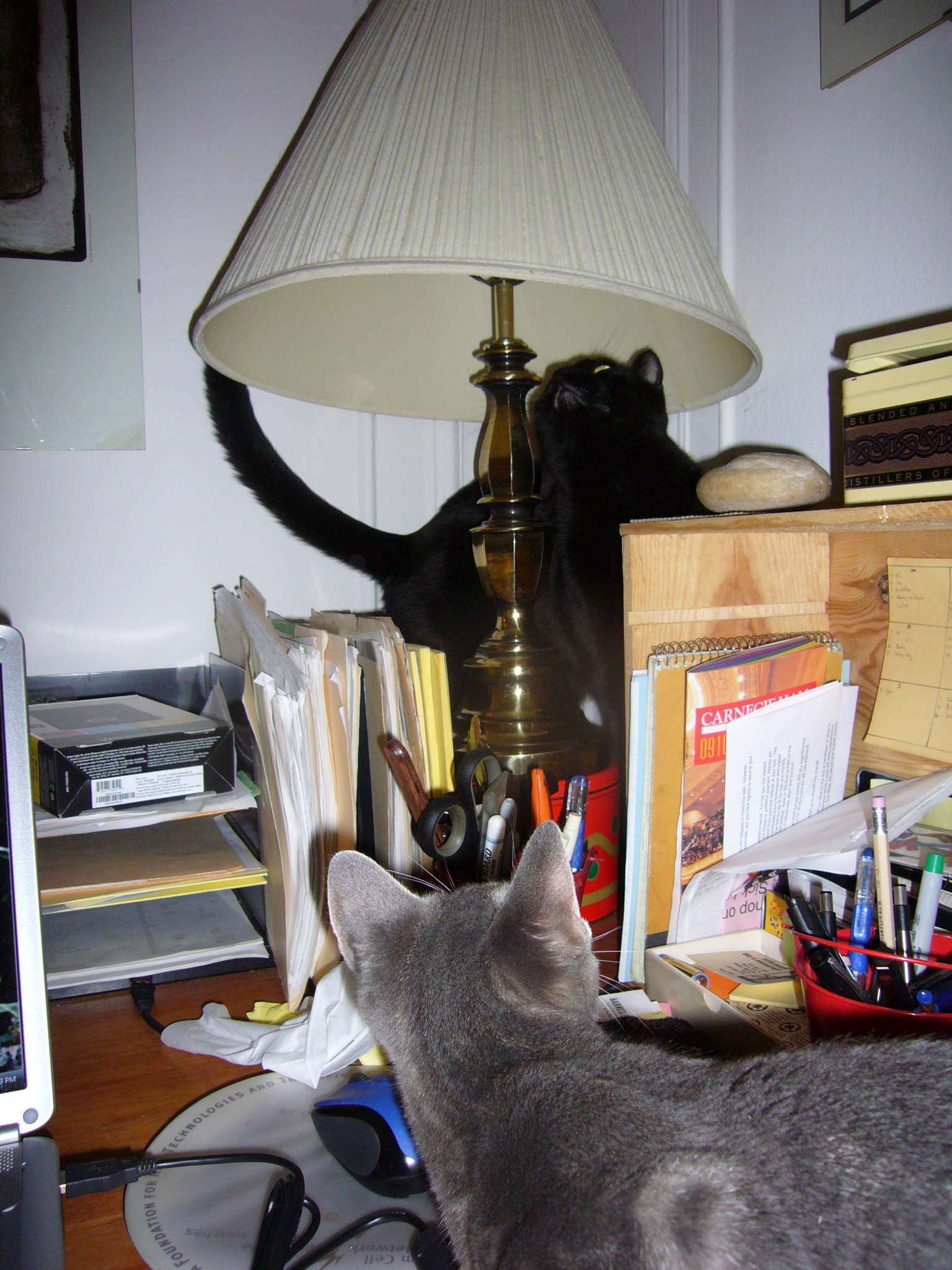
Or just hang around the desk while I’m trying to work, because, you know, it’s not as if there’s not an entire apartment available for their amusement:

*Sigh* Fucking Feline Union.