Half-listening to Beth Orton and this song comes on so I stop and listen full:
This is the song I listened to as I decided to save my own life, lo those many years ago.
Half-listening to Beth Orton and this song comes on so I stop and listen full:
This is the song I listened to as I decided to save my own life, lo those many years ago.
I’m still (mostly) avoiding articles on that One weird trick! which won Trump/cost Clinton the election, mostly because I don’t trust anyone right now who is confident in her conclusions.
As I mentioned in my original election post-mortem, I think there are a number of variables which factored into Trump’s win and Clinton’s loss, and that the particular ordering of those variables likely shifted from state to state. Further, given that information is still coming in—any bets on what will ultimately be Clinton’s popular-vote lead over Der Donald?—we don’t even have all the pieces to begin trying to assemble these puzzles.
What can be done, however, is analysis of each of those pieces: how much did Clinton’s sex matter? what was the role of economic anxiety in voting? what is ‘economic anxiety’? etc.
And, of course, what was the role of the media? Well, that may only be theorized, never truly known, but one can at least look at the coverage, it’s shape and tone—which is exactly what the Shorenstein Center did.
This is only one study, of course, but it highlights the role of the negative in press coverage:
Negative coverage was the order of the day in the general election. Not a week passed where the nominees’ coverage reached into positive territory. It peaked at 81 percent negative in mid-October, but there was not a single week where it dropped below 64 percent negative.
Even those numbers understate the level of negativity. Much of the candidates’ “good press” was in the context of the horserace—who is winning and who is losing and why.
Negativity in and of itself isn’t a bad thing, but
The mainstream press highlights what’s wrong with politics without also telling us what’s right.
It’s a version of politics that rewards a particular brand of politics. When everything and everybody is portrayed as deeply flawed, there’s no sense making distinctions on that score, which works to the advantage of those who are more deeply flawed. Civility and sound proposals are no longer the stuff of headlines, which instead give voice to those who are skilled in the art of destruction. The car wreck that was the 2016 election had many drivers. Journalists were not alone in the car, but their fingerprints were all over the wheel.
There’s a lot more at the link—a lot more—so g’head and read it all.
Media folk will have to figure out for themselves what, if any, professional standards they wish to uphold in their campaign coverage, but it’s also damned clear that candidates must prepare themselves for another worst- (or even worst-er-) case scenario in plotting their own messaging strategies and tactics.
I have precisely zero advice on what those strategies and tactics should look like. Trump received a great deal of negative coverage, which (apparently?) didn’t hurt him; Clinton was also covered negatively, and it (apparently?) did hurt her.
Man, it’s tough even to figure out the affects of the coverage: how much did it really matter in any direction? I tend to agree with Rick Perlstein that it sure as hell didn’t help, but beyond that? Dunno, and dunno if anyone does know: I’m guessing there will be all kinds of regressions run over the next few years to try to tease out some kind of answer.
In the meantime, it might be worthwhile for current and would-be Democratic politicians to start dry-running different tactics right now to try to determine what works vis-à-vis the media—and if nothing works, what then.
Because they—we—have to be prepared. Even if it only matters on the margins, well, elections are won and lost on those margins.
I live in a blue neighborhood in a blue city in a blue state: this has been an excuse for not acting politically.
Hey, I don’t have to do anything, my rep’s gonna vote right, my senators’ll vote (mostly) right.
But that ain’t right, and I need to step up. I’ve written one letter to each, and need to write or call regularly to say Hold the line! And with the mayor and my city council member, too.
Still, there’s more that could be done, especially when it’s important to hang the Trump anchor around and drag each and every Republican in the House and Senate. So I’m going to adopt a red district.
I grew up in a small town in Wisconsin, so I’ve decided to adopt James Sensenbrenner and, by extension, Ron Johnson. Johnson just won re-election and Sensenbrenner has held his seat forever, but what the hell: why not spend some time tracking each and every thing these fuckers do, then coordinate with some Badger Democrats? Besides, Tammy Baldwin is up for re-election in 2018, so I’ll see what I can do for her campaign. (Oh, and whoever runs against Scott Walker? You betchyer ass I’ll be all over that.)
Or, y’know, maybe coordinate with some Badger Democrats, first, and go from there.
I’m not much for marching, anymore, and I don’t need to track the media—there are enough media people tracking the media—so why not do something I can do? Research, hunting down and collating information, maybe a little analysis.
Is this something you, similarly surrounded in blue, can do? Try it! Pick a place at random! Pick a place where you once had a pleasing interaction with a waitress at a roadside diner! Pick the place of your first kiss or last kiss or where you think would be a good kissing place! Pick a town whose name you love saying out loud and figure out who represents it!
Then contact the local Dems and say Hi, I love the sound of your town and have some skills and would like to help you elect Democrats, what can I do?
Or maybe you’re shy and not sure you can call out of the blue, so do some work and publish it to social media or maybe send an abashed email saying Hi, I love the sound of your town and have some skills so here’s some work I did that I thought might help you elect Democrats.
You can contact state offices or if you’ve picked a place, find out the city or county party (I’ll be hitting up the Sheboygan County Dems).
Now, one of the things I’ll be doing is looking at similarly situated districts, see which ones are repped by Dems, then look at how that person won. I’ll dig into historic voting data, demographic data, census—the whole megillah.
It’ll also be worth looking at what Dems did in Nevada and North Carolina: Clinton beat Trump in Nevada and the Dems took the governorship from a Walker-level guv in NC, so there’s probably something to be learned from each.
Okay, I’m being a bit scattered, here: I’m neither an Americanist nor a statistician and I don’t quite know what are the best places to find this info. The Cook Political Report seems a good place to start, and I’ll poke around the US Census site; county-level date presidential election data is available in chart form here (click on “Detailed Results”) and as in an interactive map here. I’ll also be (re-) reading Jameson Quinn’s work with Center for Election Science (the first dispatch published here) for some guidance on how to make sense of the stats.
It’s a start, and while I might not know what I’m doing right now, I think I’ll get the hang of it as I go along. I’ll keep you posted—and hey, if you’re doing something like this or something not at all like this, lemme know!
What to do about white fragility?
I don’t think it’s at all necessary that everyone concerned about racism also try to understand why some people are racist (and why many more tolerate racists and racism), but some of us should.
That is, some of us white people in particular should—just as some of us male people should try to understand sexists and the folks who tolerate them—but even as someone who’s willing to try, I don’t know how much good it will do.
I mean, I want to understand because I don’t understand why you would feed the belief that other people are worse than you. Yes, I get it, seeing others as worse is pretty much the same as making yourself feel better (in both senses of that term), but why is better, better?
Anyway, before I go flying off into word-play, back to political matter at hand: does knowing why people are racist or believe in conspiracy theories or peddle horseshit help to combat racism/conspiracy theories/horseshit?
James Fallows, among many, many others, has noted the challenges for the media of dealing with a president-elect who lies, but what of citizens dealing with their reality-hamstrung fellow citizens?
We’re not supposed to call them out or confront them or criticize them for their shitty views—this just makes them mad and sad and defensive and won’t work anyway—so then what?
I think the first principle of any strategy is that of commitment, which is to say, militancy. If you are committed to anti-supremacism, then, goddammit, don’t back down from that, don’t apologize, and don’t act as if that commitment is somehow up for grabs. Speak and act forthrightly, and hold the line.
So that’s what one should do for oneself, but, again, what to do with others who are put off by anti-supremacism?
Some of them are themselves committed to supremacism, and should be recognized as such. Commentators who suggest we not be mean to the racists seem to operate on the assumption that if we’re all just nice enough, we can, eventually, all just get along. But no.
What of those less committed to supremacism/conspiracism/horseshittery? What’s the best way to wean them away from it? There seems to be a fair amount of social science evidence, centered on but not limited to studies of cognitive biases, that it’s damnably difficult to pull people out of their own asses, but it’s been done, right?
I mean, people convert from A to B or deconvert from B to C, leave cults, are disillusioned with someone/some movement which they formerly revered, so there must be some way or ways (which do not include kidnapping and abusive deprogramming) to nudge or seduce or yank someone out of a closed loop.
I like to win arguments—I REALLY like to win arguments—but this is less about winning arguments than opening someone to the possibility that there is even an argument to be had.
A few I-define-you examples (leftover from yesterday because I couldn’t pull it together, man, so quit bothering me, all right?!):
*Consider the reaction to fat women who are unashamed that they’re fat, who have the temerity to insist that they are human beings who don’t need your approval, thankyouverymuch: it is unbelievably nasty.
*Remember when Obama said that if he’d have had a son, he might have looked like Trayvon Martin? That seemed to me a simple, poignant, observation, but holy shit, the number of (white) people who lost their shit in response to that—I couldn’t understand it.
But now, I think that (some white) people were pissed that Obama identified with a young black man, and in doing so, reminded them that he himself was, in fact a black man. And, too, maybe his empathic imagination was just too much for (some white) people, serving as a rebuke to their own, narrow judgements.
*Oh, and this is one I remembered as I was getting in bed: Famed anti-Semite and Viennese mayor Karl Lueger responded to those who complained he was too friendly with Jews by saying “I decide who is a Jew.”
As Ta-Nehisi Coates noted in his commentary on this (and other, similar, instances):
When I was young man, I studied history at Howard University. Much of my studies were focused on the black diaspora, and thus white racism. I wish I had understood that I was not, in fact, simply studying white racism, but the nature of power itself. I wish I had known that the rules that governed my world echoed out into the larger world. I wish I had known how unoriginal we really are.
~~~
What do we do with all of this? I don’t know. That you are bothered when I define myself does not mean that I shouldn’t define myself.
Is it enough to recognize that there will be bother, conflict, and so prepare for it? Is there a way through this conflict? I don’t know.
But as a matter of justice, as a matter of human being, each one of us gets to claim that humanness for ourselves.
Tina Fey tells a story of Amy Poehler doing something vulgar and Jimmy Fallon squealing
“Stop that! It’s not cute! I don’t like it.”
Amy dropped what she was doing, went black in the eyes for a second, and wheeled around on him. “I don’t fucking care if you like it.” Jimmy was visibly startled. Amy went right back to enjoying her ridiculous bit.
I like this story.
Now, I heard this after having read Ta-Nehisi Coates for some years and imbibing his ethic of I’m not going to let you question my humanity; of Hannah Arendt stating it was no good to say she was human in spite of being Jewish, that she had to choose one or the other; of Steven Biko and Malcolm X emphasizing that their blackness made them in no way lesser.
You would not define them; they would define themselves, as they pleased—and not to please you.
To name, to define, to determine the worth of something or someone, is so basic a power that we often only see it when someone says No.
And then we see how much it matters to those who would define: How dare you think you’re pretty? How dare you think you’re funny? How dare you think you’re equal? How dare you think for yourself? How dare you think you don’t have to think of me, in thinking of yourself?
It’s not just that the default-definers don’t like the words you choose to define yourself, but that you chose them for yourself. You took a power away from them, a right to decide who others are and how they should live.
This is elemental to any supremacist (sexual, racial, ethnic, religious) system: the power to define.
That power is a power to abuse, of course, but it’s also a power of mercy: Look how good I am, deciding you’re worthy; how can I be a supremacist when I recognize that you’re not inferior? How can I be bad when I let you live?
Avid supremacists may hate your declaration of independence, but those in the majority who think of themselves as egalitarians, who act without malice, may also decry your claims: why are you rejecting me?
And sure, some of the liberationists may reject that person, personally, or may offer their own counter-supremacism, but mostly, at the center of someone saying I don’t fucking care if you like it, is the asserted-I, not the you.
Really, nothing personal, but you are no longer at the center of the world.
And this displacement can be profoundly confounding. This is, of course, a psychological as well as a philosophical disorientation, but not only that: it is also a political one. It is not always recognized as a loss of power, but that’s precisely what it is—and there should be no surprise that people fight to hang on to it.
White people are mad that black people want to talk about race. Men people are mad that women people want to talk about sex.
White men people would prefer that women people and black people and Latinx people and queer people stop talking about things that white men people don’t want to talk about.
Or so it would seem from the latest volleys in the never-ending Wars of Identity, aka Battles of Political Correctness, aka Liberal vs. Illiberal Liberalism. I have some sympathy for all sides, although the greater part is with those who speak in the language of justice. That there is overreach on the part of the insurgents is to be expected—you don’t always know how far to go until you’ve gone too far—and should be confronted directly, and with some good grace.
Condescension is neither direct nor graceful, yet condescension is what Kevin Drum and Mark Lilla have on offer.
Drum argues that the term “white supremacism” is “faddish” and counter-productive: how can we get non-liberal people to take racism seriously if we keep talking about racism? Lilla goes back to the well to pull up yet another impression of identity-siloed collegiates, unaware of anything or anyone other than their own selves.
Neither discusses justice.
They do, however, talk about how all this talk about supremacism and identity is damaging to those who don’t like it. Pointing out everyday racism, says Drum, is like crying wolf: what will you do when The Racism really comes? And Lilla cautions that invoking whiteness is like saying Bloody Mary three times in a mirror: the incantation itself will conjure white-identity politics.
As if white-identity politics doesn’t already exist, as if The Racism isn’t already here. Lilla himself remarks that the Klan was an early manifestation of white-identity politics, but acts as if that manifestation were a distant island rather than the land itself. He wants a post-identity politics, one which appeals to Americans-as-Americans—as if Americanness is itself somehow innocent of history.
Note, too, the tactic both Drum and Lilla deploy: they seek to define the rules of liberal-left political engagement by decrying the efforts of others to (re)define the rules of liberal-left political engagement.
It is unsurprising that those who hold themselves above it all are unhappy with those who point out that they are, in fact, not above it all.
I noted at the outset that white people and men people are upset with non-white people and non-men people asserting themselves—this is, of course, an exaggeration. There are many white people and men people who recognize and are trying to understand that whiteness and men-ness are partial identities and what that means, among all the many other partial identities, and how they have been used in the unjust construction of those other partial identities.
Lilla wants us to get beyond identity—a desire which a suspicious hermeneut like me shares. But we don’t get “beyond” without recognizing “here”, a place in which some people historically have claimed a universal identity so as to define the particular identities of others, a place in which those with the particular identities are now seeking to define themselves, and claim themselves, as their own kind of people.
It’s a rough town, and a rough time, but we don’t get beyond without going through.
The usual:
And the sweetest find? My grand-nephew, Henry.
He arrived a bit early, and urgently, but he and my niece are fine. I am grateful for modern medicine.
Not including a photo, here, because I don’t know my niece’s cyber-social policy regarding her new son, but he looks, as all babies do, like a stoned little old man.
He’s beautiful.
May you have beauty in your life.
I’ve mentioned before my attempt to grasp modern ideologies, an attempt since grown into a project I’m calling Modernity’s Ideologies.
Here, in maximally-minimalist form, is my sketch of the argument:
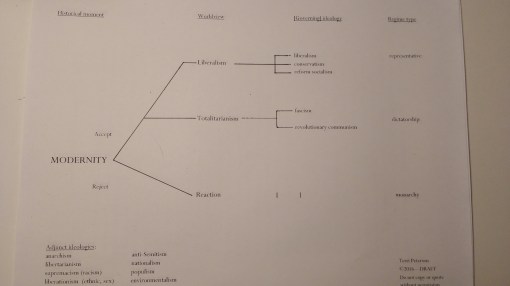
Terri Peterson ©2016. Do not quote without permission.
It’s hard to see (click to, y’know, see it), but the basic outline is MODERNITY as historical moment; Liberalism, Totalitarianism, and Reaction as worldviews; the attendant ideologies to these worldviews; and, finally, the types of regimes most compatible to these worldviews & ideologies.
The ideologies in the chart proper are referred to as ‘governing ideologies’: these refer to ideologies which offer a more-complete view of government and politics, which take account of individuals, groups, society, culture, economics, and governmental institutions. ‘Adjunct ideologies’, listed below the chart, are so-called because they are incomplete: they may cover some aspect of politics, but are unable on their own to provide a full and practical understanding of politics.
These are, of course, highly contestable claims; libertarians and anarchists, in particular, are likely to assert the wholeness of their ideologies (and, shoot, I should probably add ‘communitarianism’ to the list of adjuncts). I am unconvinced, although I do recognized that I’ll need to make the case for their adjunct status. As it stands, I argue that adjuncts may be fitted (more and less easily) with the various governing ideologies, that you could find, say, black liberation or women’s liberation accompanying liberalism or reform socialism—just as you could find white supremacism and anti-Semitism accompanying the same.
Anyway, the basic argument is that modernity emerges in European history and in so doing provides opportunities for the development of new worldviews, which in turn give rise to various worldviews. Liberalism and Totalitarianism are included on the same line insofar as both worldviews (or Weltanschauungen—I think I should stick to ‘worldview’ but oh, I’d like to sneak in that bit of German) accept modernity and the forward movement of time; Reaction rejects modernity and looks to the past.
Note as well that I list no ideologies coming out of Reaction. This is because I accept the view of ideology as a modern phenomenon; insofar as Reactionaries reject modernity, so too do they fail to develop ideologies. Reactionary regimes, however, lasted centuries into modernity: arguably, they didn’t disappear until the end of WWI.
And, again, this chart arises from European history: I make no claims about the history of ideologies elsewhere. Given that ideas, like people, travel—see communism in Asia, for example—I’m not arguing for the geographic and cultural exclusivity of these ideologies; rather, I haven’t done the work to make any claims one way or the other. Scholars steeped in the histories of the rest of the world would almost certainly generate their own, distinct, genealogies.
I have a lot of work to do: define modernity, define Europe, and then, oh yes, the worldviews and the ideologies themselves. I also have to make decisions regarding the spread of these ideas as Europeans colonized other parts of the world: do I stick strictly to the continent, or look European ideologies in, say, the Americas, in India, across Africa?
Finally, I’ll have a last chapter, ‘Post-Modernities?’ in which I’ll take up the challenges of those who think we’re already beyond. I used to be in that group, but now think, no, we’re still in modernity, frayed though it may be.
Anyway, when I refer in the future to any kind of ideologies, this is how I’ll be making sense of them. Whether it makes sense to anyone else remains to be seen.
Walt Whitman’s I contain multitudes gets its fair share of shares, and for good reason: it’s exuberant and ironic and sincere and boastful all at the same time, a declaration and excuse and an invitation to the tumult of life.
It’s easy to think of that tumult as a kind of playful churning, a shotgunning through rapids in which you are tossed and soaked but ultimately delivered, safely, to the sandy shore. It’s a ride, not a tsunami, not a hurricane; a volunteer thrill, not a crashing terror.
It is, of course, both.
I often forget this, that the multitude, the mix, the plural, contains not just joy but fear, that it’s not just a condition of freedom but the grounding of fear. I like to say about New York that we don’t all love one another, but we do, somehow, manage, mostly, to live with one another.
This is an accomplishment, albeit a fragile one.
Well, okay, not just fragile: there is a sturdiness to this and other places like this. There is a sturdiness to this country. But in taking for granted this sturdiness I have too often treated its fragility as a remnant, or mere theoretical possibility. I’d forgotten that if anything is possible, then anything is possible.
I don’t think we’re on the way to fascism, and do think that our many, varied, institutions, formal and informal, can serve as bulwarks against authoritarianism—emphasis on can. While inertia has its own force, there is nothing automatic in a defense of plural democracy: we have to act.
It’s hard, defending the tumult amidst the tumult. I don’t want everything to be political, everything to be are-you-with-us-or-against-us, even as I see the necessity of holding the line. I want to defend my side but since my side declares that everyone gets to pick their own side, do I end up defending those who would harm me?
I won’t hold to a principle which requires its own extinction, but neither will I abandon it for its practical difficulty.
This will take some doing, and some contradiction, too, probably. There is the theory, and the practice, and both will need some work.

 AbsurdBeats