So in the eyes of the law George Zimmerman is not a murderer.
This grown-ass man who followed a teenager, got out of his truck to confront him after explicitly being told not to by the police dispatcher, ended up in fight with him, then shot him, is not a murderer in the eyes of the law.
George Zimmerman followed, shot, and killed Trayvon Martin, but in the eyes of the law, he is not a murderer.
George Zimmerman may not be a murderer, but he is a killer. He killed a young man, he killed Trayvon Martin, and while the jury may acquit him of murder, it cannot take away the deed itself.
George Zimmerman may not be murderer, but he is killer. He will always be a killer.
I’m pretty good at riffing, which serves me well in front of the class.
Yeah, I sometimes go off my rails, but if I have to choose in lecture between adherence to a tightly-written script and occasional glances at outlinish notes, I’ma going with the glancing, occasional off-railing be damned.
Sometimes, though—more often than off-railing—my lecture or the conversation with students will take us into questions we’d have never planned to ask and allow us glimpses into a cranny within a subject we hadn’t known was there.
I love it when that happens.
The only downside, however, is that because those questions and glimpses are unscripted, I don’t remember them. Last semester, for example, one of the students in my bioethics class responded so unexpectedly to one of my questions that all I could say at the end of that session was “Wow, I didn’t think that was how the discussion was going to go, but that was really amazing.”
So damned amazing that when I tried to reconstruct it afterwards I forgot the comment that sent us all scrambling after him.
I do try to write down those bits which arise that I think should be handed off to the next semester’s class, but often students will come up to me after class with questions or I’ve got to clear out for the next class or run to catch the train so that by the time I have the time to recall the moment I. . . don’t recall the moment.
I’ve learned to let these fallen recalls go, because a) whatcha gonna do? and b) I know there will be other moments in other classes—some of which I may just catch.
That’s my version of faith, I guess: these moments will come, as long as I let them, these moments will come.
Twenty five years, a quarter century, almost half of my life—so far away, in so many ways.
I’ve mentioned before that I no longer recognize the desperately self-destructive person I once was, that on those rare occasions I read journal entries from later in my career as a failed suicide I think Jesus, I wrote this? Who writes this?
For twenty years, a fifth of a century, almost half of my life, I berated myself for my life, and in the midst of that fifth I tried, again, and failed, again, to end it. It would be over a decade before I would, finally, leave it all behind.
It’s been over a decade since I left it all behind.
These swaths of time, overlapping and flapping against one another, floating back into and obscuring past versions of myself.
This is the story of everyone’s life, I have to remind myself. Does anyone recognize who they were, then? Who sustains the same line all the way through?
Still, some lines are sustained, if even fictionally. There are pieces of memory I pick up and thread on to the knotted string I call my life, but I can barely remember who I tried to erase and what remains are these odd hard bits that nonetheless are unsettlingly warm in my hand.
Over a decade since I left it all behind, I cannot hold these strange remains for long without fear I will string them all together and back to that long dissolve. And so before I am too warmed I shake my hand and scatter those remains.
And so there are some ways I cannot know today of who I was before.
This is not a tragedy; this may not even be a loss. I wish I could know, nonetheless.
Twenty five years ago today I was vacationing in lovely Chez Bedlam, watching Wimbledon, enjoying the respite from the Madison heat.
Well, okay, it might be a stretch to call a just-barely-voluntary (as in: do it or else) stint in a locked psychiatric ward a “vacation”, but I did watch Wimbledon and the ward climate, like everything else, was controlled.
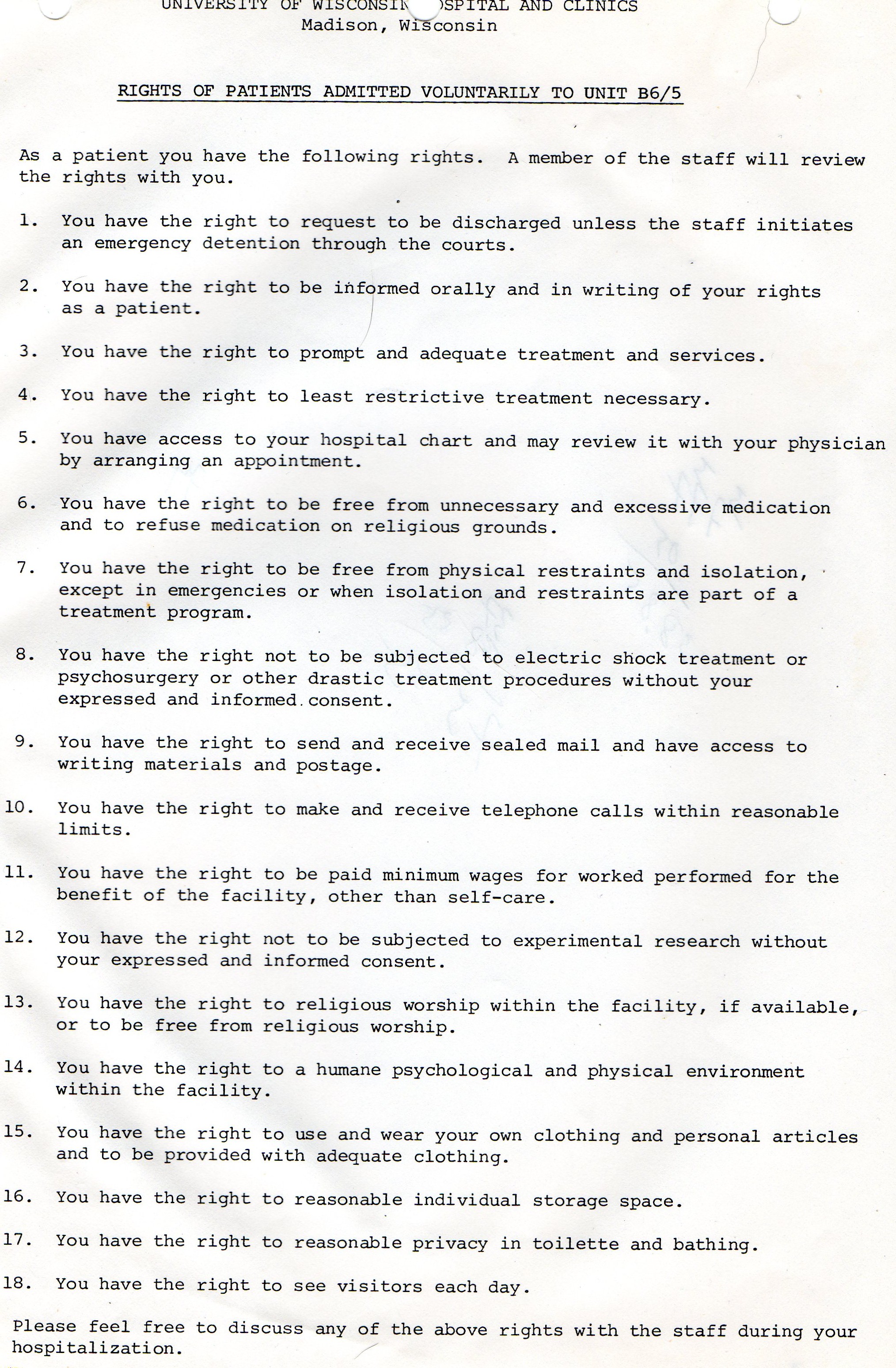
I’d first ended up in B6/5, as the unit was known, in June, and not voluntarily. I still have my “patient’s subject’s right” sheet for those detained against their wishes:
I was first interviewed by the some/all of the staff (what fun!) the day after the cops deposited me in the ER. I don’t remember much about the interview—and, really, even in calling up the event I’m almost certainly altering it—but I do recall someone asking me (after I must have mentioned I’d been accepted to grad school in political science) if I thought I’d be or wanted to be president.
I’d snorted and said “No”. My therapist was the only one who laughed.
Everyone else was dead serious. I wonder if they were trying to figure out whether my distorted thoughts had extended all the way into delusion.
I did get the hearing, was represented by a competent attorney, and ended up staying, mmm, a week, maybe?
A coupla’ weeks later I was back, not in cuffs this time, but under the impression that had I not returned voluntarily the cops would know where to find me.
My rights as a voluntary admit were a bit more expansive:
Friends did visit, bringing food and quite possibly a beer, and over the course of my two stays I made friends with J. who, unlike me, was not at all conflicted about wanting to get better. She wanted to be healthy more than anything, but it seemed like every time she managed to get a grip on the ledge, something would come smashing down on her fingers.
We stayed in touch for a few years afterward, but eventually fell away from one another. I have no idea if she’s still alive.
Anyway, no great scandal on the ward. ECT was suggested, but the suggestion was dropped at my vehement opposition. I was given an experimental drug, fluoxetine (brand: Prozac), but it made my legs shake and not much else, so that ended. I spent a few nights in the open containment rooms, got a few day passes, had a few good conversations with some of the nurses, and then I left.
And about a month or so after I left I was in Minneapolis, starting grad school.
Since I mentioned I’m grumpy about the electric bill (among other things), I guess I should look into this:
“Bitchy resting face is a definite phenomenon that plastic surgeons like myself have described, just never with that term,” he says. “Basically many of us have features that we inherit and/or develop with age that can make us look unpleasant, grumpy, or even, yes, bitchy.”
Youn says many plastic surgeons perform what he calls “expression surgeries,” procedures meant to improve resting facial expressions.
Yes, the Today show invited a surgeon on to discuss a “phenomenon” which was first discussed. . . in a comic video.
Thanks, Today, for making our world just a little more terrible.
Made it through June, but the beginning of July and it all ends.
The a/c-free livin’, that is.
I don’t have any strict rules for when I put the box in the window, but when I can’t sit in my apartment without thinking how hot I am and I can’t sleep at night without heat interruptions, it’s time.
Pre-a/c I used to just sweat and swear it out, waiting for the thunderstorm or front shift to blow through and restore me to sanity [oh hush, you]. I hated the steam bath, but ohhhh, the blow-through was divine.
Anyway, the other night the mugg couldn’t be budged by the fan and yesterday as the temp and dew point crawled skyward I said ‘Self, it’s time.’
The cats appreciate the cool, but as I’m the one paying the electric bill, I’m a bit grumpy about the whole thing.
I know some folks disdain later X as too poppy, but when your pop is as rough and jangly and heartfelt and angry and sad and what-the-hell as this, it should be sung to, not sneered at.
And, y’know, given Exene’s flexible relationship to pitch, it’s the kind of song everyone can sing to and get it right.
dmf is right: I gotta lay off the blogs that are leading me to screw myself into the ground.
Y’know, Sullivan with his Baldwin-proves-liberals-suck rampage (and before that, Clinton, and Palin, . . .). I don’t disagree with him (that Baldwin’s an asshole, and his Tweet, hateful), but jeez, make the point, and move on.
I mean, Alec Baldwin is an actor. An actor. That’s it. So you don’t like the people who like him, which gives you a chance to get all tribal and everything. Fine. We all get tribal some times. Just. . . own the tribalism, man, and stifle the it’s-the-principle! nonsense.
And Dreher, oy, reading him of late (Paula Deen, Trayvon Martin, liberals always and everywhere) is plucking my last nerves. The meanness, the double-treble-quadruple standards, the pissiness at pushback. . . .
There’s a difference between motive and intention, isn’t there? It seems that there’s a difference.
Motive is where something starts, and intention is where it leads, right?
Yeah, I think that’s right.
~~~
So I’ve been turning over this thought in my head about the whiteness of the GOP and arguments (click here for a Crooked Timber post that has the various relevant links) that Republicans don’t have to worry about being the party of the pasty.
I think they do.
I don’t have this all worked out, but it seems that in order for the GOP to be the White Party they’re going to have to entice voters based on their whiteness, and I don’t know how many folks think of themselves primarily as white.
This is the crumbling underside of the default standard of white: regular [i.e., non-academic, non-race-politicized] white folks haven’t had to think about their whiteness. To bring them to you, you first have to bring them to their whiteness, convince them that their whiteness ought to be their primary concern, then further convince them that their candidates will do the most to preserve their white privilege.
Yes, whitey-first appeals have worked and will continue to work in a number of districts, but I don’t see how this appeal can be expanded, largely because I don’t know how much white folks who aren’t already racialists really want to be racialists. I think white-first appeals would turn them off, maybe make them less likely to vote Republican.
Most Americans don’t want to think of themselves as racists—even the racists don’t want to be seen as racists—and aren’t in a hurry to separate themselves (in their imaginations, at least, if not always in practice) from their fellow Americans. We’re not always large, but an awful lot of us aspire to be.
I don’t know, I’m probably talking out of my nose. It just seems like focus-on-the-whites is a losing proposition with many of those very same whites.
Someone as non-whiggish as me casts a similarly skeptical eye on those claims, but skeptic that I am, I go even further: If there is no right side to history (which there isn’t), why the fealty to moralities anchored deep within that history, i.e., traditions?
I mean, isn’t the advocacy of tradition based on a notion of the judgment of history (properly threshed, of course)?
More talking out of my nose, I suppose, and maybe these are really two separate things.
I can go long stretches with a routine or an arrangement, and then. . . I get antsy. I toss things out, put some stuff into storage and pull other stuff out, and I move.
That used to be literal: Between college and the latter years of grad school, I moved on average of more than once a year.
There was that first year in grad school, with the screechy-horrid roommate who accused me of lying to her about. . . something, whereupon I decamped to a horrid, horrid apartment about 2 miles west on Franklin Avenue for a couple months. Then the woman who replaced me and the decent roommate kicked out the screechy-horror after she threw their kittens out of the apartment—they found tracks in the snow, but not the kitties—an invited me back in.
Oh, and there was Albuquerque, and that basement apartment that I had to leave after a week or two, into a room in the house of that nice, soft-spoken woman who turned out to be psycho when she wasn’t being nice and soft-spoken, then the duplex around the corner which my ABQ-cat Jomo broke out of with some regularity.
(Before I left Albuquerque, I found Jomo a home with a Los Alamos post-doc who wanted an indoor-outdoor cat. Figured he’d be happier on a ranch in the mountains than trapped in a Minneapolis apartment building.)
One place in Montreal, one in Somerville, then sublet in Prospect Heights, room in Clinton Hill, apartment in Bushwick, room in Bed Stuy, and then, finally, my own place, in lovely Prospect- Lefferts Garden.
And this apartment is fine, it really is. I’d like a bigger place, but, for now, with my finances, this joint works out fine.
Still, I get antsy, and since I’m in no position to move, I move. . . my furniture.
It’s tough—small place, remember?—but I can shift around my desk and various wine-box shelves and swap out rugs. Can’t really do much with the bedroom: four bookshelves line the back wall, and while I have moved my bed NSE and W in the same position, it really only works where it is now (headboard south).
Anyway, I’m sitting in my living room watching Eureka (fourth season—new episodes for me) and thinking, Huh, I’d really like to change things up. But how? I’ve tried this and that and the other thing and, really, the way I had it was probably the best way.
Still. Antsy.
So I tried something else, that I hadn’t tried before. I don’t know if it’ll work, but, y’know, it’s the summer and I was antsy and I wanted to move and so I did.
My stuff, I mean.
And maybe, someday, my stuff, my cats, and me, into a larger place where I have many—or at least, some—different ways of how to arrange it all.
I know, I know, y’all are thinking But absurdbeats, you can be such a bitch! And it’s true! I can be! But as comfortable as I am tearing into an argument, I am no good at tearing into a person—so much so that I cringe at witnessing a person getting chewed out.
That said, my discomfort transformed into awe over the course of this video:
Maybe because this guy wasn’t some poor schmoe but a CEO, maybe because Congresswoman Duckworth was so righteous, maybe because he was so. goddamned. shameless, but I actually enjoyed this, uh, little exchange.
Commenters on othersites have pointed out that the problem may lie less with Mr. Owie-I-Turned-My-Ankle-Once than with a system that allows him to claim a veteran’s disability for an injury sustained in prep school, and I don’t disagree.
But: a shitty system does not excuse shitty behavior.
Systems matter. The ancients pointed out that the type of society in which one lives affects one’s behavior, and over the millenia thinkers have exhausted a lotta brain cells trying to figure out how, exactly, culture may shore up or degrade virtue. Aristotle wondered whether one could be good in a bad polis, Diogenes wandered about searching for that one honest man, and today those of very different political persuasions bewail the corruption of our culture and the doom which awaits us all.
So, okay, culture matters.
But so, too, does conscience. I don’t know the exact relationship between culture and conscience, what resources any one individual needs to reflect on this relationship, nor what one needs to choose conscience over an interest which culture may promote, but I doubt that conscience is always and everywhere collapsible into culture.
There’s something called ‘virtue ethics‘ which focuses on conscience and character. I am dubious of its efficacy on its own—it’s too easy to slide from virtue as a goal to virtue as an excuse—but as part of a comprehensive set of standards, it’s can help to check oneself. If you want to think of yourself as a good person, then you need to consider what are the actions of a good person, and how do my actions compare.
This is where the whole conscience-culture nexus gets tangled (as least for us epistemological nihilists): If culture decides what is ‘good’, and I want to be ‘good’, then how can I go against culture?
That’s a tough one, and in its abstract form I can only offer multiple, partial answers.
The case of Mr. Owie-Ankle, happily, is not so abstract, and thus more amenable to judgement.
Braulio Castillo clearly cares about goodness. He’s a man who contributes to charity and gives back to his community. Given that he publicizes these good works, one can safely say that Castillo has at least thought about what is good.
As such, it is telling that he both highlights his “military service” and obscures the details by which he came to claim veteran’s disability based on that “service”. On his company’s website it is noted that he
attended the United States Military Academy (West Point) Preparatory School. Braulio was honorably discharged from the United States Army and received a service connected, disability rating from the Department of Veterans Affairs for his active duty service as an enlisted soldier in the US Army.
Did you catch that? He attended not West Point, but West Point Prep, doesn’t detail the injury (injured his foot in an exercise), and calls his time spent at that prep school “active duty service as an enlisted soldier in the US Army.”
If he thought that he did nothing wrong in claiming a 30-percent disability for an injury sustained prior to an active college-football career, then why not publicize the details?
It’s entirely possible that he thinks that doing good here makes good whatever he does there (another skew in virtue ethics), so why bother with such petty matters as, um, fudging the facts?
It is also entirely possible that he may have been suffering from a malady Upton Sinclair identified long ago: “It is difficult to get a man to understand something, when his salary depends upon his not understanding it!” And perhaps he could point to the particular business culture in which he operated—in which not understanding something is SOP—and say B-b-b-but everyone’s doing it! and claim that if his acts aren’t, y’know, good-good, they are at least par for the course.
(Of that last possibility, I would be unshocked.)
But that he called himself an “enlisted soldier in the US Navy Army” on “active duty service” when he was neither tells me he knew he was fucking with the facts, and was fucking with those facts for money.
That’s not good, Mr. Castillo, not good at all. You richly deserved that shredding.
And because of that, I richly enjoyed that dessert.


 AbsurdBeats