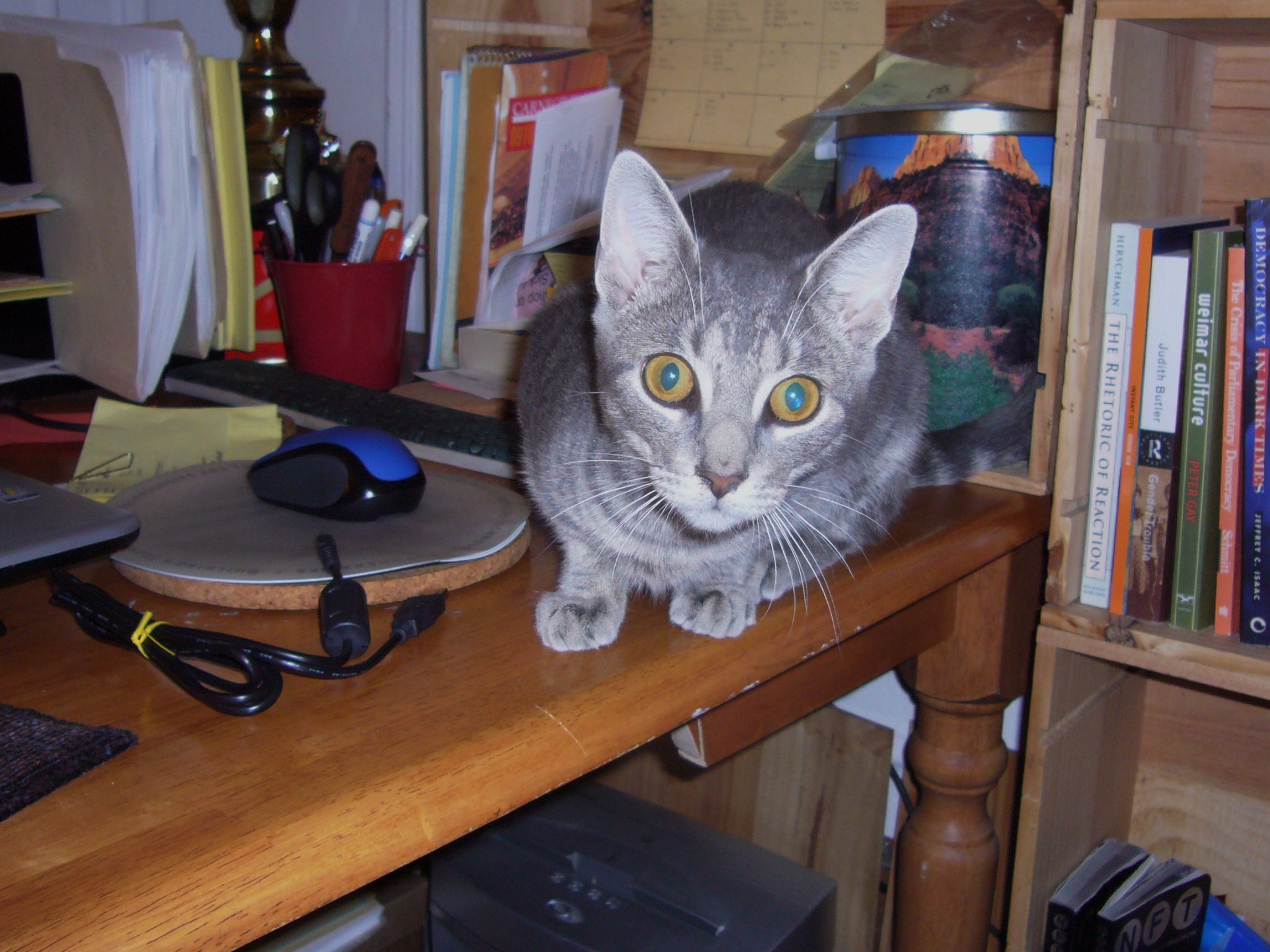
Am I sitting in a tin can

27 10 2010

My sister is not a crier.

Okay, yes, she has a sentimental streak and will tear up at matters involving her daughters or family generally, and she is far more expressive with her [non-angry] emotions than I ever will be. She’s normal, in other words.

But when I say she’s not a crier, I mean: she’s not someone to fall apart if things don’t go well or if there’s any sort of crisis. Instead, she switches into hyper-practical let’s-fix-this-mode, and then gets on with it.

She was crying when she called me.

V. was planning to visit me this weekend, flying in tonight and out on Monday. She’s flown before, but she hates it—really, really, really hates it as only someone who is terrified can hate a thing—so it was a big deal when she decided to fly here alone.

She might have made it, too, had it not been for the 60-80 mph windstorms which streaked across the upper midwest last night, windstorms which, not coincidentally, led to widespread flight delays across the region.

The flight tonight probably would have been delayed, too, but the weather on the ground in NYC has simply been a fizzle of gray and rain. She would have been fine.

But if you’re terrified of flying under even the best of conditions, to hear 24 hours before your flight about how awful the wind is and how much turbulence it’s kicking up, to think all day long at work about that wind and turbulence and having not only to fly into to NYC but back out, well, then, whatever equilibrium you’ve managed to convince yourself you could maintain is likely to dissolve into tears at an exit off the highway.

I’m not thrilled with flying—don’t (surprise!) like the feeling of being trapped—but it doesn’t panic me. Had it been me flying today, I’d have gotten on the plane.

But it wasn’t me, it was my steady, normal, practical, terrorized sister.

I felt so bad for her. She said it was a good thing my number was preprogrammed into her cell phone, because she was shaking so bad she probably couldn’t have dialed it. She said she felt stupid—and my sister never ever shames herself—not least because one daughter flew to Australia for a semester abroad and another to Austria for a series of musical performances, and I can’t even do a two-hour flight.

It’s okay, I told her. I’m not going anywhere, so it’s not like you missed out on your only chance to visit me in NYC. And I wouldn’t want you to spend your entire weekend worried about the flight home.

Let’s chalk it up to the weather, we agreed. Had it not been for the freak tree-bending winds, she could have done it.

So I hope my steady, practical, cheerful sister doesn’t let the anxiety which detoured her from the airport derail a nice, long weekend at home with her husband.

Go out to dinner with D., I suggested. Get the New York Strip.

She laughed. It was a good sign.


Blog flog: Subway Art

23 10 2010

Thoughts, oh so many thoughts, on: kyriarchy, patriarchy, enough-with-the-neologisms-already, structures of domination, confrontation, critical analysis, dissolve into understanding, alienation. . . .

Words words words blah blah blah.

So what that I’m text-oriented; luckily, others are more visual:

‘Nuff said

This pithy shot is from Subway Art Blog, which I read about in the NYTimes City Blog and, because I got a shitty night’s sleep and am too lazy to go to the gym or do much of anything, decided to visit.

Yay, laziness!

That shot is listed under ‘Stuff that Hates on Hipsters‘, but wait! There’s more!

‘You Know You Love It!’ (Aug 17)

Yes, even I, the arch feminist sophisticate (ha!) have a 14yo boy inside of her.

For those with who appreciate weirdness, check out the feature on Olek, a mad crocheter (sp?) who collaborated with the author by appearing in and around the subway wearing a crochet body suit.

Makes my bitter little heart beat just a bit faster about this New York underground life.

‘All Tracks Lead to Brooklyn’ (June 3)


Meet the new boss

6 10 2010

This absurd household has expanded once again.


The Trickster Lola


She looks innocent, doesn’t she? She certainly seemed shy and mild that first day.

Well.

Backstory: I had been worried that if I got a teeny-tiny kitten that Jasper would beat the shit out of her; a slightly older kitten, I thought, might have a chance.

The Trickster Lola (Trickster, Lola, Trixie, TrixieLa—you get the point), that was the name. Now I just needed a cat to fit the moniker.


Please don't call me Trixie


I spotted her on the Animal Control website (even though I looked too soon, I knew better, but I couldn’t help it). She was 7 months old, was given up due to owner allergies, and had a bad name.

And she was gray, striped. I wanted a gray striped kitty.

She was still there when I made it out to ACC on Saturday. Although I did look at the other cats, really, I knew as soon as I saw her she was mine; on Sunday, after her spaying, she was.


I just had surgery; no kidding I'm not all hepped up.


Tricks (that seems to be her name) was pretty laid back Sunday night, and even on Monday she was fairly calm.

But oh, did she talk. Does she talk. All the time. About everything. Reminds me of Chelsea that way—a good way.

And she’s gotten her pep back.

Jasper is not amused.


Why did you do this to me?

And, of course, she totally rules Jasper. Poor guy was freaked out by her, but it’s clear that even after he gets used to her, she’ll be running the show.

Divas are like that.


Love me, love me, say that you love me

26 09 2010

Love isn’t really my thing.

I don’t have anything against it, and it’s not that I don’t believe that it exists (whatever that means), but love and I don’t have much to do with each other.

I’m thinking about this because I referred to love in the comments to my last post, asking if someone were told that her belief was hated but that she was loved, would she, in fact, feel loved?

It was not so much the definition of love I was after so much as the question of being, but, nonetheless, it felt a bit. . . odd to use the term.

People have told me they loved me. My parents. My friend M. (who knows how it discomfits me). And I would guess that at least some of my friends would say, if not to me then at least about me, that they love me.

I don’t disbelieve them: if they say they love me, then okay. But I don’t feel it.

And I don’t feel badly about it. A little bad, insofar as I don’t say it back—this is one lie I can’t quite manage—but I don’t feel this great gaping and gasping pain of the absence of it in my life. Perhaps I can say that I feel the absence, but it is simply absence, something I register, and nothing more.

Have I ever felt love? I don’t know. I remember as a child telling my parents I loved them, and I think I would have said that I loved people (I certainly loved my pets) and meant it, but I also remember feeling that there was something obligatory in the saying: It was always tied, always. . . crimped or stapled into some line of duty.

I don’t remember it ever having been—although it must have been, once, it must have been—free.

And because it wasn’t free, because there was always that stitch in the side of any profession of love, it felt like a lie, a compulsion in order to reassure those around me that. . . oh, christ, I don’t know what. That I belonged? I can’t remember this, either, can’t remember why I felt guilty for saying it, only that I did, that I questioned whether I meant it.

This isn’t about conditional versus unconditional love: conditional doesn’t equal coerced. But I did feel compelled, for whatever reason, felt that there were certain things I must feel about certain people, and that I had to rank these people in a particular order—family before friends, parents before all others—and that to break ranks was a kind of betrayal.

And I betrayed.

Again, I don’t know where these feelings came from. Parents are the usual suspects, but they did (do) love us, and they did (do) try to be good parents. Perhaps it was a matter of their uncertainties and my sensitivities colliding in a way no one intended, but leaving us all damaged, nonetheless.

Damaged, hm. No, I’m not pained, but I do recognize that this absence is, indeed, an absence. And I wonder what its presence is like, and whether I, so long used to living without it, could even ever know what love is.

I don’t know what I’m missing, which makes me wonder what I’m missing.


Just who is the five o-clock hero?

21 09 2010

I lost out on a job; I am so relieved.

I shouldn’t be: I should be freaking out. Yes, I’m still teaching, but that covers rent, nothing more. And I do have a bit of money in the bank, but not enough for me to be relieved instead of freaking out.

So why aren’t I freaking out?

One obvious reason is that I didn’t want the job. It’s at the same place I’ve been working, so I know people there, I like the organization well enough, and it’s an easy commute. Oh, and the job would have been fine, too.

I just didn’t want it. The pay would have been okay, and the work conditions not-onerous, and there are parts of the job I think I would have enjoyed. But I was worried—worried—that I’d be offered the position, and stuck in a sideways corporate position which was more comfortable than challenging. Yes, I could have paid for things besides rent with this job—no small thing, and why I would have felt I had to take it, had it been offered to me—but jesusmaryandjoseph did I move to New York City for. . . this?

Okay, so that’s over the top, and completely unfair to the job itself. But I did take risks to move here (some of which I’m still trying to pay off in the not-rent portion of my financial obligations), and at some point it seems a waste of that risk to settle for something merely because it’s safe.

Easy for me to say, I know: I don’t have a partner or kids or a mortgage, and safety and settling matter when there are people relying upon you. Risk calculation changes when you’re responsible for someone else.

I am responsible for no one else. Whether that’s good or bad matters less than the bare fact of it itself, which means if I am to take responsibility for myself, then I need to pay attention not just to my bank account, but to the whole of my life.

Truth be told, I’m not very good at that, and too often anxiety and fear cloud my sensibilities and make me uneasy to try—to risk—what I may actually be able to do.

This 9-5 job would have been a respectable reason for me to hold off on those risks, on those efforts, and I have no good faith that those efforts will pay off.

But Christ, all that it took to bring me here: isn’t it time to take a deep breath and go?

***

And on that point: listen to and enjoy Poi!


The expulsion from the Garden of Eden is the beginning of life as I know it

19 09 2010

I’m a little fuzzy on the whole sin thing.

Yes, something about disobeying God, with apples, snakes, naked people, banishment, knowledge. . . really, if I were religious, I’d surely find this all fascinating, but as I’m not, well, it just seems curious to me.

But one thing I do like about the insistence on the sinfulness of humans is that those propounding on this corruption tend to see it as all-inclusive: Everyone is a sinner, everyone needs grace.

Handy to remember that.

I’d circled this issue in the last two posts, in terms of Christians and TeePers behaving badly, but one of the things I was too angry (!) to deal with in the Wars-of-Religion post and too politically-minded to deal with in confronting Howard Beale is my basic belief that almost all of us carry almost all of the possible characteristics any human being can demonstrate. The proportions may vary, sure, but outside of the exceptional few, I think we’re all capable of the same basic range of thoughts, feelings, and behaviors.

This doesn’t make us all the same: there are clearly differences in the mix, as well as what each of us brings to that mix in terms of conscious effort and habituation.

Oh, crap, I’m getting too windy.

Lemme put it this way: I didn’t post the extensive quote about rampaging Christians (in response to Peretz’s claim that ‘Muslim life is cheap, especially to Muslims’) as a way of saying See! It’s not just Muslims! Christians are bad, too! Boos, all around! No, the point—which I didn’t explicitly make—is that people behaving violently in the name of religion is unsurprising, given that people are capable of behaving violently.

Yes, there are belief systems which explicitly forbid violence, but the existence of pacifist belief systems proves the point: If the adherents weren’t themselves capable of violence and aggression, there’d be little need for a system to discipline them.

Again, another capacity of humans: to restrain ourselves from doing all that we can possibly do.

But why restrain or indulge? What leads Christians in one period to slaughter one another and non-Christians and in another to tolerate and even respect them? What leads Muslims to laud or condemn conquest? What makes rightists or leftists righteously angry and what will they do with that righteousness and anger?

Ask the question instead of assuming the answer.

It’s too easy to say Christians are peaceful and Muslims aggressive (or vice versa), or rightists are patriotic and leftists traitors (or vice versa), especially when the historical evidence indicates otherwise. Nor is it enough to say that x-behavior isn’t representative of true belief, especially when—again—evidence indicates that x-behavior in another time or place was treated as the sine qua non of true belief.

Do you feel the breeze? Sorry, getting windy again.

I just don’t think we humans are better or worse than we were before, nor that we can even define better or worse outside of a particular historical context. Best simply to try to understand what we  mean by these terms, and to recognize what we are capable of.

For better and for worse.

***

Addendum: Perhaps this also the case for other creatures, and how we act towards and respond to them.


Between the pen and the paperwork

12 09 2010

I finally did it.

After clearing out the 4 boxes and separating the recorded from the unrecorded articles, I piled up all the recorded articles  until I figured out what to do with them.

All that work—years worth of work—and the one, great, broken promise that those articles collectively represented sat in my small hallway, just outside of my bedroom. For months.

Yesterday, I went through the stacked meter of them one last time, pulled out a few to offer to my bioethics students, and carried the rest to the recycling bin. Today they were gone.

I still have about another foot left; these are the articles to be entered into my database and then, like the others, taken away. And there are still the hard copies of all those Human Genome Reports, the reports from DOE and NIH and NHGRI and OTA, along with some number of articles that I couldn’t quite part with; perhaps by the time I move again I’ll have figured out how to toss these, as well.

It’s not that big of deal, I tell myself. All of this is available online, either through the CUNY library system or, if I ever remember to join the Wisconsin Alumni Association, through the UW library system. It’s all still there, not gone at all.

But it feels like waste: a waste of paper, a waste of a career. All of this work I gathered (or which was gathered for me—thanks R.!) was to have led me further into an academic life, one in which I built a political theory of bioethics, taught medical and graduate students, participated in colloquia and conferences, and secured myself inside a tenured professorship.

Didn’t happen. Obviously.

I held on to those articles, nonetheless, never quite sure of when I might—might—need them again. After all, I’m still teaching, and who knows when that Theoretical Medicine or Human Gene Therapy or Philosophical Nursing piece might be exactly what I need. I once needed them, or at least, once thought I needed them; so who knows. . . .

I know: I don’t. They’ve been a kind of heavy security blanket, boxes of files I’d carted with me from Montreal to Somerville to (storage locker to storage locker in) Brooklyn. I’m done, I said, as I refused to get rid of all that with which I was done.

So about a year ago I decided it was time. I did nothing. Then I said, Hey, I have a file of all of those articles, so it’s not like I’m losing access to everything. I did nothing. Then I disinterred them from the boxes, sorted through them, piled them a meter high in the small hallway outside of my bedroom. Where they sat. Until yesterday.

It felt good to get rid of the clutter. I have pack-ratish tendencies, but I love the relief of unburdening myself of unnecessities.

It just took awhile to admit that these thousands of pieces of paper were a part of those unnecessities.


The secret to a long life is knowing when it’s time to go

5 09 2010

A friend is moving away.

Not for awhile—not for a year—but she is leaving.

I’ve got to get out of this city, she says, even as she asks, How can I leave?

Already, she’s missing it.

Already, I’m missing her.

I guess I can hope that she’ll change her mind, but her announcement isn’t a surprise, not really, and because it’s not a surprise—because what’s driving her away from the city have been there for almost as long as I’ve known her—I don’t think she’ll change her mind. It’s not a matter of saying These things you think are bad aren’t really that bad at all, not when these things are bad and not when, in the end, the bad things aren’t  the issue.

No, the city no longer works for her; she can’t live her life here. And so she must go.

I understand the impulse: it’s been pulsing in me since I was a teenager, driving me ever onward. I loved Madison, but never considered staying; it was my college town, and, defined as such, a transitional place. Similarly, Minneapolis and grad school. Albuquerque was a hideaway and I knew even as I didn’t know that the moment I landed I would depart. Montreal—so easy to love, and I did—but my postdoc was for two years, so there was no question that I was just passing through.

Somerville? Oh, no.

And New York? New York was always the holdout city, the one dreamt of as a teenager, the place I could never scrub from my mind even as I avoided moving here. Until I did.

This is the last place; where else could I go?

So I wonder about my friend, and how she can leave. I wonder this even as—still—I wonder where else I could go.

Part of this restlessness is plain unhappiness, dissatisfaction with a life to which I am ill-suited. I don’t think I will ever be rid of this dissatisfaction, that I my life will never suit me. It’s not that I nurture this estrangement, but that I distrust comfort; ergo, satisfaction will always decay into unease.

I have to remember this when I think about leaving. I cannot outrun the thermodynamics of my own existence.

But I also have to remember that even if there are no perfect places, there are better and worse places. For my friend, New York may be better than her (many) previous cities, but that a new city may be better than here. She does not have to be trapped by the grandness of this city.

And I wonder about that. I wonder if I could leave without feeling like a failure.

A year before I left Massachusetts, I visited a friend, in Madison, who grew up in the New York area and lived for many years in the city. She was about to leave for a job in the southwest, and when I told her of my plans to move here, she was wary. New York is a tough town, she said. Unhelpfully, I thought.

I now know what she means (even if it wasn’t what she meant), but at the time I took it as a challenge, as in, You don’t have what it takes to live in New York.

It was humiliating. And devastating, in a small way: How could New York City—my city, my last place—how could it not be for me, or me for it?

So I’ve been here four years, and I can handle it. But just because I’m not handled by it, I wonder, is this my last place? Do I stay to prove a point that does not in any way matter?

Could I do what my friend has done and recognize that this city and her life are not the same, and that the life matters more than the city?

I have to see that, whether I stay or go. I am staying, for now, for however long now lasts, but like my friend, I can’t let this place matter more than my life.


What you say? I’m just askin’ (pt I)

29 08 2010

When do words and acts become being?

As quoted by Tobin Harshaw in The NYTimes’ The Opinionator, Sister Toldjah:

The little secret that is not really a secret except in the closed-minded world of the left is that most conservatives don’t “hate” gay people. Apparently, because most conservatives don’t support gay marriage and don’t support gays openly serving in the military, they “hate” them. This is “hate” – in spite of the fact that most conservatives also do not support polygamy nor any other type of “alternative” marriage, nor do they support women serving on the front lines in war. It’s an issue of not wanting to tamper with the existing social structure of the two parent man/woman family, and not wanting to create an atmosphere of great uncomfortableness in the military between those who are openly gay and those who aren’t. We’ve seen the disastrous results of the left’s tampering in the social arena for decades now, and we’re opposed to signing onto anything else they have to offer on that front.

A commentor, Ralph Dempsey agreed:

I am so sick of being called a ‘homophobe’ just because I oppose gay marriage and want to keep homosexuals out of the military. The liberal Left is trying to play the same game they play with the race card. Sincere, honest, loving, genuine people oppose two men or two women attacking the sanctity of those in heterosexual marriages. That is not bigoted any more than people who opposed interracial marriages were racist. Over 85% of the country during the early 60’s did not want Black men trying to procure white women – were all these people racist? Give me a break. We should be free to oppose minority lifestyles without being labelled as haters.

Hm.

I do like that Mr Dempsey made manifest what is so often implied: Why should the majority suffer any consequences for opposing (oppressing?) minorities?

(And yes, I also like the comparison to views about interracial marriage in the 1960s, when ‘Over 85% of the country did not want Black men trying to procure white women’ didn’t necessarily mean those people were racist. I see. Would you accept sexist?)

As much as I’d like to play around all day with the scary-Negro-carrying-off-white-women image, I do think the more significant issue is the one of doing and being: At what point can your actions—your words, your deeds, your opinions—point to something about you and your character?

Nobody wants to be a bigot, but, it seems, many people wish to speak and act in a bigoted manner.

My first reaction is thus: There are two kinds of tolerance: that of the superior for the inferior, and that of equals for equals. As long as gays and lesbians (and bisexuals! don’t forget us bisexuals!) and anyone else cast in the role of Those People are treated as lesser, then those with the superiority complex may justly be called out for the bigotry of that superiority.

If you seek to deny others what you enjoy yourself, then you may be justly called out for the injustice of that denial.

If you seek to justify this injustice, then you may justly be called a bigot.

You want to be able to speak and act in a bigoted manner, but you don’t want to be called a bigot.

It’s really quite simple: If you don’t want to be called a bigot, then quit acting like one.

****

A fine conclusion (and one which sentiment I’ve almost certainly stolen from others), and certainly a satisfying shortcut through bullshit.

But, alas, in so shortcutting the deeper question is both highlighted and skirted: what are the dots between what you do and who you are?

And what are in those dots, anyway? Stay tuned. . . .


And when I fall asleep I don’t think I’ll survive the night

27 08 2010

Everyone dies, and everyone was dying.

It was the end of the world, gently. People were falling over and dying, everyone, and everyone knew their own ends were soon, and instead of hysteria and rioting we were going out restaurants and laughing on our barstools and everyone was well-lit (as in the lighting was good but maybe also a little drunk) and in a really good mood.

A bit of melancholy, but mostly a resigned good cheer.

At one point I felt the heaviness in my chest and I crept behind a plywood wall and lay on shaded grass next to a wooden bench and thought Okay, this is it, and the only thing that felt wrong was that I was all alone. We were all dying and it seemed we should die together.

I wasn’t afraid or angry or anything but accepting; it was not a bad feeling.

But then I started to write and I thought, Well, wait a minute, let me try to write before I die, so I got up and was writing on the wall and then on boards and then I thought I need another marker. I got on a bus to take me to a place to get that marker and the bus started careening all over the place and everyone was laughing and I realized that this was a crash bus (it had specific name which I can’t remember) and I had to get off. Not yet, I said, not yet. So when we passed a patch of grass I launched myself off the bus and landed and rolled and when I looked up the people on the bus were laughing and giving me the thumbs up and saying Way to go, Radio.

Radio? I was confused and thought that maybe that had something to do with something I said on the radio. I didn’t know anyone had heard.

Was I afraid to die, was that why I left the bus? I was more worried about the crashing, the injury, than death. Still, I wanted to write.

I ended up in a lab run by the guy who played Michael on LA Law and his young assistant and I said I needed markers and the assistant gave me a small marker which didn’t work and Michael said No, no, she needs a real marker and he gave me a couple and I started writing then and there on whatever wood I could find.

I knew I wouldn’t finish but I thought There has to be a record, someone has to write something down before we’re all gone. Michael and the assistant and the other people in the lab were all working on why we were all dying and they were all smiling, gentle and resigned and still working.

Is this how it is? Wouldn’t there be violence and mayhem and denial and wouldn’t we do anything wreck anything to get away from our end? But no it was like a charmed party nearing its end which we didn’t want to leave but knew the evening had finally come to a close.

So I was back to writing in block letters because it was a thick marker and my penmanship is terrible and I wanted to make sure you could read it and I wondered if other people were writing. I hope other people remembered to write about our end.

And then my chest got heavier and heavier and then I woke up.