Her body trembles with the effort to last

1 01 2009

Emma Bee Bernstein, 23, killed herself.

I didn’t know Emma, didn’t know anything about her until Courtney Martin ran an obit for her at Feministing.

All I could think, upon reading the obit, was, Awww, Jesus.

This is how I know I’m over my own folie a deux with suicide. Before, when I heard or read that someone had killed themselves, I’d be envious. Ah, I’d think, so they managed what I could not. But this time, all I could think was, Awww, Jesus.

Twenty-three. One lifetime. She could plausibly have had three more lifetimes, but chose not to.

What do you say to someone? There’s so much to live for. . . You’re so young. . . Things’ll get better. Not necessarily. Even if you believe it, she won’t.

Would it help to say, There’s no point to life. Live anyway.?

Live anyway. Through it all, live anyway.


Teacher tells you stop your playing get on with your work

29 12 2008

I hate grading. I’d rather do laundry than grade, and I hate doing laundry. Empty the cat box. Clean windows. Shovel after a blizzard.

Did I mention that I hate grading?

It is, alas, necessary in the corporate academic complex. (I almost managed to write that with a straight face.) No, I actually do see the point of it, I just hate doing it.

What would happen if I were to tell my students, on the first day of class, that they would all get B-‘s or C+’s, no questions asked. If they wanted a better grade, they’d have to do the work—and still no guarantees of a A. How many would would show up for class? How many would do the reading?

How many would actually care to learn about the subject?

Ha. I know. Perhaps I lay on one condition: You get a C+ if you show up regularly, a B- if you participate. If the class isn’t too early or too late in the day, I’d probably get a decent turnout.

And almost no grading. ‘Almost no’ because there would always be those few students who want the A and/or would feel too guilty not to do any work.

Of course, there’d also be those students who would be so offended by my mockery of the Purpose of Education that they’d narc on me. ‘How dare she not force us through flaming hoops for meaningless letters on a transcript no one will ever look at?’

Don’t worry, I lack the guts/foolishness to try this. Gotta pay the rent.


Alive and kicking

17 12 2008

More or less. Troubles with the intertubes and grading and, mm, grading.

Lotsa thoughts, tho! More blather to come!

Can I save this post with a quote from Hamlet about ‘tomorrow and tomorrow and. . . .’

Damn. Can’t remember the whole thing. Still. Later.


The Republic was a dream

12 12 2008

Still mulling the Ainadamar experience. The gathering-together for a purpose: the musicians and singers to perform, the audience to take in this performance. Yes, there was planning—practice, rehearsals—and those of us in attendance knew what was to be performed and who would perform.

But the. . . power? force? of the live performance is that it is live, i.e., that it is unpredictable, that anything could happen. Unpredictable is usually bad, insofar as it’s associated with things like falling lights or malfunctioning, er, wardrobes, or, as in the case of the Austrian actor, stabbing oneself with a real rather than prop knife. But what of the silence at the end of the performance? Is that usual? Why was it? Were we soaking it in? Waiting to hear if there’d be more music? Not wanting to clap ‘out of turn’? Just letting the moment be?

I don’t know. Any or all or none of the above. Regardless, it bound us all together, suspended us in a held breath, a silence both fraught and still.

I could not have imagined this. I could not have experience this in my apartment, or alone in that theatre. The performers threw themselves out there, and we could only marvel at their flight, and catch them at the end.

Am I making too much of this? No; I am making too little. It was as  mentioned in a previous post, and as I told Jtt.: The performers opened themselves to us, but I couldn’t open myself to them, not enough.

When I say the performers lay themselves bare, I don’t mean in every way. I knew almost nothing about them beforehand, and almost nothing after—performance ain’t group therapy. No, I mean a nakedness at the moment of performance, in the revelation of that part of themselves which was crucial to the performance itself. Sing Margarita, sing Lorca, sing Nuria and Ruiz Alonso, and bring yourself forth in bringing them forth.

It is an act of discipline and bravery.

I am sobered by all they brought forth, and my inability to respond in kind. I recognized this failing during the performance, as I kept yanking myself out of the moment. But it’s not just about ‘being in the moment’; there is also the willingness to let oneself be carried away by the moment. I wouldn’t, couldn’t, sustain that.

And yet, as I told Jtt., I could at least see this, I could see that being carried away isn’t always all bad. Carapaces and defenses and distances all have their place in my life—I do not yearn for my juvenile melodramatic self—but snark and detachment can get in the way of wonder.

I’ve joked with my students that political science doesn’t really deal with passion—‘we don’t do love’—and as such, misses so much of what drives people to meetings and demonstrations and to take part in all the scut work which is a necessary part of political action. And an analytic which doesn’t take heed of Arendt’s observation that politics happens when people gather together, that political power arises from that purposeful gathering, will miss both the passion and the purpose.

The gathering at Carnegie Hall this past Sunday was not a political one. But it was a reminder of the power of the gathering, of the purpose of passion.


For you are the one and the all

10 12 2008

A new crush: Kelley O’Connor, mezzo soprano. Or is it for Frederico Garcia Lorca, as portrayed by Kelley O’Connor? Sexy and doomed—irresistible.

Should I revisit the issue of crushes, limning the differences among crushes (from afar, either to know the person or to know the work; for a character, fictional or portrayed; or up close, as a friend-crush or get-naked crush)?

Nah.  Given the uncertainties of this latest bout of sighing—for the girl? for the girl-who-portrays-the-boy? for the boy (who himself liked boys)? for the portrayal of the boy?—I’ll forsake the excavation in favor of play.

Queer affections: so much fun!


Java jive

1 12 2008

Bit by bit. I keep forgetting that, but it’s bit by bit that one’s life settles into the ground.

I was in GradCity for over a decade (w/a year’s interlude in SouthwesternTown), and didn’t really notice how much I adapted to that city until long after I left it. The bus routes. The running and bike routes. This restaurant and that diner and the coffee shop on the corner and bourgie co-op and the militant co-op and the hidden beach with the nudists and the punks and the families and the men in suits (really!). My loop of used bookstores (starting at the cheapest one first, of course) and cd shops. The old Nat and the new (hated because new and then Oh My God It’s Fantastic!) pool and gym. The cheap movie houses and the really good-not-horribly-expensive theatre and the dive bars and wine bars and bars for groups and bars for couples. Mexican and Thai and Caribbean and Vietnamese and American soul and American diner food.

And friends. Pla and Pl and Pt and J and C and D and K and I and L and T and S and C and Js and R and Jn and god, I must be forgetting some.

Nostalgia? Not really. I didn’t like GradCity at all. Okay, my last two years there weren’t bad, especially since I had finished my dissertation and was lecturing or post-docking, but I used to complain (LOUDLY) of how much I despised the place.

But I had a life there. Bit by bit, I put together a life there. And now I live in a city which drives me around a freakin’ bend but where I really really (mostly) really want to make my home, and I haven’t yet figured out (switch to rock climbing metaphor) where are the cracks and footholds. Why not? Because I’ve been so busy trying to live in the entire freakin’ city that I’ve forgotten that I live in it in pieces.

I have tried forcing things, eagerly looking for ‘my’ cafe or park or neighborhood, but these things can’t be forced; they have to come on their own. They come when I go back to a cafe or shop or neighborhood because I’m drawn there—when the place catches on me, rather than me trying to grab on to it.

When I was a teenager my family travelled to New York on vacation, and in the midst of one of those scarifying bus tours (‘Look to the left, people, look to the left. If you don’t look to the left you won’t see it.’), we stopped at this amazing Episcopal church. I remember poking around and glimpsing, through a door, this stoneyard out back. A stoneyard! All of a sudden, the guide’s comments about this church being a work-in-progress slid into a literal, concrete, reality. This old craft in this becoming-building in New York City.

I remembered that when I moved to New York, and on a both very good and very bad day I took the train up to the Cathedral Church of St. John the Divine and rested in this large, still, space.

There’s more to be said about that, but I mention it because that’s one piece. (I have also tried forcing a relationship with this place as well—that’s a part of the more-to-be-said—but St. John’s stays with me, regardless.)

And there is another piece, as well, a coffee shop I found courtesy of Rod Dreher at CrunchyCon, where I can buy my dark roast free trade coffee—Porto Rico, on Bleeker just off W 3rd. It sounds dumb—why not just buy Paul Newman’s coffee at Target?—but I love the act of making these people, in this place, a part of my life.Yeah, it’s a wee out of my way, work-wise, but why let the work commute dictate all? Plans, and all that. . . .

Bit by prosaic bit. The poetry rises out of this.


Stay awake

27 11 2008

Given so much killing, this would not be the worst way to live:

027

(From a building across the street from Temple Emanuel-El, on Fifth and 65th.)

—–

So this is a bit of a cheat—I adapted this from a comment I left elsewhere:

I grew up in a small town in the Midwest, moved to successively larger cities, and now live in New York City.

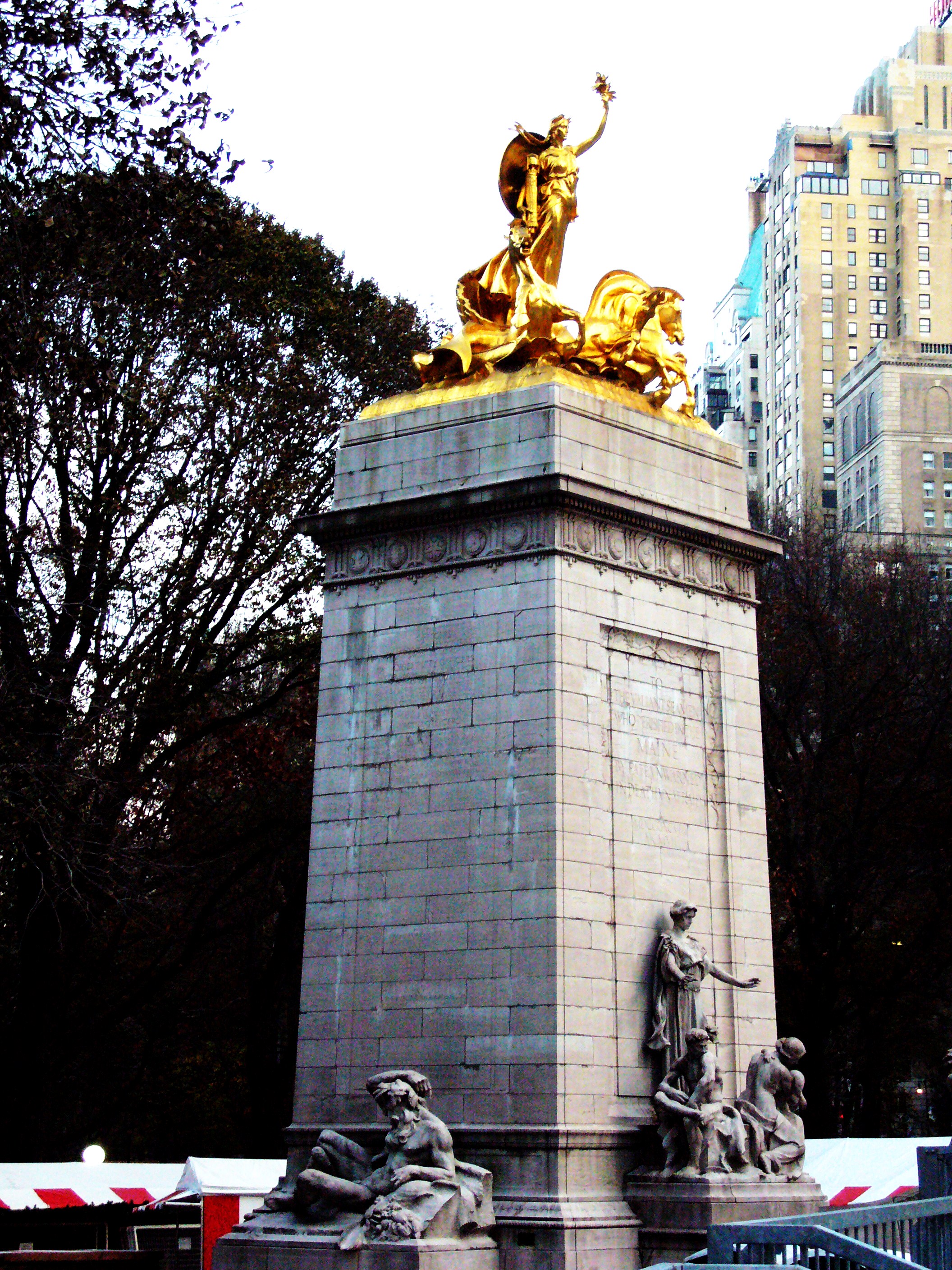
Needing to get out of the house today, I bopped over to Manhattan and strolled through Central Park. It was a bit late—the light was low—but I could catch a few images of this grand and humble place:

01510211

(stretched this one out a wee)

(jacked the contrast on this one)

I wandered around the neighborhood east of the park for a bit, taking in the discreetly exclusive apartment building between Fifth, Madison, and Park, exchanging greeting with doormen leaning out of doorways, and peeking into warmly-lit restaurants serving dinner this Thanksgiving. This is the genteel and lovely New York of near-past movies, recalling generations of families lucky enough to live within those warm lights.

Not that most New Yorkers have done so, of course. This was (and is) a city of working people, crammed together in slouching tenements which call forth a history neither genteel nor lovely.

Still, it is as easy to fall in love with the romance of hard times as it is to yearn for a sepia-lit life overlooking the park. To live amidst the tumultuous grace of history!

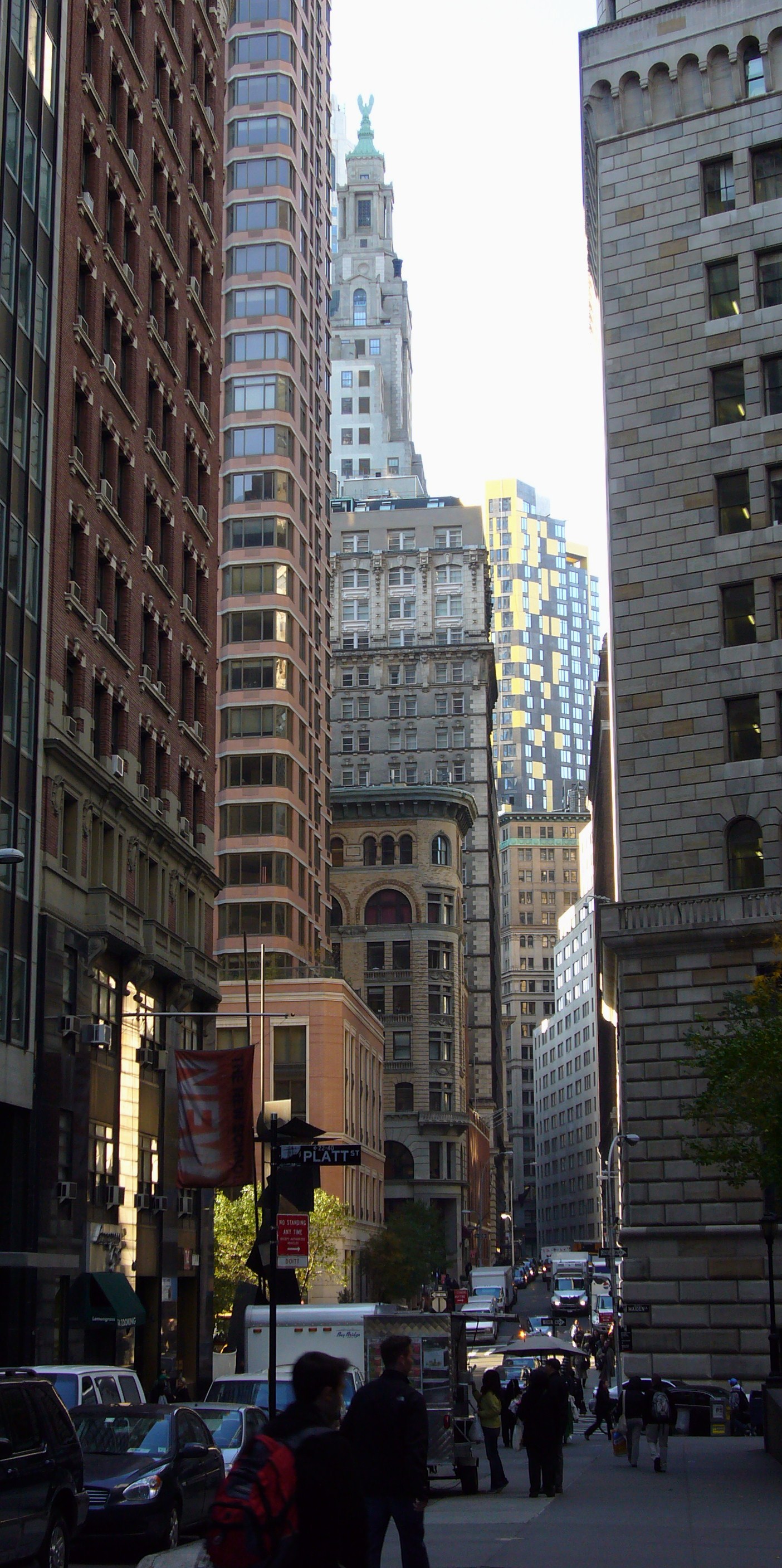
One of the things I love (and mourn) about this place is precisely that sense of history: when I walk through the Financial District early on a Monday morning I see the old iron sconces on the side of one building, the Art Deco doors on another, and the amazing mosaic at the entrance to the ITT building. It’s all still there.

Except, of course, it’s not. The old tenants have moved out and a pharmacy or bank or Starbucks has snuck in, and where o where is the idiosyncratic New York I moved here to find? Where is our tumultuous grace?

It’s there and it’s gone. New Yorkers are constantly bemoaning the loss of the ‘real’ city, the one which existed when they were teenagers or first moved here or yesterday, the city which justified the high prices and the crowds and standing-room only train cars. But this is the real city, today, and while I wish there were still Italians in Little Italy and working-class Jews on the Lower East Side, there are Poles in Greenpoint and Russians in Brighton Beach, hasidim in Williamsburg and Crown Heights and mosques in Bed Stuy. The Hare Krishnas and Scientologists lurk in the Union Square train station, and I even saw one brave soul setting up a McCain/Palin table not too far from the saxophonist. People from California and Cameroon and Oklahoma and New Zealand are tucked into corners all over this city, criss-crossing and occasionally bumping into one another. There’s the Stonewall Bar and the Cathedral Church of St. John the Divine (finally fully open this Sunday) and the wrecked earth from the Sept. 11 attacks posed in Battery Park.

This city erects and erases and absorbs its histories and cultures, mystifying and horrifying and, finally, gratifying those of us who are still learning when to hustle and when to slow down.

Where is your tumultuous grace? It’s there and it’s gone, wherever you are. Pay attention, wherever you are.


U li la lu lau (pt I)

25 11 2008

Good question. (Dammit!):

What are you expecting to see, that you’re not seeing? A plot? This is a serious question.

When I first read this, I thought Pfft, plot. Nooo.

And then I thought, Well, maybe. (This is where the ‘dammit’ comes in.)

Because I keep blowing apart my plans, I think that the plans don’t matter. But they do: I am simply not able to carry them out. Plans and plots aren’t the same, but I think I often use plans as plots, i.e., as narratives into which I can insert myself and give meaning to my actions.

That’s not necessarily a bad thing, as long as I recognize that I’m the one creating the narrative. Too often, though, I think that I treat these narratives as pre-made, dropped out of the sky or fashioned like set pieces to be rolled on to an empty stage; or, to put it another way, plot is something which happens to me.

But, of course, it doesn’t, and treating my life passively, waiting for something to happen, feeds both that passivity and my confusion with my life. I was a restless teenager, couldn’t wait to head off to BigTenU, couldn’t wait for my life ‘really’ to begin. I disintegrate, blah blah, go to grad school to hide and recover and hoop-jump for the Ph.D., which would then lead me to the serious (grown-up!) life of a professor. So that doesn’t take, and I think, Well, you’ve spent most of your life trying to end it, now that you want to live, perhaps you should, you know, live.

Okay! I’m gonna do it! I’m gonna live my life! (Cue sound of wheels screeching to a halt. Birds chirp. Uncertain looks around.)

I have, for the most part, given up on plans. This isn’t all bad: it’s forced me to think about what I want to do, what I can do, and who I’d like to be and become, even if I do often fret about rather than answer these questions. But perhaps I need to rethink this—especially because I do too often fret about rather than respond.

[Stop. Rest chin on palm. Squint at screen. Sigh. Curse.]

Shit. I have to recant: I haven’t given up the plans and plots, I’ve simply sublimated them into these questions, inflating them beyond the practical and sending them up into the sky (where at some point the answers to them will drop down. . . ). I think I’m being practical when, really, I’m a-lyin’ to myself.

Why the sublimation and inflation when the questions themselves can actually be answered? Because I think I have to provide The Answers and the once-and-for-alls, that, these questions only have to be answered once, and then I’m done.

Ha. For all my philosophical skepticism and uncertainty, I’m a right-proper self-authoritarian. (Could ‘plot’ be another name for ‘order’?) So I need to allow the dissenter some space, to say, Hey chickie, working answers, you know, work. I can deal with drafts for my writing, so why not with my life? Not in the sense of ‘rehearsal’, but in the sense that this is what you do: you try, and do over, and do over, and do over, and move on. And if writing draft one or two or five is all writing, why can’t living here and then here and this way and that all be living?

Insert Lolcats caption here: Life. Ur doin’ it. . . alreddy akshully.

(That sounds better than Getchyer head outta yer ass. Or clouds, as it were.)

The questions aren’t the problem, and even a little fretting isn’t all bad. But I do know that worrying about getting the story right can get in the way of writing the story; I know enough to write, and then to clean it up in the rewrite(s). And in these stories plot doesn’t descend over the characters, but comes out of them. Even if I had different ideas at the outset, I let my characters take over and veer away, if that’s what makes sense. I don’t worry about it; I let them be.

I don’t worry about it because, as I’ve told people, I write to find out what happens: If I knew at the outset, I wouldn’t bother writing.

Dammit! Look what you’ve done, C.: A goddamned lesson!

Still, not a bad one. And if I don’t remember, smack me upside head every once in awhile, to jar it loose.


Once in a lifetime

23 11 2008

I have a little problem with reality.

Mainly, it’s something that’s out there, a place where I ought to belong, but I can’t quite come up with the password or secret handshake or underground tunnel or whatever the hell it takes to gain entry. I can see it—I think—but then I fall back and wonder, Hm, is that it?

And if reality is over there, and I’m over here, then where the hell am I?

I blame my confusion on (at least) two things, one of which was my, ahem, extended stay in grad school. As high school and college friends were off doing the things regular people do, I was buying pizza at 2am to eat with fellow grad students in the computer lab. They took out car loans; I took out student loans. They bought suits for work, I washed my jeans.

Yeah, that’s a little glib, but not much. They were becoming adults, and I was becoming. . . a grad student. I got older, sure, but plotzing over a stalled dissertation is not the usual path to adulthood. And I finished—yay!—but then what? A coupla’ post-docs, and resignation from a profession I never got the hang of. A move to Bummerville, an escape to New York City, and. . . this.

Not that I have a clue what ‘this’ is.

So: When did you know you were an adult? When you left home? Got your first apartment? Moved in with your boyfriend or girlfriend? Got a mortgage? Got married? Had kids? Got divorced? When you look at your life do you say, Yep, this is mine? Or do you find yourself in the midst of a Talking Heads song: Well, how did I get here?

I know, we don’t all have to live the same lives, and it’s not as if anyone’s life is going to make sense all the time, but shouldn’t I be able to recognize something in it as mine? Or, more accurately, shouldn’t I be able to recognize myself somewhere in all of this?

Yeah, the second reason may play into this, namely, that long personality-destroying depression, but, really, how long can I continue to point at my voids and blame them for my. . . voids? Besides, don’t people without a history of self-destruction gape at their own lives, too?

So, what do we do? How do we know we belong where we are, or where we’re going?


Everything in its right place

18 11 2008

So when my mom got to the hospital this morning, my pop was sitting up in bed and talking to the speech therapist.

Good news. Gooooooooooood news.

He’s not all back, but enough that he’ll be going home Tuesday.

I spoke to him a few hours ago. It was good to hear his voice. He asked me how I was, and I told him how I get into Manhattan early on Mondays, and like to take pictures. Well, he said, New York seems to suit you.

So even though he doesn’t know I blog, and even though he doesn’t particularly like New York, these pics are for you, pop.

0021I do like those tall buildings, I said.

039

And this one is for a site he did appreciate on his last (and, he told me, it would be his last) visit to NYC:

038

Be well, pop.