This cat
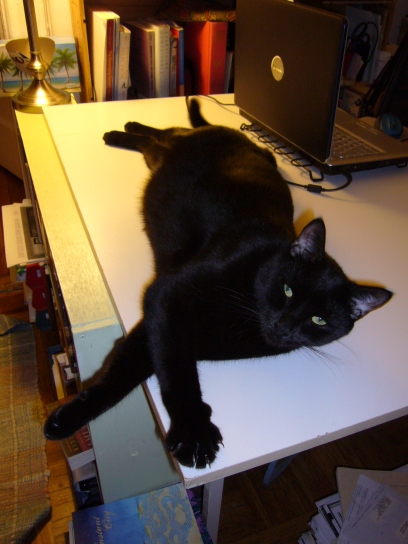
is afraid of this.
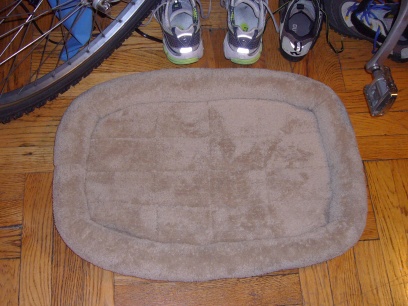
I do not understand.
He clearly likes the soft:
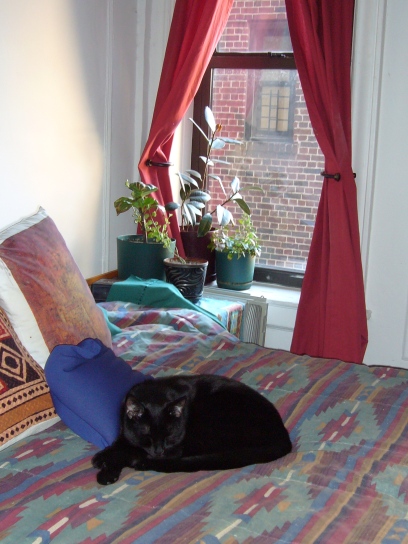
But only the human bed. Not the cat bed.
Strange boy.
This cat
is afraid of this.
I do not understand.
He clearly likes the soft:
But only the human bed. Not the cat bed.
Strange boy.
Oh, this made me giggle. . .

Theron Humphrey
. . . and a little wistful.
~~~

A De Brazza monkey—what a magnificent creature!
And s/he lives on this planet with us—our neighbor. If one considers the earth a big ol’ neighborhood. Which some days I do.
Shakespeare comes to mind. . . .
h/t: Cute Overload
Courtesy of the redoubtable dmf, a few of the Google street-shot photos caught by Canadian artist Jon Rafman:

The. . . absurdity of this scene strikes me.

The building makes the rock seem alive.
See the rest of the sad, surreal, and puzzling photos—including one of a tiger ambling across a parking lot—here.
Cousin!
And, to steal the line from Cute Overload (from where I also stole this picture): Ooooooooooooooooooooooooooooooooooooooooooooooooooooooooooooooooooooooooooooooo that’s cold!

(Image via Uzoo Facebook page.)
And remember: Ape, not monkey. A-P-E.
Despite Rwanda’s Volcanoes National Park being a wildlife refuge, poaching is still a problem. The snares, set by hunters in the region, are intended for antelope and other forms of game, however young apes are known to get accidentally caught in them. While adults are normally strong enough to get out of them, younger apes aren’t so luck and often die. That was what happened to a young infant named Ngwino, who was found too late by workers from Karisoke, and later died of snare-related wounds. Deep lacerations had sliced open her leg and gangrene had set in. …
On Tuesday tracker John Ndayambaje spotted a trap very close to the Kuryama gorilla clan. He moved in to deactivate the snare, but a silverback named Vubu grunted, cautioning Ndayambaje to stay away. Instead two juveniles—Rwema, a male; and Dukore, a female; both about four years old—ran toward the trap. According to Ndayambaje, “Rwema jumped on the bent tree branch and broke it, while Dukore freed the noose.” The pair then spied another snare nearby—one the tracker himself had missed—and destroyed that trap as well. Vecellio believes this wasn’t the first time the young gorillas had performed such teamwork. “They were very confident,” she said. “They saw what they had to do, they did it, and then they left.”
Remember: gorillas are apes, not monkeys. APES, NOT MONKEYS!
Sorry, pet peeve.
Anyway. Clever critters.
h/t Charles Mudede, The Stranger
Late late, quick quick—or should I say, regarding this photo, quick quick, then slow slow:

Photo by Florian Haid/Nat Geo Photo of the Day July 8, 2012
There is a country in the glimpse and a whole other world in the long.
I am not a visually-oriented person—or, at least, I’ve gotten into the habit of describing myself as a not-visually-oriented person—but there are some images which cannot be contained by words:

That little boy in the red shorts. . . !
(Photo by Thomas L. Kelly; ripped out of an old, old Harper’s magazine.)

Afar depression hot spring; photo by George Steinmetz/Nat Geo Photo of the Day
Fifteen or so years ago L. and her friend S. motored over from Wisconsin to pick up me and my friend J. on the way to Wyoming and the Tetons.
Our first day’s drive we made it to Devils Tower (bad name, cool feature) and celebrated by breaking out a six-pack on our way to the campsite. We toured the base the following morning, crabby on instant coffee, then broke camp and hied on over to Yellowstone.
Yellowstone is a massive park full of curious and foolish people. (An example: You are given brochures at the entrance to the park warning you to stay away from the bison. They are as large as a small Honda and can go as fast, one of them said. And probably something about them not being pets. So what do curious and foolish people do? Instead of using their telephoto lens, they crawl under or over the fence to approach the bison.)
(Another example: we decided to pass a slow-moving RV on one of the few stretches of straight road. There were cars from the other direction heading for us. Our car was a small and old Honda without much pick-up. Nonetheless, we floored it, with all of us leaning forward screaming GoGoGoGoGoGoGoGoGoGoGoGoGooooooooooo! in an effort to give the little sedan a little oomph and scoot in front of the RV before we smashed into the oncoming cars.)
(No curiosity; just foolishness.)
Anyway, there’s a lot that’s cliched about Yellowstone and yeah, Old Faithful is cool and all but, y’know, the effect can be replicated by a machine.
What would be far harder to replicate, however, would be the sulfur pits (or, more accurately, the Artist Paint Pots). It looked like something out of a sci-fi flick or a recreation of what the earth might have looked like a million years ago. There was a crack in the planet and its history poured forth into the present.
Standing there, amidst the stench and steam and mud bubbles popping, I knew how small I was, how small this life was, and what a gift it was to witness the vastness of time stretched across the universe, catching us all up within it.
These hot springs, emerging out of the Afar depression gashed across east Africa, took me back to that moment, caught me back up in the yawn of time.
Make sure to read the story, by Virginia Morell, and click through the rest of Steinmetz’s photos.
Astonishing.

Bought this in 1999? 2000? at the Minneapolis College of Art & Design student art show. I got a couple of good pieces, but this is my favorite.
Appropriately absurd, don’t you think?
~~~
I saved the artists’ names for the other pieces, but for whatever reason, I don’t have this one. If you happen to know who created this marvelous print, please let me know!

 AbsurdBeats